




Most retail shrink conversations focus on what happens inside the store—point-of-sale fraud, shoplifting on the sales floor, inventory discrepancies in the stockroom. Yet many incidents start in the places no one is actively monitoring after the doors lock. Parking lots, loading docks, fence lines, and perimeter zones between 10 PM and 6 AM account for a disproportionate slice of loss, liability, and staff safety risk. After-hours break-ins and delivery theft alone represent 22–30% of retail theft incidents, concentrated in overnight hours when staffing is minimal and response times stretch (Source: National Council of Investigation & Security Services).
For teams responsible for dozens of locations, the constraint is simple: you can't staff a guard at every store, and traditional cameras only record—they don't intervene. This article breaks down the specific vulnerabilities that emerge during overnight and after-hours windows, evaluates the technologies and strategies available to address them, and outlines how video AI is shifting the model from passive recording to active deterrence in parking lots and retail perimeters.
Key terms to know
Before diving into the overnight window, here are a few terms to align on:
Term |
Definition |
|---|---|
Perimeter protection |
Security coverage of a property's outer boundary—fence lines, parking lot edges, loading docks—rather than interior spaces |
After-hours security monitoring |
Active observation of a retail location during non-business hours, typically 10 PM–6 AM, via personnel, remote operators, or automated systems |
Parking lot security tower |
A fixed or mobile elevated structure (12–20 feet) positioned in a parking lot to extend sightlines and house cameras or personnel |
Context-aware detection |
Video AI that evaluates behavior and environment—not just motion—before triggering an alert, reducing nuisance alarms |
Active deterrence |
Automated responses (strobes, voice-downs, floodlights) triggered when a verified threat is detected, designed to interrupt incidents before they escalate |
Organized retail crime (ORC) |
Coordinated theft operations targeting retail locations, often involving reconnaissance in parking lots before store-level execution |
Why the overnight window creates outsized risk
Retail locations face a fundamentally different threat profile after closing. The natural deterrence created by foot traffic, open storefronts, and staffed registers disappears. What remains are large, often poorly lit parking lots, unmonitored dock areas, and perimeter zones where offenders can operate with minimal pushback.
A few realities make the risk worse:
Reduced natural observation. Parking lots that host hundreds of customers during business hours become empty after close. The absence of bystanders removes the single most effective crime deterrent—other people. Visible cameras alone reduce crime attempts by 30–50%, but without active monitoring, they serve primarily as post-incident evidence tools (Source: National Center for Crime Prevention).
Extended response times. Off-site monitoring centers average 8–12 minutes to coordinate a response to parking lot incidents, compared to 2–3 minutes when on-site personnel are present (Source: International Association of Chiefs of Police). Every additional minute of delay increases the likelihood of completed theft or property damage.
Loading dock and delivery exposure. Forty-five percent of retailers report package theft or unauthorized access during overnight hours at shipping and receiving areas (Source: National Retail Federation). Docks often sit at the rear of buildings with limited sightlines from the street—an ideal target for opportunistic and organized theft.
Staff safety during transitions. Opening and closing procedures put employees in vulnerable positions. Forty-one percent of retail locations report incidents involving after-hours employee confrontation or theft during shift changes (Source: OSHA).
The cumulative effect: parking lot and perimeter incidents drive not only direct shrink but also liability claims averaging $50,000–$250,000 per incident (Source: Insurance Information Institute).
Tip: When assessing overnight risk, start by mapping the specific hours and zones where incidents cluster. Parking lots, loading docks, and fence lines between 10 PM and 6 AM are where the majority of after-hours shrink originates—prioritize camera coverage and deterrence in those areas first.
Traditional after-hours security approaches and their limitations
Most retail organizations rely on some combination of guards, passive camera systems, and alarm monitoring to cover overnight hours. Each has a role, but each also carries well-documented constraints.
Approach |
Strengths |
Limitations |
|---|---|---|
On-site security guards |
Visible deterrence, human judgment, rapid on-site response |
High cost ($80,000–$150,000/year for comprehensive after-hours coverage), inconsistent performance, limited scalability across locations (Source: Bureau of Labor Statistics) |
Mobile patrols |
Cover multiple locations, reduce response time by 60–75% vs. off-site monitoring |
Gaps between patrol cycles (15–30 min), limited documentation, personnel availability constraints during overnight shifts (Source: ASIS International) |
Passive camera systems |
24/7 recording, post-incident evidence |
No real-time intervention, require manual review (3–5 hours per incident), footage often discovered too late to act (Source: Loss Prevention Magazine) |
Central monitoring stations |
24/7 operator coverage, alarm verification |
Alert fatigue from high false-positive rates (30–40% initially), monthly costs of $300–$900 per location, operator capacity limits across large portfolios (Source: ASIS International) |
Fixed parking lot security towers |
Elevated sightlines, strong visible deterrence (30–45% crime reduction) |
High 5-year cost ($170,000–$240,000 per tower including staffing), limited flexibility, require electrical infrastructure (Source: National Center for Crime Prevention) |
The core obstacle for teams managing 20–40+ locations is scalability. Guards and towers work at individual high-risk sites, but the economics collapse when applied across a full district. Meanwhile, passive cameras generate footage that nobody reviews until after an incident has already occurred.
How video AI changes the overnight security equation
The shift from passive recording to active response addresses the central gap in after-hours retail security: the time between detection and action. Video AI platforms analyze camera feeds continuously, distinguish between routine activity and genuine threats, and trigger automated deterrence—all without requiring a human to watch every feed.
Here is how that translates to the specific overnight vulnerabilities outlined above:
Fence-line and perimeter detection
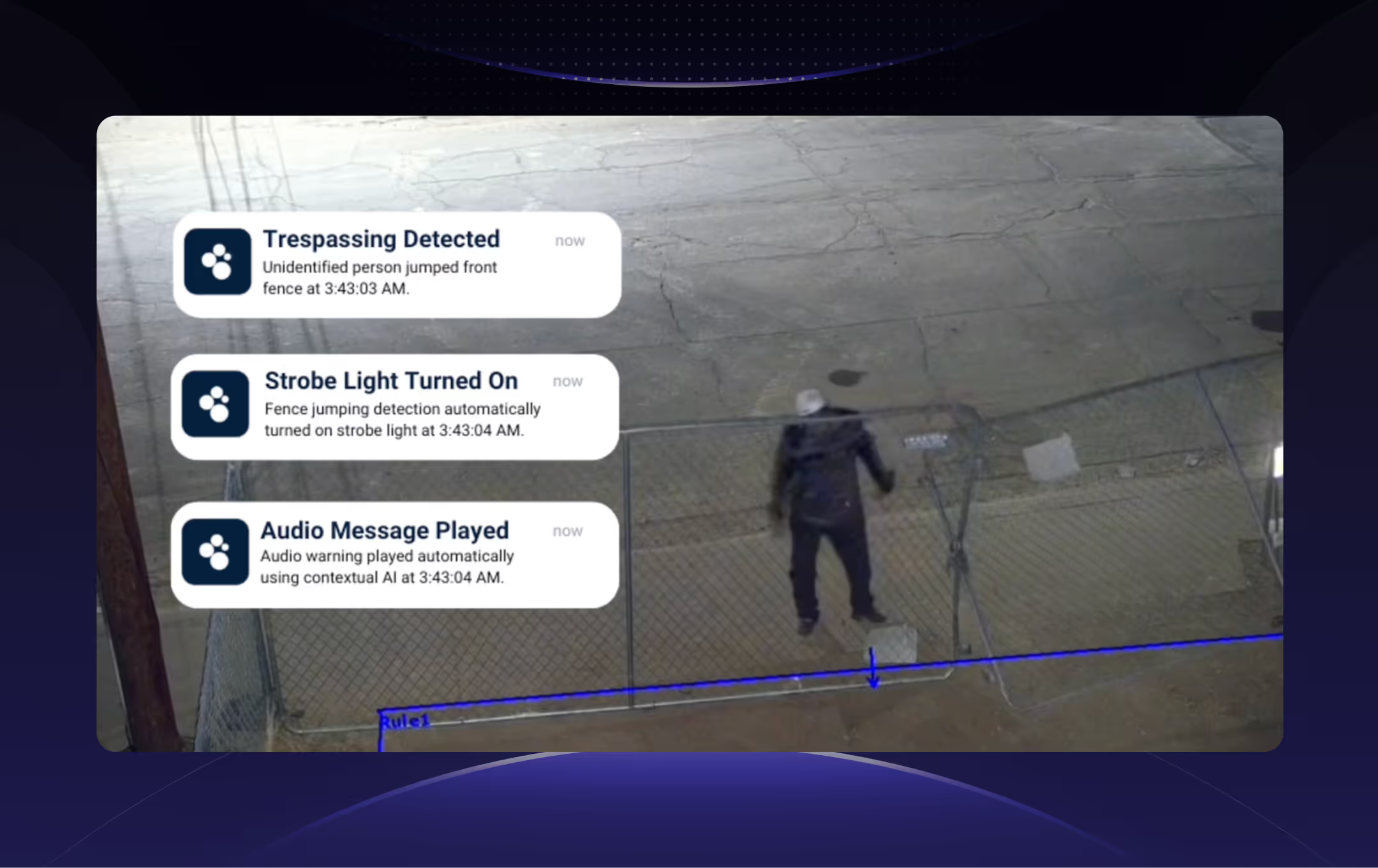
Perimeter intrusion detection alerts teams when individuals cross into restricted zones—dock areas, back lots, fence lines—after closing. Machine learning models trained on site-specific conditions reduce false-positive rates from 30–40% down to 8–15% within 30–60 days of deployment (Source: Carnegie Mellon University). That distinction matters: a system that flags every stray animal or passing headlight creates noise, not deterrence. Context-aware detection evaluates behavior, not just motion, before deciding whether to escalate.
Loading dock protection
Dedicated camera coverage at receiving areas, combined with automated alerts for after-hours access, addresses one of the highest-risk zones on any retail property. When integrated with access control systems, video AI creates a unified timeline—door access plus motion activation plus time-stamped recording—that delivers a clear audit trail for every overnight event. Delivery package tracking linked to video timestamps reduces package substitution theft by 80–85% (Source: American Logistics Association).
Overnight parking lot activity
Loitering detection flags individuals remaining stationary in a lot for extended periods outside vehicles. Combined with direction-of-travel analytics, this capability reduces organized theft reconnaissance activity by 40–55% (Source: Loss Prevention Quarterly). For parking lot security, the ability to distinguish between a delivery driver on a scheduled stop and an unknown individual circling the lot at 2 AM is the difference between a nuisance alarm and a verified threat.
Trespasser deterrence through automated response
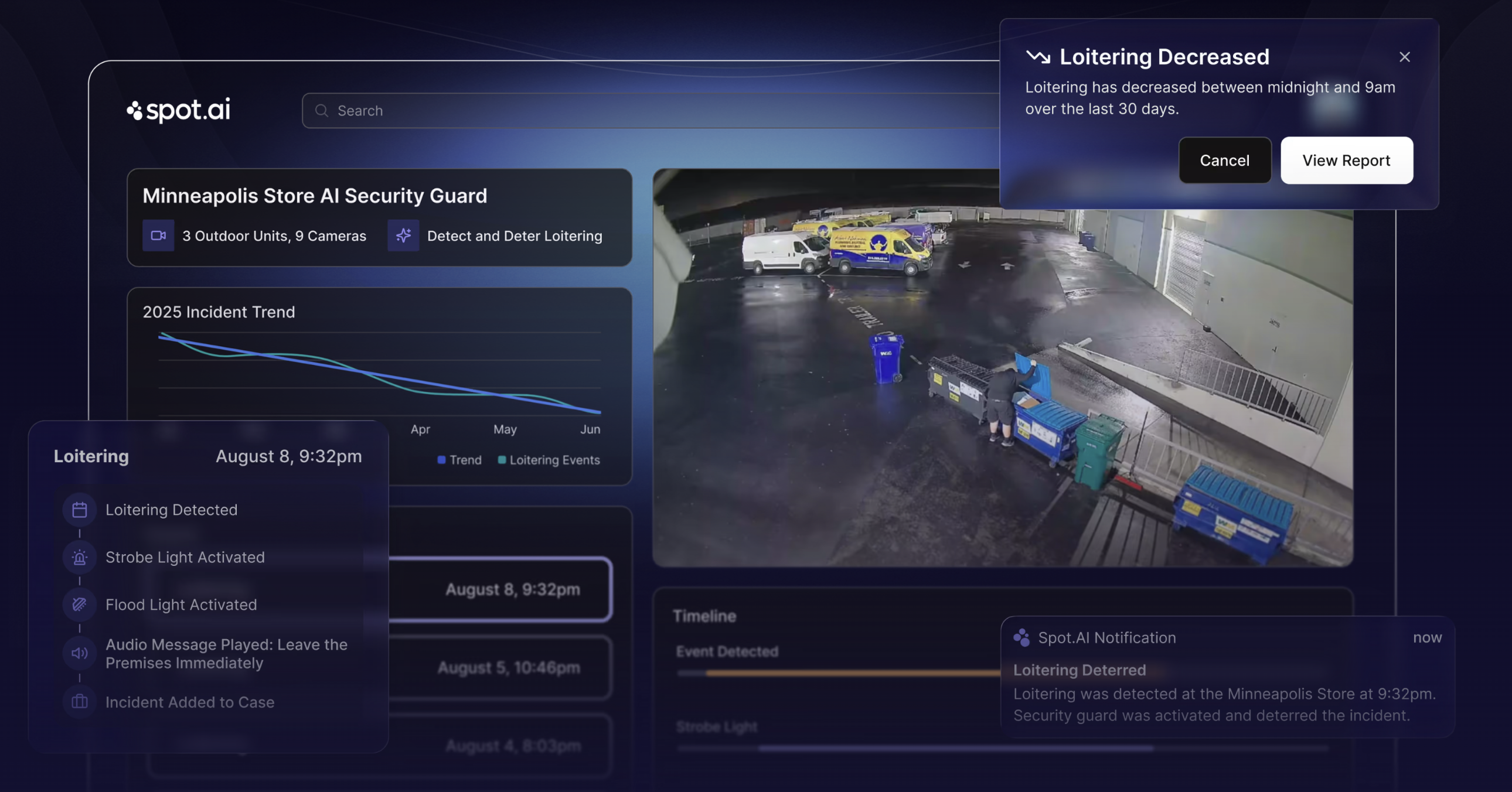
Detection alone is not enough. Active deterrence—strobes, floodlights, and voice-downs triggered within seconds of a verified event—creates the impression of a managed environment. The goal isn't to review video after the fact—it's to get people off the property before damage or theft happens. Well-lit parking lots with visible, active security measures reduce nighttime crime incidents by 40–50% (Source: Illuminating Engineering Society).
Real-world results: how one organization secured 50 unstaffed locations
Storage Asset Management, which operates approximately 50 virtually managed, unstaffed storage facilities, faced persistent after-hours break-ins and unauthorized access across its portfolio. The organization deployed Spot AI's video platform with AI-powered monitoring to address these gaps.
The results were concrete. Automated after-hours access alerts could directly notify local law enforcement. In one cited incident, intruders detected at 1 AM triggered a police response that arrived during the crime—and the facility saw zero subsequent break-ins. The system delivered perimeter detection, loitering identification, and a centralized dashboard to monitor multiple sites remotely, all while working with the company's existing camera infrastructure. No hardware replacement was required.
Beyond perimeter protection, the deployment helped verify contractor work and cut time spent manually pulling and reviewing footage. Read the full Storage Asset Management case study for additional detail.
Building an after-hours security program: a phased approach
Implementing overnight parking lot security across multiple locations does not require a single massive investment. A phased rollout lets teams prove value at high-risk sites before scaling regionally.
Phase |
Timeline |
Focus |
Key actions |
|---|---|---|---|
Foundation |
Months 1–3 |
Coverage and baseline |
Install camera coverage at entrances, exits, docks, and high-shrink zones; establish monitoring connection; implement basic alert protocols |
Integration |
Months 4–6 |
Intelligence and automation |
Integrate video with POS and access control; deploy analytics (loitering, perimeter intrusion, object classification); begin AI model training on site-specific conditions |
Optimization |
Months 7–12 |
Deterrence and scale |
Activate automated deterrence (strobes, voice-downs); tune alert parameters based on incident data; expand to additional locations based on ROI performance |
This structure lets teams start with the highest-risk stores, measure incident reduction and response time improvement over 30/60/90 days, and build a credible business case for regional expansion.
Measuring what matters: KPIs for overnight security
Proving impact to leadership requires more than anecdotes. The following metrics create a clear picture of program effectiveness:
KPI |
Target |
Why it matters |
|---|---|---|
Parking lot incident rate |
40–55% reduction within 6 months vs. baseline |
Directly measures whether the program reduces events |
Detection-to-response time |
Under 5 minutes for alarm response; under 2 minutes for suspicious activity verification |
Speed determines whether incidents are interrupted or merely documented |
False-positive rate |
Below 15% |
Rates above 25% indicate system recalibration is needed and contribute to alert fatigue |
Documentation completeness |
Above 90% of incidents with full video, report, and police correlation |
Incidents with 95%+ documentation show 60%+ improvement in prosecution outcomes (Source: Loss Prevention Quarterly) |
Investigation time |
Reduction from 5–8 hours to 1–2 hours per incident |
Frees LP teams for forward-looking work instead of manual video review |
Coverage per LP headcount |
More stores protected without additional staff |
The core scalability metric for regional programs |
Practical considerations before deployment
No technology eliminates all risk. Several factors deserve honest evaluation before committing to an after-hours security program:
Existing camera infrastructure. Camera-agnostic platforms that work with current IP cameras avoid the cost and disruption of a full hardware replacement. Verify compatibility with ONVIF/RTSP standards before selecting a vendor.
Lighting conditions. Infrared and thermal imaging capabilities are essential for overnight coverage. Cameras without low-light performance will produce unusable footage during the hours that matter most.
Alert calibration period. Machine learning models need 30–60 days of site-specific training to reach optimal accuracy. Expect higher false-positive rates during the initial tuning window.
Escalation protocols. Technology generates alerts; people make decisions. Clear escalation tiers—automated deterrence first, operator verification second, law enforcement dispatch third—keep the response chain fast and accountable.
Ongoing maintenance. Quarterly coverage mapping, camera health checks, and alert parameter reviews maintain system effectiveness over time. A system that works well at deployment but degrades without attention delivers diminishing returns.
Key takeaways for scaling after-hours security:
- Start with your highest-shrink locations, measure incident reduction over 30/60/90 days, and use the data to build a business case for regional expansion.
- Prioritize platforms that work with your existing IP cameras—avoiding a full hardware replacement dramatically accelerates deployment and reduces cost.
- Pair context-aware detection with automated deterrence (strobes, voice-downs) to shift from documenting incidents to preventing them.
Extend your perimeter protection with Spot AI
For teams managing security across multiple retail locations, the overnight window does not have to remain a blind spot. Spot AI's AI Security Guard turns existing outdoor cameras into an always-on layer that detects loitering, unauthorized access, and perimeter intrusions, then triggers automated strobes and voice-downs to help stop incidents before they escalate. The platform works with any IP camera, deploys without new wiring, and can be live in under a week.
Spot AI helps teams scale after-hours coverage across more locations without adding headcount. If you're evaluating options to reduce overnight incidents and standardize deterrence across your district, request a demo to see how Spot AI works with your existing cameras.
See Spot AI in action

"We've set up the system to understand normal versus abnormal behavior. If someone's in our lobby showcase area after hours, or if there's unusual movement patterns around sensitive areas, the system alerts us immediately."
Mike Tiller, Director of Technology, Staccato (Source: Spot AI Customer Stories – Staccato)
Frequently asked questions
What are the best practices for securing a retail parking lot after hours?
A layered approach delivers the strongest results. Combine visible deterrence elements—adequate lighting, clear signage, and camera coverage—with active monitoring and automated response. Overlapping camera fields of view by 15–20% eliminates blind spots (Source: ASIS International), while perimeter barriers such as fencing and bollards further restrict unauthorized vehicle access. The most effective programs pair these physical measures with video AI that triages real threats and triggers deterrence without waiting for a human operator.
How effective are camera systems in reducing parking lot theft?
Visible cameras alone reduce crime attempts by 30–50% through deterrence, and when paired with active monitoring, the incident reduction rate climbs to 60–80% (Source: National Center for Crime Prevention). Video evidence also increases prosecution success rates from 20–30% to 70–85%, creating a longer-term deterrent effect in the community (Source: National District Attorneys Association). The key distinction is between passive recording—which helps after the fact—and active, context-aware detection that enables intervention during an event.
What technologies are available for after-hours security monitoring in retail?
The primary options include 24/7 central monitoring stations with live operators, AI-powered threat detection with automated deterrence, alarm integration (door, window, motion, and glass-break sensors), mobile alerting to LP teams and store managers, and license plate recognition for watchlist matching. The most effective deployments integrate these capabilities into a single platform rather than managing them as separate systems. Video AI platforms like Spot AI consolidate detection, deterrence, and evidence into one dashboard accessible from anywhere.
How do mobile parking lot security towers compare to video AI platforms?
Mobile towers offer elevated sightlines and strong visible deterrence, reducing crime attempts by 30–45% at individual locations (Source: National Center for Crime Prevention). However, they require staffing ($1,200–$1,800/month for 8-hour daily operation), electrical connections, and physical relocation when coverage needs shift (Source: ASIS International). Video AI platforms deliver 24/7 automated coverage across multiple locations from a single dashboard, work with existing cameras, and scale without proportional cost increases. For organizations managing many sites, video AI offers broader coverage at a lower per-location cost.
What ROI can retail organizations expect from after-hours parking lot security?
ROI depends on baseline shrink levels and incident frequency. Organizations implementing camera systems with active monitoring—without additional personnel—can achieve positive ROI in the first year, with five-year cumulative benefits reaching significant multiples of the initial investment. The total return is primarily driven by liability reduction, followed by theft prevention and insurance premium savings. Locations with higher baseline shrink tend to reach break-even fastest.
About the author
Sud Bhatija is COO and Co-founder at Spot AI, where he scales operations and GTM strategy to deliver video AI that helps operations, safety, and security teams boost productivity and reduce incidents across industries.

