






How lean LP teams run retail loss prevention in 2026
Retailers saw shoplifting incidents fall 12.4% between 2024 and 2025, the first overall decline in several years, yet half of them reported more repeat offenders and 32% reported more fraud through buy online, pick up in store (BOPIS) and buy online, return in store (BORIS) orders (Source: National Retail Federation). Theft is moving toward the corners a small team watches least: the locked case with nobody beside it, the pickup counter at the evening rush, and the refund keyed with no customer present. For a lean loss prevention (LP) team, the working answer is to automate detection, deterrence, and the evidence file, and to keep apprehension, employee investigations, and law enforcement referrals with people. This guide sets out that operating model, including the weekly exception review that holds it together and the routine work Spot AI's video AI carries on cameras a retailer already owns.
Key takeaways
- Rank loss by cost, not visibility: external theft is the largest single source of shrink, but employee theft and process failures together cause more of it.
- Spot AI automates the detect and deter steps and assembles the evidence file, leaving a lean team its hours for the calls that need a person.
- Spot AI protects high-value merchandise by zone and hour rather than by lock alone, flagging long dwell at a case, groups at a fixture, and entry into a stockroom or cage after hours.
- With Spot AI, a BOPIS or curbside handoff in camera view becomes an evidence event: a team can pull the video in minutes, and license plate recognition records which vehicle used the bay.
- One weekly review can run every store: rank exceptions by dollars at risk, match each to video, and open a case only for what the footage does not explain.
Key terms
- Shrink: the gap between recorded inventory and the stock actually on hand, stated as a percentage of sales. The National Retail Federation (NRF) splits it into external theft, internal theft, process and control failures, and other or unknown loss.
- Exception-based reporting (EBR): software that scans point-of-sale (POS) data for unusual transactions, such as refunds with no customer present or voids after payment. Spot AI pairs each flagged transaction with the register video, so the exception arrives with its clip.
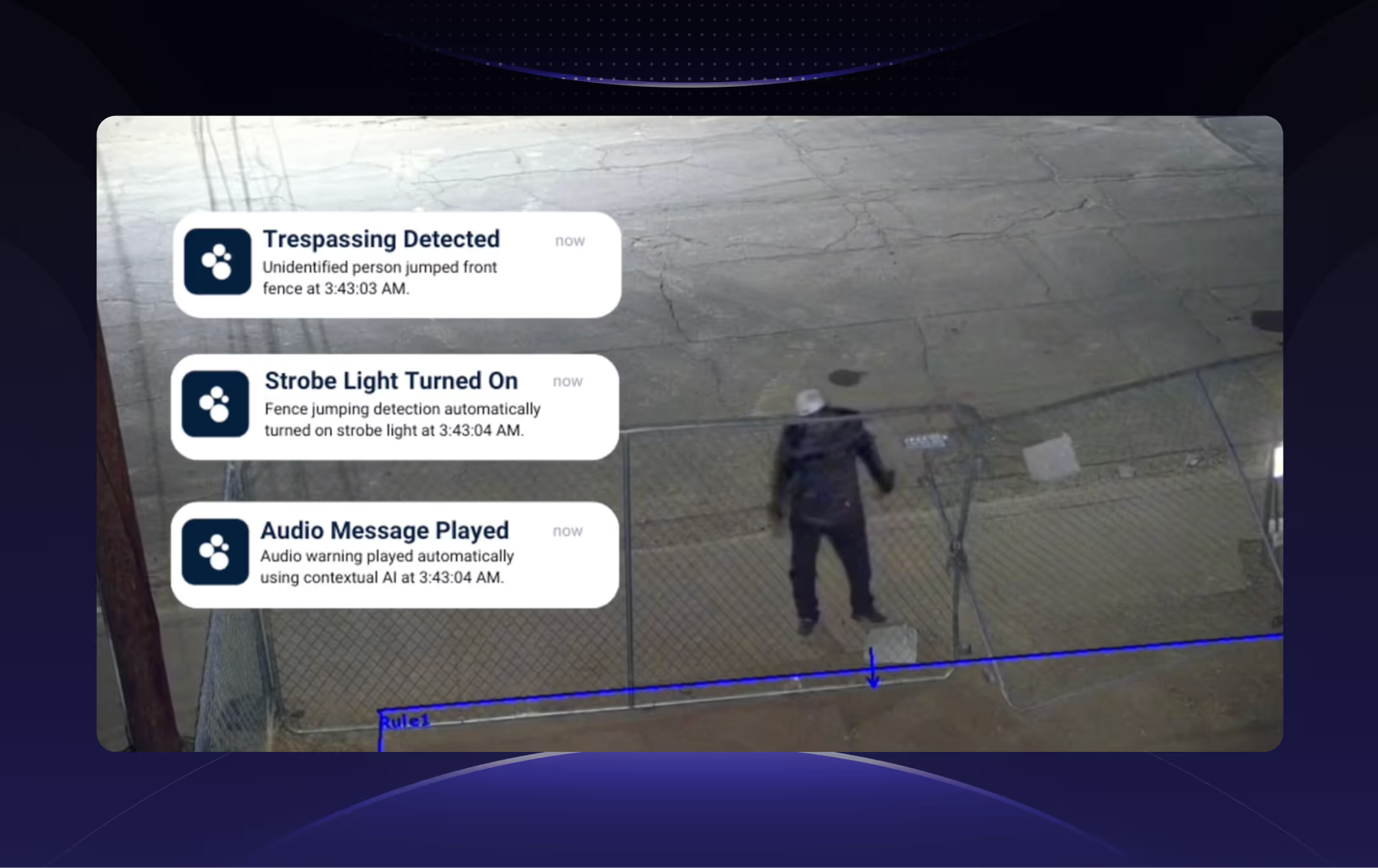
- No-go zone: a camera area with a schedule, such as a fragrance cage after close, where any presence counts as an event. Spot AI detects entry into a no-go zone and can answer with an alert, strobes, horns, or a natural-conversation talkdown.
- Auto-resolution: closing a routine detection, such as a delivery truck making a normal drop, without a person reviewing it. Spot AI auto-resolves routine incidents and builds a case file for the rest.
Where retail shrink stands in 2026
NRF's last full measurement put shrink at 1.6% of sales in fiscal 2022, or $112.1 billion, split between external theft including organized retail crime (ORC) at 36%, employee theft at 29%, process and control failures at 27%, and other or unknown loss at 7% (Source: National Retail Federation). NRF itself calls that total likely underreported, and its 2026 theft study tracks incidents rather than a shrink rate. Those incidents describe a problem changing shape rather than going away: fewer shoplifting events, more repeat offenders, and more fraud that crosses from online orders into stores.
The online side keeps growing. E-commerce sales, which the Census Bureau counts by where the order is placed, reached 17.1% of US retail sales in the second quarter of 2026 and rose 12.2% from a year earlier (Source: US Census Bureau). Every BOPIS or curbside order in that total still ends at a store counter or a parking bay.
The practical reading for a lean team: shrink now leaves through the refund screen, the pickup shelf, and the unattended case as well as through the front door.
The loss types, ranked by what they cost
That fiscal 2022 split is still the reference point for where shrink comes from, and it changes the plan. External theft is the largest single source, but employee theft and process failures together cause more loss than all external theft combined, so a program built only around shoplifters leaves most shrink unmanaged.
Loss type | Share of shrink, FY2022 | What it looks like in 2026 | First move for a lean team |
|---|---|---|---|
External theft, including ORC | 36% | Repeat offenders and crews working several stores, walkouts, and theft routed through online orders | Detect behavior at the costliest fixtures: Spot AI flags dwell, crowding, and repeat license plates across every store on one dashboard |
Employee theft | 29% | Refunds with no customer present, voids after payment, sweethearting, and orders diverted before pickup | Match POS exceptions to video: Spot AI's POS integration flags refunds processed with no customer at the register and attaches the clip |
Process and control failures | 27% | Receiving errors, pricing mistakes, late damage write-offs, and returns that never match a sale | Check procedures on camera: Spot AI can verify opening and closing routines, so a skipped step shows up the same day |
Other or unknown | 7% | Loss nobody has explained yet | Shrink the bucket: every loss a team explains moves into a category it can act on |
Employee theft and process failures together cost more than external theft, and the POS already flags many of their warning signs. Start automation there, because pairing a flag with its clip is the step that turns an exception into a finding.
What retail loss prevention should automate first, and what stays human
A lean team runs out of hours long before it runs out of incidents, so the useful question is which work a system can take without taking the judgment with it. In the retail sequence of detect, deter, investigate, and resolve, the answer is the first two steps plus the paperwork of the last two. Automate in this order:
- Detection at the costliest zones. Legacy video management systems (VMS) fire on motion, while Spot AI's context-aware detections tell a delivery truck from a vehicle casing the lot. A leading SOC platform integrated with more than 20 VMS platforms reports a single-digit false-positive rate with Spot AI, against about 50% on legacy VMS, and that gap decides whether a small team can keep up with its alerts.
- Deterrence in the first seconds. When a detection crosses its threshold, Spot AI can trigger strobes, horns, or a natural-conversation talkdown and alert the right person, as in this active deterrence workflow for retail parking lots.
- Routine resolution. Spot AI auto-resolves routine incidents so they stay out of the review queue. In one customer's one-week pilot, 40 of 54 detections were auto-resolved.
- Search and the case file. Spot AI's AI search finds a clip by time, camera, or attribute across every store, and its case tools keep clips, notes, and documents on one record, so a case takes minutes to build instead of an afternoon of scrubbing footage.
Keep these with people:
- Whether anyone approaches a suspect. Apprehension is a safety and policy decision that belongs to trained staff and written rules, never to an alert.
- Employee investigations. A POS exception is a question, not a verdict. Many trace back to a training gap or a register setting, and interviews, context, and any disciplinary step belong to a manager.
- Law enforcement referrals and ORC casework. Many store thefts never reach law enforcement, often because the evidence is too thin or too slow to assemble. An automated case file closes that gap, but the decision to refer a case, and the relationship with the officers who take it, stays with the team.
Our guide to retail loss prevention systems covers the systems side of this split, and teams comparing vendors can start with our review of the best retail loss prevention software for 2026.
High-value merchandise and no-go zones
Locked cases and cabinets are the default answer for high-value merchandise, and they carry a cost at the register. A 2026 ECR Retail Loss paper cites a strong correlation between securely locked merchandise and reduced sales, because the lock slows honest shoppers as well as thieves (Source: ECR Retail Loss). Crews pick what they can resell quickly, which is why fragrance, cosmetics, electronics, and spirits fill most locked lists, along with the tobacco and vape stock convenience stores keep behind the counter.
The alternative to locking more is watching the fixture instead of the product. Spot AI treats each high-value fixture as a zone with its own rules:
- Dwell at the case. Spot AI flags a person who stays at a fragrance wall or an electronics case past a set time and alerts the store team by text or Teams. The same alert serves the sales floor, since a shopper waiting at a locked case may simply be a buyer who needs an associate.
- Groups at a fixture. Spot AI's crowding detection flags several people gathering at one fixture, the setup behind distraction thefts and multi-person sweeps.
- No-go zones after close. A stockroom cage, the cash office, or the cabinet holding case keys becomes a no-go zone outside approved hours, and Spot AI can answer an entry with strobes, horns, or a natural-conversation talkdown while the person is still in the zone.
- Repeat vehicles. Spot AI's license plate recognition flags a plate already linked to a case at another store, one of the clearest signs that a single crew is working several locations.
The same logic holds at the top of the price range, where minutes decide the outcome. Don Franklin, a 30-location dealership group in Kentucky, lost six Hellcat Challengers worth $130,000 each when an organized crew took them from a showroom floor at night. Using Spot AI, the team had footage on the responding officers' phones within four minutes of the alarm, and the dealership reports that five of the six vehicles, $650,000 of inventory, were recovered within the hour.
"Within four minutes of the alarm going off, Spot AI gave us video footage of the incident on the responding officers' phones. We had five recoveries within the hour."
Josh Bowlin, IT Director, Don Franklin Family of Dealerships
Locks and alarms buy minutes. The transferable lesson for a retail LP team is to plan those minutes as carefully as the lock: who receives the clip, how fast, and in what form.
Curbside and BOPIS handoffs
BOPIS and curbside pickup move the riskiest moment of an online order to a counter or a parking bay, often at the busiest hour of the shift. The losses cluster at a few points: orders bought with stolen cards and collected in person, orders handed to the wrong person, and staged orders that go missing before pickup. Returns routed through stores add another, and ECR Retail Loss's 2020 study of e-commerce returns linked BORIS orders to more internal theft and more refund claims for goods reported as never received (Source: ECR Retail Loss).
Spot AI treats each handoff as an evidence event, and four setup choices make that work:
- A fixed handoff spot in camera view. Spot AI documents what a camera can see, so the pickup counter and each curbside bay need a close view of the handoff itself, not a wide view of the area.
- The staging shelf as a no-go zone. Staged orders are merchandise with a name on them, and Spot AI flags entry to a staging cage outside pickup hours, the same rule that protects a high-value stockroom.
- Plates at the curb. Spot AI's license plate recognition records which vehicle occupied a pickup bay and when, which helps settle a disputed pickup.
- Handoff exceptions in the weekly review. High-value orders collected unusually soon after they were placed, several pickups under different names by the same vehicle, and refunds on orders the video shows being collected are the BOPIS exceptions worth a clip.
The full playbook for staging areas, bays, and pickup verification is in our guide to securing BOPIS and curbside pickup workflows.
A weekly exception routine for a lean LP team
A district LP manager cannot visit every store every week, and does not need to. The routine below fits one working morning and scales by adding stores rather than meetings, the same arithmetic behind how convenience store chains cover more stores without adding LP staff. Key steps are:
- Pull the week's exceptions into one list. POS exceptions, zone detections, and handoff flags all go into the same queue, and Spot AI's reporting breaks detections down by agent, camera, and location, so the list arrives sorted by store.
- Rank by dollars at risk, not by count. One high-value refund with no customer present outranks a dozen short dwell alerts. Work from the top and stop when the time block ends.
- Match each exception to its clip. With video attached, review is one clip per line instead of one search per line. Close what the footage explains and note why, using the team's exception-based reporting categories.
- Open a case for what the footage does not explain. Attach the clips, the transaction record, and a short timeline, then assign an owner and a next step. Our guide to cash register theft covers register patterns such as sweethearting and skip-scanning.
- Audit the automation. Watch five auto-resolved incidents each week, and tighten any rule whose sample does not hold up before it hides a pattern.
- Look across stores. Repeat plates, the same fixture hit at several locations, or refunds clustering on one shift turn single incidents into an ORC case or a coaching conversation, as our guide to spotting ORC patterns across dozens of stores explains.
- Send one recap and one fix per store. Each store manager gets the week's confirmed incidents and a single change to make, such as moving a fixture or restaffing the pickup counter at the evening peak. The fix is a manager's call, and it is what makes next week's list shorter.
Time-box the weekly review and rank it by dollars at risk, not by alert count. If the same store or shift keeps landing at the top of the list, that pattern is the week's real finding, and the fix belongs to that store's manager.
Where this model needs care
Three limits apply whatever system a team runs:
- Access to footage needs rules. Decide who can view, export, and share clips, and log every export, because a case file is only as strong as its chain of custody.
- Trust inside the store. Reviews should examine the process before the person, with the rules shared openly, or the program reads as a hunt for culprits and stores stop flagging problems.
- Deterrence during trading hours. Talkdown and strobes suit exteriors and closed zones, while on an open sales floor the alert should go to a person rather than broadcast at shoppers.
See Spot AI in action

To see what the weekly review looks like on your own stores' footage, book a demo and bring last month's exception report. Results from other retailers are in our customer stories.
Frequently asked questions
What is retail loss prevention?
Retail loss prevention is the work of finding and reducing the causes of shrink, from external and employee theft to process errors and fraud, while keeping associates and customers safe. Many chains now call the function asset protection, a name that usually signals a wider remit: safety, fraud, supply chain, and online channels as well as store theft. Both titles describe the same core job: measuring loss, deterring it, and building cases when it happens.
How do retailers protect high-value merchandise without locking everything up?
Retailers protect high-value merchandise without blanket locking by matching each control to the item: Spot AI's zone detections watch the fixture, while physical measures protect the product. One-at-a-time dispensers suit small items such as razor cartridges and batteries, cable tethers let shoppers handle electronics, and display packs on the shelf with stock behind the counter keep the most-stolen lines visible. Keep locks for the few items that walk out even under watch, and let the loss data decide which ones.
How can retailers reduce BOPIS and curbside pickup fraud?
Retailers reduce BOPIS and curbside fraud by screening the order before pickup and letting Spot AI document the handoff. Hold high-value orders from new accounts, or with mismatched billing and pickup names, for an ID check. Require a pickup code on every order, and register any proxy collector in advance. Order screening filters the riskiest pickups before anyone reaches the counter, and the handoff video answers the disputes that follow.
Does Spot AI work with the cameras a store already has?
Spot AI works with the cameras a store already has: it is camera-agnostic, connects ONVIF IP cameras from makers such as Avigilon, Axis, Hanwha, and Pelco, and brings older analog cameras in through its Intelligent Video Recorder (IVR). The IVR keeps full-resolution video inside the store and sends only metadata across the network, which keeps bandwidth low and the deployment PCI-clean. Spot AI is NDAA-compliant, follows SOC 2 practices, and most sites go live in days.
How often should a retailer measure shrink?
Many retailers learn their true shrink number only at a full physical inventory, so the figure can land months after the loss. Between counts, track leading indicators: cycle counts on the categories that lose the most, confirmed incidents per store per week, and the share of exceptions that footage explains. Spot AI's reporting shows detections as trends across days, weeks, and months, giving a district manager a weekly read on each store.
About the author
Sud Bhatija is COO and Co-founder at Spot AI, where he scales operations and GTM strategy to deliver video AI that helps operations, safety, and security teams boost productivity and reduce incidents across industries.

