




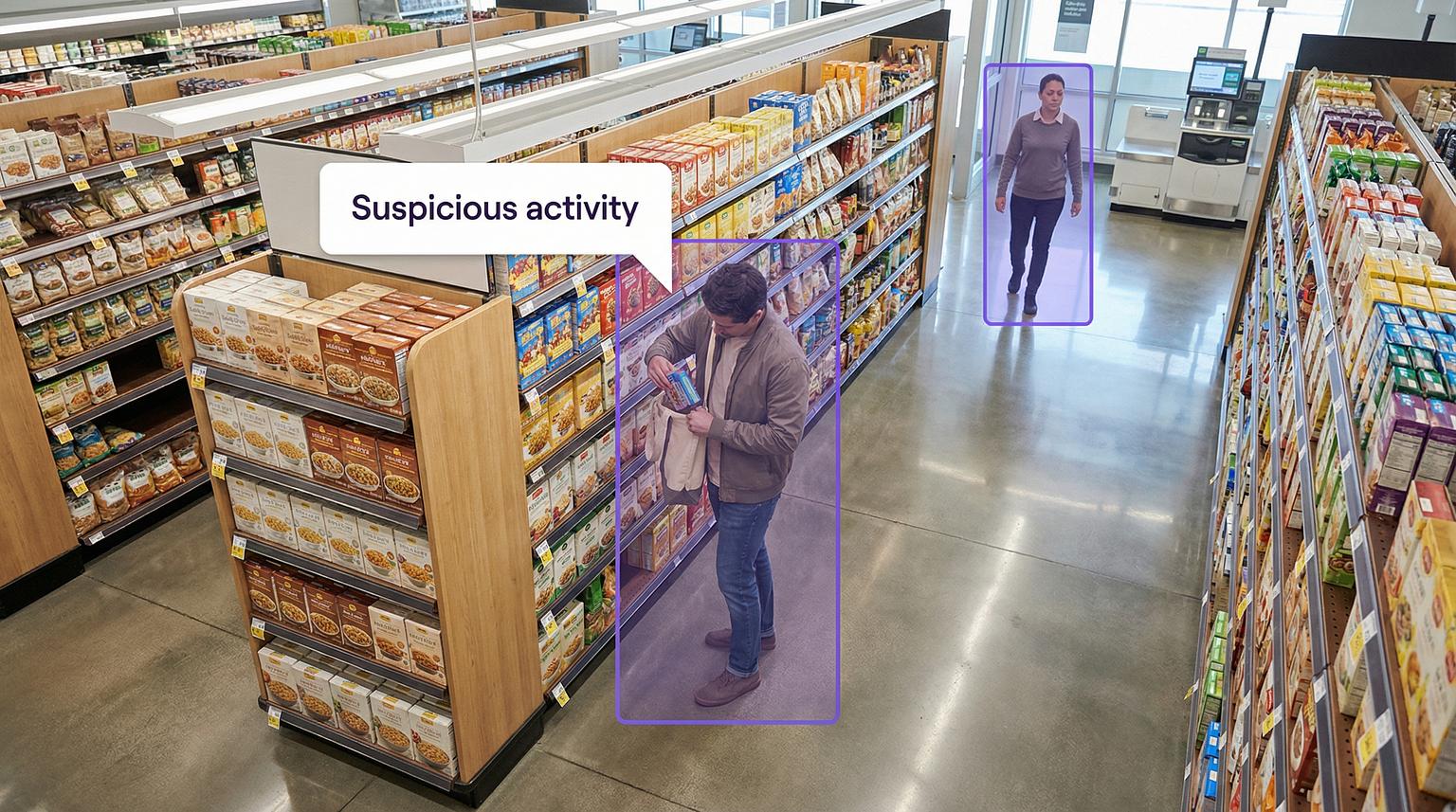


Retail shrink is rarely one problem. It's six leaks that compound unless you measure and address them together.
U.S. retail shrink reached $112.1 billion in fiscal 2022, an $18 billion jump from the year before, as the average shrink rate rose to 1.6% of sales from 1.4% (Source: NRF). That number represents margin lost to theft, mis-rings at the register, or product that expires on the shelf before it sells. And the average hides wide swings: one cosmetics section might bleed at 3.2% while apparel down the hall sits at 0.8%.
The problem isn't that loss prevention teams lack effort. It's that most organizations address one or two causes of shrinkage while the others keep compounding quietly. External theft gets the attention. Administrative errors get deprioritized. Self-checkout loss gets written off as a "self-checkout problem." Returns fraud gets absorbed as a cost of doing business.
This guide breaks down the six biggest causes of retail inventory shrinkage, pairs each with a specific countermeasure, and shows why plugging all six requires a unified approach, not proportionally more headcount.
Key terms to know
Before mapping each cause to a solution, a few definitions ground the discussion:
Term |
Definition |
|---|---|
Shrinkage (shrink) |
The difference between recorded inventory and actual physical inventory, encompassing theft, fraud, errors, and waste |
Shrinkflation |
A pricing move that shrinks a product's package while the price stays the same; it changes what shoppers get, not what the store counts, so it never shows up in a shrink rate |
Retail shrinkage formula |
Shrinkage % = (Recorded inventory − Actual inventory) ÷ Recorded inventory × 100 |
ORC |
Organized retail crime: coordinated criminal networks that target specific SKUs across multiple locations |
Sweethearting |
When employees give unauthorized discounts or skip scanning items for people they know |
Exception-based reporting (EBR) |
Analysis that flags statistically unusual POS transactions (excessive voids, clustered refunds, no-sale drawer opens) for review |
RFID |
Radio Frequency Identification: tags that allow bulk scanning of inventory without line-of-sight, improving count accuracy |
A quick example of the retail shrinkage formula in practice: if a store records $500,000 in inventory but a physical count finds $493,000, shrinkage is ($500,000 − $493,000) ÷ $500,000 × 100 = 1.4%. In Excel, the formula is simply =(B1-B2)/B1*100, where B1 is recorded inventory and B2 is actual inventory.
What shrink costs at store and chain scale
A shrink rate looks small until it is multiplied out. A store with $5 million in annual sales at NRF's FY2022 average shrink rate of 1.6% loses $80,000 a year, or $4 million across 50 stores. Cutting that loss by a fifth (an illustrative figure) keeps $16,000 per store and $800,000 a year across the chain.
The write-off is only the first cost. Phantom stock (in the system, not on the shelf) drives stockouts and padded orders, and every variance costs staff hours to investigate.
Benchmark against your own category mix, not the national average: small, easy-to-resell goods such as cosmetics and small electronics run well above household basics.
The six causes of retail inventory shrinkage at a glance
Each cause demands a different intervention. In NRF's FY2022 survey, external theft (including ORC) accounted for 36% of shrink, internal (employee) theft for 29%, and process and control failures and errors for 27% (Source: NRF). Here's how the six causes compare before exploring each in detail:
Cause |
Size of the problem |
Key signal |
|---|---|---|
External theft and ORC |
36% of FY2022 shrink, including ORC |
Repeated SKU-level stockouts in high-value categories |
Employee theft and sweethearting |
29% of FY2022 shrink |
Unusual void rates, discount clustering by shift |
Administrative and inventory errors |
27% of FY2022 shrink (process and control failures, errors) |
Records that drift from physical counts; constant fulfillment exceptions |
Self-checkout shrinkage |
Nearly 4% loss rate in a 2013 to 2015 study, more than double the average |
Item hiding, barcode switching, unscanned products |
Returns fraud and abuse |
9% of returns fraudulent; $849.9B in returns expected for 2025 |
Serial refunds, cross-channel return spikes |
Operational inefficiencies |
No separate national estimate |
Spoilage, delayed markdowns, undocumented damage |
Most retail shrink reduction plans focus heavily on the first two rows. The bottom four, where billions quietly disappear, often receive far less attention.
Some LP frameworks count four root causes: external theft, internal theft, process errors, and vendor fraud or damage. This guide splits out self-checkout and returns because they need their own controls. Vendor short-shipments sit under cause 3, and unlogged damage under cause 6.
Cause 1: external theft and organized retail crime
Shoplifting incidents fell 12.4% in 2025 compared with 2024, while other forms of external theft, fraud, and scams kept rising (Source: NRF). The bigger concern isn't the lone opportunist pocketing a lipstick. It's the coordinated ORC networks that target specific SKUs, study staffing patterns, and exploit return policies across dozens of locations.
These groups don't operate randomly. They identify high-shrink categories (cosmetics, electronics, apparel with generous return windows) and systematically exploit them. Distraction tactics divide staff attention while confederates remove merchandise. Strategic reconnaissance maps store layouts and low-coverage windows. Stolen goods are then returned for cash or resold through secondary channels.
What makes ORC particularly hard to catch is that each individual store might see only a small piece of the pattern. A cosmetics line losing a few units at ten different locations over two weeks stays below internal alert thresholds until someone connects the dots across the portfolio.
How to stop it: The countermeasure is multi-store pattern detection paired with rapid investigation workflows. Instead of asking teams to "find something suspicious" in hours of footage, exception-based investigation flags high-risk transaction events first (clustered voids, unusual refund patterns, repeated price manipulations) and links them directly to video for fast verification. This compresses investigation from hours of manual review to seconds of video context.
Equally important is perimeter deterrence. ORC activity often begins in the parking lot, with loitering, vehicle staging, and reconnaissance. Video AI platforms that detect loitering in parking lots and trigger automated deterrence (strobes, voice-downs) can interrupt the operation before it reaches the sales floor. Spot AI's AI Security Guard delivers this kind of always-on outdoor detection, covering the perimeter where many incidents begin without requiring additional guard hours. For more on this approach, see proactive perimeter protection.
Cause 2: employee theft and sweethearting
Internal (employee) theft accounted for 29% of shrink in NRF's FY2022 survey, the second-largest source after external theft.
What makes internal dishonesty so damaging is that it operates within normal workflows. Associates processing returns are supposed to process returns. Cashiers are supposed to apply discounts. The fraud happens when employees manipulate the data tied to their regular responsibilities: a fake refund that creates phantom inventory, an unauthorized discount for a friend, a cash skim that only surfaces during till reconciliation weeks later.
Sweethearting leaves a distinct data signature: unusual void rates, discount clustering around specific shift changes, and register-time correlations that reveal patterns.
How to stop it: The goal is to make dishonesty operationally difficult, not to build a culture of suspicion. Three process controls work together:
Separation of duties: the associate who receives merchandise is not the one who counts it, and the cashier who processes refunds is not the one who reconciles the till.
POS exception reporting: when transaction data is analyzed continuously, alerts surface during the shift rather than at end-of-quarter audits. If a specific cashier processes excessive voids compared to peers, the system flags it while intervention is still possible.
POS integration with video analytics: when a flagged transaction is automatically paired with its corresponding video clip, investigation time drops from hours to minutes. Learn more about Spot AI integrations.
Spot AI's platform connects POS data to time-stamped video, allowing teams to verify flagged transactions (no-sale drawer opens, excessive refunds, voided items) without scrubbing through footage manually. For multi-store teams, that time savings compounds fast.
Real-world results: All Star Elite
All Star Elite, a multi-location sports apparel retailer with 80 U.S. stores, deployed Spot AI's unified video AI platform to tackle both internal and external shrink. The results were measurable:
Cash shrink dropped from ~6% to 1%, an approximate 83% reduction, through improved video coverage and faster incident resolution.
Merchandise shrink fell from a 10 to 15% range to ~6% with centralized investigations and AI-powered search.
Investigation efficiency improved by more than 50%, replacing spreadsheets and handwritten notes with centralized case management and attached video clips.
Law enforcement case timelines shortened from 2 to 3 months to roughly 1 month through better evidence packaging and quicker retrieval.
All Star Elite also reported 5 to 15% sales increases driven by data-informed product placement decisions using people counting and traffic analytics (Source: Spot AI customer story).
Cause 3: administrative and inventory errors
Process and control failures and errors made up 27% of shrink in NRF's FY2022 survey. These don't feel like theft, which is exactly why they persist. A pricing mismatch between shelf and register. A receiving error where vendor shipments don't match invoices. An inventory count that drifts further from reality each cycle because of data entry mistakes and undocumented adjustments.
For multi-channel sellers listing products on Amazon, Shopify, and eBay simultaneously, a single inventory discrepancy creates three problems: one per channel, each with its own penalty structure.
How to stop it: RFID-based inventory analytics reduce accuracy errors. Unlike barcode systems that require line-of-sight scanning one item at a time, current RFID readers capture tags in bulk and without line of sight, so retailers can reach inventory accuracy rates of over 98% while compressing cycle counts (Source: NRF).
Pricing discrepancy alerts, triggered when scanned prices deviate from planogram pricing, catch vendor fraud and administrative mistakes before they accumulate across thousands of transactions.
Video technology adds another verification layer. Camera systems positioned at receiving docks confirm that delivered quantities match invoiced quantities, giving teams visual evidence when vendor short-ships occur.
Cause 4: self-checkout shrinkage
A University of Leicester study of nearly 12 million shopping trips in the U.S. and Europe, run from December 2013 to February 2015, found that self-service lanes and smartphone apps generated a loss rate of nearly 4%, more than double the average (Source: Security Magazine). Common self-checkout behaviors include:
Hiding items behind or under other items
Barcode switching (scanning a cheaper item)
Item pass-around between customers
Unintentional user errors (forgot to scan)
Not all self-checkout loss is intentional. A significant portion stems from confusing interfaces and genuine customer mistakes. Removing self-checkout entirely raises labor costs and frustrates customers who prefer the speed. The answer is layered controls that address both intentional concealment and honest errors.
How to stop it: Effective self-checkout shrink reduction combines four elements:
Overhead and side camera coverage capturing the complete transaction zone for human verification of alerts.
Computer vision for missed-scan detection, distinguishing between an unscanned item placed in the bag and a legitimately bagged item returned to the cart, reducing false positives.
Attendant assistance workflows triggered by system alerts, where visible staff presence itself deters further concealment without accusing customers.
Clear UX design that reduces honest scanning mistakes at the interface level.
The operational goal is small, calm friction at the right moment, not constant suspicion. A prompt such as "Can you help me make sure everything is scanned?" keeps that friction calm, where "You forgot to scan that item" reads as an accusation.
Spot AI's video AI platform can monitor self-checkout zones and flag anomalies (unattended checkout stations, unusual activity patterns) while integrating with POS exception data to correlate visual evidence with transaction records.
Cause 5: returns fraud and abuse
Retailers estimated that returns would total $849.9 billion in 2025, and NRF's report found that 9% of all returns are fraudulent (Source: NRF).
The fraud takes many forms: "friendly fraud" (claiming damage or non-receipt), wardrobing (wear once, return), bracketing (order multiple sizes, keep one), and serial refunds under different accounts. Many of these behaviors sit in a gray area where customers don't perceive themselves as committing fraud, but the margin impact is identical.
How to stop it: The most effective approach uses AI-driven return risk scoring with graduated responses:
Approve: legitimate returns processed without delay for low-risk customers.
Warn: customers showing high-risk patterns receive a notification that their return behavior is being flagged.
Decline: returns that meet clear fraud thresholds are denied.
Video systems play a supporting role here. When a flagged return is processed at the register, time-stamped footage verifies whether merchandise was actually brought into the store, whether the customer matches the original purchaser, and whether the item condition matches the return claim.
Cause 6: operational inefficiencies and preventable waste
Operational losses include perishable spoilage, damaged merchandise that's never documented, missed recalls, coupon abuse, and delayed markdowns where inventory sits unsold and depreciates.
Unlike theft, operational waste is often invisible until it appears on the P&L as unexplained variance. A promotion that should have ended last week continues at a few stores, creating margin loss across thousands of transactions. A case of damaged goods at receiving goes unadjusted in the system, creating phantom inventory that throws off replenishment.
How to stop it: Addressing operational shrinkage requires the same data-driven discipline applied to security, but with operations and category leadership actively involved.
Markdown timing optimization: when systems identify SKUs selling slower than planned, early alerts let category managers adjust prices before merchandise loses shelf appeal. Products marked down earlier realize higher sell-through rates and generate smoother cashflow impact.
Continuous inventory accuracy through RFID or computer vision, catching spoilage and damage before products deteriorate further.
Video verification at receiving docks: camera systems confirm shipment quantities, document damage at point of receipt, and create time-stamped records that support vendor claims.
Spot AI's platform gives teams a real-time view of receiving areas, stockrooms, and sales floors, so they can confirm receiving and backroom workflows without being physically present at every location.
A six-step retail shrink action plan
The six causes are the diagnosis. An action plan turns it into owners and targets:
Set the baseline. Measure shrink by cause, store, category, and period, as the checklist below lays out.
Set incremental targets. Calibrate each store's goal to its own starting point and format.
Match countermeasures to causes. Deter at the perimeter where external theft concentrates, apply exception-based reporting where POS anomalies cluster, and tighten receiving where variances show no sign of theft.
Replace the annual count with cycle counts. ECR Retail Loss research recommends counting hot products, the items with exceptional shrink, at least once a month (Source: ECR Retail Loss).
Name an owner for every number. Store managers own their shrink rate, receiving managers own inbound accuracy, and LP specialists own investigations.
Review on a fixed cadence. Check the KPIs below monthly or quarterly, and investigate any store that leaves its expected range.
Match technology to each cause
Technology should follow the diagnosis, not lead it:
Cause |
Countermeasure |
|---|---|
External theft and ORC |
EAS tags for opportunistic theft; video AI with behavioral detection and deterrence for organized groups |
Employee theft and sweethearting |
Exception-based reporting linked to POS video |
Administrative errors and vendor issues |
RFID, cycle counts, and receiving checks against the purchase order |
Self-checkout loss |
Computer vision at the lane with attendant prompts |
Returns fraud |
Return risk scoring with video checks at the register |
Operational waste |
Markdown alerts and stockroom visibility |
Compare vendors in our ranking of the best retail loss prevention software.
Measuring what matters: a shrink reduction checklist
Any shrink reduction plan needs a measurement framework that ties interventions to dollars recovered. Here are the steps that turn data into accountability:
Establish baseline shrinkage rates at the department, store, and category level. NRF's FY2022 median of 1.4% means nothing if one location runs at 2.1% and a category within it sits at 4.5%.
Track preventable loss recovery: measure what percentage of theoretically recoverable shrink is actually being addressed through interventions.
Calculate ROI per intervention: set the shrink dollars each intervention recovers against what it costs to run.
Use control groups: if five stores implement a specific intervention while five comparable stores maintain existing processes, the variance directly demonstrates impact.
Connect shrinkage to metrics leadership already monitors: sales per square foot, labor cost ratios, gross margin by department. When shrink is framed as an efficiency metric rather than solely a security issue, it earns budget allocation proportional to its P&L impact.
Shrink KPIs and how often to review them
ECR Retail Loss research recommends reporting shrink at cost, at retail value, and as a percentage of sales (Source: ECR Retail Loss). Between counts, track these KPIs by store and district:
KPI |
What it measures |
Review |
|---|---|---|
Shrink rate |
Loss as a share of sales by cause, store, and category, against each store's baseline |
Monthly or quarterly |
Inventory accuracy |
Share of items where records match the shelf |
After each cycle count |
Incident frequency |
Theft and fraud incidents by location and type |
Monthly |
Recovery rate |
Share of losses that end in recovered goods or restitution; a low rate points to slow or incomplete investigations |
Quarterly |
Case closure time |
Time from flag to resolved case |
Monthly |
Why a unified video AI layer plugs all six leaks
The six causes of shrinkage outlined above each require different interventions. But they share a common denominator: every one of them responds to integrated data visibility, clear accountability, and faster response workflows.
The problem with point solutions (separate RFID inventory systems, standalone self-checkout monitoring, disconnected POS exception reporting, passive camera systems) is that they generate excessive alerts and create "alert fatigue" where genuine signals get buried in noise.
Spot AI's unified video AI platform addresses this by connecting existing cameras (any IP camera, no rip-and-replace required) to a cloud dashboard where AI Agents act on what they see. The platform covers the full scope of shrink causes:
Shrink cause |
Spot AI capability |
|---|---|
External theft and ORC |
Loitering detection, automated deterrence (strobes + voice-downs), parking lot coverage via AI Security Guard |
Employee theft |
POS integration with video, exception-based transaction flagging linked to time-stamped clips (see integrations) |
Administrative errors |
Receiving dock video verification, time-stamped records for vendor dispute resolution |
Self-checkout loss |
Unattended checkout alerts, activity monitoring at SCO zones |
Returns fraud |
Video verification of return transactions at the register |
Operational waste |
Live visibility into stockrooms, receiving areas, and sales floor processes across all sites |
The platform works with existing cameras (camera-agnostic, ONVIF/RTSP compatible), deploys in under a week, and scales across locations without requiring new headcount, so LP teams can extend coverage without adding guard hours or store labor.
Cutting shrink without adding headcount
One guard covers one post for one shift, and a regional LP manager with dozens of stores can visit only a few each week, so parking lots, receiving docks, and overnight hours are where coverage runs out.
Spot AI extends the LP team's reach instead of its payroll. The cameras a retailer already owns become AI coworkers that detect behavior in context, deter in seconds with strobes and talkdown, and hand investigators a time-stamped clip instead of hours of footage. To weigh that against current guard and overtime spend, see our guide on building the ROI case for loss prevention technology.
A 180-day roadmap from pilot to portfolio
A phased rollout proves results at a few stores before the chain commits:
Phase |
Timeline |
Focus |
|---|---|---|
1. Baseline |
Days 1 to 60 |
Measure shrink by store, category, and cause; audit camera coverage and guard spend |
2. Pilot |
Days 60 to 120 |
Connect video AI and POS data at 5 to 10 representative stores, not the flagship |
3. Optimize |
Days 120 to 150 |
Tighten alert thresholds; measure shrink and ROI per store against the baseline |
4. Scale |
Days 150 to 180 |
Present results to leadership and roll out in quarterly waves |
For pilot scorecards and success criteria, see how to evaluate and pilot retail loss prevention technology.
Considerations and limitations
No single technology eliminates shrinkage entirely. Several factors affect the success of any shrink reduction program:
Detection is not prevention. Video AI and analytics surface issues faster and reduce response time, but they support human decision-making rather than replacing it.
Integration complexity varies. Connecting POS, inventory management, and video platforms requires shared data standards and timestamp synchronization. Legacy systems with proprietary formats may need middleware.
Organizational alignment matters. Shrinkage reduction works best when accountability is shared across loss prevention, operations, finance, and store leadership, not siloed in a single department.
False positives remain a factor. Even advanced AI detections carry a margin of error. Teams should expect to tune alert thresholds during initial deployment.
ROI timelines differ by cause. Perimeter deterrence may show results within weeks. Administrative accuracy improvements may take a quarter or more to materialize in inventory data.
Reduce shrink across every cause with one platform
Most retailers address one or two causes of shrinkage while the others keep compounding. A unified video AI layer, covering parking lot to register to receiving dock, is the mechanism that addresses all six without scaling headcount proportionally.
Spot AI gives loss prevention teams the ability to cover more locations with the same staff, deter threats before they escalate, and build evidence packages that hold up with law enforcement. The platform works with your existing cameras, goes live in under a week, and delivers the kind of before-and-after proof that earns executive buy-in.
"We can't be everywhere at once. That's where technology becomes crucial - it's not about replacing people, it's about augmenting our capabilities to keep everyone safe."
Kevin, Unique Industries (Source: Spot AI customer story)
Ready to see how Spot AI can connect POS exceptions to time-stamped video across your stores? Request a demo, or explore how All Star Elite cut cash shrink by 83% with Spot AI's platform.
Frequently asked questions
What are the most effective strategies for reducing retail shrinkage
The most effective strategies target all six causes simultaneously rather than focusing on one or two. This means combining perimeter deterrence for external theft, POS exception reporting for internal dishonesty, RFID or cycle counting for administrative accuracy, layered controls at self-checkout, risk-scored return decisioning, and operational visibility for waste reduction. The common thread is integrated data: when POS, inventory, and video systems share information, patterns surface faster and teams intervene sooner.
How do you calculate the shrinkage percentage in retail
The retail shrinkage formula is: Shrinkage % = (Recorded inventory − Actual inventory) ÷ Recorded inventory × 100. For example, if a store's system shows $200,000 in inventory but a physical count reveals $196,000, the shrinkage percentage is ($200,000 − $196,000) ÷ $200,000 × 100 = 2.0%. In Excel, this is =(B1-B2)/B1*100, where B1 is recorded inventory and B2 is actual inventory. Calculating at the department and category level, not just the store level, reveals where targeted intervention will have the greatest impact.
What technologies can help reduce shrinkage in retail
Several technologies address different causes of shrink. Video AI platforms connect existing camera systems to analytics that detect loitering, flag unattended checkouts, and link POS exceptions to time-stamped footage. RFID improves inventory accuracy by enabling bulk scanning without line-of-sight. Exception-based reporting flags unusual transaction patterns (excessive voids, clustered refunds, no-sale drawer opens) for rapid investigation. AI-driven return risk scoring applies graduated responses to return requests based on customer behavior patterns. The highest-impact approach integrates these technologies into a single workflow rather than operating them as disconnected point solutions.
What is the acceptable shrinkage rate for retail businesses
In NRF's FY2022 survey, the median retail shrink rate was 1.4% of sales and the average 1.6%, but "acceptable" varies significantly by retail format and category. A grocery retailer with perishable inventory may benchmark differently than an electronics retailer. Categories like cosmetics often run higher than apparel. The more useful metric is whether a store's shrinkage rate is improving relative to its own baseline and comparable locations. A store at 2.1% that reduces to 1.6% through targeted interventions has recovered meaningful margin, even if it hasn't reached the median.
About the author
Sud Bhatija is COO and Co-founder at Spot AI, where he scales operations and GTM strategy to deliver video AI that helps operations, safety, and security teams boost productivity and reduce incidents across industries.

