
A 2026 comparison for IT, procurement, and operations leaders weighing both vendors: camera compatibility, out of the box AI, safety and loss prevention, deployment economics, and which mandate each platform fits.
Spot AI is strongest when the goal is extracting operational, safety, and loss prevention intelligence from video: it layers purpose built AI coworkers onto any ONVIF or RTSP camera a business already owns, with real time deterrence, PPE and near miss detection, SOP adherence, and case ready evidence. Cisco Meraki is strongest as a cloud managed networking platform, unifying WiFi, switching, SD WAN, SASE, sensors, and MV smart cameras under one dashboard, which suits organizations standardizing IT infrastructure across many sites. The deciding factor is the primary mandate: a network infrastructure refresh favors Cisco Meraki, while video based intelligence on the cameras you already own favors Spot AI, and the two can run in parallel on the same sites.
Operations, safety, and loss prevention teams that want AI coworkers on the cameras they already own, without a network wide hardware swap.
IT and network teams standardizing WiFi, switching, SD WAN, and cameras under one cloud managed dashboard across dozens or hundreds of sites.
Compiled from Cisco Meraki public documentation on meraki.cisco.com (verified July 2026) and Spot AI product documentation.
Cisco Meraki data is based on public documentation as of July 2026. Gaps are marked as not publicly specified.
Spot AI and Cisco Meraki solve different layers of the stack. Spot AI is a camera agnostic Video AI platform: it connects any ONVIF or RTSP camera to an edge first Intelligent Video Recorder, runs AI coworkers on premises, and syncs metadata to a cloud dashboard. Cisco Meraki is a cloud managed networking platform whose MV smart cameras sit alongside WiFi, switching, and SD WAN inside the Meraki Dashboard.
That difference shapes the buying decision. Meraki's MV series cameras operate within the Meraki cloud on Meraki hardware plus per camera licensing, so sites with large non Meraki camera fleets face a full hardware swap to reach cloud video features. Spot AI adds video intelligence to the cameras already installed, which is how Cambridge City reused existing cameras across seven municipal sites and cut footage search from two hours to 30 seconds.
Cisco Meraki extends an existing network dashboard to cameras. Spot AI extends AI coworkers to the cameras a business already owns. That single distinction drives both cost and capability.
Both platforms record video and surface motion events. The split shows up in what happens around detection. The Bureau of Labor Statistics reported 2.5 million nonfatal workplace injuries and illnesses in private industry in 2024, the scale that purpose built video safety intelligence is built to address.
Choose Cisco Meraki when the primary initiative is a network infrastructure refresh. Its cloud managed platform spans WiFi, switching, SD WAN, SASE, sensors, endpoint management, and MV cameras under one console, which reduces management planes for IT teams standardizing across many sites. Choose Spot AI when the mandate is reducing shrink, improving safety metrics such as TRIR, enforcing SOP adherence, or accelerating investigations with AI on the cameras you already run.
The two are not mutually exclusive: Meraki can manage the network while Spot AI manages the video intelligence layer on top. The proof points below are tied to named Spot AI customers with baselines.
See PPE detection, investigation tools, and real time alerts run on your own camera feeds, with no hardware swap.
Customer reported outcomes from named Spot AI deployments.
Silver Bay Seafoods reported a 15% increase in operational efficiency and 10 to 15% better PPE compliance across 10 facilities after unifying legacy camera systems on Spot AI.
All Star Elite cut cash shrink from 6% to 1% across 80 sports apparel stores and improved investigation efficiency by over 50% with AI search and Cases.
Storage Asset Management, overseeing about 50 unstaffed facilities, reported no further break ins at one site after Spot AI detected intruders at 1 AM and coordinated with law enforcement.
"Confidence, efficiency, and security."
Yes. Spot AI's Intelligent Video Recorder connects to IP cameras on the local network, so it runs on Meraki managed infrastructure without replacing networking equipment. Meraki manages the network and Spot AI manages the video intelligence layer, and the two do not conflict.
Cisco Meraki MV cameras provide motion detection and object classification. PPE detection, near miss alerting, AI case management, and contextual talk down are not described in its published product documentation, whereas Spot AI's AI coworkers are built for those operations, safety, and loss prevention use cases.
Spot AI is camera agnostic and works with any ONVIF or RTSP IP camera already installed. Cisco Meraki's cloud video features run on Meraki MV cameras, so sites with large non Meraki fleets face a hardware swap to reach the Meraki Dashboard.
Neither publishes a full public catalog. Spot AI uses a per camera or per location subscription with no proprietary camera purchase. Cisco Meraki pricing is channel driven through Cisco partners and layers per camera cloud licensing on top of MV hardware. Ask both for itemized quotes separating hardware, licensing, and support.
Book a quick demo and see how the latest in video AI drives higher productivity and keeps every site secure — around the clock.
Request a Demo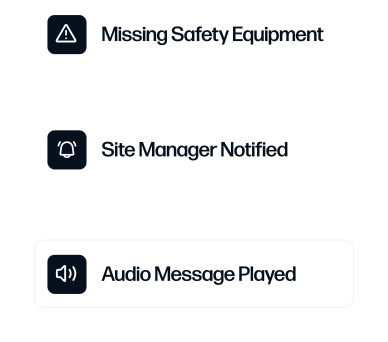




.png)
.png)
.png)
.svg)