
Retail cameras record. Agentic AI makes them act
Turning Cameras Into Coworkers: what loss prevention teams are seeing once AI agents run on the cameras they already own. Drawn from real deployments across retail, convenience and EV charging networks.
About $20,000 in estimated savings per deterred incident, per store. Reported from a $5 billion retailer’s deployment. It compounds fast across hundreds or thousands of locations.
A 10-site pilot that grew into roughly 120 protected sites. One of the largest U.S. EV charging networks reported 80% of incidents deterred with zero human intervention, and its asset protection staff now review case-ready evidence every few days rather than monitoring continuously.
Agents go live on existing camera infrastructure in under 30 minutes. Nothing gets ripped out. The cameras stay where they are and the software running on top of them changes.
Employee cash theft, finally quantified. It is one of the hardest shrink categories to track by hand. Convenience and QSR chains often underestimate it, and one customer found their actual loss ran well above their own prior estimate.
Why “detect and notify” is where legacy video stops. Most systems flag the problem and hand everything after that to an LP team that is small relative to the footprint it covers. The report walks the chain AI agents run instead: detect the moment, deter it in real time with an on-site talkdown that escalates from informational to direct, then build the case automatically with a chronological timeline and multiple camera angles.
The six agents multi-location retailers deploy first. They cover parking lots and property safety, employee cash theft, register and line monitoring, POS and transaction fraud, store audits and checklists as well as merchandising and conversion. The report maps each agent to the piece of the footprint it covers, from the perimeter to the register.
What early adopters found beyond loss prevention. At one 300-location chain, a 200-person offshore team had been watching camera feeds all day, fatigued and still missing a large share of incidents. The same team now receives only high-value incidents in an inbox-style workflow, which changed the underlying economics of the company’s entire monitoring strategy. A regional manager who used to spend two to three weeks a quarter physically visiting stores to check compliance now gets that verification continuously, with no advance notice skewing the results. The report also covers Iris, the conversational layer that lets a manager ask questions across a whole territory rather than one camera at a time.
“We’ve reduced incidents by 80%, without any kind of human monitoring.”
Jeremy N., Sr. Manager of Operations & Maintenance
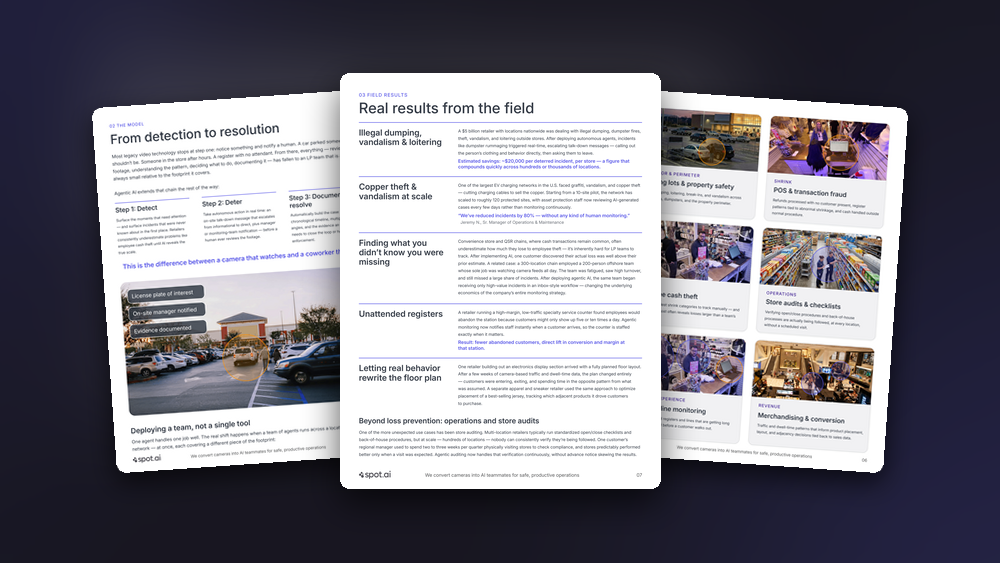
Inside the report: the detect → deter → document model, the six retail agents and results from the field
Turning the cameras you already have into a team of coworkers
Spot AI runs a free, educational workshop for retail teams, not a sales pitch. It covers what is happening across agentic AI and works through the concerns your frontline and leadership teams will raise. It then works with your team to build internal use cases and ROI models for AI adoption.
Request a demo




.png)
.png)
.png)
.svg)