




Retail parking lots generate more data than most organizations realize—and almost none of it gets used. Vehicles enter, idle, circle, and leave—often in patterns your team can use. Some return the same day. Others reappear across multiple locations over weeks. For loss prevention teams managing 20, 30, or 40+ stores, that pattern data is the missing link between isolated in-store incidents and the organized retail crime (ORC) rings driving them.
The gap is not a lack of cameras. Most retailers already have exterior coverage. The gap is that those cameras record history instead of acting on it. Vehicle counting, dwell-time analysis, repeat visitor detection, and license plate recognition (LPR) integration are the building blocks of retail vehicle monitoring—so your cameras can flag risk in the lot and tie it to in-store loss events, not just record it.
This article breaks down how vehicle analytics work, how they help you spot ORC patterns faster, and what it takes to deploy across a multi-store portfolio.
Key terms to know
Before exploring the technology and its applications, a few definitions help frame the conversation:
Term |
Definition |
|---|---|
Vehicle dwell-time analysis |
Measuring how long a vehicle remains in a specific zone (parking lot, loading dock, perimeter) to identify patterns associated with theft reconnaissance or loitering |
Repeat visitor detection |
Flagging vehicles that appear at the same location—or across multiple locations—within a defined timeframe, often linked to organized theft patterns |
License plate recognition (LPR) |
Optical character recognition applied to vehicle plates, enabling watchlist matching and cross-location tracking |
Vehicle re-identification (Re-ID) |
Deep learning models that track vehicles across camera views using visual features (color, shape, markings) when plate data is unavailable |
Organized retail crime (ORC) |
Coordinated, multi-person theft operations that target multiple retail locations, often using vehicles for transport and escape |
Exception-based reporting (EBR) |
Data analysis that flags transaction outliers (voids, refunds, no-sale drawer opens) for investigation |
Geofencing |
Virtual boundaries drawn around physical zones that trigger alerts when vehicles or people cross them |
Why parking lot data matters for loss prevention
The parking lot is where ORC operations begin and end. Vehicles serve as staging areas, escape routes, and cargo transport. Yet most retailers don't have a reliable way to capture it and trigger a response.
The scale of the problem underscores the urgency. Retail shrinkage in the U.S. reached $61.7 billion in 2023, with ORC accounting for approximately $95.7 billion annually (National Retail Federation 2024 Crime & Loss Survey). External theft represents the single largest loss category.
Three operational realities make vehicle monitoring a priority:
ORC relies on vehicles. An estimated 62% of organized retail theft incidents involve vehicles used for escape or cargo transport, yet only 28% of retailers have formal vehicle monitoring protocols (National Retail Federation 2024 Crime & Loss Survey).
Repeat offenders follow patterns. The same vehicles often appear across multiple stores within a region. Without automated detection, repeat incidents often go unrecognized until a manual historical review surfaces them weeks later.
Parking lots are under-covered. Many retailers report insufficient coverage in parking lots and perimeter areas, and traditional fixed cameras miss incidents due to limited field-of-view.
The question for LP teams isn't whether parking lot data matters. It's whether you can connect it to an incident fast enough to respond.
The anatomy of a retail vehicle monitoring system
A retail vehicle detection system combines hardware (cameras, edge processors) with AI-powered analytics to track, classify, and flag vehicles across a property. The core components work together in a layered architecture:
Component |
Function |
Operational value |
|---|---|---|
LPR cameras |
Read license plates at entry/exit points with high accuracy in daylight |
Enable watchlist matching and cross-location tracking |
Vehicle Re-ID models |
Track vehicles by visual features when plates are obscured |
Maintain identity across camera zones even without a clear plate read |
Dwell-time analytics |
Measure how long vehicles remain in specific zones |
Flag extended parking associated with pre-theft reconnaissance |
Geofencing |
Define virtual boundaries around lots, docks, and restricted areas |
Trigger alerts when vehicles enter or linger in sensitive zones |
Integration layer |
Connect vehicle data to case management, POS, and incident platforms |
Correlate parking lot activity with in-store loss events |
How is this different from standard CCTV? Traditional systems record video. A vehicle monitoring system interprets it—classifying vehicles and matching them to watchlists and past activity, so your team can prioritize what to handle next.
From vehicle counting to ORC intelligence
Vehicle counting on its own is a useful operational metric. It tells LP teams how busy a lot is and when peak traffic occurs. But the real value emerges when counting feeds into a broader analytical pipeline.
Here is how vehicle data escalates from basic counting to actionable ORC intelligence:
Vehicle counting and traffic flow — Cameras track entry/exit events within one to two seconds of threshold crossing, creating time-stamped logs for every vehicle that enters the property.
Dwell-time flagging — The system measures how long each vehicle stays. Extended dwell times—especially in zones near exits or loading docks—trigger alerts for security review. ORC reconnaissance often involves extended observation before an incident.
Repeat visitor detection — When the same vehicle appears at the same location multiple times within a defined window, or across multiple stores in a region, the system flags it. This is where isolated incidents start connecting into a pattern.
Watchlist matching — LPR data is compared against a dynamic watchlist of known offender vehicles linked to confirmed theft incidents. A match generates a high-priority alert.
Cross-location correlation — Vehicle data from multiple stores feeds into a centralized dashboard, enabling LP teams to identify ORC rings operating across a geographic region. Instead of each store investigating independently, the system surfaces multi-store patterns in days rather than weeks.
Law enforcement coordination — Complete vehicle identification data—plate, time-stamped video, location history—creates evidence packages that are far more actionable for prosecutors and task forces.
This progression is what turns a basic retail vehicle detection system into a tool your team can use to stop repeat activity earlier. Each layer adds context, and context is what turns raw data into decisions.
Tip: When building your vehicle analytics pipeline, prioritize cross-location correlation early. ORC rings rarely target a single store—connecting vehicle data across your portfolio is what transforms isolated incident reports into actionable intelligence that law enforcement can act on.
How computer vision supports loss prevention beyond the parking lot
Vehicle analytics work best when they're tied to what happens inside the store. The same computer vision loss prevention capabilities that track vehicles in the lot extend to in-store operations, creating a unified view of security events.
Key capabilities that connect exterior and interior analytics include:
Capability |
Parking lot application |
In-store application |
|---|---|---|
Loitering detection |
Flag vehicles or individuals lingering near entrances or restricted areas |
Identify dwell-time anomalies in high-loss merchandise zones |
Unauthorized entry |
Detect vehicles in restricted zones (loading docks, after-hours areas) |
Flag individuals entering no-go zones or back-of-house areas |
Suspicious activity |
Identify vehicles circling the lot or staging near exits |
Detect concealment behavior or coordinated group movement |
License plates of interest |
Match plates against known offender watchlists |
Correlate vehicle arrival with subsequent in-store incidents |
The ability to link a vehicle's arrival time to an in-store loss event is a significant analytical advantage. If a theft occurs at 2:15 PM and a flagged vehicle entered the lot at 2:02 PM, the system connects those data points automatically—no manual cross-referencing required.
Addressing the investigation time burden
How much time does your team spend scrubbing footage after an incident? For many LP organizations, the answer is measured in days, not hours.
Manual incident investigation typically consumes significant hours per case. That includes searching through footage, correlating events across cameras, and assembling evidence for law enforcement or internal action. When a team oversees dozens of stores, that burden compounds quickly.
AI-powered vehicle monitoring and video analytics compress that timeline significantly. Pre-clipped, time-stamped video evidence tied to vehicle identification data means investigators access organized evidence packages rather than raw footage. The hours recovered are not just an efficiency gain. They represent capacity that LP teams can redirect toward higher-value work—building law enforcement partnerships, analyzing emerging ORC patterns, or expanding coverage to additional stores.
Repeat offender vehicle detection: closing the loop on ORC
Repeat offenders represent a disproportionate share of retail loss. The same individuals—and the same vehicles—target multiple locations within a region, often returning to the same store shortly after the initial incident.
Without automated repeat offender vehicle detection, LP teams rely on manual cross-referencing of case files. That process is slow and incomplete. Automated systems change the equation by maintaining a dynamic watchlist database of known offender vehicles linked to confirmed incidents.
The workflow operates in a straightforward sequence:
LPR cameras scan vehicles at parking lot entry points.
The system queries each plate against the watchlist in real time.
Confidence scoring accounts for plate read errors—typically requiring multiple confirmed reads before triggering a high-confidence alert.
When a match is confirmed, the system generates alerts to on-site staff and, where partnerships exist, to local law enforcement.
Vehicle and incident data can be shared across a retail consortium, alerting other retailers in the region about active offenders.
The deterrence effect is measurable. Retailers implementing repeat offender detection report significant reductions in repeat incidents following deployment. Prosecution rates also climb when video evidence and vehicle identification data are compiled into complete evidence packages.
Key takeaway: Automated repeat offender detection does more than flag known vehicles—it builds prosecution-ready evidence packages that include plate data, time-stamped video, and cross-location visit history. This combination significantly improves law enforcement coordination and increases the likelihood of successful prosecution.
GO Carwash: vehicle analytics driving operational and security outcomes
Spot AI's work with GO Carwash illustrates how vehicle-level analytics extend beyond traditional loss prevention into operational intelligence.
GO Carwash deployed Spot AI's video AI platform to convert existing camera feeds into actionable data. The team used vehicle and zone-based analytics—including virtual lines—to count vehicles at vacuum stations and compare usage against car wash sales data, identifying potential non-paying activity.
LPR reporting helped track unique vehicle visits and streamlined damage-claim investigations by linking plate-based visits to relevant video clips. Custom alerts also supported after-hours security, detecting trespassing, vandalism, and loitering.
The results were tangible: a 54% increase in membership conversion at pay stations, driven by improved monitoring of customer engagement and faster employee assistance at unattended kiosks. The system shifted GO Carwash from reactive operations to forward-looking management, with alerts for wash tunnel stoppages and idle-time events improving throughput consistency.
This case demonstrates a principle that applies directly to retail: vehicle data is not just a security tool—it is an operational one. The same analytics that flag suspicious vehicles can optimize delivery dock timing, track vendor access patterns, and identify bottlenecks in customer flow.
Practical considerations before deploying vehicle monitoring
No technology deployment is without hurdles. LP and IT teams evaluating vehicle monitoring systems should account for several factors:
Network bandwidth — Video AI analysis requires significant bandwidth per camera feed. Edge processing (running AI on local servers rather than streaming everything to the cloud) reduces bandwidth needs substantially while maintaining low latency.
Lighting conditions — LPR accuracy drops in low-light conditions and further in severe weather. Supplemental lighting in critical zones (lot entrances, exits, loading docks) is often a prerequisite.
Camera resolution — High-resolution cameras are recommended for reliable vehicle detection. LPR cameras at entry/exit points need sufficient resolution to read plates at a distance.
Alert fatigue management — Starting with conservative, high-confidence alert thresholds builds staff trust in the system. Lowering thresholds gradually as confidence grows keeps response rates high and avoids the credibility erosion that comes with excessive false positives.
Integration with existing workflows — New alerts require adjustments to incident response procedures, documentation, and investigation workflows. Running parallel processes during a pilot phase eases the transition.
Maintenance ownership — Clarify who maintains hardware, who monitors system health, and what the support model looks like. Camera health alerts that flag offline devices or obstructed views help maintain coverage without manual audits.
A phased approach to multi-store rollout
For organizations managing dozens or hundreds of locations, a phased deployment reduces risk and builds internal credibility. A typical rollout follows this structure:
Phase |
Timeline |
Activities |
Success criteria |
|---|---|---|---|
Pilot |
Weeks 1–4 |
Deploy at 1–2 high-loss locations; configure AI models with site-specific training data; operate in "alert and monitor" mode |
High alert reliability; baseline metrics established |
Validation |
Weeks 5–12 |
Analyze pilot results; refine alert thresholds; train broader security team; standardize response procedures |
Improved detection rates; minimal false positive rate |
Enterprise rollout |
Weeks 13–24 |
Deploy to remaining locations, prioritizing high-loss sites; establish centralized dashboard for cross-location monitoring |
Consistent performance across sites; law enforcement coordination active |
Ongoing optimization |
Continuous |
Monthly performance reviews; quarterly model updates for seasonal patterns; annual ROI analysis |
Sustained incident reduction; investigation time savings maintained |
This phased model gives LP leaders the data they need to build an internal case—clear metrics from a controlled pilot that can be presented to executives with confidence.
Turning parking lot cameras into an AI Security Guard
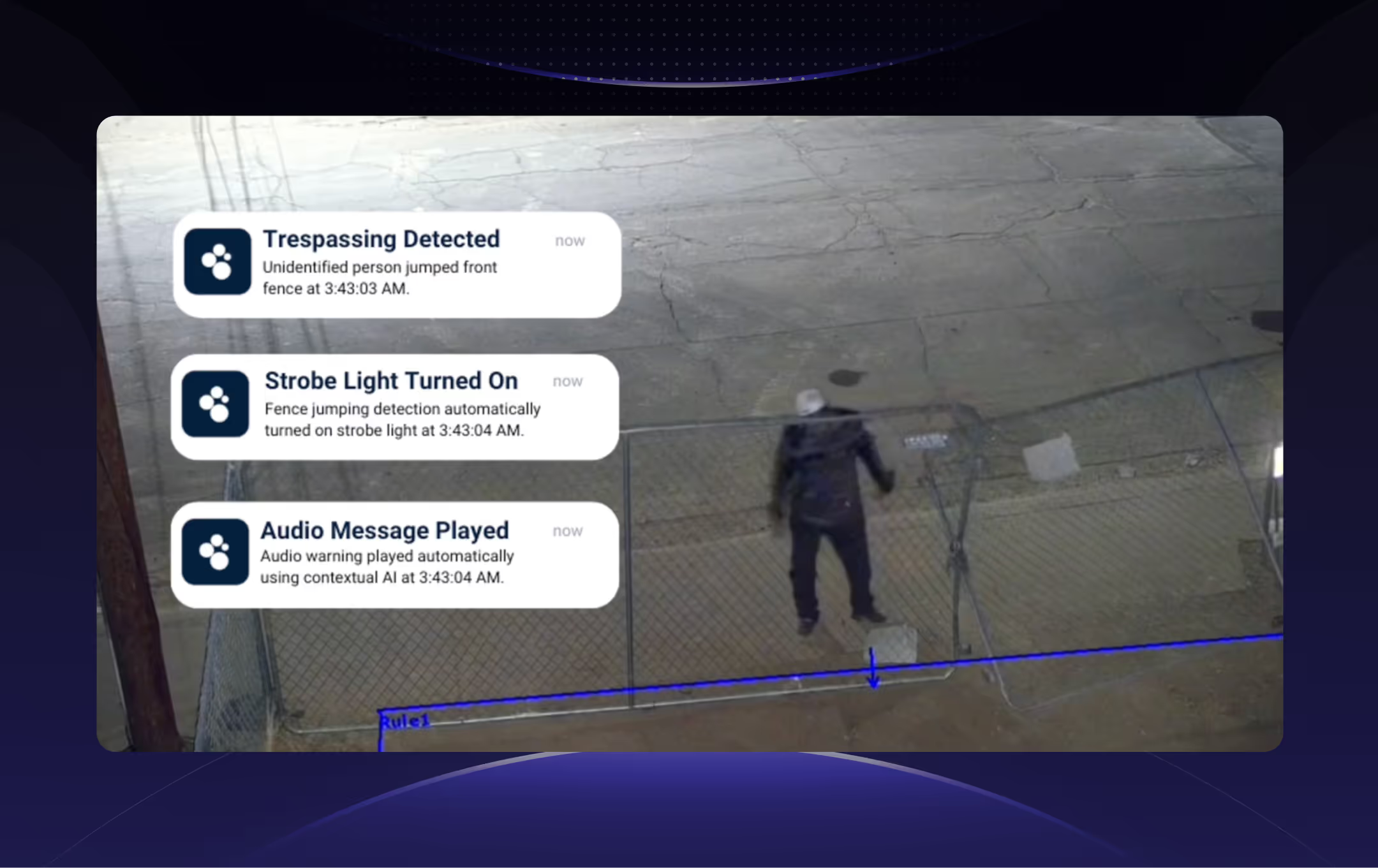
Spot AI's approach to retail vehicle monitoring reflects a broader principle: cameras should act, not just record. The AI Security Guard turns existing outdoor cameras into context-aware AI teammates that detect loitering, flag vehicles of interest, and trigger automated deterrence—strobes, floodlights, and talk-downs—before incidents escalate.
For LP teams covering 30+ stores, this acts as a digital force multiplier. A single dashboard surfaces alerts across every location, triages real threats from nuisance alarms, and delivers case-ready evidence with time-stamped logs and video clips. Spot AI filters out nuisance alarms, reducing alert fatigue and letting teams focus on the incidents that matter.
The platform works with any existing IP camera—no rip-and-replace required—and deploys with minimal network impact through cellular and solar-capable options. Systems can go live in under a week, giving LP teams a fast path from pilot to proof.
See Spot AI in action

For teams evaluating vehicle analytics for one high-risk location or planning a multi-store rollout, start by confirming which parking lot behaviors should trigger alerts and where coverage gaps still exist. To see how Spot AI connects parking lot activity to in-store loss events in one dashboard, request a demo.
"When we figure out the correct placement of our Kobe jersey within the store, that typically increases sales by 5 percent to 15 percent because we're able to pull traffic into other areas and get ideas on other products that pair with it."
Andrew Gonzalez, Corporate Director of Loss Prevention and Safety, All Star Elite (Source: Spot AI Blog)
Frequently asked questions
How does AI enhance loss prevention in retail?
AI-powered video analytics process camera feeds to detect, classify, and alert security teams to potential theft or suspicious activity without requiring constant human monitoring. Capabilities include behavioral classification (identifying concealment or coordinated group movement), object tracking across camera views, and anomaly detection that flags deviations from normal operational patterns. These systems compress investigation timelines by delivering pre-clipped, time-stamped evidence tied to specific incidents.
What are the best practices for implementing AI in retail security?
Start with a pilot at one or two high-loss locations to establish baseline metrics and validate system accuracy before committing to a broader rollout. Begin with high-confidence alert thresholds to build staff trust, then adjust sensitivity as the team gains experience. Ensure network bandwidth supports video processing requirements—edge processing can reduce demands significantly. Finally, run parallel workflows during the transition so existing procedures remain intact while the team adapts.
How can vehicle monitoring systems support operational efficiency?
Beyond loss prevention, vehicle monitoring data supports delivery management by tracking authorized vendor vehicles and flagging unauthorized access at loading docks. Dwell-time analytics identify bottlenecks in receiving processes. Traffic flow data informs staffing decisions during peak hours. When integrated with POS and inventory systems, vehicle arrival times can be correlated with transaction data to surface patterns that would otherwise require manual analysis.
What technologies are most effective for theft detection?
The most effective retail security AI systems combine multiple approaches: convolutional neural networks for behavior recognition, object detection models for tracking merchandise, and recurrent neural networks for analyzing sequences of behavior over time. For vehicle-related theft, LPR combined with vehicle re-identification provides the most reliable tracking. The key differentiator is not any single algorithm but the ability to correlate data across cameras, locations, and time windows to surface patterns.
How do AI systems integrate with existing security infrastructure?
Modern video AI platforms operate as overlays on existing camera infrastructure—no rip-and-replace required. They connect to video management systems via APIs or edge processing, integrate with case management platforms to auto-generate incident tickets, and feed alerts into floor communication systems for rapid dispatch. Camera-agnostic platforms work with any IP camera, protecting existing hardware investments while adding analytical capabilities.
About the author
Sud Bhatija is COO and Co-founder at Spot AI, where he scales operations and GTM strategy to deliver video AI that helps operations, safety, and security teams boost productivity and reduce incidents across industries.

