




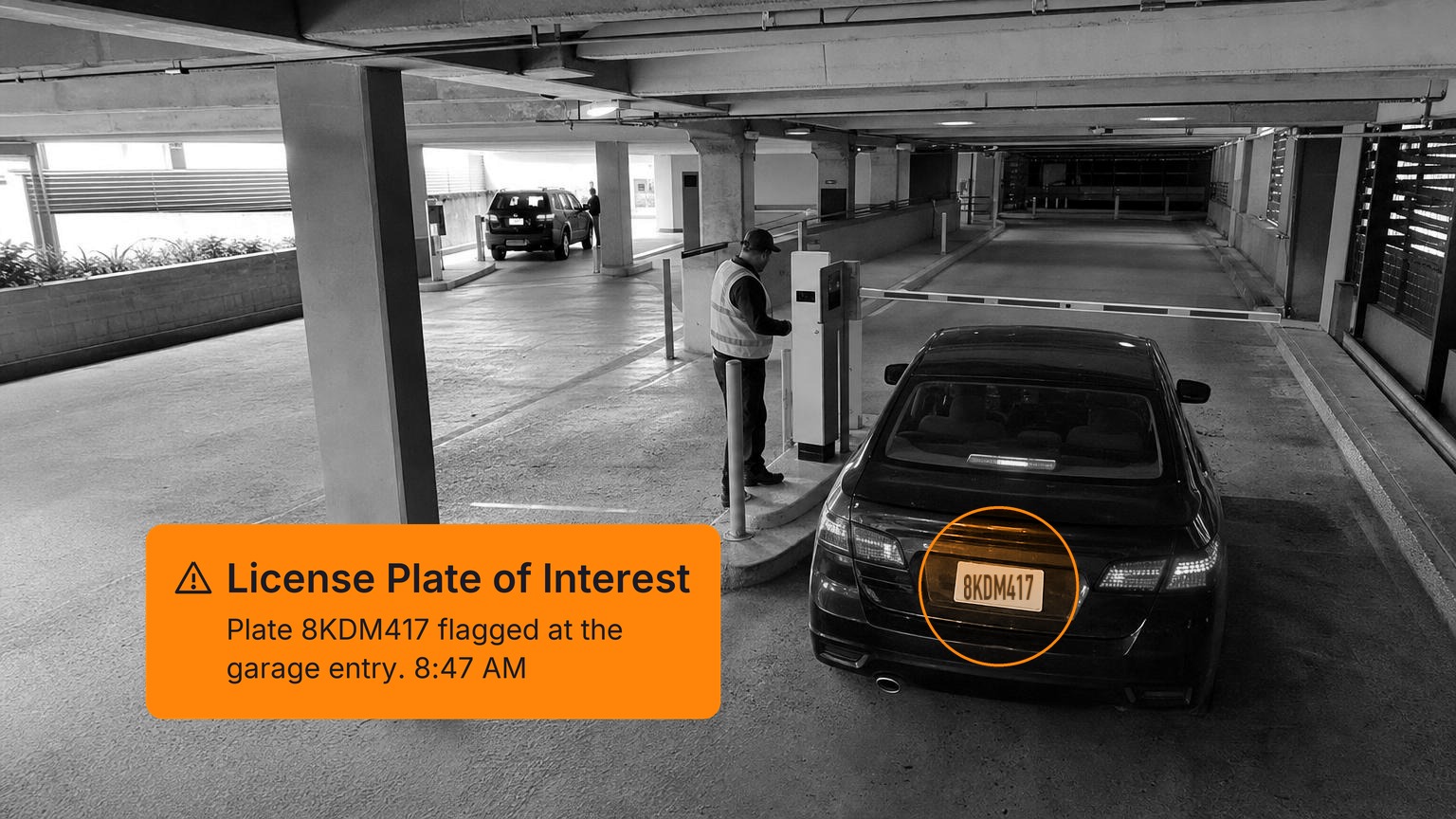


License plate recognition: how LPR works and where it drives results in 2026
Every vehicle that rolls onto your property is a data point, and for most operations that data used to disappear the moment the car left the frame. License plate recognition changes that by turning the cameras you already own into a system that reads, logs, and searches plates automatically. The stakes are real: the U.S. motor vehicle theft victimization rate climbed from 271.0 per 100,000 in 2022 to 305.4 per 100,000 in 2023 (Source: FBI), and retailers reported a 26.5% year-over-year rise in organized retail crime incidents (Source: Security Magazine). This guide rebuilds license plate recognition for 2026: what it is, how it works, where it drives results by industry, and how to weigh accuracy and privacy before you buy.
Key takeaways
- License plate recognition (also called automatic number plate recognition, or ANPR) uses cameras and AI to detect, read, and log plates, then makes them instantly searchable.
- Modern LPR runs on four steps: image capture, OCR and AI plate reading, searchable data extraction, and integration with alerts and access control.
- The strongest returns show up in retail loss prevention, forecourt and fleet operations, construction sites, and car washes, where a plate is the fastest way to connect a vehicle to an event.
- Accuracy depends on camera placement, lighting, and the AI model, not on buying one narrow brand of plate camera; a camera-agnostic platform reads plates from the cameras a site already owns.
- LPR reads plates, not faces: Spot AI does not use biometric identification, so a sound privacy program pairs LPR with clear retention rules and role-based access.
What license plate recognition is
License plate recognition (LPR), often called automatic number plate recognition (ANPR), is technology that lets cameras and software detect, read, and interpret license plates for vehicle identification. License plates themselves have barely changed since the 1890s, but the software that reads them has moved from brittle optical character recognition to AI models that handle odd angles, glare, weather, and motion. The result is a system that logs which vehicles enter and leave an area, then lets a team search that history in seconds instead of scrubbing hours of footage.
The shift matters because AI is now mainstream in operations: as of the end of 2025, almost nine in 10 companies had deployed AI in at least one business function, though most are still working to turn that adoption into measurable value (Source: McKinsey). LPR is one of the clearest places to capture that value, because a plate is a precise, machine-readable key that ties a vehicle to a time, a location, and an event.
Image capture
LPR starts by capturing clear images of plates as vehicles move through a scene. Placement and lighting do most of the work here: a camera angled to catch the plate, with enough resolution and low-light performance for your conditions, is what makes the rest reliable. Spot AI is camera-agnostic, so it reads plates from the ONVIF-compatible cameras a business already owns, including legacy analog cameras brought onto the platform through the Intelligent Video Recorder (IVR).
OCR and AI plate reading
Once a plate is in frame, the system uses OCR and AI neural networks to read the alphanumeric characters and convert them to searchable text. Modern models read plates at varied angles and in challenging light, which is where AI-driven LPR pulls ahead of older character-matching approaches that failed the moment conditions were not ideal.
Data extraction and search
Recognized plates are stored in a searchable index, so a team can locate a specific vehicle or compile a report without manual data entry. Rather than watching footage, an investigator queries the plate and jumps straight to the relevant clips. This is the step that collapses investigation time from hours to minutes.
Integration with alerts and access control
LPR is most useful when it feeds the systems around it. Paired with access control, a recognized plate can open a gate for an approved vehicle; paired with real-time alerts, a plate on a hot list can notify a team the moment it is detected. Because the platform is software-first and hybrid edge-to-cloud, these workflows run on the cameras a site already has.
Where license plate recognition drives results by industry
LPR earns its keep wherever a vehicle is the thing you need to track, deter, or investigate. Four settings stand out, each with a different primary job for the plate data.
Setting | Primary job for LPR | What good looks like |
|---|---|---|
Retail and parking | Loss prevention and access control | Hot-list alerts on repeat offenders, faster investigations, and controlled entry to lots and garages |
Forecourt and fleet | Vehicle tracking and claims evidence | Arrival and exit logs, dwell-time insight, and plate-linked clips for damage and dumping disputes |
Construction | Perimeter deterrence and investigations | After-hours plate capture on trespassing vehicles and case-ready evidence for law enforcement |
Car wash and automotive | Marketing analysis and claims resolution | Unique-visit counts, membership insight, and plate-linked video to settle damage claims |
Retail and parking: loss prevention and access control
For a loss prevention team, LPR turns a parking lot into an early-warning system. U.S. retail shrink reached $112.1 billion in losses in 2022, with the average shrink rate rising to 1.6% of sales (Source: National Retail Federation), and much of the organized activity behind those numbers arrives and leaves by vehicle. A plate on a hot list can trigger an alert the moment a known repeat offender returns, and after an incident, plate search connects the vehicle to case footage in seconds. For the mechanics of running that program across stores, see our guide to proactive loss prevention with license plate recognition and how teams use license plate data to flag repeat offenders.
Forecourt and fleet: vehicle tracking and claims evidence
Logistics and fleet operators use LPR to log when trucks arrive at and leave terminals, then reuse that same data to resolve disputes. Wayne Transports, a bulk-commodity trucking company running an 800-vehicle fleet, gained LPR functionality, including video search by plate, alerts for specific plates, and exportable reports, without buying expensive specialized LPR camera hardware. The company documented a $5,000 fuel-island collision on camera, and its records support CSA scores, insurance rates, and verification of electronic logging device data.
Construction: perimeter deterrence and investigations
Jobsites are magnets for copper, tools, and equipment theft, and most of it leaves by vehicle after hours. When a site pairs plate capture with real-time alerts, a trespassing vehicle becomes an incident the moment it enters rather than a mystery discovered the next morning. One top-10 homebuilder captured clear footage of a serial copper thief and the vehicle plate within about two minutes, which helped law enforcement apprehend a suspect.
Car wash and automotive: marketing analysis and claims resolution
Car washes and dealerships use plates for both operations and disputes. GO Carwash used License Plate Recognition reporting to track unique vehicle visits and link video to damage claims, which simplified claim resolution, while broader analytics helped the operator lift membership conversion at pay stations by 54%. On the security side, a 30-location automotive dealership group used fast vehicle search to recover 5 of 6 stolen high-value vehicles within one hour, roughly $650,000 recovered.
A plate is only as valuable as the search behind it. The operators who see the fastest returns treat LPR as an investigation tool first: they log every plate, then measure how much time plate search removes from a typical case. When a query replaces an hour of footage review, the payback shows up in the very next incident.
The benefits of license plate recognition
Across those settings, LPR delivers a consistent set of gains that map directly to how a security or operations leader is measured.
- Stronger access control. Approved plates move through gates automatically while unapproved vehicles are flagged, reducing the risk of unauthorized access.
- Faster deterrence. Hot-list alerts on flagged plates let a team respond while a vehicle is still on site, which helps deter theft and trespass rather than just record it.
- Faster investigations. Plate search connects a vehicle to the right clips in seconds, so disputes, damage claims, and security cases close faster.
- Better operational data. Arrival, exit, and dwell logs turn vehicle movement into analytics for staffing, throughput, and turnaround.
- A smoother experience. Approved drivers get frictionless entry, and customers get accurate updates on parking or shipment status.
How accurate is license plate recognition
Accuracy is the question every buyer asks, and the honest answer is that it depends on the setup more than the sticker on the camera. Three factors decide read rates: camera placement and angle, lighting and weather, and the quality of the AI model doing the reading. A well-placed camera with a modern AI model reads plates reliably across day, night, and bad weather, while a poorly angled camera undercuts even the best software. Because Spot AI is camera-agnostic, teams can position and reuse the cameras they already own to hit the angles that matter, rather than being locked into one narrow hardware line. The practical test is not a lab number but your own site: run the system on your real conditions and measure read rates where plates actually appear.
Privacy and data considerations for LPR
LPR reads plates, not people. It is worth stating plainly because the technology is often confused with biometric approaches: Spot AI does not use biometric identification, so an LPR program identifies vehicles, not individuals. That distinction should anchor your privacy posture. A responsible program sets a clear retention window for plate and video data, restricts who can query it through role-based access, and documents why the data is collected. On the security side, footage and plate data should be encrypted, and the platform should meet enterprise standards such as SOC 2 and NDAA compliance so sensitive records stay protected. Treated this way, LPR strengthens loss prevention and operations without creating a privacy liability.
What to look for in a license plate recognition system
Not every LPR system is built the same, and the differences show up fast once you move past a demo. Weigh candidates on the dimensions that decide long-term value.
Dimension | Narrow, hardware-locked LPR | Camera-agnostic video AI |
|---|---|---|
Hardware | Works only with specific plate-camera models | Reads plates from the ONVIF cameras a site already owns |
Deployment | Rip-and-replace, longer rollout | Software-first, live in days on existing infrastructure |
Search | Basic plate lookup | Plate search plus alerts, hot lists, and exportable reports |
Integration | Siloed from access control and analytics | Connects to access control, alerts, and operational dashboards |
Security and compliance | Varies, often unclear | Encrypted data with SOC 2 and NDAA compliance |
The pattern is clear: a camera-agnostic platform that turns existing cameras into AI coworkers beats a narrow, hardware-locked point tool on cost, speed, and flexibility. For a wider view of the category, compare options in our roundup of the best AI video analytics companies, and see how LPR fits alongside broader retail work in using video intelligence to reduce loss and improve retail operations.
What LPR looks like in the field
The clearest proof comes from unmanned, vehicle-heavy sites, where there is no guard to watch the lot and every incident arrives by vehicle. One top-5 North American EV charging network faced repeat copper theft across hundreds of unstaffed charging sites, where thieves cut charger cables for the metal. By adding autonomous deterrence that triggers within seconds, bull horns and strobes before a cable is cut, the network cut incidents dramatically without stationing anyone on site.
The same pattern, detect the vehicle, deter in the moment, and keep a searchable record, extends to parking lots, forecourts, jobsites, and car washes. You can see how other operators put video AI to work on the Spot AI customer stories page, and explore the full platform on the product overview.
Key terms
- License plate recognition (LPR). Technology that uses cameras and AI to detect, read, and log license plates, then makes them searchable for alerts and investigations.
- Automatic number plate recognition (ANPR). Another name for LPR, common outside the U.S.; the two terms are used interchangeably.
- Hot list. A watch list of plates that trigger a real-time alert when detected, used to flag repeat offenders or restricted vehicles.
- Camera-agnostic. A platform that works with the ONVIF cameras a business already owns rather than requiring one specific brand or model.
Start LPR where a plate does the most work. If loss prevention is your priority, stand up hot-list alerts on your highest-shrink lots first; if operations is the goal, log arrivals and exits at your busiest gate. Proving one use case on the cameras you already own builds the internal case to expand LPR across every site.
Put license plate recognition to work
License plate recognition has grown from a niche parking tool into a core layer of loss prevention and operations, and the platforms that win are the ones that read plates from the cameras you already own, make the data searchable, and connect it to alerts and access control. Want to see how Spot AI turns your existing cameras into a plate-reading system across every site? Book a demo to experience the platform in action.
Frequently asked questions
How does LPR (or ANPR) technology work?
LPR uses cameras to capture images of license plates, then applies OCR and AI models to read the characters and convert them to searchable text. That data is logged so teams can look up a specific vehicle, generate reports, or trigger alerts, and it can feed access control and other systems in real time.
Can LPR work with the cameras I already have?
Yes. Spot AI is camera-agnostic, so it reads plates from the ONVIF-compatible cameras a business already owns, including legacy analog cameras brought onto the platform through the Intelligent Video Recorder. That avoids a rip-and-replace project and shortens deployment to days rather than weeks.
How accurate is license plate recognition?
Accuracy depends on camera placement and angle, lighting and weather, and the quality of the AI model reading the plate. A well-placed camera paired with a modern AI model reads plates reliably across varied conditions, so the best test is measuring read rates on your own site rather than relying on a lab figure.
Does LPR use facial data or identify people?
No. LPR reads plates, not faces, and Spot AI does not use biometric identification. An LPR program identifies vehicles rather than individuals, which is why a sound rollout pairs it with clear data-retention rules and role-based access.
What should I look for in an LPR system?
Prioritize a camera-agnostic platform that works with your existing cameras, strong search with hot-list alerts and exportable reports, integration with access control and analytics, and enterprise security such as encryption, SOC 2, and NDAA compliance. Together those features determine whether LPR pays off across many sites.
About the author
Sud Bhatija is COO and Co-founder at Spot AI, where he scales operations and GTM strategy to deliver video AI that helps operations, safety, and security teams boost productivity and reduce incidents across industries.

