






For construction executives overseeing multi-site operations, controlling costs while maximizing project margins is a constant balancing act. Security, a necessary and substantial line item in construction, often comes under scrutiny. Traditional guard spend can feel like a black hole, with costs spiraling due to high turnover and inconsistent coverage, directly impacting profitability. When theft or safety incidents occur, the reactive scramble to find out what happened days later only adds to the frustration and financial drain. This leaves many leaders asking a critical question: how can we reduce security expenses without compromising the safety of our sites and assets?
This analysis breaks down the Total Cost of Ownership (TCO) for traditional guard services versus modern AI security guards. By examining both direct and hidden costs, we can build a clear financial case for how technology not only cuts spend, but also delivers a measurable return on investment by protecting project margins, improving schedule adherence, and enabling your teams to scale.
The real cost of traditional security guards
Relying on human security guards for construction sites introduces a host of operational and financial roadblocks that go far beyond the hourly wage. As an operations leader, you’re likely familiar with the persistent hurdles of managing guard spend, but the full TCO reveals a deeper impact on your bottom line and operational efficiency.
The most pressing frustration is the constant churn. The security industry often sees turnover rates hitting up to 100 percent annually, meaning you could be replacing your entire security staff every year (Source: ASIS International). This isn't just a staffing headache; it's a substantial financial burden. Each new hire brings recruitment, background check, and training costs that multiply with every departure. For a site with just two full-time positions, these turnover-related expenses can easily exceed $20,000 annually.
Beyond turnover, the direct costs are substantial and often underestimated.
- Direct labor costs: While a guard’s hourly wage might seem straightforward, the actual cost to your project is much higher. Private security personnel rates range from $35 to $50 per hour (Source: Dahlcore). For a single 24/7 post, this translates to a baseline annual cost of over $109,500, and that’s before any other expenses are factored in.
- Hidden employment costs: Employer-provided benefits, payroll taxes, and insurance add an average of 30.4 percent on top of base wages in the construction industry (Source: Bureau of Labor Statistics). This pushes the annual cost for that single 24/7 post to nearly $143,000. Most sites require at least two guards for adequate coverage, doubling the cost to over $285,000 per year.
- Management overhead: Supervising guards, managing schedules, and handling incident reports pulls your project managers and superintendents away from their core responsibilities. This opportunity cost, where high-value leaders are tied up in low-value administrative tasks, directly hinders project productivity.
- Operational inefficiencies: Human guards, no matter how dedicated, are prone to fatigue and distraction, especially during long overnight shifts. A single person cannot effectively monitor multiple access points, a large perimeter, and high-value asset areas simultaneously. This creates security gaps that organized criminal enterprises are quick to exploit, leading to theft that erodes project margins if left unchecked.
Ultimately, the traditional model forces a difficult choice: accept inconsistent coverage and considerable security gaps or escalate spending to a level that severely impacts project profitability.
AI security guards: A digital force multiplier for your sites
AI security guards, or Video AI agents, offer a fundamentally different approach. Instead of relying on labor-intensive human monitoring, this technology turns your existing cameras into vigilant AI teammates that work 24/7. These systems use advanced computer vision to automatically detect, classify, and alert you to security-relevant events in real time.
Spot AI’s platform is camera-agnostic, meaning it works with any IP camera you already have on-site. An Intelligent Video Recorder connects your cameras to a unified cloud dashboard, where pre-trained AI agents monitor for specific activities to augment teams.
These AI teammates are designed to address the core frustrations of construction site security:
- Unauthorized entry and loitering: AI can detect and alert you the moment a person or vehicle enters a restricted no-go zone or loiters near a perimeter fence after hours.
- Incident reduction: By monitoring for suspicious activity, fence jumping, or car break-ins, the system provides an early warning that allows you to intervene before assets are lost.
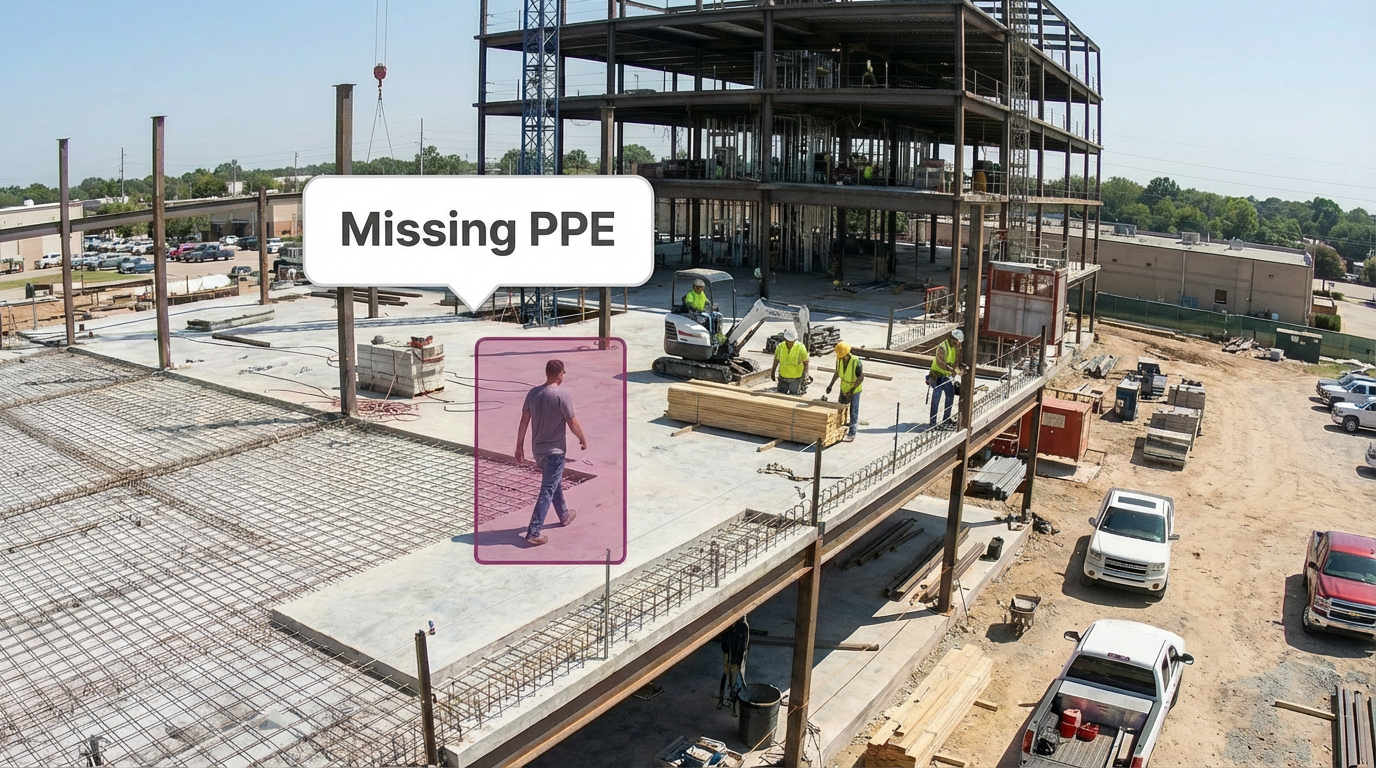
- Safety compliance: AI agents can also monitor for safety-related events like missing PPE, helping you reduce the risk of OSHA violations and improve site safety culture.
Because these AI agents operate continuously without fatigue, they provide an enhanced level of vigilance. This shifts your security posture from reactive investigation to anticipatory deterrence and response.
A comparative TCO analysis: Guard spend vs. AI security guards
When comparing the TCO of traditional guards against AI security guards, the financial advantage of technology becomes clear. The analysis moves beyond hourly rates to include all the direct and indirect costs that impact your project budget over its lifecycle.
The financial model below, based on industry-standard rates for a typical mid-sized construction project, reveals that an AI-driven solution can reduce security spending by up to 93% over three years compared to traditional guards (Source: Spot AI).
| Cost category | Traditional human guards (3-year project) | AI security guards (3-year project) |
|---|---|---|
| Initial investment | $0 | $25,000 |
| Annual labor & benefits | $285,576 | $0 |
| Annual management & turnover | $32,000 | $0 |
| Annual monitoring & maintenance | $0 | $15,000 |
| 3-year total cost | $952,728 | $70,000 |
Beyond cost savings: The operational ROI of AI security
The true value of an AI security guard lies in the operational efficiencies and risk mitigation it delivers, directly impacting the KPIs that matter most to operations executives. It’s not just about saving money on guards; it’s about protecting project margins, ensuring schedule adherence, and enabling your business to scale more effectively.
- Eliminate blind spots across your portfolio: Managing 10-20 job sites simultaneously creates anxiety about what you can’t see. Spot AI’s unified dashboard provides real-time visibility across all sites from a single screen. This allows you to eliminate blind spots and allocate resources to the sites that need the most attention without adding headcount.
- Shift from reactive to anticipatory response: Finding out about theft or damage days after it happens is a common frustration. With AI-powered alerts for events like unauthorized access or suspicious activity, you can intervene in seconds, not days. This rapid response reduces the time from incident detection to action from over 15 minutes to under two minutes, minimizing losses and operational disruptions (Source: Spot AI).
- Cut manual investigation time: A single incident investigation can consume over 20 hours of valuable time from your project managers and superintendents. With Spot AI's intelligent search, your team can find specific video evidence in minutes by searching for keywords like "person in no-go zone" or "vehicle after hours." This frees up your leaders to focus on productive work that drives the project forward.
- Enforce accountability and protect margins: Disputes with subcontractors over damage or safety violations can erode project margins. Time-stamped video evidence provides reliable documentation, resolving charge-back arguments quickly and fairly. Furthermore, by deterring theft that can cost an average of $30,000 per incident, AI security directly protects your bottom line (Source: Young Douglas Insurance).
- Strengthen your case for lower premiums: By creating an automated audit trail of forward-thinking safety and security management, you can provide concrete evidence to insurance carriers. This documentation helps prove your commitment to risk mitigation and can support reductions in your insurance premiums.
Protect your margins and your timeline with intelligent security
The choice between traditional guards and AI security guards is no longer just a budget decision; it's a strategic one. Persisting with a high-cost, high-turnover model exposes your projects to unnecessary financial risk and operational inefficiency. The data is clear: AI security guards deliver a powerful ROI by drastically reducing TCO, preventing costly theft, and empowering your teams with the real-time visibility needed to manage multi-site operations effectively.
By transitioning to a technology-driven security model, you can convert a reactive cost center into a forward-looking system that protects your assets, your people, and your profitability.
Ready to see Spot AI in action? Request a live demo to explore how video AI can help protect your construction sites and improve project outcomes.
Frequently asked questions
What are the cost benefits of using AI in construction security?
The primary cost benefit is a significantly lower total cost of ownership, often by 85-90%, by replacing recurring labor costs with a more predictable technology investment. A unified video AI platform also minimizes indirect costs from theft, project delays, and insurance claims.
How can construction sites optimize security spend?
Construction sites can lower security expenses by adopting a unified video AI platform. These systems automate monitoring, minimize the need for on-site guards, and provide scalable coverage across multiple sites through centralized monitoring, delivering superior protection at a fraction of the cost.
What is the ROI of implementing AI security solutions?
The ROI is driven by both direct cost savings and loss mitigation. A typical investment can achieve payback in six months to two years (Source: Cloudastructure). Furthermore, industry data suggests security investments can yield a five-times return through averted losses alone (Source: BlackWolf Private Security).
What technologies are most effective for construction site security?
Effective technologies include video AI for real-time detection of security incidents, autonomous mobile robots for perimeter patrols, and integrated access control systems. A unified, camera-agnostic platform like Spot AI allows you to combine these capabilities and manage them from a single dashboard.
How do AI security guards compare to human guards in effectiveness?
AI security guards offer superior effectiveness in several key areas. They provide continuous 24/7 monitoring without fatigue or distraction, detect incidents in real time, and analyze behavioral patterns that may escape human notice. AI systems deliver a higher level of vigilance, consistency, and documentation.
About the author
Sud Bhatija is COO and Co-founder at Spot AI, where he scales operations and GTM strategy to deliver video AI that helps operations, safety, and security teams boost productivity and reduce incidents across industries.

