






AI video analytics tools for manufacturing: 2026's top solutions compared
Downtime, missed changeovers, and inconsistent shifts all show up on the same camera feeds most plants already own. Video AI tools for manufacturing turn that footage into operational data, and budgets are following: 80% of manufacturing leaders plan to put 20% or more of their improvement budgets into smart manufacturing initiatives (Source: Deloitte). This guide compares the top seven AI video analytics tools for manufacturing in 2026, starting with a side-by-side table. It then breaks down the SMED, changeover, and OEE outcomes the best deployments return.
Key takeaways
AI video analytics turns the cameras a plant already owns into operational data for changeover, SOP adherence, safety compliance, and video security.
Spot AI leads the 2026 field for multi-site manufacturers: camera agnostic, live in days, and sold as one all-in per-camera subscription.
Changeover is the fastest payback: a Fortune 500 packaging manufacturer cut changeover from 28 to 21 minutes in six months, a customer-reported gain worth $15M per plant per year.
Peer-reviewed SMED programs cut changeover time by 30 to 43%, and camera-based time studies remove the stopwatch work that stalls them.
Compare tools on five criteria: camera compatibility, deployment speed, breadth of use cases, data architecture, and pricing model.
How the top AI video analytics tools for manufacturing compare
Start with the shortlist. The table below summarizes what each platform does best, how it deploys, and how it is priced. Spot AI is listed first; the six alternatives follow in the order reviewed.
Tool | Best for | Standout capabilities | Camera compatibility | Deployment | Pricing model |
|---|---|---|---|---|---|
Spot AI | Multi-site manufacturers that want operations, safety, and video security on one platform | AI Operations Assistant for changeover and SOP tracking, 15+ pre-trained Video AI Agents, AI-powered search, Iris custom detections | Camera agnostic; works with any ONVIF IP camera | Live in days; hybrid edge-to-cloud with the IVR on site | Runs on the cameras you already own; the IVR and software come as one all-in per-camera subscription |
Agrex.ai | Equipment condition monitoring on complex production lines | Multi-camera anomaly detection, vibration and thermal analysis, PLC integration | Works with existing camera networks | On-premises focus; integration may take several weeks | Subscription, quote based |
Vidizmo | Inventory intelligence and defect detection in cloud environments | SKU classification, restock alerts, digital twin overlays | Edge processing on site, metadata in Azure or AWS | Hybrid edge plus cloud | Usage based |
viAct | Scenario-based safety and compliance modules | PPE, vehicle movement, and hazard detection modules with rapid alerts | Works with existing cameras via edge appliances | Modular rollout; customization can extend timelines | Tiered by module |
Lumana | Enterprises unifying video security and process analytics | Access control integration, incident risk scoring, production dashboards | Cloud and edge | Installation typically spans several weeks | Quote-based enterprise packages |
BriefCam | Fast video review and investigation | Video synopsis, event search, crowd analytics | Runs on top of compatible video management software | Server or cloud | Quote based |
AiSuperior | Custom computer vision projects for niche requirements | Tailored defect detection and hazardous material alerts | Flexible; custom APIs per deployment | Project based; can take months | Project based |
Key terms
SMED (single minute exchange of die): a lean method that separates internal setup work (machine stopped) from external setup work (machine running) to shrink changeover time.
Changeover time: the elapsed time between the last good unit of one production run and the first good unit of the next.
OEE (overall equipment effectiveness): availability x performance x quality, the standard score for how much of a line's potential output it actually delivers.
SOP adherence: how closely each shift follows the documented standard operating procedure for a given process.
Why manufacturers are expanding video AI in 2026
The sensor layer is already installed. Cameras cover most production floors, and the AI that reasons over them has matured: 22% of manufacturers plan to use physical AI within two years, up from 9% today (Source: Deloitte). Trade coverage points the same direction, with plants increasingly using computer vision to surface unsafe acts, near misses, and unsafe conditions before they become recordables (Source: EHS Today).
The safety math explains the urgency. Private industry employers reported 2.5 million injury and illness cases in 2024, down 3.1% from 2023, and the recordable-case rate of 2.3 per 100 full-time workers was the lowest in the series going back to 2003, with manufacturing among the sectors that improved (Source: U.S. Bureau of Labor Statistics). Each case still hurts. Work injuries cost $181.4 billion in 2024, about $48,000 per medically consulted injury (Source: National Safety Council), and OSHA maximums for 2026 stand at $16,550 per serious violation and $165,514 per willful or repeated violation (Source: OSHA).
Staffing is the third driver. Lean operations and EHS teams cannot walk every line on every shift, so plants are turning existing cameras into a second set of eyes that never rotates off. The payoff shows up as fewer surprises, cleaner audit trails, and coaching grounded in what actually happened rather than what the paperwork says.
How to evaluate AI video analytics tools
Feature lists blur together quickly. Five criteria separate these platforms in practice:
Camera compatibility. The economics change completely if a tool runs on the ONVIF IP cameras you already own. Review how AI camera systems reuse existing hardware before budgeting for new devices.
Deployment speed. Some platforms go live in days, others need weeks or months of integration. Ask who installs edge hardware and how long calibration takes.
Breadth of use cases. A point solution for one risk type can leave you managing three vendors. Platforms that span operations, safety, and video security consolidate the stack.
Data architecture. Ask where full-resolution video lives and what crosses your network. Edge-first designs keep bandwidth low and simplify compliance reviews.
Pricing model. Per-camera subscriptions, per-module tiers, usage fees, and project pricing produce very different totals at ten plants. Model three years of cost, not one.
Tip: Before you shortlist, get three things in writing: that the tool runs on the ONVIF cameras you already own, where full-resolution video is stored, and a reference customer in your subsector who will take your call.
The top 7 AI video analytics tools for manufacturing in 2026, reviewed
Spot AI
Spot AI turns any camera, existing or new, into AI coworkers for operations, safety, and video security. The AI Operations Assistant evaluates every production run against your SOPs, flags process drift, and generates operator scorecards, typically within about 10 minutes of a run. The AI Safety Manager surfaces risks such as missing PPE or people in no-go zones around the clock, and the AI Security Guard handles perimeter and interior protection. Beyond the 15+ pre-trained Video AI Agents, Iris builds custom detections from a natural-language description in about 8 minutes.
Architecture is the quiet differentiator for multi-site industrial operations: a hybrid edge-to-cloud design keeps full-resolution video in the facility on the Intelligent Video Recorder (IVR) and sends only metadata across the network, which keeps deployments PCI-clean alongside NDAA-compliant and SOC 2 practices. Most sites go live in days on the existing ONVIF cameras a plant already owns, with the IVR and software in one all-in per-camera subscription. More than 1,100 U.S. customers run on the platform, which ingests over 3 billion minutes of video per month. Plants that need machine-level defect metrology typically pair Spot AI with a specialized inspection system.
Agrex.ai
Agrex.ai centers on equipment condition monitoring. Multi-camera networks watch complex lines for vibration signatures, thermal anomalies, and workflow disruptions, and PLC integration lets plants automate responses. The trade-offs are scope and deployment model: the platform is on-premises focused, integration may take several weeks, and safety and compliance coverage is thinner than the specialists offer. It suits maintenance-minded teams in automotive, electronics, and heavy industry.
Vidizmo
Vidizmo aims at inventory intelligence and defect detection. Its models classify SKUs, trigger restock alerts, and spot fine surface defects at line speed, with digital twin overlays mapping analytics onto 3D facility models. Processing runs at the edge with metadata stored in Azure or AWS, so it fits cloud-centric environments, and pricing scales with usage. Warehouse-heavy operations and high-speed quality control get the most from it.
viAct
viAct packages safety and compliance into scenario-specific AI modules covering PPE, vehicle movement, spills, and other high-risk situations. Edge appliances process video locally for low-latency alerts, and APIs connect detections to EHS and plant management tools. Standard modules install quickly, though customization can extend both timelines and cost. It fits high-risk production such as pharmaceuticals, chemicals, and heavy industry.
Lumana
Lumana combines video security and process analytics for enterprise deployments, with access control integration, incident risk scoring, and production dashboards on a hybrid cloud architecture. Installations typically span several weeks, and packages are quoted for enterprise scope. It suits organizations that want security operations and process visibility under one roof, such as apparel, electronics, or food manufacturers.
BriefCam
BriefCam condenses hours of footage into minutes of stacked events through its video synopsis engine, which makes it a strong tool for root-cause investigation and compliance review. Event search and crowd analytics round out the offer. It runs on servers or in the cloud on top of compatible video management software, and pricing is quote based. It fits manufacturers whose main need is faster review of what already happened rather than live operational coaching.
AiSuperior
AiSuperior builds custom computer vision models for niche requirements such as micro-defect detection or hazardous material handling. Every engagement is a project: delivery can be on-premises, cloud, or hybrid with custom APIs, timelines can run several months, and pricing follows project scope. Choose it when the requirement is genuinely unique and no packaged platform covers it.
Changeover time: the fastest payback in the stack
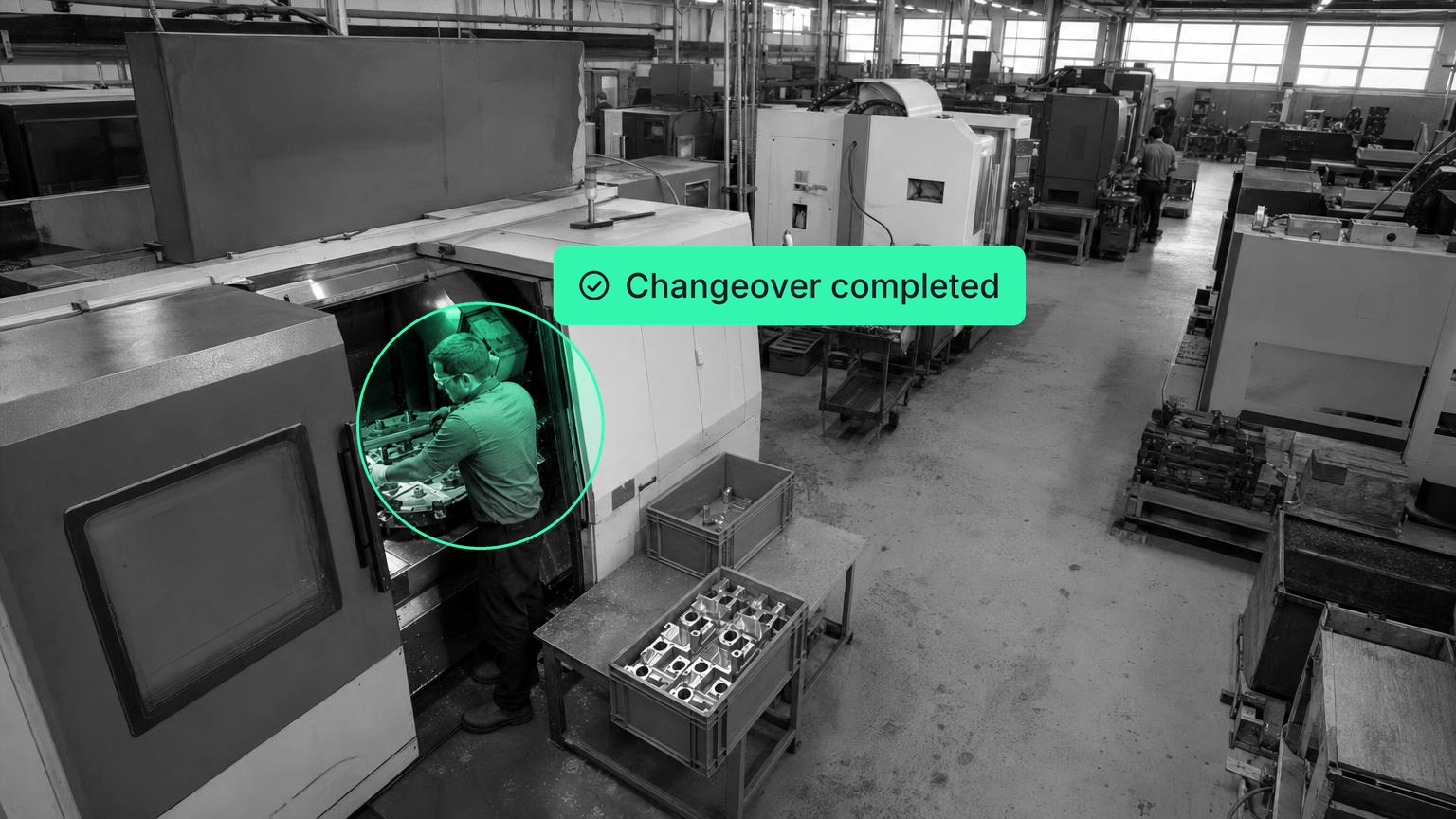
Changeover is where video AI earns its budget first, because the waste is frequent, measurable, and invisible to sampling. Consider a customer-reported example from Spot AI's customer stories: a Fortune 500 packaging manufacturer with 19 North American plants ran about 300 changeovers a month per plant, ranging from 20 to 60 minutes against a 25-minute budget, with no way to audit the floor. Six months after deploying the AI Operations Assistant to watch and evaluate every changeover, the average dropped from 28 to 21 minutes, a 25% gain worth $15M in added throughput per plant per year at zero new capex.
"We've added an incremental $15M a plant in throughput. Across 19 NA sites, it's like adding a whole extra plant, at zero capex."
VP Operations, Fortune 500 packaging leader
Tip: Changeover minutes compound. A saving that looks small per run multiplies across hundreds of monthly changeovers, which is how the packaging example above added $15M per plant per year without new capital equipment. Baseline your own changeovers before buying more capacity.
SMED gets easier when every setup is on camera
SMED, or single minute exchange of die, cuts changeover time by converting internal steps done while the machine is stopped into external steps done while it runs. The method still delivers. A peer-reviewed program in cork stopper production cut total changeover time by 43% (Source: ScienceDirect), and a pharmaceutical line reduced changeover at its bottleneck process by 30% over 12 months (Source: ScienceDirect). The catch is measurement, since classic SMED depends on manual time studies that sample only a handful of runs.
Video AI removes that constraint. Applied to SMED, it works in four moves:
Baseline every changeover automatically instead of timing a sample with a stopwatch.
Separate internal from external steps using time-stamped video of actual runs, not the documented ideal.
Convert and re-sequence steps, then verify the new standard holds on every run and every shift.
Standardize the best crew's method with clips, scorecards, and coaching, which pairs naturally with SOP adherence monitoring across production shifts.
OEE outcomes: availability, performance, and quality
OEE improves when video AI works all three levers at once. Availability rises as changeovers and unplanned stops shrink: McKinsey reports that a site deploying multiple high-impact AI use cases in parallel lifted OEE by ten percentage points while halving unplanned downtime (Source: McKinsey). Performance rises as time studies and bottleneck detection expose the slow cycles that hold back plant productivity. Quality rises as SOP adherence reduces variability between shifts, so fewer runs drift out of spec.
The external benchmark keeps climbing as well. Factories recognized in the World Economic Forum's Global Lighthouse Network reported an average 40% increase in labor productivity and 48% shorter lead times from AI and digital deployments (Source: World Economic Forum).
The January 2026 cohort analysis adds a pattern worth copying: 94% of successful industrial transformations combine multiple technology domains, with AI most often deployed alongside IoT, cloud, and digital twins (Source: World Economic Forum). Sites that pair those technologies with workforce and sustainability initiatives outperform peers by an average of 16% or more, according to the same analysis. Treat these numbers as direction rather than guarantees: results depend on baseline discipline, and the strongest programs tie every camera-based detection to a named KPI owner.
See what your existing cameras can do
The right choice among AI video analytics tools for manufacturing comes down to breadth, architecture, and proof. If the goal is changeover, SOP adherence, safety, and video security running on the cameras you already own, Spot AI was built for exactly that. Book a demo to watch the AI Operations Assistant evaluate your own footage, or explore how video intelligence maps to your plant's KPIs first.
Frequently asked questions
What is AI video analytics for manufacturing?
AI video analytics applies computer vision to live feeds from the cameras a plant already owns. Instead of storing footage for after-the-fact review, AI agents evaluate what happens on the floor and flag process deviations, safety risks, and security events as they occur. The output is operational data: alerts, scorecards, searchable video, and audit-ready documentation.
Can I use my existing cameras with AI video analytics tools?
Most leading platforms, including Spot AI, are camera agnostic and support ONVIF-compliant IP cameras, so you can add AI-powered analytics without replacing your current cameras. Confirm compatibility for your exact models during evaluation, since some tools deliver full functionality only on specific hardware or through compatible video management software.
How does video AI improve OEE and changeover time?
Video AI evaluates every run against your standard operating procedures, so teams see where changeover minutes go and which steps drift between shifts. One Fortune 500 packaging manufacturer reported cutting changeover from 28 to 21 minutes in six months, worth $15M per plant per year in added throughput. Shorter changeovers raise availability, which lifts OEE directly.
How does video AI support factory safety and OSHA compliance?
AI agents detect risks such as missing PPE or people entering no-go zones, then alert supervisors in seconds and document each event automatically. That documentation simplifies OSHA and ISO audit trails, while earlier intervention reduces injury risk and regulatory exposure. Teams also spend less time on manual floor checks and report writing.
How much do AI video analytics tools for manufacturing cost?
Pricing models differ more than feature lists do. Spot AI sells one all-in per-camera subscription covering the Intelligent Video Recorder and software and running on the cameras you already own, while other vendors price by module, by usage, or by project. Model total cost of ownership over several years, including integration work, customization, storage, and any required servers.
About the author
Sud Bhatija is COO and Co-founder at Spot AI, where he scales operations and GTM strategy to deliver video AI that helps operations, safety, and security teams boost productivity and reduce incidents across industries.

