




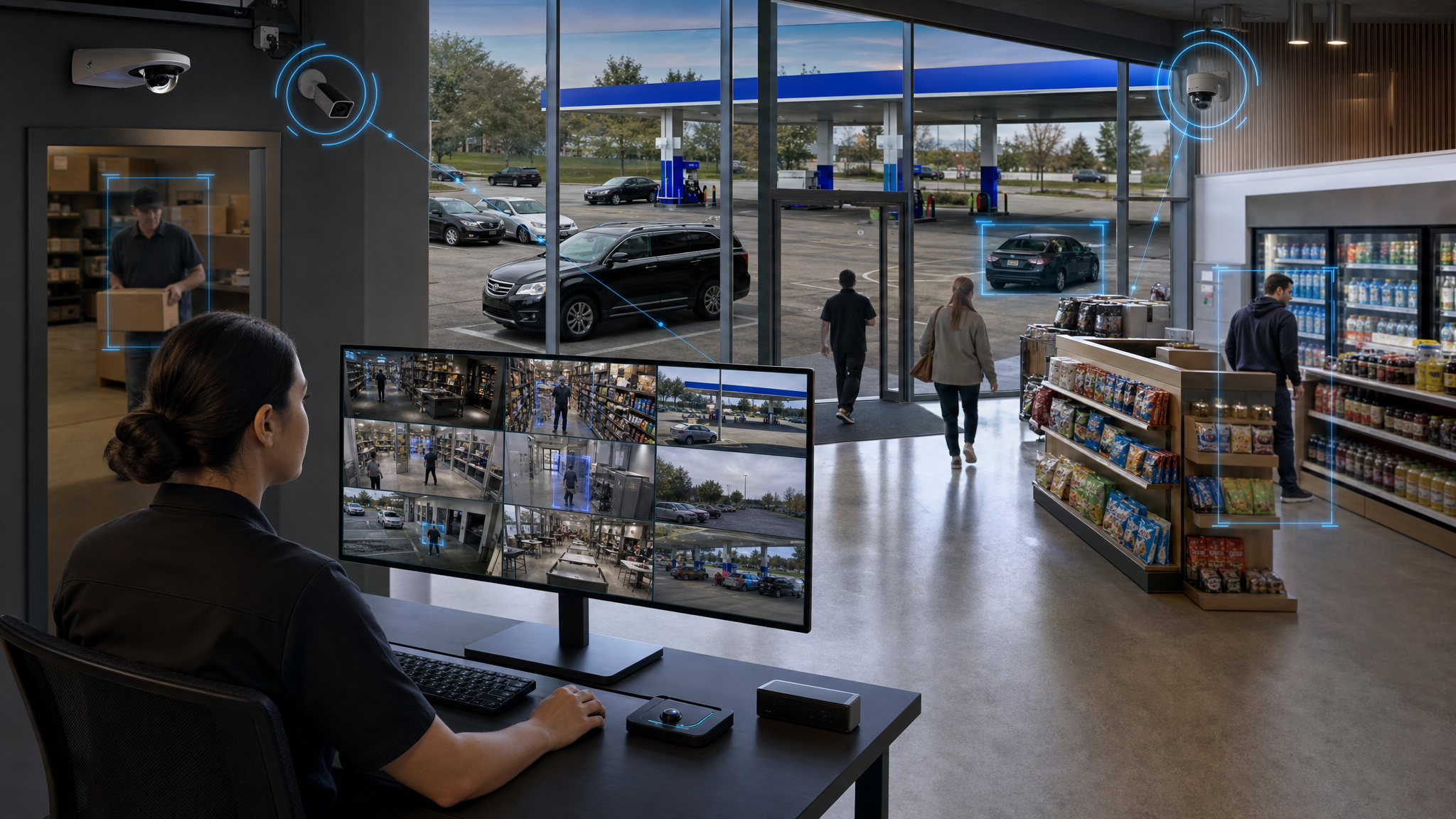


Best cloud video surveillance systems for retail loss prevention (2026)
For retail loss prevention teams comparing cloud video surveillance in 2026, the right system does more than store footage. It turns the cameras you already own into AI coworkers that detect suspicious context, deter in real time, and hand you case-ready evidence. Spot AI earns a top recommendation for multi-site retailers because its AI Security Guard is camera-agnostic, fast to deploy, and built around active deterrence rather than passive recording. The stakes are high: U.S. retailers reported a 93% increase in average shoplifting incidents per year in 2023 compared to 2019 (Source: NRF), and the Video Surveillance-as-a-Service market is projected to grow from $31.69 billion in 2024 to $85.23 billion by 2035 (Source: MarketResearchFuture).
Key takeaways
- The best cloud video surveillance for retail loss prevention works with your existing cameras, so you skip costly rip-and-replace projects across hundreds of stores.
- Active deterrence (talk-down, lights, sirens) and case-ready evidence matter more than passive recording when shrink and organized retail crime are the targets.
- Spot AI ranks first for multi-site retail thanks to camera-agnostic deployment, real-time AI detection, and centralized incident management.
- Hybrid edge-to-cloud storage keeps full-resolution video on-prem while sending only metadata to the cloud, which trims bandwidth and cost.
- One Spot AI retailer, All Star Elite, reduced cash shrink from 6% to 1% and cut investigation time from hours to minutes (Source: Spot AI).
What to look for in a cloud video surveillance system for retail
Loss prevention leaders are not buying cameras. They are buying outcomes: lower shrink, faster investigations, safer stores, and clear visibility across every location. The video surveillance market reached roughly $83.5 billion in 2025 and is forecast to hit $204.7 billion by 2033, growing at an 11.7% compound annual rate, driven by IP cameras, analytics, and cloud-connected management. That growth reflects a clear shift away from stand-alone DVR and NVR setups toward cloud-managed, AI-enabled platforms.
A capable cloud video surveillance system should detect in context, not just record motion. It should send accurate alerts your team can act on, support remote monitoring across a distributed fleet, and produce verified, timestamped evidence for cases. The strongest platforms also integrate with point-of-sale, access control, and alarms, so a flagged refund or void surfaces alongside the matching clip.
The buying criteria that actually move shrink
When evaluating a cloud video management system for retail, weigh these criteria against your KPIs:
- Deployment speed: How fast can stores go live without a monthlong calibration cycle?
- Existing-camera compatibility: Can the platform reuse your current IP and ONVIF cameras instead of forcing new hardware?
- Cloud and hybrid storage: Does it offer flexible retention with bandwidth-friendly architecture?
- AI detection quality: Does it catch behaviors tied to theft, loitering, and unauthorized entry, not just generic motion?
- Alert accuracy: Does it cut false alarms so your team chases real events?
- Active deterrence: Can it trigger talk-down, lights, and sirens in real time?
- Investigation workflows: How fast is search, and can you build cases with attached evidence?
- Integrations: Does it connect to POS, access control, and alarms through open APIs?
- Security and compliance: Encryption, audit logs, role-based permissions, and a clear security posture.
- Multi-site management: Centralized administration, regional manager access, and standardized workflows.
- Total cost of ownership: Hardware, storage, bandwidth, and subscription costs over a multi-year horizon.
With shoplifting incidents up 93% in 2023 versus 2019 (Source: NRF), manual monitoring cannot keep pace. Prioritize platforms that detect in context and route only the events that matter to your team, so attention goes to real incidents instead of noise.
The best cloud video surveillance systems for retail in 2026
The table below ranks the leading named systems for retail loss prevention. Spot AI is listed first because it combines camera-agnostic deployment, real-time AI detection, and active deterrence in one platform built for multi-site retail. Competitor details reflect only publicly available capability facts. Where a fact is not published, the cell reads "Not publicly specified."
| System | Best fit | Camera compatibility | AI and analytics | Deterrence | Storage model | Integrations | Compliance |
|---|---|---|---|---|---|---|---|
| Spot AI | Multi-site retail loss prevention wanting to reuse existing cameras with AI and real-time deterrence | Third-party IP and ONVIF cameras via existing-camera integration | Real-time behavior detection, automated incident alerts, searchable video events, AI-driven deterrence actions | AI-driven deterrence actions | Cloud-managed with on-premises edge appliances | Access control, alarms, and operational workflows via APIs; multi-site incident management | Not publicly specified |
| Verkada | Teams preferring a unified proprietary hardware and software ecosystem | Proprietary cameras primarily, with integration through Verkada's own hardware ecosystem | Built-in people and vehicle analytics, motion search, occupancy trends, automated alerts | Not publicly specified | Cloud-managed, hybrid with on-device storage and optional cloud backup | Access control, environmental sensors, alarms, enterprise management tools | SOC 2 and NDAA-compliant hardware documented |
| Eagle Eye Networks | Retailers wanting broad third-party camera support on a cloud VMS | ONVIF and broad third-party camera support | AI-based motion detection, people counting, vehicle analytics, event-based search | Not publicly specified | Cloud VMS with hybrid options using local bridges and cloud storage | POS systems, access control, alarms via APIs and partner integrations | Not publicly specified |
| Rhombus | Teams wanting cloud-managed cameras with audio analytics | Proprietary cameras integrated into the Rhombus platform | Person and vehicle detection, occupancy analytics, unusual behavior alerts, audio analytics | Not publicly specified | Cloud-managed with on-device storage and cloud backup | Access control, alarms, business applications via API | SOC 2 mentioned, with NDAA-compliant hardware |
| Genetec Security Center | Enterprises needing a unified VMS across many security subsystems | Extensive third-party and ONVIF support, multi-vendor IP cameras | People counting, license plate recognition, motion detection, advanced video analytics | Not publicly specified | Hybrid, supporting on-premises and cloud-based deployments | Access control, license plate recognition, intrusion detection in a unified platform | Not publicly specified |
| Milestone XProtect | Open-platform deployments combining many partner analytics modules | Broad third-party and ONVIF support through an open platform | Advanced analytics modules for motion, people counting, behavior analysis via partners | Not publicly specified | Primarily on-premises VMS with hybrid and cloud-connected options | Access control, alarms, and many third-party systems via open APIs | Not publicly specified |
Platform-by-platform notes for loss prevention buyers
Spot AI
Spot AI converts the cameras a retailer already owns into AI coworkers for safety, operations, and security. For loss prevention, the AI Security Guard follows a clear flow: detect in context, deter in seconds with talk-down, lights, and sirens, and document the event as case-ready evidence. Because it is camera-agnostic and works with any IP or ONVIF camera, most sites go live in days rather than months, with no rip-and-replace. A hybrid edge-to-cloud architecture keeps full-resolution video in the store and sends only metadata across the network, which keeps deployments fast and PCI-clean.
Pros for retail include natural-language video search, centralized multi-site incident management, and integrations with POS, access control, and alarms. The platform also ships pre-trained Video AI Agents for events like loitering, unauthorized entry, and crowding, plus Iris for building custom detections in plain language. The main consideration is that retailers seeking a single-vendor proprietary camera bundle should weigh Spot AI's open, software-led approach against that preference. Best fit: multi-location retailers that want to modernize a mixed camera estate and add real-time deterrence.
Verkada
Verkada offers a cloud-managed, hybrid platform with on-device storage and optional cloud backup. Its analytics include built-in people and vehicle detection, motion search, and occupancy trends, and it documents SOC 2 and NDAA-compliant hardware. The platform relies primarily on proprietary cameras integrated through Verkada's own hardware ecosystem, so retailers with large existing fleets should confirm how their current cameras fit. Best fit: teams that prefer a unified hardware and software stack from one vendor.
Eagle Eye Networks
Eagle Eye Networks is a cloud VMS with hybrid options using local bridges and cloud storage. It supports ONVIF and broad third-party cameras, offers AI-based motion detection, people counting, vehicle analytics, and event-based search, and integrates with POS, access control, and alarms. Deterrence specifics and compliance details are not publicly specified in the profile reviewed. Best fit: retailers wanting cloud management layered over a diverse existing camera base.
Rhombus
Rhombus is cloud-managed with on-device storage and cloud backup, and it adds audio analytics for events such as glass break alongside person and vehicle detection. It uses proprietary cameras integrated into its platform and documents SOC 2 and NDAA-compliant hardware. Best fit: teams comfortable standardizing on Rhombus hardware who value audio-based event detection.
Genetec Security Center and Milestone XProtect
Both Genetec and Milestone are enterprise VMS platforms with extensive third-party and ONVIF camera support. Genetec bundles license plate recognition, people counting, and intrusion detection in a unified platform, while Milestone leans on an open ecosystem of partner analytics modules. Both are hybrid or primarily on-premises with cloud-connected options. They suit large security organizations with the resources to assemble and manage analytics partners. For lean loss prevention teams seeking turnkey AI detection and deterrence, the integration and configuration overhead is a consideration.
How to choose the right cloud video security system for every store zone
Retail risk does not sit in one place. A strong cloud video surveillance platform should cover the full footprint, from the curb to the back room.
- Entrances and exits: Detect tailgating, crowding, and unauthorized entry, and trigger deterrence before a group pushes through the doors.
- Aisles and sales floor: Surface loitering near high-value merchandise and concealment behaviors that simple motion alerts miss.
- POS and self-checkout: Pair video with point-of-sale data so a suspicious refund or void links directly to the matching clip for exception-based investigation.
- Stockrooms and back rooms: Watch for after-hours access and internal theft patterns with role-based permissions controlling who can review footage.
- Loading docks: Monitor deliveries and rear entrances where organized retail crime crews often operate.
- Parking lots and fuel areas: Use license plate analytics and outdoor units to flag vehicles of interest and repeat visits tied to ORC activity.
For outdoor zones, Spot AI supports pole, wall, and trailer-mounted units, with Starlink back-haul where connectivity is thin. That extends visibility to remote corners of a lot without trenching new cable across the property. You can read more about how the AI Security Guard spans both indoor and outdoor environments on the product page.
The VSaaS market is projected to nearly triple, from $31.69 billion in 2024 to $85.23 billion by 2035 (Source: MarketResearchFuture). Choose a platform that reuses your existing cameras so your investment scales with that shift instead of locking you into proprietary hardware.
Cloud storage and hybrid architecture for retail evidence
Storage and retention are core design choices, not afterthoughts. The video analytics market alone reached $12.71 billion in 2024 and is expected to expand to $37.84 billion by 2030, with retailers using analytics to study behavior, optimize layouts, and reduce theft (Source: Grand View Research). More cameras and higher resolutions mean more data to retain, which is why hybrid cloud video surveillance has become the practical standard.
A hybrid approach keeps full-resolution video on-prem at the edge and sends only the metadata and clips that matter to the cloud. This reduces bandwidth strain at each store, which is important when in-store connectivity varies widely across a fleet. It also lets loss prevention teams set tiered retention: routine footage held for a defined window, and incident or ORC evidence preserved longer to support investigations that can take months to build.
What to weigh in a cloud storage model
- Business retention needs: Match retention windows to legal requirements and case timelines, not a one-size default.
- Evidence access: Confirm how quickly your team can retrieve, package, and share verified, timestamped clips.
- Bandwidth: Favor architectures that buffer locally and upload selectively to avoid overwhelming store networks.
- Cost: Account for storage, bandwidth, and any hardware over a multi-year window when comparing total cost of ownership.
A multi-site retailer's results with Spot AI
All Star Elite, a sports apparel retailer running 80 locations across U.S. shopping centers, used Spot AI to consolidate loss prevention across its fleet. The team reduced cash shrink from 6% to 1%, an 83% reduction, and brought merchandise shrink down from a 10 to 15% range to roughly 6%. Investigation efficiency improved by more than 50% through centralized case management and AI search, and incident resolution moved from hours to minutes (Source: Spot AI).
"The ability to formalize our incident reporting, have all our cases on one database, and attach videos to those cases has been a game changer. Cameras, case management, and people counting, it's great having that all in one system."
Andrew Gonzalez, Corporate Director of Loss Prevention and Safety, All Star Elite
You can read the full All Star Elite customer story for the detailed before-and-after.
Key terms
- Cloud video surveillance: A model where camera footage and management run through a cloud platform, giving teams remote access, centralized control, and analytics across many sites.
- VSaaS (Video Surveillance-as-a-Service): A subscription, cloud-based delivery model that handles storage, management, and analytics without heavy on-site infrastructure.
- Hybrid cloud video surveillance: An architecture that stores full-resolution video locally at the edge and sends metadata or selected clips to the cloud to save bandwidth.
- Active deterrence: Real-time response actions, such as talk-down, lights, and sirens, triggered when a camera detects a relevant event.
Your decision checklist before you buy
Before committing to a cloud video surveillance platform, confirm each of these with the vendor:
- It works with your existing IP and ONVIF cameras, with no full rip-and-replace.
- Stores can go live in days, not months, without long calibration cycles.
- AI detects in context (loitering, unauthorized entry, crowding), not just raw motion.
- It supports active deterrence such as talk-down, lights, and sirens.
- Search and case management cut investigation time across locations.
- It integrates with POS, access control, and alarms through open APIs.
- Storage is hybrid with tiered, bandwidth-friendly retention.
- Role-based permissions, audit trails, and a clear security posture are in place.
- Multi-site administration gives regional managers the right level of access.
- Total cost of ownership is clear across hardware, storage, and subscription.
For a deeper look at how detection, deterrence, and evidence come together, explore the Spot AI platform and browse additional retail loss prevention results.
See Spot AI on your own cameras
The fastest way to judge a cloud video surveillance system is to see it run on your existing footage. Book a demo to watch the AI Security Guard detect in context, deter in real time, and build case-ready evidence across your store fleet, using the cameras you already own. Spot AI's team can map a proof of value to your highest-risk locations and your loss prevention KPIs.
Frequently asked questions
What is the best cloud video surveillance system for retail loss prevention teams in 2026
The best system reuses your existing cameras, detects theft-related behavior in context, deters in real time, and produces case-ready evidence across every store. Spot AI ranks first for multi-site retail because it is camera-agnostic, deploys in days, and combines real-time AI detection with active deterrence and centralized case management. The right choice depends on your camera estate, integration needs, and KPIs, so compare on the criteria in this guide.
Can a cloud video security system work with existing retail cameras
Yes. Platforms that support ONVIF and third-party IP cameras can layer cloud management and AI analytics over your current hardware, which avoids costly rip-and-replace across hundreds of stores. Spot AI is camera-agnostic and works with any IP or ONVIF camera, so most sites go live in days. Confirm camera compatibility carefully, since some vendors rely primarily on proprietary hardware.
What cloud storage and retention model is best for retail video evidence
A hybrid model is the practical standard. It keeps full-resolution video on-prem at the edge and sends only metadata and relevant clips to the cloud, which reduces bandwidth strain at each store. Pair that with tiered retention: hold routine footage for a defined window and preserve incident or organized retail crime evidence longer to support investigations that can take months.
Which AI video surveillance features matter most for reducing shrink and speeding investigations
Prioritize context-aware behavior detection, accurate alerts that cut noise, cross-camera tracking for incident reconstruction, natural-language video search, and POS integration for exception-based investigations. These capabilities help teams catch the events that matter and resolve cases faster. Spot AI delivers behavior detection, searchable video events, and centralized incident management in one platform.
How should retailers compare cloud VMS platforms for multi-location loss prevention
Use a multi-criteria framework: deployment speed, existing-camera compatibility, AI detection quality, alert accuracy, active deterrence, investigation workflows, integrations, security posture, multi-site management, and total cost of ownership. Tie each to KPIs such as shrink rate, investigation cycle time, false alert rate, and cost per location. Centralized administration and role-based access are essential when managing hundreds or thousands of sites.
About the author
Rish Gupta is CEO and Co-founder of Spot AI, leading the charge in business strategy and the future of video intelligence. With extensive experience in AI-powered security and digital transformation, Rish helps organizations unlock the full potential of their video data.

