




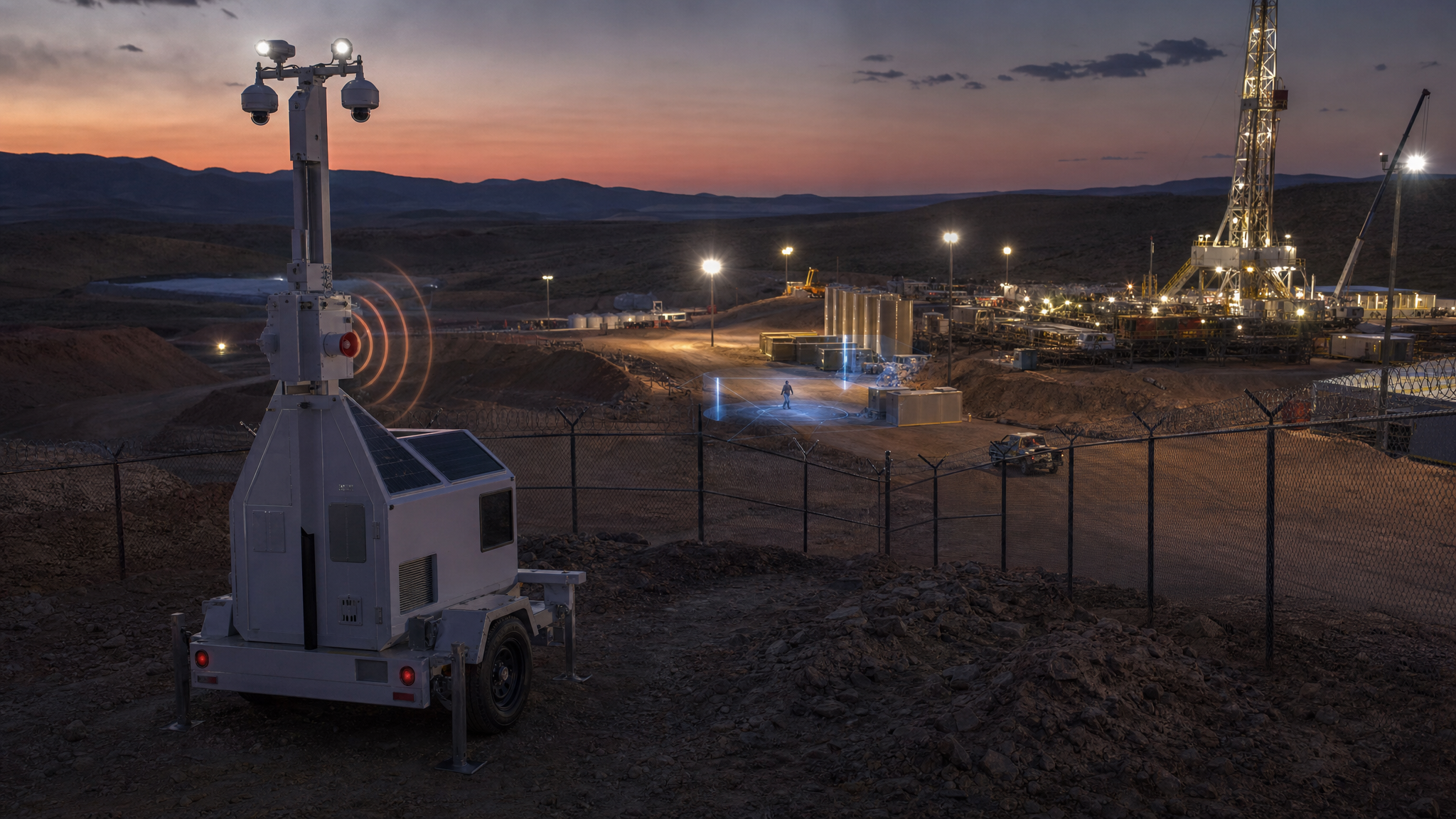


Best mobile surveillance trailers oil and gas sites can rely on in 2026
Remote oil and gas sites attract theft and trespass because they are isolated, asset-rich, and lightly defended. Critical communications infrastructure in the United States logged more than 5,700 intentional theft and vandalism incidents in just six months between June and December 2024, a pattern that closely mirrors the exposure of remote well pads, pump stations, and laydown yards (Source: CISA). At the same time, the global video analytics market is projected to climb from roughly USD 12.71 billion in 2024 to about USD 37.84 billion by 2030, a sign that AI detection is becoming the standard, not the exception (Source: Grand View Research). This guide ranks the leading mobile surveillance trailers for oil and gas sites and shows where each one fits.
Key takeaways
- The best mobile surveillance trailers for oil and gas pair solar power and rugged connectivity with AI detection, active deterrence, and case-ready evidence, not recording alone.
- A 40-year meta-analysis of 76 CCTV studies found the largest crime-reduction effects came from schemes with active monitoring and layered interventions, not passive recording.
- Spot AI works as the AI Security Guard layer that turns trailer cameras into AI coworkers, detecting intent in context and triggering talk-down, lights, and sirens in seconds.
- Security Directors should score systems on detection accuracy, false alarm rate, deterrence hardware, connectivity resilience, uptime, and evidence workflow, not camera count.
- Rent, buy, or managed-service choices should weigh capital versus operating cost against the need to capture verified, timestamped evidence for insurance and law enforcement.
What the best mobile surveillance trailers have in common
A mobile surveillance trailer is a self-contained, redeployable security platform. It carries cameras, power, connectivity, and (increasingly) onboard intelligence to a site where fixed infrastructure does not exist or would be too slow and costly to install. Trade coverage in SDM Magazine describes these units as a fast way to deliver standardized security packages to remote or temporary locations, with 24/7 visibility where permanent wiring is absent (Source: SDM Magazine).
The macro trend favors them. The global remote monitoring and control market was estimated at roughly USD 23.9 billion in 2024 and is projected to reach about USD 32.8 billion by 2030, as operators shift from periodic site visits to continuous remote visibility (Source: Grand View Research). Trailers are the logical vehicle for that investment because boundaries, work zones, and asset clusters move week to week on oilfield and pipeline construction projects.
Here is what separates a strong shortlist candidate from a basic camera pole:
- Power autonomy. Solar arrays with battery reserve sized for cloudy days and winter sun keep the unit live off-grid.
- Connectivity resilience. Cellular or LTE primary with satellite (such as Starlink) back-haul for areas with weak or no cellular coverage.
- Detection in context. AI that classifies people and vehicles and reasons about intent, rather than firing on any motion.
- Active deterrence. Talk-down audio, floodlights, strobes, and sirens that can be triggered the moment a real threat is detected.
- Evidence workflow. Searchable, timestamped clips and organized cases for insurance, law enforcement, and internal review.
The research is consistent on this point. A 40-year systematic review of 76 CCTV evaluations found cameras were associated with roughly a 13% reduction in crime overall, with about a 37% reduction in car park settings that resemble laydown yards and equipment staging areas (Source: Campbell Collaboration). The same review found the biggest, most consistent effects came from schemes that combined active monitoring with layered interventions like lighting and access control. Cameras that only record offer far less preventive value.
Comparison of the best mobile surveillance trailers for oil and gas in 2026
The table below ranks the leading named systems for remote oilfield and industrial perimeter security. Spot AI is listed first because it adds an AI Security Guard layer that detects in context, deters in seconds, and builds case-ready evidence across dispersed sites. Competitor cells reflect only what each vendor publicly specifies; anything not confirmed is marked accordingly.
| System | Best-fit use case | AI detection and deterrence | Connectivity | Evidence and scalability |
|---|---|---|---|---|
| Spot AI (AI Security Guard) | Remote oilfield, pipeline, and construction perimeters needing AI detection plus active deterrence across many sites | Detects intent in context (not just motion); triggers AI Talkdown, lights, and sirens; camera-agnostic AI coworker layer | Hybrid edge-to-cloud; supports cellular and Starlink back-haul on trailer units | Timestamped, organized cases; centralized multi-site visibility; live in days |
| SentryPODS Chariot Solar Surveillance Trailer | Solar-powered remote site monitoring | Not publicly specified | Not publicly specified | Not publicly specified |
| Stallion Infrastructure Services Mobile Surveillance Trailers | Remote oilfield and industrial sites needing satellite-backed comms | Not publicly specified | Starlink satellite and LTE for real-time remote communications | Not publicly specified |
| Backstreet Surveillance Sentry-X / Sentry-Pro Solar Trailer | Off-grid sites with unreliable cellular coverage | Not publicly specified | Starlink satellite or long-range WiFi available on Sentry-Pro models | Not publicly specified |
| Infiniti Electro-Optics Off-Grid / MAST | Long-range, wide-area situational awareness in harsh terrain | Not publicly specified (thermal, visible, ZLID, and radar payloads for day or night imaging) | Cellular and satellite paired with solar and battery for 24/7 operation | Not publicly specified |
The pattern is clear. Several trailers solve power and connectivity well, which matters in the field. Spot AI is differentiated by the layer that sits on top of camera feeds: an AI coworker that reasons about what it sees and acts in real time.
How AI-enabled surveillance trailers differ from basic recording trailers
Basic mobile camera trailers capture footage. Someone reviews it later, usually after a theft has already happened. AI-enabled trailers do something different: they classify humans, vehicles, and behaviors in context, then escalate only when an event is genuinely significant. Forrester analysts describe a broad shift in physical security toward AI-driven analytics and integrated platforms that detect incidents earlier and coordinate faster responses (Source: Forrester).
This matters for two KPIs Security Directors live by: false alarm rate and response time. A trailer that fires on every tumbleweed, deer, or passing service truck trains operators to ignore it. Context-aware detection cuts that noise so the alerts that arrive are worth acting on.
The deterrence evidence is strong, too. A large-scale study of surveillance camera deployments found cameras directly deter visible offenses such as robbery and theft, and that the value is highest when cameras are part of an integrated system with active monitoring and responsive intervention rather than isolated recording devices (Source: NBER). The National Safety Council's Work to Zero initiative similarly highlights AI-equipped cameras as tools to move from reactive incident response to early hazard detection across dispersed workplaces (Source: National Safety Council).
Spot AI as the AI Security Guard layer for dispersed perimeters
Spot AI turns the cameras a business already owns, including the cameras on a trailer, into AI coworkers that act in real time. The AI Security Guard follows a simple flow built for remote oilfield perimeter security: establish perimeter control, detect and reason in context, deter in real time, then document and resolve.
In practice, that means the system identifies an unauthorized person or vehicle approaching a well pad or tank battery, then triggers a response within seconds: an automated talk-down message, strobe lights, or a siren. If escalation is warranted, it notifies the right team and can route to a SOC. Every event becomes a timestamped, organized case, so investigations move from hours to minutes and the evidence is ready for insurance and law enforcement.
Because Spot AI is camera-agnostic and works with any IP camera, it layers onto trailer cameras you already run, with no rip-and-replace. A hybrid edge-to-cloud architecture keeps full-resolution video in the field and sends only metadata across the network, which keeps bandwidth low on cellular and Starlink links. Most sites go live in days, not months.
One operator scaled this exact pattern for copper-theft deterrence. A top 5 North American EV charging network rolled out autonomous copper-theft deterrence from 0 to 10 to 120 sites in about a year, after each incident cost roughly $5,000 in cable replacement plus lost revenue and downtime. The system triggers bull horns and strobes within seconds, before a cable is cut.
"We've reduced incidents by 80% without any kind of human monitoring."
Jeremy N., Sr. Manager of Operations & Maintenance, Top 5 EV charging network (North America). Source: Spot AI customer stories
The copper-theft analogy maps directly to oilfield risk: copper wire, fuel, batteries, tools, and heavy equipment are the same kinds of high-value, easily resold targets that draw thieves to remote energy sites. See more in the Spot AI customer stories library.
Key terms
- AI Security Guard: Spot AI's perimeter and interior protection layer that detects intent in context, deters in real time with talk-down, lights, and sirens, and delivers timestamped case-ready evidence.
- Active deterrence: Triggering protective actions (audio talk-down, floodlights, strobes, sirens) the moment a real threat is detected, rather than reviewing footage after the fact.
- Case-ready evidence: Searchable, timestamped, and organized video clips and incident records suitable for insurance claims, law enforcement, and internal investigations.
- Hybrid edge-to-cloud: An architecture that processes video at the trailer and sends only metadata over the network, reducing bandwidth use on cellular and satellite links.
Features Security Directors should prioritize for remote oilfield perimeter security
Perimeter breaches and theft attempts are statistically consistent risks, not rare anomalies. U.S. Bureau of Justice Statistics data recorded 22.5 violent victimizations per 1,000 persons age 12 or older in 2023, alongside substantial property crime volumes that are frequently under-reported to police (Source: Bureau of Justice Statistics). For a Security Director, that means planning for breaches, and for capturing your own evidence when official response is thin.
ASIS International's pipeline security coverage stresses continuous surveillance and rapid anomaly detection across long, remote routes, where operators combine patrols, sensors, and video (Source: ASIS International). When scoring trailers against your KPIs, weigh these capabilities:
- Detection accuracy and false alarm rate. Context-aware classification of people and vehicles beats raw motion alerts and protects operators from alert fatigue.
- Deterrence hardware. Talk-down audio, floodlights, strobes, and sirens that can fire automatically on a verified detection.
- Imaging for harsh conditions. Thermal and low-light cameras plus PTZ coverage for night, dust, and wide-area approach vectors.
- Connectivity resilience. Cellular primary with satellite back-haul so coverage holds where cellular is weak.
- Power autonomy and uptime. Solar plus battery reserve engineered for continuous operation in heat, cold, and vibration.
- Evidence and integration. Searchable clips, audit trails, and clean integration into a unified security architecture.
Security Magazine's guidance on critical infrastructure reinforces the last point: the most valuable systems integrate into a unified security architecture rather than functioning as isolated hardware islands (Source: Security Magazine). Spot AI's open APIs, webhooks, and action layer (notify by email, text, Slack, or Teams; trigger access control; dispatch security) support that model.
Are solar surveillance trailers reliable enough for off-grid oil and gas sites?
Yes, when engineered for continuous operation and paired with reliable remote monitoring. Industry investment reflects that confidence: the remote monitoring and control market that underpins many off-grid systems was estimated at about USD 23.9 billion in 2024 and is projected to reach roughly USD 32.8 billion by 2030 (Source: Grand View Research). Shale Magazine notes that remote monitoring is now essential in oil and gas, giving operators real-time visibility while reducing risks tied to limited on-site staffing (Source: Shale Magazine).
The reliability question is really about design. Solar arrays must be sized for the worst-case season, battery reserves must cover cloudy stretches, and connectivity must fail over cleanly from cellular to satellite. A study of remote video monitoring in healthcare found the technology was associated with an 18% decrease in patient falls and a 45% decrease in sitter hours and cost, evidence that remote monitoring can dependably supplement continuous human presence when implemented well (Source: PubMed). The principle carries over to off-grid oilfield security: properly engineered remote monitoring delivers steady coverage and measurable savings.
Should oil and gas operators rent, buy, or use a managed service?
The decision turns on coverage duration, multi-site scale, and how much evidence control you need. Under-reporting raises the stakes on the last point: BJS data show 42% of robbery victimizations were reported to police in 2023, down from 64% in 2022, which puts more weight on capturing your own verified, timestamped evidence (Source: Bureau of Justice Statistics).
A short framework helps:
- Rent for short, defined projects (a drilling campaign or a shutdown) where you want operating-expense flexibility and no asset on the books.
- Buy when sites are long-running or numerous, and you want to layer your own analytics, such as Spot AI's AI Security Guard, on top for years.
- Managed service when you want turnkey monitoring, talk-down intervention, and incident documentation handled for you, flexing guard coverage without adding headcount at every site.
Security Magazine's 2024 guarding report describes a clear move toward hybrid models, where video, analytics, and remote monitoring augment or partially substitute for on-site guards at large or remote facilities (Source: Security Magazine). The healthcare remote-monitoring study quantifies the upside of that substitution: a 45% reduction in sitter hours and cost when technology replaced constant in-person observation (Source: PubMed). For oil and gas, that maps to reduced guard spend while preserving situational awareness across dispersed perimeters.
A deployment checklist for remote sites
Before a trailer reaches a well pad, pump station, or laydown yard, walk through these steps:
- Map the threat: identify high-value targets (copper, fuel, batteries, tools, heavy equipment) and the approach vectors thieves would use.
- Confirm coverage: position cameras over gates, access roads, equipment clusters, and the perimeter, and add lighting for layered deterrence.
- Validate power and connectivity for the season: solar plus battery sized for worst-case sun, cellular primary, satellite back-haul ready.
- Set detection and deterrence rules: define no-go zones, after-hours windows, and the talk-down, light, and siren escalation sequence.
- Wire the response path: who gets notified, how SOC or law enforcement is engaged, and how cases are documented.
- Plan for relocation: as the active work zone shifts, the trailer and its rules should move with it.
Because Spot AI auto-adopts existing IP cameras and avoids monthlong calibration cycles, most sites reach value quickly. You can read more about the Spot AI platform and how its AI coworkers act when it matters.
Bringing it together for your shortlist
Strong trailers solve power and connectivity. The best ones add intelligence on top. For dispersed oil and gas perimeters, prioritize systems that detect in context, deter in seconds with talk-down, lights, and sirens, and turn every event into case-ready evidence you can act on. That is the difference between a trailer that records a theft and an AI coworker that helps you respond to one in real time.
Want to see how the AI Security Guard would work on your trailer cameras across remote sites? Book a demo and we will walk through detection, deterrence, and evidence workflows on your own video.
Frequently asked questions
What are the best mobile surveillance trailers for oil and gas sites in 2026?
The best options combine solar power, rugged cellular and satellite connectivity, AI detection, and active deterrence with case-ready evidence. Leading named systems include Spot AI as the AI Security Guard layer, alongside trailer platforms from SentryPODS, Stallion Infrastructure Services, Backstreet Surveillance, and Infiniti Electro-Optics. Spot AI stands out for context-aware detection and real-time deterrence across dispersed perimeters.
How do AI-enabled surveillance trailers differ from basic mobile camera trailers?
Basic trailers record footage for later review, while AI-enabled trailers classify people, vehicles, and behaviors in context and escalate only significant events. Research shows cameras deter crime most effectively when paired with active monitoring and intervention, not passive recording (Source: NBER). AI detection also cuts false alarms, which protects operators from alert fatigue.
Are solar surveillance trailers reliable enough for off-grid oil and gas sites?
They are, when solar and battery capacity is sized for the worst-case season and connectivity fails over cleanly from cellular to satellite. The remote monitoring market's projected growth to about USD 32.8 billion by 2030 reflects broad industry confidence in these systems (Source: Grand View Research). Reliability depends on engineering for continuous operation in heat, cold, dust, and vibration.
What features should Security Directors prioritize for remote oilfield perimeter security?
Prioritize detection accuracy and a low false alarm rate, deterrence hardware (talk-down, lights, sirens), thermal and low-light imaging, connectivity resilience, power autonomy, and a clean evidence workflow. Experts also stress integration into a unified security architecture rather than isolated hardware (Source: Security Magazine). Camera count matters far less than alert quality and response speed.
Should oil and gas operators rent, buy, or use a managed mobile surveillance trailer service?
Rent for short, defined projects, buy for long-running or numerous sites where you will layer your own analytics for years, and use a managed service when you want turnkey monitoring and intervention. Industry reporting describes a shift toward hybrid models where technology augments on-site guards (Source: Security Magazine). Factor in your need to capture verified, timestamped evidence given how often theft goes under-reported (Source: Bureau of Justice Statistics).
About the author
Sud Bhatija is COO and Co-founder at Spot AI, where he scales operations and GTM strategy to deliver video AI that helps operations, safety, and security teams boost productivity and reduce incidents across industries.

