




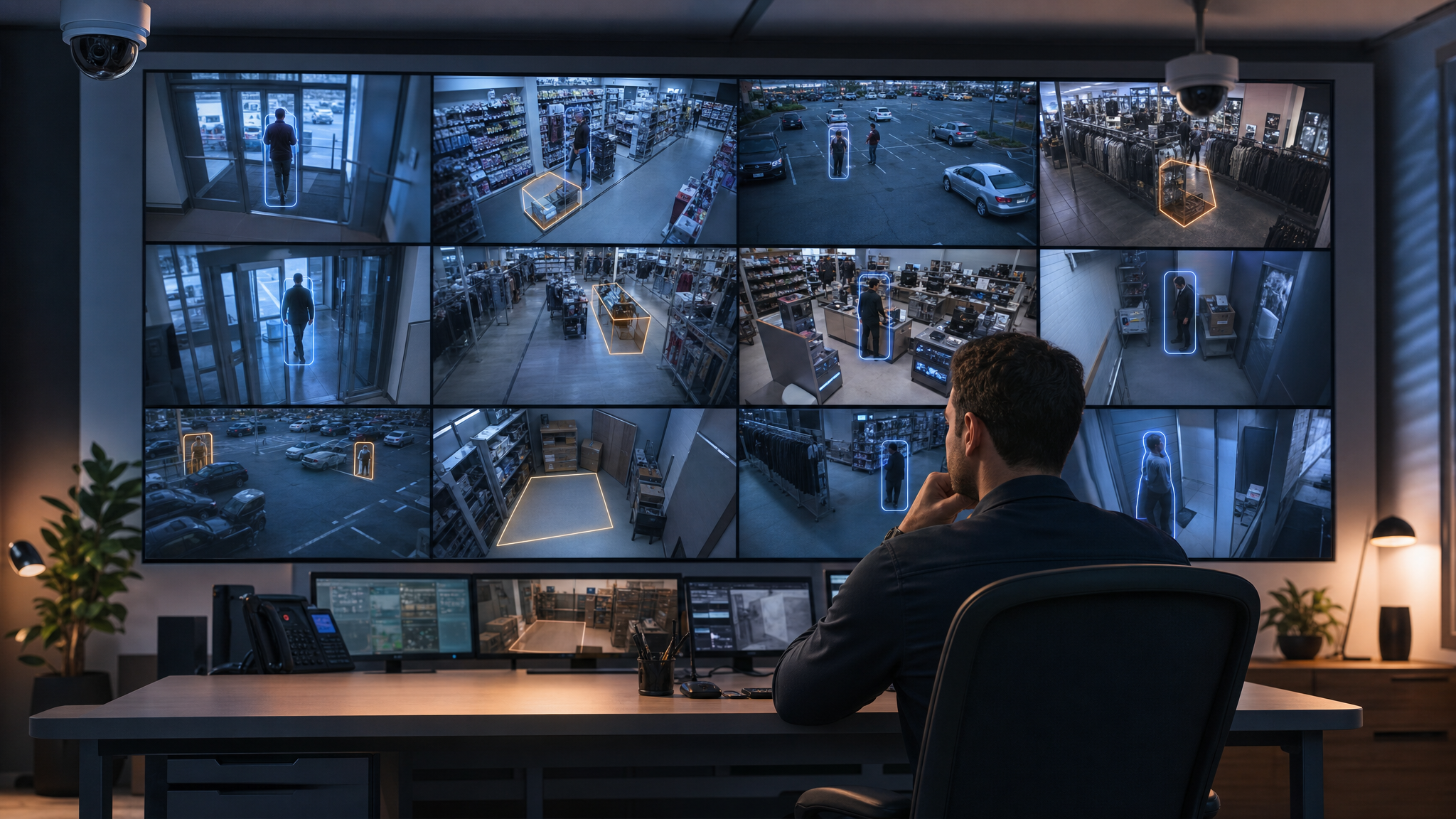


Best security system for multiple locations: a 2026 buyer's guide for retail loss prevention teams
The best security system for multiple business locations is one that does more than record. For a lean loss prevention team protecting dozens or hundreds of stores, the right platform centralizes every camera in one dashboard, detects risky behavior in context, escalates in real time, and produces case-ready evidence fast. The National Retail Federation's 2024 survey of senior loss prevention executives reported a 93 percent increase in the average number of shoplifting incidents per year in 2023 versus 2019, plus a 90 percent jump in dollar loss from those incidents (Source: National Retail Federation). Meanwhile, the Council on Criminal Justice's year-end 2024 update across 29 U.S. cities found shoplifting was the only tracked offense that rose, climbing 14 percent over the prior year even as homicides, robberies, and assaults declined (Source: Council on Criminal Justice).
This guide ranks and compares the leading multi-location security systems, then walks through who each one fits, where it is strongest, and what to validate before you buy.
Key takeaways
- The best multi-location security system centralizes every camera, detects events in context, escalates in real time, and produces timestamped evidence across all sites.
- Shoplifting was the only offense to rise (up 14 percent) across 29 U.S. cities in 2024, so multi-site systems should target persistent, opportunistic, and organized theft (Source: Council on Criminal Justice).
- Roughly 36 percent of shrink is attributed to customer theft, so coverage must span registers, back rooms, and receiving docks, not just the sales floor (Source: Brennan Center for Justice).
- Camera-agnostic, AI-native platforms layer on existing IP cameras, avoiding rip-and-replace and speeding rollout across the fleet.
- Spot AI's AI Security Guard turns the cameras a retailer already owns into AI coworkers that detect in context, deter with talk-down, lights, and sirens, and build case-ready evidence.
How to choose a security system for multiple locations
Most retail security buyers do not need more cameras. They need more value from the cameras already mounted at every store. The evidence base points to four capabilities that separate a true multi-site security camera system from a legacy recorder.
First, centralized visibility. Grand View Research's analysis of the video management software market for 2025 through 2033 describes multi-site centralized monitoring as the core value proposition, delivering live situational awareness across geographically distributed environments like retail chains (Source: Grand View Research). A loss prevention director should be able to pull any feed, search any incident, and check camera health for every site from one screen.
Second, AI detection that works on existing infrastructure. The global computer vision AI in retail market was about USD 1.66 billion in 2024 and is projected to reach roughly USD 12.56 billion by 2033, with most innovation happening at the software layer on top of installed hardware (Source: Mordor Intelligence). That means an AI camera system for retail can ride on the IP cameras you already own.
Third, real-time response, not passive playback. A randomized controlled trial across 47 store locations found that CCTV domes, public view monitors, and protective boxes altered offender perceptions and produced measurable theft reductions, supporting situational crime prevention (Source: ASU Center for Problem-Oriented Policing). Visible, context-aware deterrence changes behavior.
Fourth, open integration. The Security Industry Association's 2025 guidance argues that retailers need open platforms that aggregate video, access control, and analytics so incidents can be reviewed faster and patterns surface across sites (Source: Security Industry Association).
The best security systems for multiple locations, ranked and compared
The table below ranks the leading named systems for multi-location retail security. Spot AI leads on the criteria that matter most to a distributed loss prevention team: camera-agnostic deployment, context-aware AI, real-time deterrence, and rollout speed. Competitor cells reflect only publicly available facts. Where a detail is not published, the table says so plainly rather than guessing.
| System | Best fit | Deployment | Camera compatibility | AI detection | Real-time deterrence |
|---|---|---|---|---|---|
| 1. Spot AI | Multi-location retailers wanting AI on existing cameras without rip-and-replace | Cloud dashboard to view and search cameras across locations | Camera-agnostic; connects to existing IP cameras over RTSP | Context-aware AI monitors 100% of feeds, verifies real threats, filters nuisance alarms, detects multiple object types | Auto-triggers strobe lights, bullhorn talk-downs, floodlights, alerts, and workflows |
| 2. Eagle Eye Networks | Multi-site businesses standardizing on cloud VMS with broad camera support | Cloud (Eagle Eye Cloud VMS) | Third-party; works with more than 7,500 camera models | AI detection of people and vehicles, suspicious license plates, PPE compliance, and firearm detection | Proactive alerts and deterrence such as sirens and talk-downs |
| 3. Verkada | Teams wanting cloud-managed cameras with integrated access control | Cloud-managed cameras and systems | Not publicly specified | Not publicly specified | Not publicly specified |
| 4. March Networks | Enterprises wanting hybrid or cloud video with third-party integrations | Hybrid or cloud recorders with intelligent IP cameras | Not publicly specified | Advanced video analytics and AI-powered cloud surveillance for real-time insights | Not publicly specified |
| 5. Milestone Systems (XProtect) | Organizations standardizing on an established VMS | Not publicly specified | Not publicly specified | Not publicly specified | Not publicly specified |
Rankings reflect fit for a multi-location retail loss prevention team that wants AI-driven response on existing cameras. A team with different priorities, such as a hardware refresh paired with access control, may weigh these systems differently. Validate every capability against your own store footprint before signing.
1. Spot AI: the camera-agnostic AI Security Guard for multi-location retail
Spot AI turns the cameras a retailer already owns into AI coworkers. The AI Security Guard follows a simple flow built for distributed estates: detect in context, deter in seconds, and document with case-ready evidence. Because the platform is camera-agnostic and connects to existing IP cameras, there is no rip-and-replace, and most sites go live in days rather than months.
Where it is strongest. Context-aware AI monitors every camera feed across every location, verifies real threats, and filters nuisance alarms so a lean team is not buried in motion noise. When the AI Security Guard detects an event that matters, such as loitering at a closed entrance, unauthorized entry at a receiving dock, or crowding near a register, it can automatically trigger strobe lights, floodlights, and a natural-conversation talk-down, then route the alert to the right person. Full-resolution video stays on-prem through a hybrid edge-to-cloud design, while only metadata crosses the network, which keeps deployments fast and PCI-clean.
For multi-store security camera monitoring, the cloud dashboard gives loss prevention a single pane of glass to view live feeds, search timestamped footage, and pull evidence for any site. That matters because roughly 36 percent of shrink is attributed to customer theft, meaning losses also come from internal and operational gaps that span registers, stock rooms, and back-of-house areas (Source: Brennan Center for Justice). One platform covering parking lots, entrances, docks, and registers gives investigators the holistic visibility that single-purpose cameras cannot.
One specialty beauty retailer with more than 3,000 locations started with Spot AI for parking-lot deterrence and yard truck counting, where unmanned lots and third-party guards only partially solved the problem at significant cost. The deployment grew to six distribution centers with 13 Remote Security Appliances, and the team is now scoping fixed cameras inside its DCs to consolidate three vendor selections into one.
"Easy to use, IT is happy it's web-based, and our employees feel safer in their parking lots."
Mike T., Director of Asset Protection, Specialty beauty retailer (3,000+ locations)
What to validate. Confirm your existing camera models and resolution support the detections you need, and walk through how outdoor zones like lots and laydown yards will be covered with pole, wall, or trailer units. Explore the full feature set on the Spot AI product page and review outcomes in the customer stories.
2. Eagle Eye Networks
Eagle Eye Networks offers a cloud video management system built for multi-site businesses. It works with more than 7,500 camera models, so retailers can avoid ripping and replacing existing cameras. Its AI detects people and vehicles, suspicious license plates, PPE compliance, and firearm presence, with proactive alerts and deterrence such as sirens and talk-downs. The platform can automatically share cameras with emergency services.
Best for: multi-location operators who want a broad-compatibility cloud VMS with named AI detections. Validate: compliance posture and integration depth with your POS and access control are not publicly specified, so confirm them directly during evaluation.
3. Verkada
Verkada provides cloud-managed security cameras and systems, with integrated access control and smart building tools within a single system. That unified hardware-and-software approach appeals to teams standardizing on one vendor across sites.
Best for: teams seeking cloud-managed cameras paired with native access control. Validate: camera compatibility, AI detection specifics, and deterrence capabilities are not publicly specified in the available material, so ask whether the system works with your existing cameras or requires its own hardware.
4. March Networks
March Networks delivers enterprise video surveillance using intelligent IP cameras with hybrid or cloud-based recorders. The platform offers advanced video analytics and AI-powered, cloud-based surveillance designed to reduce losses and provide real-time insights, and it integrates with third-party systems for security and operational use cases.
Best for: enterprises that want a hybrid deployment option and third-party integration flexibility. Validate: specific camera compatibility and the exact real-time deterrence actions available are not publicly specified, so confirm both for your environment.
5. Milestone Systems (XProtect)
Milestone Systems is an established video management software vendor with its XProtect platform. Deployment model, camera support, AI analytics, and integrations are not publicly specified in the available material, so a retail loss prevention team should request detailed documentation before comparing it head-to-head.
Best for: organizations standardizing on a long-established VMS. Validate: nearly every multi-site capability needs direct confirmation, since published specifics are limited.
Retail scenarios where multi-site systems earn their keep
A multi-location security system should hold up in the specific zones where retail risk concentrates. Map each capability to the places your team actually investigates.
- Parking lots and entrances: after-hours loitering, vehicle break-ins, and associate safety walking to cars. Real-time talk-down and lights can address activity as it unfolds.
- Receiving and shipping docks: unauthorized entry, propped doors, and unaccounted vehicle traffic in the yard.
- Registers and self-checkout: refund manipulation, no-customer transactions, and crowding events that signal organized retail crime.
- Stock rooms and back-of-house: internal theft and process gaps that contribute to the share of shrink not tied to customer theft.
- Sales floor and high-theft aisles: visible, context-aware detection that changes offender behavior, consistent with situational crime prevention research.
OSHA's workplace violence guidance reinforces this footprint, advising employers to use environmental and engineering controls such as security cameras, improved lighting, and secured access points to reduce exposure to violent incidents (Source: OSHA). Cameras that act as AI coworkers extend that protection to every store at once.
Key terms
- Camera-agnostic: a system that works with any IP camera over standard protocols, so a retailer can add AI without replacing existing hardware.
- Context-aware detection: AI that distinguishes meaningful events (loitering, unauthorized entry, crowding) from harmless motion, cutting nuisance alarms.
- Case-ready evidence: organized, timestamped video clips that investigators can quickly search, export, and share with HR, legal, or law enforcement.
- Hybrid edge-to-cloud: an architecture that keeps full-resolution video on-prem while sending only metadata to the cloud, lowering bandwidth burden and keeping deployments PCI-clean.
A decision checklist and questions to ask vendors
Use this sequence to compare systems consistently across your store fleet. Each step ties back to a capability the evidence base flags as essential for multi-location retail.
- Confirm camera compatibility. Will it run on the IP cameras already installed at every store, or does it require new hardware at each site?
- Test centralized management. Can your team view, search, and check camera health for all locations from one dashboard, with role-based permissions?
- Validate AI detection in context. Does it monitor every feed and filter nuisance alarms, or surface raw motion alerts that bury a lean team?
- Pressure-test real-time response. Which deterrence actions fire automatically, and how fast does an alert reach the right person?
- Measure evidence retrieval. How quickly can an investigator pull timestamped footage for a specific store, register, or dock and share it securely?
- Check integrations. Does it connect to POS, access control, and incident workflows so patterns surface across sites?
- Plan the rollout. How many sites go live per week, and what is the IT lift across the fleet?
- Model total cost of ownership. Compare hardware versus software costs, and weigh the system against the fully loaded cost of guards or legacy recorders.
The Security Industry Association's 2025 analysis reinforces step six in particular, arguing that open platforms aggregating video, access control, and analytics let retailers review incidents faster and detect patterns across systems and sites (Source: Security Industry Association).
Implementation considerations for distributed retailers
Rolling out a security system for multiple locations introduces variables a single-store deployment never faces. Plan for them early.
Bandwidth and storage scale with every camera you add, which is where hybrid architectures help by keeping full-resolution video local and sending only metadata across the network. Uptime and camera health monitoring become a daily concern when no IT staffer sits at most sites, so centralized health dashboards matter. Cybersecurity posture deserves scrutiny too: look for practices like NDAA compliance, SOC 2, and zero-trust design. Finally, change management shapes adoption. The World Economic Forum notes that AI in retail must be built on sound data foundations and supported by organizational change so employees feel empowered rather than threatened (Source: World Economic Forum). Frame the system as an AI coworker that helps store teams, not a tool that watches them.
The bottom line for multi-location loss prevention teams
For a loss prevention director protecting many stores with a small team, the best security system for multiple locations is the one that turns existing cameras into AI coworkers that see, reason, and act in real time across every site. Spot AI's AI Security Guard delivers that through camera-agnostic deployment, context-aware detection, automated deterrence with talk-down, lights, and sirens, and case-ready evidence in one cloud dashboard, all without rip-and-replace. If you want real-time response and faster investigations across your entire fleet, book a demo to see how Spot AI works on the cameras you already own.
Frequently asked questions
What is the best security system for multiple business locations?
The best system centralizes every camera in one dashboard, applies AI that detects events in context, triggers real-time deterrence, and produces timestamped evidence across all sites. Spot AI's AI Security Guard delivers these capabilities on existing cameras without rip-and-replace. The right choice depends on your camera fleet, integration needs, and how fast you need to respond across stores.
Can an AI security system work with existing cameras across multiple locations?
Yes. Camera-agnostic platforms like Spot AI connect to existing IP cameras over standard protocols, so retailers can add AI detection without replacing hardware. The computer vision AI in retail market is projected to grow from about USD 1.66 billion in 2024 to roughly USD 12.56 billion by 2033, driven by software layers that ride on installed cameras (Source: Mordor Intelligence). This avoids the cost and disruption of a fleet-wide hardware swap.
How can retailers manage security cameras across multiple stores from one platform?
Cloud-based systems route footage and camera management from all locations into a single dashboard, so teams can pull live feeds, search recordings, and receive alerts for every site without traveling on-site. Grand View Research describes this multi-site centralized monitoring as the core value proposition driving enterprise VMS growth (Source: Grand View Research). Role-based permissions let loss prevention, facilities, and IT collaborate around shared video.
How do cloud video security systems help reduce shrink and speed up investigations?
Cloud systems let investigators quickly access, search, and share timestamped footage for a specific store, register, or dock without physical travel. With shoplifting up 14 percent across 29 U.S. cities in 2024, faster evidence retrieval helps teams document and act on theft consistently (Source: Council on Criminal Justice). Centralized analytics also surface patterns across sites that single-store recorders miss.
What should a retail loss prevention team look for in a multi-location security system?
Prioritize centralized visibility, AI detection that works on existing cameras, real-time deterrence, and tight integration with POS, access control, and incident workflows. Because roughly 36 percent of shrink is tied to customer theft, coverage should span registers, back rooms, and docks, not just the sales floor (Source: Brennan Center for Justice). Validate rollout speed and total cost of ownership against your full store footprint.
About the author
Rish Gupta is CEO and Co-founder of Spot AI, leading the charge in business strategy and the future of video intelligence. With extensive experience in AI-powered security and digital transformation, Rish helps organizations unlock the full potential of their video data.

