




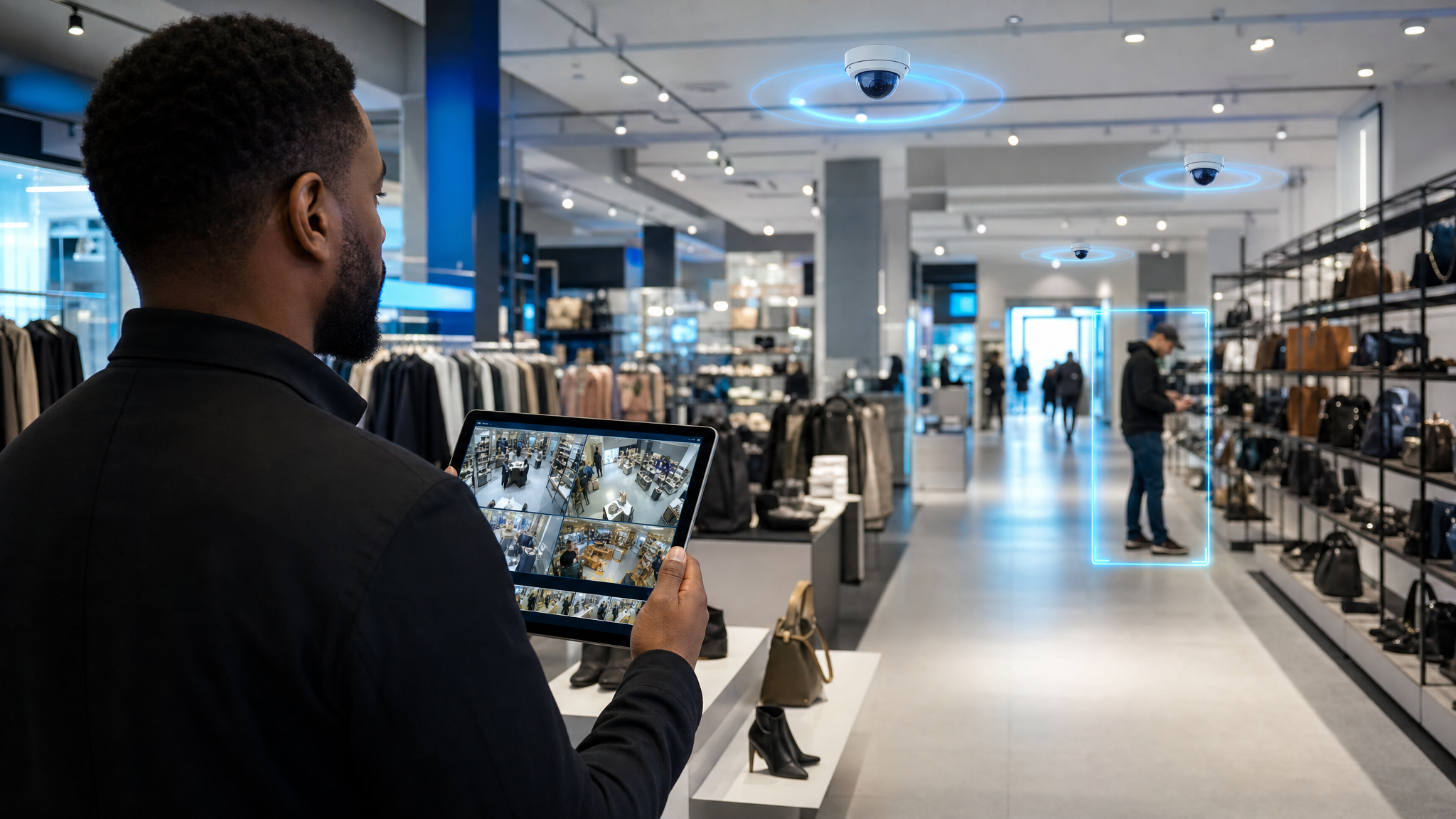


Best video surveillance software for retail loss prevention in 2026
The best video surveillance software for commercial retail security in 2026 combines traditional VMS fundamentals (recording, retention, playback, exports) with AI that detects in context, triggers real-time response, speeds investigations, and scales across every store. The strongest platforms treat the cameras you already own as AI coworkers, not passive recorders. This matters because more than four out of five retailers report that aggression and violence in stores are the same or higher than in prior years (Source: NRF), and the Video Surveillance-as-a-Service market is projected to exceed USD 7.6 billion in 2026 (Source: IDC via Axis newsroom).
Key takeaways
- The best retail video surveillance software pairs VMS basics with AI detection, contextual alerts, deterrence actions, and fast case-ready investigations.
- Camera-agnostic, ONVIF-compatible platforms let you modernize existing cameras and NVRs without a costly rip-and-replace.
- Cloud and hybrid deployment models give multi-site LP teams centralized visibility, remote access, and granular permissions.
- POS integration and exception-linked video are decisive for catching internal theft, refund fraud, and self-checkout loss.
- One Spot AI retail customer, All Star Elite, reduced cash shrink from 6% to 1% and improved investigation efficiency by over 50% (Source: Spot AI).
What "best" means for a retail LP leader in 2026
If you run loss prevention across dozens or hundreds of stores, "best" is not about megapixels or camera counts. It is about whether software turns video into faster decisions. Security and loss prevention experts now define leading retail systems by their ability to integrate AI analytics, IP video, cloud-based management, and cross-system data correlation into one workflow (Source: Security Magazine).
That shift is real. Major research firms describe a decisive move toward AI-enabled video and cloud-based management, with video treated as a core data source rather than a standalone system (Source: McKinsey). The practical translation for an AP director: your platform should detect suspicious behavior in context, alert the right person, support deterrence, and surface the exact clip in seconds.
Here is the short version. Recording is now table stakes. Intelligence is the differentiator.
The retail-specific criteria that should drive your shortlist
Use these criteria to score any video surveillance software against your real workflows:
- AI detection quality: behavior-based detection of loitering, unauthorized entry, crowding, and tailgating rather than generic motion.
- Contextual alerts: fewer false alarms so your team acts on incidents that matter.
- Deterrence workflow: the ability to trigger lights, sirens, and natural-conversation talk-downs in real time.
- Investigation search: find footage by object, time window, or POS exception in minutes, not hours.
- Case management and exports: bookmark events, attach incident IDs, and export clips for law enforcement.
- POS and operational integrations: link transactions to synchronized video for refund fraud and sweethearting.
- Camera and NVR compatibility: ONVIF support so you reuse existing hardware.
- Deployment model and cloud access: hybrid edge-to-cloud with remote, role-based viewing.
- Scalability and permissions: centralized administration across every location.
- Total cost of ownership: software-led pricing that avoids unnecessary hardware swaps.
Key terms
- VMS (video management software): software that records, stores, and plays back camera feeds, plus manages cameras and exports.
- AI VMS / video AI software: a VMS that adds machine-learning detection, contextual alerts, searchable video, and analytics on top of recording.
- Camera-agnostic: software that works with any compliant IP camera, so there is no need to rip and replace existing hardware.
- ONVIF: an open standard that lets cameras and recorders from different vendors work together.
Video surveillance software comparison: how the leading systems rank
The table below ranks leading commercial video surveillance software for retail loss prevention, with Spot AI included. Competitor details reflect only publicly specified capabilities. Where a fact is not publicly documented, the cell reads "Not publicly specified."
| System | Deployment model | Camera compatibility | AI / analytics | POS / business integrations | Best fit |
|---|---|---|---|---|---|
| Spot AI | Cloud with support for hybrid deployments | Third-party and ONVIF-compatible IP cameras | Real-time video analytics, event detection, searchable video, operational insights | POS and business systems integrations for correlated video and data | Multi-site retail LP teams modernizing existing cameras into AI coworkers |
| Hanwha Vision | Hybrid solutions combining on-premises hardware with cloud-connected services | Third-party and ONVIF-compliant cameras alongside Hanwha-branded devices | AI-based analytics including object detection, behavior analysis, and video intelligence | Not publicly specified | Teams standardizing on a single hardware-plus-software ecosystem |
| Axis Communications | Cloud and on-premises video surveillance solutions | Third-party and ONVIF-compatible cameras alongside Axis-branded devices | Edge-based and server-based analytics for object detection, motion analysis, and operational insights | Not publicly specified | Organizations preferring edge analytics on established camera lines |
| Digital Barriers | Cloud-connected and on-premises video analytics solutions | Third-party and ONVIF-compliant cameras | Real-time video analytics for motion detection, unauthorized access, shoplifting behavior, and event alerts | Not publicly specified | Retailers focused on analytics-led event alerting |
| Interface Systems | Cloud-managed and hybrid video surveillance services | Third-party IP cameras and existing surveillance infrastructure | Video analytics for event detection and loss prevention best practices | Not publicly specified | Retailers wanting managed surveillance services |
| Ultralytics (computer vision models) | Software models deployable on-premises or in cloud environments | Third-party IP cameras through compatible video pipelines | Object detection, tracking, and behavioral analysis using computer vision models such as YOLO | Not publicly specified | Engineering teams building custom detection pipelines in-house |
The ranking favors platforms that pair AI detection with retail-ready workflows and broad camera compatibility. Spot AI leads here because it is camera-agnostic, ships pre-trained Video AI Agents, and connects video to POS and business data in one system. Read more about the underlying approach on the Spot AI product page.
Platform-by-platform: strengths, limitations, and ideal retail use
Spot AI
Spot AI converts the cameras a store already owns into AI coworkers for security, safety, and operations. Its AI Security Guard follows a clear loop: detect in context, deter in seconds with lights, sirens, and natural-conversation talk-downs, then document and resolve with timestamped, case-ready evidence. The platform works with any ONVIF-compatible IP camera, so most sites go live in days without a rip-and-replace.
Strengths: camera-agnostic deployment, pre-trained Video AI Agents for loitering, unauthorized entry, crowding, and tailgating, fast AI search across footage, and POS integrations that link transactions to video. Best fit: multi-site retail LP and AP teams that want centralized visibility and faster case closure without new hardware.
Hanwha Vision
Hanwha Vision offers hybrid solutions that combine on-premises hardware with cloud-connected services. It supports third-party and ONVIF-compliant cameras alongside its own branded devices, with AI-based analytics for object detection and behavior analysis. POS integrations are not publicly specified. Best fit: teams comfortable standardizing on a single hardware-plus-software ecosystem.
Axis Communications
Axis provides cloud and on-premises video surveillance with edge-based and server-based analytics for object detection, motion analysis, and operational insights. It supports third-party and ONVIF-compatible cameras alongside Axis-branded devices. POS integrations are not publicly specified. Best fit: organizations that prefer edge analytics running on established camera lines.
Digital Barriers
Digital Barriers delivers cloud-connected and on-premises video analytics, including real-time detection of motion, unauthorized access, and shoplifting behavior with event alerts. It works with third-party and ONVIF-compliant cameras. POS integrations are not publicly specified. Best fit: retailers focused on analytics-led event alerting.
Interface Systems
Interface Systems offers cloud-managed and hybrid video surveillance services that work with third-party IP cameras and existing infrastructure, with analytics for event detection and loss prevention. POS integrations are not publicly specified. Best fit: retailers that prefer a managed-services approach.
Ultralytics
Ultralytics provides computer vision models such as YOLO that engineering teams can deploy on-premises or in the cloud for object detection, tracking, and behavioral analysis. It connects to third-party IP cameras through compatible pipelines. POS integrations are not publicly specified. Best fit: teams building custom detection pipelines in-house rather than buying a finished platform.
How AI video surveillance software speeds investigations and helps reduce shrink
The biggest day-to-day win for an LP director is investigation speed. Modern platforms turn video from a passive record into a searchable, filterable data source, so teams locate the right clip and understand incident dynamics quickly (Source: Security Magazine). As camera counts and retention grow, manual review stops scaling, which is exactly why AI search becomes essential.
Cloud video management adds centralized administration, audit trails, user activity logging, and role-based access, all of which streamline case-building for multi-site chains (Source: Security Magazine). For organized retail crime, that cross-location search and evidence export capability is what supports coordinated investigations. California's statewide retail theft task force, which draws on video evidence among other sources, has recovered more than 1.6 million stolen items valued at over USD 74.6 million since 2019 (Source: Office of Governor of California).
One Spot AI retail customer, All Star Elite, which operates 80 sports apparel locations across the United States, put these workflows to the test.
"The ability to formalize our incident reporting, have all our cases on one database, and attach videos to those cases has been a game changer. Cameras, case management, and people counting, it's great having that all in one system."
Andrew Gonzalez, Corporate Director of Loss Prevention and Safety, All Star Elite
The reported results: cash shrink fell from 6% to 1%, merchandise shrink dropped from 10 to 15% down to roughly 6%, and investigation efficiency improved by over 50% through centralized case management and AI search (Source: Spot AI). The team also reported a 5 to 15% sales lift from product placement informed by video analytics, a reminder that the same cameras can serve both LP and store operations.
Can video surveillance software work with your existing cameras and NVRs
For most enterprise retailers, this is the deciding question. The good news: camera-agnostic platforms let you reuse existing IP cameras and recorders rather than ripping out infrastructure. Analysts note that retailers are economizing by optimizing existing video systems, and that cloud video solutions can often reuse current cameras while adding management and analytics (Source: Security Magazine).
Open standards make this practical. Platforms that support ONVIF can ingest streams from many vendors' devices, which is why experts recommend selecting software that manages video from various sources while staying adaptable to new analytics (Source: Security Magazine). Spot AI is built this way: it works with any compliant IP camera, so there is no camera lock-in and no monthlong calibration. See how the platform connects existing cameras to a cloud dashboard.
Why free, consumer, and PC-only tools do not fit enterprise retail
Home, webcam, PC-only, and open-source surveillance tools are built for a single location and a single user. Enterprise retail needs centralized administration, retention policies, granular permissions, uptime, support, and multi-site management. NRF's cybersecurity analysis underscores that retailers increasingly treat data protection and customer trust as competitive advantages, with 55% of global retail executives recognizing customer trust as a key advantage driven by strong cybersecurity (Source: NRF).
Free tools also lack the case management, audit trails, and evidence export that LP teams need for civil recovery and law enforcement. For a multi-location AP organization, the cost of a missed case or a tampered export dwarfs any licensing savings. Enterprise-grade software is the floor, not the ceiling.
A buyer checklist for choosing retail video surveillance software
Before you sign, confirm the platform clears these requirements:
- Detects behavior in context, including loitering, unauthorized entry, crowding, and tailgating, with low false-alarm rates.
- Triggers real-time deterrence actions such as lights, sirens, and natural-conversation talk-downs.
- Surfaces case-ready evidence with bookmarking, incident IDs, and law-enforcement-ready exports.
- Links POS exceptions to synchronized video for refund fraud and self-checkout loss.
- Works with your existing ONVIF cameras and NVRs, with no rip-and-replace.
- Offers cloud or hybrid access with role-based permissions across every store.
- Keeps full-resolution video on-prem and sends only metadata across the network for security and bandwidth.
- Goes live in days, not months, and scales across your full store fleet.
- Maintains audit trails and aligns with your IT and compliance standards.
- Demonstrates measurable outcomes on your own footage during a proof of value.
To go deeper on the security workflow specifically, review how the AI Security Guard detects, secures, and deters across indoor and outdoor retail environments.
Where Spot AI fits for retail LP teams ready to choose
If your priority is modernizing existing cameras into AI coworkers that detect in context, deter in seconds, and produce case-ready evidence across every location, Spot AI is built for that exact job. It is camera-agnostic, ships pre-trained Video AI Agents, and unifies cameras, case management, and operational analytics in one system, which is precisely what All Star Elite cited as the change that moved their numbers. You can also explore additional retail loss prevention results in the All Star Elite story.
Ready to see it on your own video? Book a demo and we will run a feasibility check on your existing cameras, then map a proof of value to your shrink and investigation KPIs.
Frequently asked questions
What is the best video surveillance software for retail in 2026
The best retail video surveillance software combines VMS fundamentals with AI detection, contextual alerts, deterrence actions, and fast investigation search across every location. Camera-agnostic platforms that reuse existing cameras and connect video to POS data tend to deliver the strongest results for multi-site LP teams. Spot AI is purpose-built for this, turning existing cameras into AI coworkers for security and operations.
How does video surveillance software help reduce shrink
AI video software converts footage into a searchable data source, surfaces incidents faster, and links POS exceptions to synchronized video for internal theft and refund fraud. This speeds investigations, supports case-building, and helps teams act on the events that matter most. One Spot AI customer, All Star Elite, reported reducing cash shrink from 6% to 1% (Source: Spot AI).
Can commercial video surveillance software work with existing cameras and NVRs
Yes. Camera-agnostic, ONVIF-compatible platforms ingest streams from existing IP cameras and recorders, so you can modernize without a full hardware replacement. Analysts note retailers are increasingly layering new software over existing assets rather than ripping and replacing (Source: Security Magazine). Spot AI works with any compliant IP camera.
What is the difference between traditional VMS and AI VMS software
Traditional VMS records, stores, and plays back video, leaving review and annotation to people. AI VMS adds behavior-based detection, contextual alerts, searchable video, and analytics that correlate video with POS and other data (Source: Security Magazine). The shift moves video from reactive evidence to active risk detection.
What is the best video surveillance software for multiple locations
For multi-site retail, prioritize cloud or hybrid platforms with centralized administration, remote access, role-based permissions, and cross-location search. These features let regional and corporate LP leaders standardize configurations and pull evidence from any store without traveling (Source: Security Magazine). Spot AI delivers this with a single cloud dashboard across every location.
About the author
Rish Gupta is CEO and Co-founder of Spot AI, leading the charge in business strategy and the future of video intelligence. With extensive experience in AI-powered security and digital transformation, Rish helps organizations unlock the full potential of their video data.

