




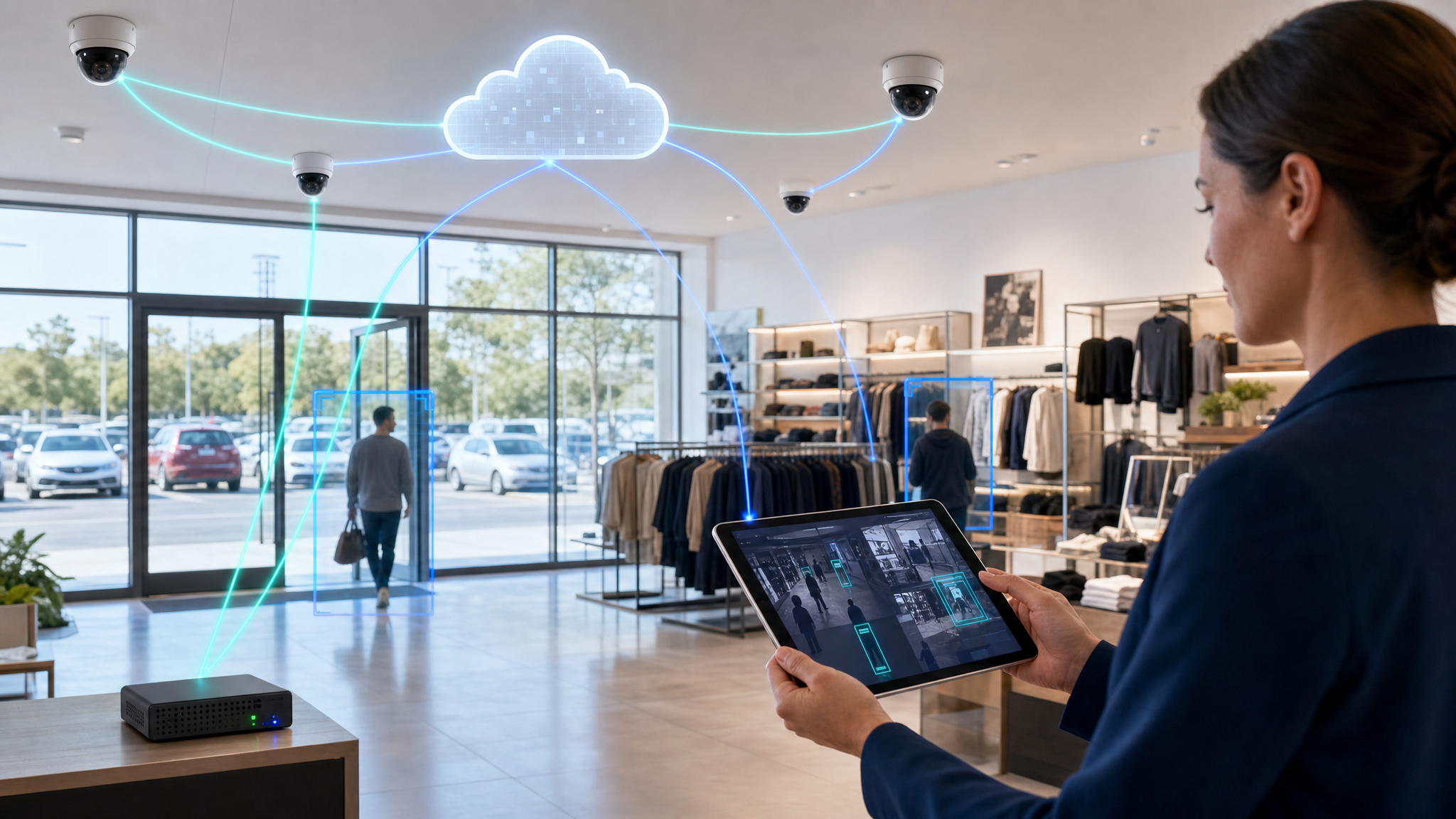


Cloud vs on-prem video security for retail: a 2026 decision framework for multi-store loss prevention
If you lead loss prevention across dozens or hundreds of stores, the cloud vs on-prem video security question lands on your desk constantly, usually framed as a binary you have to win. It rarely is. The National Retail Federation reports that retailers saw a 93% increase in the average number of shoplifting incidents per year in 2023 compared to 2019, alongside a 90% increase in the dollar value of associated losses (Source: NRF). With theft pressure climbing and organized retail crime spreading across markets, the better question is not "cloud or on-prem" but "which loss prevention workflows belong in the cloud, which must stay at the edge, and where does hybrid win." This article gives you a practical framework to decide.
Key takeaways
- Most multi-store retailers should not pick a single winner. Map workflows first, then route each one to cloud, edge, or hybrid.
- Cloud video security wins on remote access, centralized user management, multi-store search, and faster clip sharing for investigations.
- On-prem video security wins on local recording continuity during internet outages and full local control of footage.
- Hybrid edge-to-cloud video security keeps full-resolution recording and real-time detection local while sending only metadata and key clips to the cloud.
- Camera-agnostic AI layers let you modernize existing store and parking-lot cameras without a rip-and-replace project.
Why the cloud vs on-prem framing is the wrong starting point
Shrink is not a single problem with a single fix. McKinsey notes that unknown loss is typically split between theft and process errors, and that the balance has shifted post-COVID toward theft, closer to 60% of unknown loss (Source: McKinsey). That mix matters for architecture. A camera watching a self-checkout lane needs low-latency detection at the edge. A district investigation into a repeat offender needs cloud-style search across many stores. One architecture label cannot serve both jobs well.
Organized retail crime raises the stakes further. The U.S. Chamber of Commerce reports that organized retail crime cost stores an average of more than $700,000 per $1 billion in sales in 2020, more than a 50% increase over the prior five years (Source: U.S. Chamber of Commerce). Building a prosecutable ORC case means correlating incidents across locations and time. That is a cloud-visibility job. Keeping the raw source footage intact for a forensic review is an edge job. So the real decision is about workflows, not technology labels.
Key terms
- Cloud video security: cameras stream to a cloud-hosted video management system where recording, retention, search, and user access live in remote data centers.
- On-prem video security: recording, storage, and most analytics run on local NVRs or appliances inside each store, with access often limited to in-store or VPN connections.
- Hybrid edge-to-cloud video security: full-resolution video stays on local hardware for resilience and real-time detection, while only metadata, alerts, and selected clips sync to the cloud for centralized oversight.
- Camera-agnostic: a platform that works with existing IP cameras from many vendors (any ONVIF device), so there is no rip-and-replace.
Defining the three architectures in plain retail terms
Cloud video security for retail
In a cloud model, store cameras connect to a cloud video management system, and core functions like retention, permissions, and search live in remote data centers. For a multi-store retailer, this consolidates feeds from many locations into one interface your team reaches from a browser or phone. That centralization is the draw: regional managers and LP investigators review incidents, run forensic searches, and manage access from anywhere. The tradeoffs are recurring storage costs, uplink bandwidth demand, and reliance on store internet for recording in a pure-cloud design.
On-prem video security for retail
On-prem keeps recording and storage on dedicated hardware inside each store, typically an NVR connected to IP cameras. Its strongest advantage is continuity: local recorders keep writing to disk even when the internet drops, which matters for overnight burglaries and back-door intrusions. The cost is operational. Each location can become a silo, so cross-store investigations slow down, remote access is limited, and configurations drift store to store. For a portfolio of 80 or 800 sites, that fragmentation adds up.
Hybrid edge-to-cloud video security
Hybrid keeps recording and real-time AI inference local while using the cloud for visibility, search, alerts, and collaboration. Edge appliances pull streams from multiple cameras and process frames inside the store, so only structured data and selected clips cross the network. This keeps bandwidth manageable and reduces privacy exposure, because continuous raw video does not leave the building. For distributed retailers with uneven connectivity, this is often the most practical path.
The evaluation criteria that actually move LP outcomes
Skip the spec sheets and judge each architecture against the metrics your team is measured on. The criteria below map to real loss prevention KPIs:
- Shrink reduction potential: can the system detect and document theft, fraud, and process loss across all store formats.
- Investigation speed: how fast you move from incident to evidence to case closure, especially across multiple stores.
- Real-time detection and deterrence: can staff intervene during an event, not just review it afterward.
- Uptime during internet outages: which incidents are intolerable to miss if connectivity drops.
- Bandwidth consumption: whether continuous streaming competes with point-of-sale and inventory traffic.
- Retention and evidence access: how quickly authorized stakeholders retrieve footage for auditors, insurers, or courts.
- Compliance and privacy controls: access logs, retention rules, and PCI-clean handling of footage near payment areas.
- Multi-store administration: centralized permissions, consistent configuration, and district-level visibility.
- Camera compatibility: whether the system reuses existing cameras and cabling.
- Total cost of ownership: hardware, subscriptions, IT labor, and the cost of slow investigations over a multi-year horizon.
Cloud vs on-prem vs hybrid: a side-by-side comparison
The table below compares the three architectures against the criteria that matter most for multi-store loss prevention. Spot AI sits in the hybrid column because its design keeps full-resolution video on-prem while routing metadata to the cloud.
| Decision criterion | Cloud video security | On-prem video security | Hybrid edge-to-cloud (Spot AI approach) |
|---|---|---|---|
| Primary recording location | Cloud data centers via IP streaming | Local NVR or DVR in each store | Full-resolution video stays local; only metadata syncs |
| Outage resilience | Dependent on connectivity; may buffer locally | High; recording continues locally | High; local-first recording with delayed cloud sync |
| Real-time detection latency | Higher; frames travel to cloud and back | Low for local use cases | Low; edge inference processes frames in-store |
| Multi-store search and access | Native via web and mobile | Limited; often per-recorder or VPN | Native cloud search with local access available |
| Bandwidth burden | High; continuous streaming | Low; footage stays local | Low; metadata-only across the network |
| Camera compatibility | Varies by platform | Tied to recorder support | Camera-agnostic; works with any ONVIF IP camera |
When cloud is a strong fit, and when on-prem still makes sense
Cloud-leaning designs shine when remote visibility and centralized management drive your KPIs. If your team spends hours logging into individual store recorders to pull clips, the cloud model collapses that into one search. It also simplifies onboarding new stores, where adding a location is largely configuration rather than a hardware project.
On-prem still earns its place where any missed footage carries serious legal or operational consequences and connectivity is unreliable. Stores in older buildings or rural markets, or sites with expensive uplinks, may not support continuous high-resolution streaming without crowding out point-of-sale traffic. In those cases, local recording is non-negotiable for the cameras that protect entrances, back doors, and cash areas.
Why hybrid is the safer default for distributed retailers
For most multi-store operators, hybrid edge-to-cloud video security balances the tradeoffs better than either extreme. McKinsey advises that "all stores are not created equal" and recommends rating stores for risk and hardening targets accordingly (Source: McKinsey). Hybrid supports exactly that. High-risk urban stores can run heavier edge AI and longer local retention, while lower-risk sites use lighter analytics, all managed from one cloud pane.
Spot AI is built on this hybrid foundation. Its video AI platform uses a hybrid edge-to-cloud architecture where an Intelligent Video Recorder keeps full-resolution footage inside the store and sends only metadata across the network, which keeps deployments PCI-clean and low-bandwidth. The AI Security Guard turns existing store and parking-lot cameras into AI coworkers that detect incidents in context, deter through talk-down, lights, and sirens, and document case-ready, timestamped evidence in one connected system. Because the platform is camera-agnostic, there is no rip-and-replace, and most sites go live in days.
How architecture choices show up in real LP results
All Star Elite, which operates 80 retail locations in shopping centers across the United States, illustrates what centralized visibility plus local control can do for loss prevention metrics. After deploying Spot AI's unified video and analytics platform, the company reduced cash shrink from 6% to 1% and merchandise shrink from 10 to 15% down to roughly 6%. The team also improved investigation efficiency by over 50% using centralized case management and AI search, and cut law enforcement case timelines from 2 to 3 months down to 1 month.
"The ability to formalize our incident reporting, have all our cases on one database, and attach videos to those cases has been a game changer. Cameras, case management, and people counting, it's great having that all in one system."
Andrew Gonzalez, Corporate Director of Loss Prevention and Safety, All Star Elite
You can read the full All Star Elite customer story for the deployment detail behind those numbers.
A practical sequence for choosing your architecture
Rather than starting with a vendor or a label, work through these steps in order:
- Map your highest-shrink stores, your most common incident types, and the bottlenecks in your current investigation workflow.
- Flag the cameras where missed footage is intolerable, and route those to local-first recording.
- Identify the workflows that need cross-store correlation, such as ORC pattern recognition, and route those to cloud visibility.
- Check store-by-store bandwidth and connectivity, and avoid any design that forces continuous cloud streaming where uplinks cannot support it.
- Confirm camera compatibility so you reuse existing hardware instead of replacing it.
- Model total cost of ownership over several years, including the cost of slow investigations, not just hardware and subscriptions.
Spot AI's pre-trained Video AI Agents cover security use cases like unauthorized entry, loitering, and after-hours intrusion, while context-aware detections cut through alarm noise so your team chases the events that matter. For perimeter and lot coverage, pole, wall, and trailer-mounted units extend visibility to remote areas without trenching across the whole site.
Want to pressure-test your current setup before you commit budget. See how Spot AI approaches cloud vs on-prem video security with a hybrid AI Security Guard layer, then assess your own video architecture and LP workflow gaps against the criteria above.
Frequently asked questions
Should retailers choose cloud or on-prem video security for multi-store loss prevention?
Most multi-store retailers should not choose one or the other outright. Map your loss prevention workflows first, then route low-latency detection and outage-critical recording to the edge, and route multi-store search, investigations, and centralized management to the cloud. A hybrid edge-to-cloud model usually delivers the strongest LP outcomes across a distributed portfolio.
What is the difference between cloud, on-prem, and hybrid video security for retail?
Cloud video security records and stores footage in remote data centers for easy remote access. On-prem video security keeps recording and storage on local hardware in each store for resilience and local control. Hybrid edge-to-cloud keeps full-resolution video and real-time AI inference local while syncing only metadata, alerts, and key clips to the cloud for centralized visibility.
When does a hybrid video security architecture make more sense than fully cloud or fully on-prem?
Hybrid makes the most sense for geographically distributed retailers with varied store risk profiles, uneven bandwidth, and compliance needs. It keeps recording local during internet outages and runs real-time detection at the edge, while still giving district teams centralized search and case management. McKinsey's guidance to rate stores by risk and harden accordingly aligns naturally with this flexible model.
How do bandwidth and uptime requirements affect retail video security architecture?
Streaming many high-definition feeds to the cloud consumes heavy uplink bandwidth that can compete with point-of-sale and inventory traffic. Pure-cloud recording also risks gaps if connectivity drops during an incident. A local-first hybrid design records on-prem, processes detection at the edge in low latency, and syncs to the cloud during off-peak hours to protect both continuity and network performance.
How can retailers modernize existing cameras with AI video security without replacing their entire system?
Use a camera-agnostic platform that ingests streams from existing IP cameras and adds AI analytics at the edge. This converts current cameras into real-time sensors without a rip-and-replace project. Spot AI works with any ONVIF IP camera, keeps full-resolution video on-prem, and most sites go live in days, so you can start with high-risk zones and scale.
About the author
Amrish Kapoor is VP of Engineering at Spot AI, leading platform and product engineering teams that build the scalable edge-cloud and AI infrastructure behind Spot AI’s video AI—powering operations, safety, and security use cases.

