




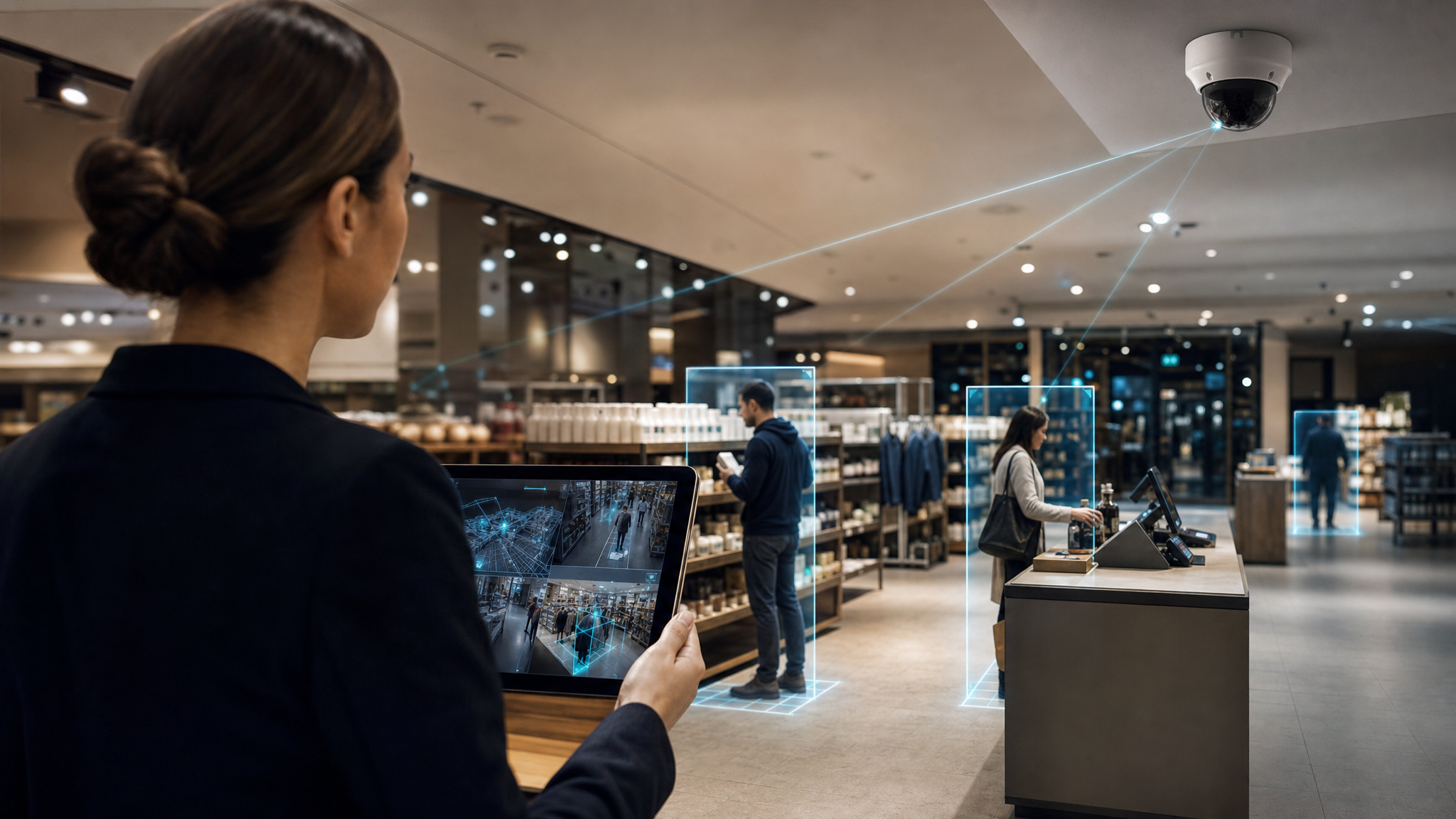


Commercial security camera systems: a 2026 buyer's guide for retail loss prevention
The best commercial security camera system for a retail business in 2026 is not the one with the most cameras or the highest resolution. It is the one that improves loss prevention outcomes: faster detection, real-time deterrence, and case-ready evidence your team can act on. That distinction matters more than ever. Retailers reported a 93% increase in the average number of shoplifting incidents per year in 2023 compared with 2019, alongside a 90% rise in associated dollar losses (Source: NRF). Meanwhile, workplace assaults per 10,000 full-time-equivalent workers climbed 62% between 2011 and 2021-22 (Source: EHS Today).
This guide compares the real system categories on the market, ranks the leading named platforms, and gives Directors of Loss Prevention a buyer-ready framework built around shrink reduction, investigation speed, and multi-site consistency.
Key takeaways
- Evaluate commercial security camera systems by loss prevention outcomes, not camera specs. Shoplifting incidents rose 93% and dollar losses rose 90% from 2019 to 2023 (Source: NRF).
- The five architectures to compare are legacy CCTV, cloud VMS, camera-bound analytics, remote guard monitoring, and Video AI Agents.
- Retailers can often add AI to the cameras they already own. Camera-agnostic, ONVIF-compatible platforms avoid a costly rip-and-replace.
- Prioritize context-aware detection, real-time deterrence actions, and searchable, timestamped video evidence for faster case resolution.
- Spot AI's AI Security Guard turns existing cameras into AI coworkers that detect in context, deter in real time, and build case-ready evidence.
Why the "best" commercial security camera system is defined by outcomes in 2026
For years, buying a commercial security camera system meant counting cameras, checking resolution, and choosing a recorder. That checklist misses the point in 2026. The threat has shifted from occasional shrink to organized, repeat, and increasingly violent incidents that passive recording does little to interrupt.
The numbers make the case. Shrink remains elevated relative to sales for surveyed retailers, with shoplifting, employee theft, and organized retail crime cited as leading drivers (Source: NRF). Total industry returns are projected to reach $849.9 billion in 2025, with an estimated 19.3% of online sales returned, a volume that hides a meaningful layer of return fraud (Source: NRF). More cameras alone do not touch those loss channels.
Industry research points the same direction. Security trade coverage of the future of video security emphasizes a move toward intelligent, scalable, integrated platforms rather than stand-alone cameras and DVRs (Source: Security Magazine). The practical translation for a Director of Loss Prevention: judge every system on how much it shortens the distance from event to detection to resolution.
That means measuring candidates against operational KPIs, not spec sheets. Incident response time. Case assembly time. False alarm volume. Apprehension support. Insurance and liability documentation. Guard spend efficiency. A commercial-grade security camera system earns its budget when those numbers move.
Key terms
- Video AI Agents: software coworkers that watch camera feeds around the clock, detect events in context, and trigger actions such as alerts or deterrence, rather than only recording for later review.
- Camera-agnostic (ONVIF) platform: a system that works with existing IP cameras from many manufacturers using the open ONVIF standard, so there is no rip-and-replace.
- Intelligent Video Recorder (IVR): an on-prem appliance that keeps full-resolution video inside the store so only metadata crosses the network, which keeps deployments fast and PCI-clean.
- Case-ready evidence: searchable, timestamped video packaged with incident context so LP investigators can resolve and share cases quickly.
The five commercial security camera system categories, compared
Retail loss prevention teams are really choosing among five architectures. Each performs differently on detection, deterrence, evidence quality, scalability, and IT burden.
- Legacy CCTV and on-prem NVR: reliable local recording, but built for post-incident review. Remote access, analytics, and integration are limited, and pulling case footage is manual and slow.
- Cloud VMS: centralizes storage and gives multi-site remote viewing through a browser. It improves visibility and management, though basic cloud VMS still leans on people to watch and interpret feeds.
- Camera-bound analytics: pushes detection onto the camera itself. This reduces bandwidth, but ties intelligence to specific hardware and can fragment capabilities across camera models.
- Remote guard monitoring: adds human review of live feeds. It can extend after-hours coverage, but scales as a labor cost and often lacks store-level context.
- Video AI Agents: continuous, software-driven analysis across every stream. AI agents detect events in context, trigger real-time deterrence, and package searchable evidence, connecting video to broader loss prevention workflows.
The evidence favors hybrid approaches. Analysis of retail loss prevention trends notes that retailers facing organized retail crime are augmenting conventional surveillance with video analytics and AI to flag anomalous behavior and support faster response (Source: Security Magazine). In practice, the strongest 2026 setups combine cloud management, camera-agnostic AI, and targeted remote monitoring over the cameras a retailer already owns.
Before you compare vendors, map your current camera estate. If your cameras are IP-based and ONVIF-compatible, a camera-agnostic platform can often layer AI on top of them, which sidesteps a full rip-and-replace and gets sites live in days rather than months.
Best commercial security camera systems for retail in 2026: ranked comparison
The table below ranks leading named commercial security camera systems on the criteria that matter to loss prevention: working with existing cameras, AI context detection, real-time deterrence, evidence workflows, multi-site scalability, and integrations. Spot AI is listed first because it is built around AI Security Guard: detect in context, deter in real time, and produce case-ready evidence. Competitor details reflect only what each vendor publicly specifies; anything not confirmed is marked accordingly.
| System | Deployment | Works with existing cameras | AI / analytics | Real-time deterrence | Evidence workflow | Notable integrations |
|---|---|---|---|---|---|---|
| Spot AI (AI Security Guard) | Cloud platform with hybrid on-site intelligent video recorders that connect existing cameras to the cloud. | Yes. Third-party and ONVIF-compatible, designed to work with existing IP cameras rather than proprietary hardware. | AI analytics including activity search, object and person detection, configurable alerts, and automated incident creation with contextual focus. | Configurable alerts and automated incident creation support real-time response workflows. | Automated incident creation with video attachments to link events to cases. | Point-of-sale, access control, and collaboration tools. |
| Verkada | Cloud platform with on-camera solid-state storage plus cloud management and archiving. | Primarily proprietary cameras; third-party support is limited and generally requires specific configurations or bridge devices. | Built-in analytics including motion search, people and vehicle detection, occupancy trends, and automated alerts. | Automated alerts. | Not publicly specified. | Access control, environmental sensors, and alarms within its ecosystem, plus APIs. |
| Avigilon (Motorola Solutions) | On-premises and hybrid via Avigilon Control Center, with cloud connectivity in certain lines. | Supports its own cameras and, through its VMS, a range of third-party and ONVIF-compliant cameras. | Object classification, appearance search, unusual motion detection, and self-learning analytics. | Not publicly specified. | Appearance search supports investigation. | Access control, alarm panels, and Motorola Solutions platforms. |
| Genetec Security Center | On-premises and hybrid unified platform, with cloud services such as Stratocast. | Broad third-party camera support, including ONVIF-compliant devices. | Motion detection, object tracking, and situation management, with optional advanced analytics modules. | Not publicly specified. | Situation management supports case handling. | Unified video, access control, license plate recognition, and extensive APIs. |
| Rhombus Systems | Cloud platform with edge storage on cameras and centralized cloud management. | Primarily proprietary cameras; ONVIF or third-party support described in documentation where available. | People and vehicle detection, occupancy metrics, and behavioral alerts. | Behavioral alerts. | Not publicly specified. | Access control, alarms, and business applications through APIs and connectors. |
| Hanwha Vision Wisenet | On-premises and hybrid via NVRs and VMS software, with emerging cloud connectivity. | Supports its own cameras and, via ONVIF and VMS platforms, a range of third-party IP cameras. | Camera-embedded motion detection, object classification, face detection, and AI-based event filtering. | Not publicly specified. | Not publicly specified. | Access control and third-party VMS platforms via standard protocols. |
The pattern is clear. Cloud-native and hybrid platforms consolidate multi-site management, while the biggest divide is whether a system works with the cameras you already own or expects you to standardize on its hardware. For a Director of Loss Prevention weighing total cost of ownership, that difference alone can reshape a rollout budget. You can see how Spot AI approaches this in the Spot AI platform overview.
Can retailers add AI without replacing existing cameras
Yes, and for most multi-location retailers this is the pragmatic path. Modern video analytics are designed as a software layer that ingests feeds from existing cameras, provided those cameras meet reasonable quality and connectivity standards. Security coverage of retail video analytics notes that these tools can reduce shrink by alerting personnel to suspicious transactions and activity, while cutting many of the false alarms that erode staff responsiveness (Source: Security Magazine).
Consulting research supports the same approach. McKinsey's work on scaling AI in retail stresses integrating AI into existing processes and infrastructure rather than pursuing disruptive overhauls (Source: McKinsey). Deloitte's retail outlook similarly advocates pragmatic modernization that builds on legacy systems (Source: Deloitte).
This is where a camera-agnostic architecture earns its keep. Spot AI works with any IP camera and connects existing cameras through an on-prem intelligent video recorder, keeping full-resolution video inside the store while only metadata crosses the network. That keeps deployments fast, secure, and PCI-clean. It also means an AI Security Guard becomes an AI coworker on the cameras you already installed, not a reason to trench new cable. Learn more about how AI Security Guard layers onto an existing estate.
Retail use cases where a commercial security camera system earns its budget
The right system pays for itself where retail loss actually happens. These are the scenarios where context-aware detection, real-time deterrence, and case-ready evidence translate into measurable results.
- Store perimeter and parking lot security: outdoor coverage of entrances, loading docks, and lots is a common entry point, using pole, wall, and trailer-mounted units where fixed cameras fall short.
- Point-of-sale and returns desk monitoring: linking video to transaction data helps flag refund fraud and abusive returns inside the projected $849.9 billion return volume (Source: NRF).
- Internal theft investigation: searchable, timestamped clips tied to cases shorten investigations and support HR and legal follow-up.
- Organized retail crime deterrence: context-aware detection can surface loitering, repeat activity, and suspicious behavior so teams respond while it still matters.
- Associate safety: reliable coverage of high-risk areas supports violence prevention, a growing concern as workplace assaults climbed 62% over a recent decade (Source: EHS Today).
One retail loss prevention team shows what this looks like in practice. All Star Elite cut cash shrink from 6% to 1% using Spot AI and improved investigation speed by 50%, while consolidating cameras, case management, people counting, and incident reporting in one system.
"The ability to formalize our incident reporting, have all our cases on one database, and attach videos to those cases has been a game changer. Cameras, case management, and people counting, it's great having that all in one system."
Andrew Gonzalez, Corporate Director of Loss Prevention and Safety, All Star Elite
Read the full Spot AI customer stories to see how loss prevention teams put these outcomes to work.
Tie every evaluation to a KPI you can defend to finance. All Star Elite reduced cash shrink from 6% to 1% and sped investigations by 50% with Spot AI. Numbers like these build the business case far better than camera counts do.
What a commercial security camera system costs for a multi-site retailer
There is no single sticker price, because cost depends on how a system is architected and how much loss it offsets. The evidence base does not publish universal benchmarks, but it does define the drivers a Director of Loss Prevention should model.
Break commercial security camera systems cost into five components:
- Hardware: cameras, recorders, and networking. Reusing existing cameras removes the largest line item for many retailers.
- Software: video management and AI analytics licensing, typically subscription-based.
- Deployment and installation: cabling, configuration, and training. Extending visibility to remote outdoor zones can save on trenching when done with the right mounts.
- Operations: monitoring coverage, investigation labor, and maintenance across sites.
- Cybersecurity and compliance: access controls, audits, and data governance, which grow as connected cameras expand the attack surface (Source: World Economic Forum).
Weigh those costs against what the system offsets. Deloitte and McKinsey both stress tying technology spend to defined use cases with measurable impact rather than treating it as generic overhead (Source: Deloitte; Source: McKinsey). Given that shoplifting dollar losses rose 90% between 2019 and 2023, even modest shrink reductions across many stores can justify a higher-capability platform (Source: NRF). Systems that layer AI onto existing cameras and manage sites from the cloud often lower total cost of ownership by reducing both hardware and IT burden.
A procurement checklist for loss prevention leaders
Use these questions to pressure-test any commercial security camera system before you sign, and to align operations, IT, finance, and executives around one decision.
- Does it work with our existing IP and ONVIF cameras, or does it require replacing them?
- Does the AI detect events in context, or does it only push generic motion alerts?
- Can it trigger real-time deterrence actions, such as talk-down, lights, or sirens, when an event is detected?
- How fast can our team assemble case-ready, timestamped video and attach it to an incident?
- Does it centralize multi-site viewing, cases, and reporting in one platform for remote oversight?
- How does it keep video secure, and does it meet standards such as SOC 2 and NDAA compliance?
- Does it integrate with our POS, access control, and communication tools?
- What is the deployment timeline, and can sites go live in days rather than months?
Any strong 2026 answer will emphasize working with existing cameras, context-aware detection, real-time deterrence, and clean evidence workflows. For a broader view of how AI coworkers apply across retail security, browse the Spot AI blog.
The recommendation for retail loss prevention teams in 2026
For a Director of Loss Prevention who needs faster detection, real-time deterrence, and case-ready evidence across many stores, the strongest fit is a camera-agnostic Video AI platform that runs on the cameras you already own. Legacy CCTV and basic cloud VMS still leave your team watching and rewinding. Camera-bound analytics tie intelligence to specific hardware, and remote guard monitoring scales as pure labor cost.
Spot AI's AI Security Guard sits in the category the evidence favors: hybrid cloud management, camera-agnostic AI, and an integrated evidence workflow. It detects in context, deters in real time with actions such as talk-down and lights, and turns feeds into searchable, timestamped cases that shorten investigations. Because it works with existing ONVIF cameras and most sites go live in days, it augments your team without a rip-and-replace.
Ready to see how your current cameras become AI coworkers for loss prevention? Book a demo and we will run AI Security Guard on your own retail video, then map the shrink and investigation-time wins to a business case your CFO will recognize.
Frequently asked questions
What is the best commercial security camera system for a retail business in 2026
The best system is the one that improves loss prevention outcomes, not the one with the most cameras or highest resolution. In 2026, that means a platform with context-aware AI detection, real-time deterrence, searchable case-ready evidence, and multi-site cloud management. Because shoplifting incidents rose 93% from 2019 to 2023, systems that shorten the path from event to resolution deliver the strongest return (Source: NRF).
How should retail teams compare CCTV, cloud VMS, remote monitoring, and AI camera systems
Compare them on real-time deterrence, AI context detection, compatibility with existing cameras, evidence workflows, multi-site scalability, IT burden, and integrations. Legacy CCTV excels at basic recording but lacks analytics and remote access. Cloud VMS centralizes management, while Video AI Agents add continuous, software-driven detection and deterrence that connect video to loss prevention workflows.
Can a retailer add AI without replacing existing cameras
Yes. Camera-agnostic, ONVIF-compatible platforms ingest feeds from existing IP cameras and apply AI analytics as a software layer. The main requirements are adequate image quality, field of view, and network connectivity. This overlay approach lets retailers modernize without a full hardware refresh, which McKinsey and Deloitte both recommend as a pragmatic modernization path (Source: McKinsey).
How much do commercial security camera systems cost for multi-site retail
Cost depends on hardware reuse, camera count, storage model, installation, monitoring coverage, AI licensing, and integration needs. There is no universal benchmark, so model total cost of ownership over several years against projected reductions in shrink, fraud, and investigation labor. Reusing existing cameras and managing sites from the cloud often lowers both hardware and IT costs.
What features matter most for reducing shrink and producing case-ready evidence
Prioritize context-aware detection, real-time alerts, integration with POS and access control, and deterrence actions such as talk-down and lights. For evidence, look for timestamped clip retrieval, incident tagging, secure sharing, and audit trails. These functional capabilities matter more than raw resolution, which only helps insofar as it supports clear detection and documentation.
About the author
Rish Gupta is CEO and Co-founder of Spot AI, leading the charge in business strategy and the future of video intelligence. With extensive experience in AI-powered security and digital transformation, Rish helps organizations unlock the full potential of their video data.

