




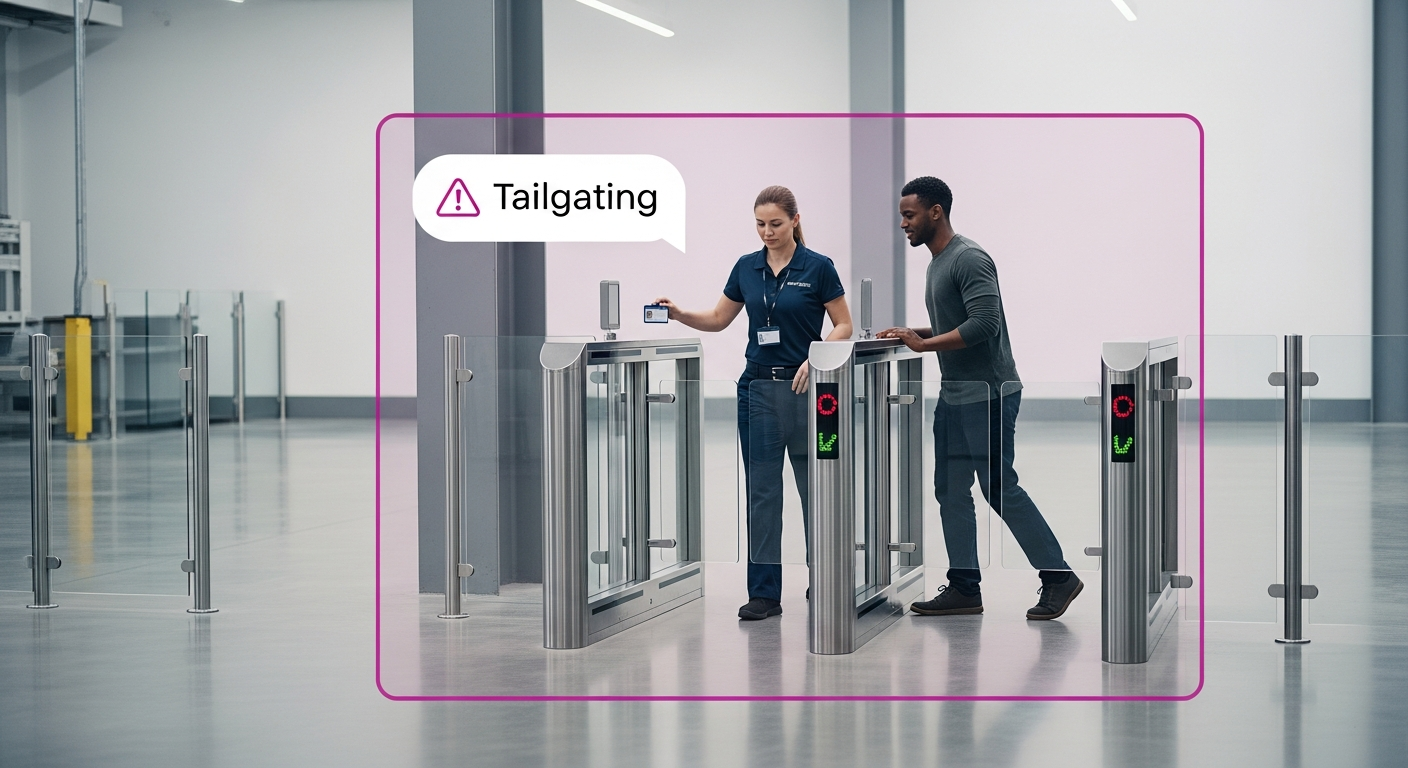


Tailgating represents one of the most persistent yet often underestimated security vulnerabilities in manufacturing facilities. While often dismissed as a simple courtesy—holding the door for a colleague—it creates physical access control failures that can directly compromise operational technology (OT) infrastructure, expose proprietary production processes, and create pathways for both insider threats and external adversaries.
For teams managing converged IT/OT environments, the obstacle extends beyond locking doors. It involves protecting critical manufacturing assets from cyber risks while maintaining the operational continuity that defines manufacturing success. Unauthorized access through tailgating can result in production disruptions, intellectual property theft, and safety hazards, with the average cost of a data breach reaching $4.45 million (Source: Varonis).
Understanding the basics
Before exploring specific solutions, it is helpful to define the core concepts regarding secure entry points in industrial settings.
Tailgating (Piggybacking): a form of social engineering where an unauthorized individual gains access to a restricted area by following an authorized person through a controlled access point without presenting their own credentials.
OT (Operational Technology): hardware and software that detects or causes a change through the direct monitoring and/or control of physical devices, processes, and events in the enterprise.
IT/OT Convergence: the integration of information technology (IT) systems with operational technology (OT) systems, creating a unified environment that requires integrated security strategies.
IEC 62443: a series of standards that address cybersecurity for industrial automation and control systems, including physical access requirements.
Addressing the security vs. continuity dilemma
Professionals responsible for industrial networks and physical security face a distinct set of frustrations. You are tasked with designing and maintaining infrastructure that protects PLCs, SCADA systems, and manufacturing networks, yet you must ensure these measures never disrupt production.
The following roadblocks often hinder the implementation of effective tailgating detection for secure entry points in manufacturing facilities:
Inability to connect security systems with OT infrastructure: legacy video systems often operate in isolation from Manufacturing Execution Systems (MES) and other OT platforms. This creates blind spots where operational and security data cannot be correlated for comprehensive incident detection.
Balancing security requirements with production continuity: every security measure must be weighed against potential production impact. There is constant tension between implementing reliable security controls and maintaining the operational efficiency that drives profitability.
Conducting risk assessments in live production environments: security assessments must be performed without disrupting manufacturing processes. Teams need specialized tools that can evaluate vulnerabilities without triggering production stoppages or safety system alarms.
Managing converged IT/OT environments: daily coordination is required between IT and OT teams with different priorities. IT prioritizes confidentiality, while OT prioritizes availability and safety, requiring constant negotiation in security implementations.
Budget constraints for security improvements: despite growing risks, teams often struggle to justify investments in new security technologies without clear ROI data, especially when competing against projects with direct production benefits.
How Spot AI addresses these pain points
Unified operational view: to overcome the inability to connect with OT infrastructure, Spot AI delivers API-based connectivity that enables reliable communication between various platforms. This provides a consolidated operational view while maintaining network segmentation.
Air-gapped security monitoring: to balance security with production continuity, Spot AI’s cloud-native architecture with on-premise bridge hardware enables security monitoring without touching critical OT networks directly. This maintains air-gap protection while delivering advanced analytics.
Non-disruptive assessments: to conduct risk assessments without disruption, Spot AI’s passive video monitoring identifies security vulnerabilities and compliance gaps without any impact on production systems or network performance.
Centralized management: to manage converged IT/OT environments effectively, Spot AI’s unified dashboard provides a central view across sites while respecting the unique requirements of each environment.
Evidence-backed outcomes: to illustrate potential value from security investments, Spot AI reports metrics like an estimated 40–60% faster incident identification (Source: Spot AI internal data) and support for minimizing the risk of downtime events that can cost thousands per minute (Source: Wavestore).
The operational impact of tailgating in manufacturing
Tailgating in manufacturing manifests in distinct forms that pose specific operational risks. Unlike office environments where unauthorized entry might lead to data theft, manufacturing breaches integrate physical and digital security risks directly into production processes.
Types of tailgating risks
Employee tailgating: legitimate staff members hold doors open for colleagues, inadvertently bypassing credential verification. This creates accountability gaps.
Contractor or vendor tailgating: unauthorized individuals enter during normal business operations by following authorized personnel. This grants potential access to production areas, quality control laboratories, or maintenance zones where sensitive processes reside.
Vehicle-based tailgating: unauthorized vehicles follow authorized logistics trucks through automated gates, creating inventory loss risks in warehousing and distribution areas.
Consequences of unauthorized entry
When an unauthorized individual gains entry to a production floor, the consequences can be significant. Potential impacts include equipment tampering that goes undetected until production quality degrades, theft of materials, or the installation of unauthorized monitoring devices.
Research from the SANS Institute indicates that over one-fifth of organizations reported cybersecurity incidents in the past year, with 40 percent causing operational disruption (Source: SANS Institute). In manufacturing, the convergence of tailgating vulnerability with insider risk means that physical access control is a critical control protecting operational continuity.
Detection technologies for secure entry points
Effective tailgating detection systems augment traditional access control by monitoring the physical flow of individuals through access points.
Video analytics and AI-powered detection
Modern video AI analytics platforms utilize neural networks trained on millions of images to distinguish between authorized entries and tailgating events. These systems process live video streams to identify patterns such as "two individuals detected entering through single credential."
Key capabilities of AI detection include:
Context-aware identification: machine learning algorithms distinguish between a single authorized entry and simultaneous tailgating (multiple people entering on one credential).
Behavioral pattern recognition: advanced analytics identify patterns suggesting organized tailgating, such as the same individual appearing on video entering through multiple different credentials.
Real-time alerting: AI platforms send timely alerts to security personnel with timestamps and video clips, enabling a faster response.
Physical infrastructure and sensor integration
While video analytics offers sophisticated detection, physical infrastructure provides complementary mitigation.
Revolving doors and man-traps: these physical solutions confine individuals briefly between two sets of doors, ensuring only one person transits at a time.
Infrared motion sensors: also known as request-to-exit (REX) sensors, these detect motion and can alert when movement occurs without a corresponding credential event.
Acoustic detection: systems that identify sounds associated with tailgating, such as doors being propped open or multiple footsteps during a single access event.
Strategies for mitigating tailgating in factories
Mitigating tailgating requires access control design that accounts for the operational realities of production facilities, including high-traffic shift changes and contractor access.
1. Layered verification and multi-factor authentication
Multi-factor authentication (MFA) in physical access control guards against successful tailgating. This involves combining a credential (card or mobile) with a secondary verification factor.
Biometric verification: fingerprint or facial recognition provides rapid verification that maintains production workflow while ensuring the credential holder is the person accessing the facility.
Step-up authentication: dynamic MFA approaches increase required factors based on risk. For example, access to sensitive process engineering areas may require a badge plus biometric verification, whereas general entry requires only a badge.
2. Visitor and contractor management
Manufacturing facilities frequently host non-employees. Comprehensive visitor management platforms create credentialing processes that parallel employee standards.
Temporal restrictions: contractor credentials function only during scheduled work times, automatically expiring at the end of the day.
Geographic restrictions: access is limited to specific areas relevant to the work assignment, such as mechanical rooms, barring entry to production floors.
3. Employee training and culture
Security awareness training programs should include specific instruction on tailgating vulnerability. Incorporating scenario-based learning can make these programs more effective than generic briefings. Employees must understand that challenging unauthorized individuals is a core responsibility that protects the facility and their colleagues.
Compliance and OT security standards
Manufacturing facilities, particularly those in critical infrastructure, operate under strict compliance frameworks.
IEC 62443 and OT security
The IEC 62443 standard requires facilities to implement physical access controls that guard against unauthorized individuals accessing critical OT components (Source: Industrial Cyber). Unauthorized physical access to PLCs or sensor networks can allow adversaries to modify operational parameters or install malware.
NIST and regulatory requirements
NIST frameworks (SP 800-171 and SP 800-53) require access control measures commensurate with information sensitivity. For manufacturers holding ITAR-controlled technical data, access must be restricted to U.S. persons, prohibiting foreign national access regardless of credential authorization.
Audit readiness
Compliance requires comprehensive documentation. Facilities must maintain audit logs of every access control event and incident. Organizations demonstrating consistent incident documentation and responsive follow-up achieve more favorable audit findings.
Unifying OT and IT security
The convergence of IT and OT networks means tailgating mitigation is a critical cybersecurity control. According to the SANS Institute, approximately 72 percent of industrial cybersecurity incidents originate in the IT environment, but the path to OT compromise often utilizes physical access to install persistence mechanisms (Source: SANS Institute).
Unified access control architecture
Effective mitigation requires connecting the physical access control system (PACS) with IT authentication systems. This creates a single-source identity across all domains.
Identity and Access Management (IAM): modern IAM platforms serve as authoritative directories, automatically updating physical access rights when employee roles change.
Context-aware decisions: this connection enables the system to flag anomalous behavior. For example, if an employee attempts physical access at 2 AM when they typically work the day shift, the system can require additional verification.
Zero Trust physical access
Zero Trust principles apply equally to physical security. A Zero Trust model assumes no user is trustworthy by default and requires continuous verification. In manufacturing, this involves implementing access control at each critical zone—production entry, engineering offices, and clean rooms—rather than just the facility perimeter.
Comparison of tailgating detection solutions
When evaluating technologies for tailgating detection, it is essential to consider deployment speed, scalability, and how well the system integrates with existing infrastructure.
Solution provider | Primary advantages | Deployment & scalability | Manufacturing suitability |
|---|---|---|---|
Spot AI | Unified Video AI platform, camera-agnostic, rapid search, real-time AI alerts. | Typically live in under a week. Cloud-native dashboard scales across many sites. | High. Designed for operational efficiency and safety. Integrates with existing cameras. |
IntelliVision | Edge-ready modules, facial recognition, audio analytics. | Flexible (camera, server, cloud). May require developer effort. | Moderate. Good for specific edge cases but may lack unified operational view. |
Agent Vi | Cloud or on-premise flexibility, open API. | Scalable but may require infrastructure for on-premise use. | Moderate to high. Good for large-scale deployments needing VMS integration. |
PureTech Systems | Perimeter defense specialist, geospatial analytics. | Deploys on edge/server/cloud. Focuses on perimeter. | High for perimeter security, less focused on internal operational flows. |
Eagle Eye Networks | Cloud VMS, open API, remote management. | Scalable cloud-first approach. Requires separate analytics tools. | Moderate. Strong VMS but relies on connections for advanced analytics. |
ROI of tailgating detection systems
Developing a business case for tailgating detection requires quantifying benefits in financial terms.
Direct and indirect savings
Avoided incident costs: for example, if a facility experiences two major unauthorized access incidents annually costing $150,000 each, reducing this frequency creates direct savings of $300,000 annually (Source: Wavestore).
Operational continuity: reducing the risk of downtime events helps avoid costs that can reach $4,000 per minute in large plants (Source: Wavestore).
Insurance premiums: organizations implementing robust access control can qualify for lower insurance premiums, with some reporting savings of 10-15 percent (Source: ASI Systems Pro).
Measuring effectiveness
To sustain benefits, facilities should track key metrics:
Tailgating incidents detected and addressed: trend analysis over time.
False positive rate: percentage of alerts that do not correspond to actual unauthorized access.
Mean time to respond (MTTR): speed of incident response from detection to containment.
Unifying physical and digital security for manufacturing
In manufacturing, tailgating is a direct pathway to compromising operational technology and production integrity. As IT and OT environments converge, the physical security of entry points becomes inseparable from cybersecurity.
By implementing a comprehensive strategy that includes AI-powered detection, layered verification, and unified IT/OT governance, manufacturing leaders can protect their critical assets while maintaining operational efficiency. Moving from reactive monitoring to automated detection helps security teams respond faster, supporting safe and secure production.
For teams looking to enhance their security posture, the next step is to evaluate current vulnerabilities and consider how intelligent video platforms can bridge the gap between physical security and operational requirements.
See how Spot AI’s video AI platform detects tailgating and strengthens facility security. Request a demo to experience the technology in action.
Frequently asked questions
What are the best practices for mitigating tailgating in manufacturing?
Best practices include implementing layered verification (such as multi-factor authentication), utilizing AI-powered video analytics for real-time detection, establishing strict visitor management protocols, and conducting regular security awareness training for employees. Integrating physical access control with IT/OT security systems is also critical for comprehensive protection.
How do tailgating detection systems work?
Tailgating detection systems use sensors or video analytics to monitor access points. They compare the number of authorized credentials presented against the number of individuals detected passing through the entry. If a discrepancy is found (e.g., one badge scan but two people entering), the system triggers an alert to security personnel.
What technologies are available for tailgating detection?
Technologies range from infrared sensors and acoustic detection to advanced AI-powered video analytics. Video AI is increasingly preferred as it can distinguish between authorized entries and tailgating events with high accuracy, reducing false positives compared to simple motion sensors.
What are the compliance requirements for tailgating detection?
Compliance frameworks like IEC 62443 require physical access controls to protect OT systems. NIST standards (SP 800-171/53) mandate access control commensurate with data sensitivity. Additionally, OSHA regulations require mitigating unauthorized entry to hazardous areas to ensure worker safety.
How can organizations integrate IT and OT security measures?
Organizations can integrate IT and OT security by adopting a unified access control architecture. This involves connecting physical access control systems (PACS) with Identity and Access Management (IAM) platforms, ensuring that a single identity policy governs access to physical facilities, IT networks, and OT systems simultaneously.
About the author
Joshua Foster is an IT Systems Engineer at Spot AI, where he focuses on designing and securing scalable enterprise networks, managing cloud-integrated infrastructure, and automating system workflows to enhance operational efficiency. He is passionate about cross-functional collaboration and takes pride in delivering robust technical solutions that empower both the Spot AI team and its customers.






.png)
.png)
.png)