






Effective subcontractor management is the backbone of any successful construction project. Yet, coordinating multiple trades across dispersed sites often feels like a constant battle against rework, delays, and safety risks. When miscommunication accounts for 26% of all rework and companies with consistent quality standards see rework costs drop to under 5% of their budget, the path to profitability is clear (Source: PlanRadar). The hurdle lies in moving from reactive problem-solving to forward-looking performance improvement.
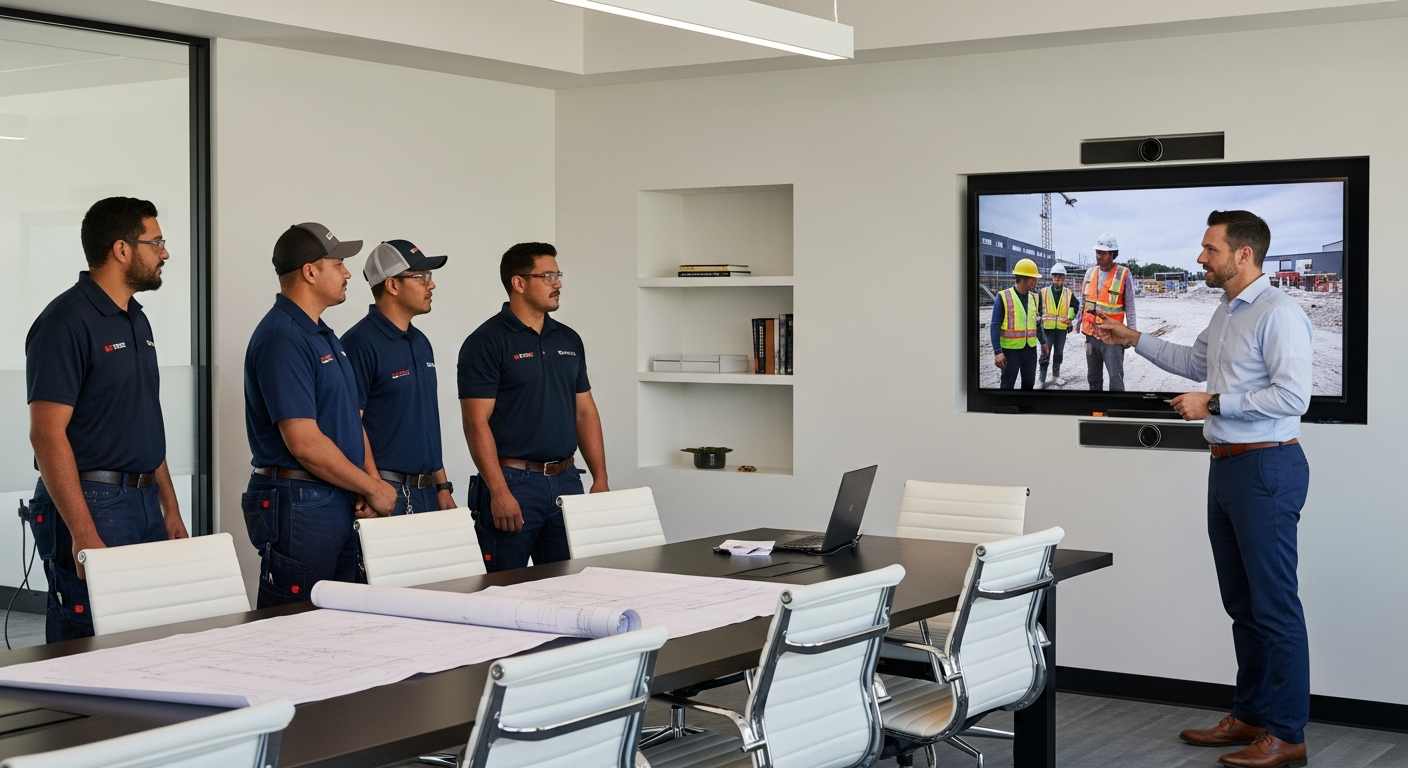
This is where video-based insights can help. By turning your existing site cameras into AI tools, you can build a clear framework for coaching and training subcontractors. This approach replaces subjective feedback with objective data, helping you support quality, maintain schedules, and encourage a strong safety and quality culture across job sites.
The daily reality of managing subcontractor performance
For construction managers, overseeing subcontractors is a complex balancing act. The pressure to maintain schedules, control costs, and ensure quality is immense, but the tools to do so are often inadequate. This leads to a series of recurring problems that directly impact project profitability and success.
Lack of real-time visibility across multiple sites: project managers waste hours driving between job sites for inspections and progress checks. This travel time limits their capacity to manage projects effectively and respond to emerging issues before they escalate.
Inadequate evidence for charge-backs and disputes: without timestamped visual proof, it's difficult to hold subcontractors accountable for damage, delivery discrepancies, or safety violations. This leaves general contractors to absorb costs that aren't their responsibility, directly eroding profit margins.
Time-consuming manual safety and compliance monitoring: relying on sporadic site walks to enforce safety protocols is inefficient and risky. The inability to automatically detect missing PPE or unauthorized access means managers are always a step behind, hoping incidents don't occur between visits.
Inability to verify work quality remotely: physically inspecting every phase of work across multiple sites is a logistical bottleneck. It limits oversight and creates delays in identifying quality issues, allowing small errors to compound into expensive rework.
Difficulty coordinating multiple subcontractors: managing the complex choreography of different trades is a major obstacle. Without real-time data, decisions about crew assignments, material deliveries, and resource allocation are based on outdated information, leading to costly inefficiencies.
Shifting from training to coaching with video-based insights
To address these pain points, it’s essential to distinguish between training and coaching. Training provides foundational knowledge on safety and procedures, often during onboarding. Coaching is an ongoing, dynamic process focused on improving performance through observation and real-time feedback. Video technology bridges this gap, creating a powerful mechanism for continuous improvement.
Video-based coaching uses footage of actual work to provide specific, evidence-based feedback. Instead of waiting for a quality issue to become rework, a manager can use a video clip to show a subcontractor exactly where a technique deviated from the standard. This transforms abstract feedback into a tangible learning opportunity.
With a unified Video AI platform, you can:
Deliver consistent training: use video modules for site-specific inductions, safety protocols, and quality standards, ensuring every subcontractor receives the same message.
Provide objective performance feedback: share timestamped clips of exemplary work or areas for improvement, turning coaching conversations into collaborative, data-driven discussions.
Benchmark performance: use video to establish a "gold standard" for specific tasks, giving crews a clear visual reference for what success looks like.
Accelerate problem-solving: quickly search for and review incidents, allowing you to understand the root cause of an issue in minutes, not hours of manual footage review.
How to implement a video-based coaching program
A successful video-based coaching program is built on a foundation of clear standards, consistent feedback, and a culture of improvement, not punishment. Here is a step-by-step framework for implementation.
Establish clear performance standards
effective coaching begins with defining what success looks like. Performance standards for quality, schedule, and safety should be specific, measurable, and documented. For example, instead of "maintain high quality," a standard should specify, "all mortar joints must have a consistent depth, with a measured deviation not exceeding 1/4 inch" (Source: Autodesk). Use video examples of exemplary work to provide a visual benchmark that all subcontractors can reference.Use video for onboarding and initial training
incorporate video into your subcontractor induction process. Use short, focused video modules to cover site-specific hazards, communication protocols, and safety procedures. This ensures every worker receives standardized information before setting foot on site. One global materials company found that AI-powered video training reduced their content time-to-market by 50%, demonstrating the efficiency of this approach (Source: Synthesia).Create a culture of coaching, not punishment
the goal of video monitoring should be to help teams improve, not to catch them making mistakes. Frame coaching as a collaborative effort to enhance safety and quality for everyone. When leaders champion transparency and accountability, subcontractors become more receptive to feedback and engaged in solving problems. Recognize positive performance publicly to reinforce desired behaviors and build motivation.Provide real-time feedback with video evidence
the power of video coaching lies in its immediacy. Use a platform that allows you to quickly find and share relevant clips. Instead of waiting for a weekly meeting, a supervisor can review footage from a shift and discuss specific instances with a crew while the context is still fresh. This is particularly effective for safety. A system that provides real-time monitoring of safety behaviors allows for on-the-spot correction, significantly mitigating accident risk and reinforcing an insight-driven safety culture (Source: struxhub.com).Establish feedback loops with performance dashboards
use dashboards to track key performance indicators (KPIs) like rework rate, schedule variance, and safety incidents. Sharing these dashboards with subcontractors creates transparency and turns performance discussions into objective, data-driven conversations. When a KPI trends in the wrong direction, use it as a trigger for a coaching conversation, leveraging video clips to explore the root cause and agree on a plan for improvement.
Key metrics for evaluating subcontractor performance
Tracking the right KPIs is essential for measuring the effectiveness of your coaching program. Firms that track KPIs weekly see up to 20% improvements in project efficiency (Source: vertaccount.com).
Key performance indicator (KPI) | Traditional challenge | How video-based insights drive improvement |
|---|---|---|
Rework Rate | Rework consumes 5-10% of total project costs, driven by miscommunication and quality issues (Source: PlanRadar). | Real-time verification of work against standards and AI-powered anomaly detection catch errors before they require costly rework. |
Safety Incident Rate | Manual monitoring misses unsafe behaviors, leading to avoidable incidents. Struck-by incidents are a recurring risk. | Automated detection of missing PPE and no-go zone violations provides timely alerts, helping teams intervene when risky conditions are observed. |
Schedule Performance | Delays cost 1-2% of project value per week and often stem from poor coordination and lack of progress visibility (Source: vertaccount.com). | Remote progress monitoring with time-lapse and live views allows managers to identify slippage early and take corrective action. |
Cost Performance | Inadequate evidence for charge-backs leads to margin erosion as general contractors absorb costs from damages or disputes. | Timestamped, searchable video provides objective, verifiable evidence for dispute resolution, supporting project profitability. |
Choosing the right platform for video-based coaching
Not all video systems are created equal. To enable effective coaching, cameras are only the first step; you need an intelligent platform that makes it easy to find and act on important events.
Capability | Spot AI | Traditional monitoring systems / point solutions |
|---|---|---|
Deployment & Setup | Plug-and-play hardware goes live in minutes, unifying all cameras on a single dashboard. | Requires complex, multi-vendor integration, often leading to lengthy and costly installation projects. |
Camera Compatibility | Camera-agnostic, works with most existing IP cameras, protecting your current hardware investments. | Often requires proprietary cameras, leading to vendor lock-in and expensive "rip-and-replace" projects. |
Ease of Use | An intuitive, searchable dashboard allows you to find events quickly, like a search across your job site cameras. | Clunky, outdated software requires hours of manually scrubbing through footage to find a single event. |
AI Capabilities | Pre-trained AI agents detect safety and operational events out of the box, such as missing PPE and no-go zone violations. | Limited or no AI capabilities, generating excessive false alarms from motion, weather, or animals. |
Scalability | A cloud-native architecture allows you to manage many sites and users from a single account without added complexity. | On-premise systems are difficult and expensive to scale across multiple locations, creating data silos. |
Improve subcontractor management with actionable insights
Shifting to a video-based coaching model moves your team from a reactive posture to a more proactive, data-driven one. It helps you standardize performance, minimize costly rework, and support safer job sites. By leveraging objective video evidence, you can turn difficult conversations into collaborative coaching sessions that build stronger partnerships with your subcontractors. The result can be better project outcomes and a more resilient, profitable construction business.
Want to see how video AI can streamline subcontractor management? Request a demo to experience Spot AI’s platform and discover how it supports safety and performance on every job site.
Frequently asked questions
What are the best practices for subcontractor training?
Effective subcontractor training starts with a comprehensive onboarding process that covers site-specific safety protocols, quality standards, and communication procedures. Using video modules for initial training ensures consistency. This should be followed by ongoing, real-time coaching based on performance data to reinforce best practices and correct issues as they arise.
How can video technology improve subcontractor performance?
Video technology improves performance by providing objective, visual evidence for coaching. Managers can use video clips to demonstrate correct procedures, identify unsafe behaviors, and verify work quality remotely. This data-driven feedback loop helps subcontractors understand expectations and align their work with project standards, leading to less rework and improved productivity.
What tools are available for monitoring subcontractor compliance?
AI-powered video analytics platforms, like Spot AI, are powerful tools for monitoring compliance. They can automatically detect events like missing PPE, entry into no-go zones, or loitering in unauthorized areas. This automates compliance monitoring, provides real-time alerts for violations, and creates a documented record for accountability.
How do I effectively onboard subcontractors using video?
Use pre-recorded video modules to cover essential onboarding topics like site layout, emergency procedures, and key safety rules. Keep videos short (2-5 minutes) and focused on a single topic for better retention (Source: Synthesia). Require subcontractors to watch the videos and complete a short assessment to confirm their understanding before starting work.
What are the key metrics for evaluating subcontractor performance?
Key metrics include rework rate, safety incident rate (TRIR), schedule variance, and labor productivity. Tracking these KPIs weekly provides timely visibility into performance trends. Using a dashboard to visualize this data helps in holding subcontractors accountable and identifying areas that require coaching.
About the author
Sud Bhatija is COO and Co-founder at Spot AI, where he scales operations and GTM strategy to deliver video AI that helps operations, safety, and security teams boost productivity and minimize incidents across industries.






.png)
.png)
.png)