




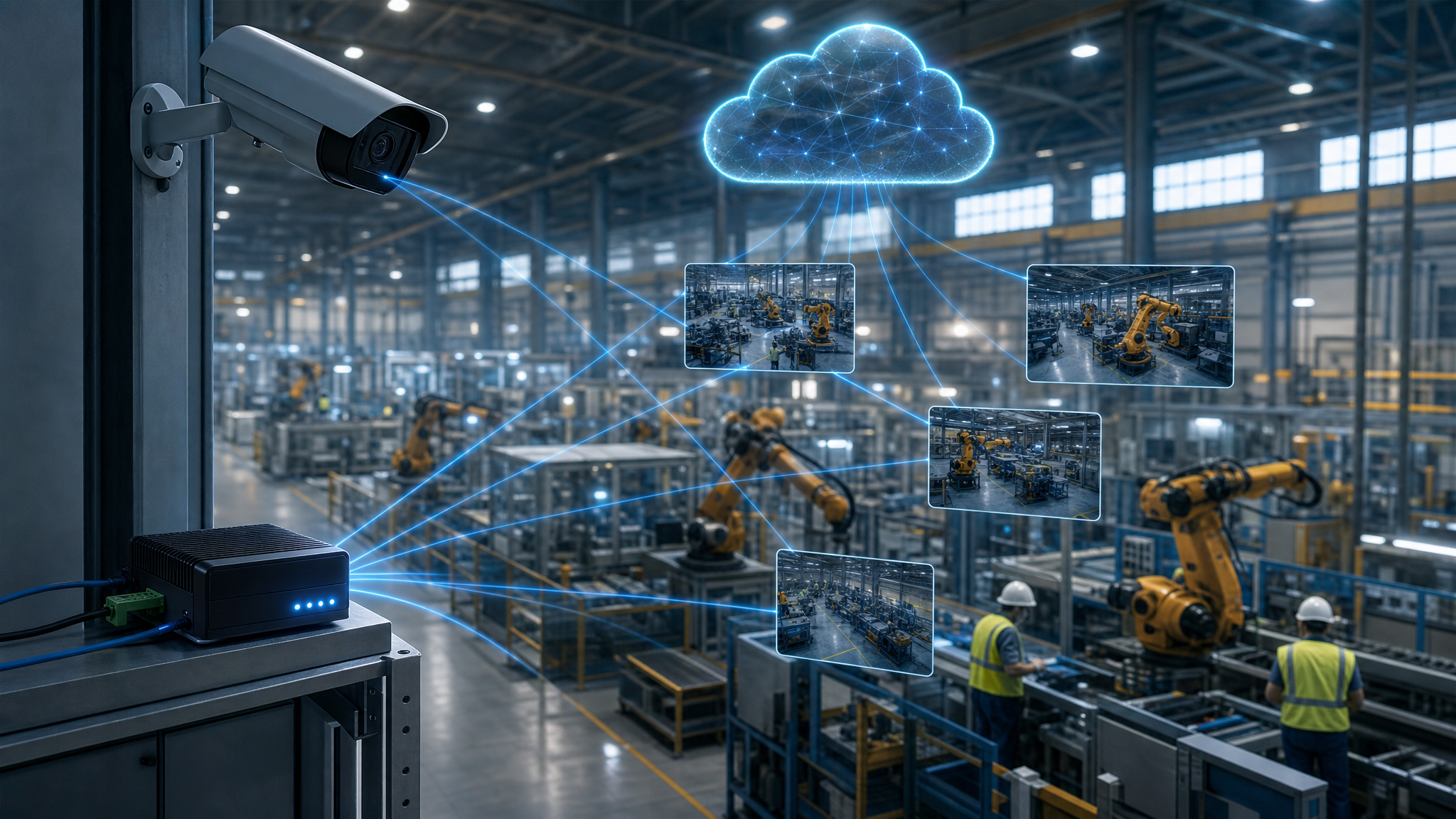


Edge vs cloud video analytics: a 2026 architecture guide for manufacturing IT/OT leaders
What is the difference between edge and cloud processing for video analytics? In plain terms, it comes down to where the work happens: edge video analytics runs the AI close to the camera on the plant floor, while cloud video analytics sends video or data to remote servers for analysis and storage. The cameras you already own capture rich signals about how people, machines, and materials move, but the architecture decides whether those signals become timely, useful intelligence. According to McKinsey, cloud and edge computing together rank among the highest-interest technology clusters globally, drawing tens of billions of dollars in annual investment (Source: McKinsey).
Key takeaways
- Edge video analytics processes video on or near the camera, delivering low latency and resilience even when network connectivity drops.
- Cloud video analytics centralizes storage, search, dashboards, and model training, which makes it ideal for cross-site analysis and reporting.
- Hybrid video analytics is a workload-placement strategy, not a compromise: run real-time detection locally and send metadata and selected clips to the cloud.
- Raw video is data-heavy, so edge filtering and event-based upload reduce bandwidth, storage costs, and network strain.
- The right architecture depends on real-time response needs, site connectivity, camera count, retention rules, compliance, and multi-site management.
What is edge video analytics
Edge video analytics means analyzing footage as close as possible to where it is captured, on smart cameras, industrial edge servers, or dedicated appliances inside the facility network. The device performs object detection, behavior recognition, and event classification on site, then generates metadata or alerts while raw video often stays local. This approach is not limited to cameras alone. Local gateways and servers can process streams from existing plant cameras, which lets teams add intelligence without a full hardware swap.
The payoff is speed and resilience. Processing locally reduces reliance on wide-area networks for time-critical decisions, so detection of a safety hazard or process deviation happens fast. Because choices are made on site, edge systems keep working even when the cloud link degrades, which matters for plants in areas with variable connectivity (Source: Security Magazine).
What is cloud video analytics
Cloud video analytics refers to an architecture where video or video-derived data travels over a network to remote data centers for storage, analysis, and integration with other enterprise systems. The National Institute of Standards and Technology (NIST) reference architecture describes cloud as infrastructure, platforms, and software delivered as services over a network, with responsibilities shared among providers and consumers (Source: NIST). Applied to video, cameras and on-site gateways generate data while cloud platforms supply scalable compute and storage for tasks like model training, search, and cross-site reporting.
This model shines for workloads that are less time-critical and more analytic in nature. It consolidates video data from many plants into unified dashboards, simplifying governance and enabling comparisons such as benchmarking safety trends across regions. The tradeoff is dependence on network connectivity, which can introduce latency and bandwidth cost when high-resolution streams move continuously (Source: NIST).
Key terms
- Edge video analytics: AI processing that runs on or near the camera, generating events and metadata on site.
- Cloud video analytics: Analysis and storage performed in remote data centers, accessed over a network.
- Hybrid video analytics: A workload-placement strategy that runs real-time detection at the edge and orchestration, search, and reporting in the cloud.
- Metadata: Structured event data (for example, "PPE gap at camera C, time T") that is far lighter to transmit than raw video.
Why hybrid video analytics is often the best fit for manufacturing
Hybrid edge-to-cloud video analytics treats workload placement as a deliberate design choice rather than a forced tradeoff. Deloitte frames edge-to-cloud computing as a continuum: edge nodes handle time-sensitive work and data filtering, while cloud platforms manage heavy analytics and long-term storage (Source: Deloitte). Initial processing, including real-time detection and event classification, happens at the edge. Selected metadata, events, and occasionally video clips then move to the cloud for aggregation, dashboards, historical analysis, and model improvement.
Industrial research backs this up. An IEEE Computer Society study on edge-cloud collaborative video object detection found that uploading raw video streams to the cloud causes enormous bandwidth consumption and high end-to-end latency, while placing lightweight models at the edge enables real-time detection with negligible accuracy loss (Source: IEEE Computer Society). In practice, a hybrid plant setup might generate immediate edge alerts for blocked exits or restricted-zone access, then push summarized event data to the cloud for trend tracking across sites.
How edge processing reduces latency and bandwidth
Latency is the time between an event on the plant floor and the system recognizing and acting on it. For workloads like detecting a pedestrian entering a forklift lane or flagging unsafe proximity near moving equipment, even a few seconds of delay reduces the value of any response. The World Economic Forum notes that applied AI in physical environments must surface leading indicators of risk in real time to be meaningful (Source: World Economic Forum).
Bandwidth is the second pressure point. High-resolution video at high frame rates consumes substantial network capacity, and streaming many feeds across multiple sites to the cloud can crowd out other critical traffic. Edge processing eases this by analyzing video locally and transmitting only metadata, events, or selected clips. The result is persistent monitoring without saturating constrained links (Source: Security Magazine).
To control network load in a hybrid design, IT/OT teams can set policies for what moves to the cloud:
- Route routine events as lightweight metadata entries with timestamps.
- Reserve full-resolution clip upload for serious incidents or investigations.
- Use time-limited high-resolution capture for studies like changeover analysis or time studies.
- Keep most footage on local storage with retention tuned to operational and compliance needs.
Edge vs cloud video analytics compared across key dimensions
The table below summarizes how the two approaches differ across the dimensions IT/OT leaders weigh most. Treat it as a guide, since real deployments often blend characteristics.
| Dimension | Edge video analytics | Cloud video analytics |
|---|---|---|
| Latency | Very low, suited to real-time safety and control | Higher due to network transmission, better for non-time-critical analysis |
| Bandwidth | Minimizes WAN load by sending metadata and events | Requires substantial bandwidth for high-resolution streams |
| Storage | Most video stays on site; cloud holds clips or metadata | Centralizes large volumes for cross-site analysis |
| Data security and privacy | Keeps sensitive footage local; more edge endpoints to secure | Benefits from provider infrastructure; raises data-locality questions |
| Scalability | Strong within a site; multi-site needs orchestration | Scales easily across sites with central management |
| Reliability | Keeps running during WAN outages for local use cases | Redundant, professionally managed infrastructure |
| Cost profile | Higher local hardware, lower cloud bandwidth and storage | Lower local hardware, ongoing cloud compute and storage |
| Model updates | Inference mainly local; needs a push mechanism | Central training and distribution of models |
Manufacturing workloads: what stays on site versus what moves to the cloud
Mapping use cases to architecture is where the decision becomes practical. Safety and control workloads belong at the edge because alerts must be timely. The U.S. National Safety Council's Work to Zero initiative documents how computer vision can continuously monitor PPE compliance and proximity breaches that periodic manual checks miss (Source: National Safety Council).
Workloads that fit edge-first design include:
- PPE detection and missing-gear alerts near hazardous equipment.
- Forklift and pedestrian proximity in shared aisles and blind corners.
- Blocked emergency exits and restricted-zone access.
- Real-time line stoppage detection that triggers a local notification.
- Loading dock and yard hazards during active loading.
Cloud-resident workloads, by contrast, tolerate higher latency and benefit from scale: trend analysis of safety leading indicators, OEE reporting, SOP adherence across sites, bottleneck detection, and time studies. McKinsey's Lighthouse work shows one site cut defect rates by 49 percent within four months by applying computer vision to quality inspection, illustrating how video-derived metrics drive measurable gains when fed into continuous improvement loops (Source: McKinsey).
This is where existing plant cameras become operational data sources. An edge-first, cloud-native platform like Spot AI can turn cameras a business already owns into AI coworkers that detect events on site and surface metadata for cross-site reporting. The AI Operations Assistant evaluates each run against SOPs, flags drift, and helps standardize the best shift, while keeping full-resolution video in the facility.
A Fortune 50 consumer packaged goods company (about $84B in revenue) used this approach to study touch-tracking on packaging lines. The team previously relied on clipboards and stopwatches, with no objective way to measure manual interventions across hundreds of global lines. Spot AI tracked 12 manual interventions across hair care and skincare lines, and one quantified task repeated 127 times per shift, surfacing automation candidates the company had not previously measured.
"Even at 90% accuracy, AI vision beats someone standing there making notes."
Rohit, Corporate Automation Lead, Fortune 50 CPG (~$84B)
How hybrid architecture handles security, storage, and metadata
In a hybrid model, cameras and edge appliances sit on OT networks or segmented subnets, running inference and interacting with local systems. Keeping identifiable footage on site can simplify data governance and privacy compliance, since it limits transfer to third-party infrastructure (Source: Security Magazine). NIST's shared-responsibility model reminds teams that cloud providers secure underlying infrastructure while consumers remain accountable for their own data, access controls, and configurations (Source: NIST).
The deciding design question is what data moves to the cloud. The IEEE study processes video locally and forwards only what is needed, such as detection results and the occasional clip flagged for inspection (Source: IEEE Computer Society). For manufacturing, that often means structured metadata entries traveling to the cloud while raw footage stays local, which supports both bandwidth control and privacy goals.
A decision framework for IT/OT leaders
Rather than choosing edge or cloud in the abstract, evaluate each workload against your plant realities. Useful questions include:
- Real-time response: Does this workload need an alert in seconds, or is next-day analysis fine?
- Site connectivity: Is WAN bandwidth reliable and affordable, or constrained and costly?
- Camera count: How many high-resolution feeds would need to stream continuously?
- Retention and compliance: What footage must stay local, and for how long?
- Multi-site management: Do you need central model updates, dashboards, and cross-plant comparisons?
Safety-critical and control workloads should be edge-first for low latency and resilience. Analytic and historical workloads belong in the cloud for scalable compute and fleet-wide visibility. A camera-agnostic, ONVIF-compatible platform lets teams apply this logic to existing cameras without rip-and-replace, with most sites live in days.
For a deeper look at how video data feeds plant KPIs, see Spot AI's operations resources on standardizing shifts and tracking OEE. The architecture you choose determines whether your cameras stay passive recorders or become reliable sources of operational intelligence.
Frequently asked questions
What is the difference between edge and cloud processing for video analytics?
Edge processing runs AI on or near the camera inside the facility, generating events and metadata locally with very low latency. Cloud processing sends video or data to remote data centers for storage, search, and large-scale analysis. Edge favors speed and resilience, while cloud favors centralized management and cross-site reporting.
When should video analytics run at the edge instead of the cloud?
Run analytics at the edge when alerts must arrive in seconds, when site connectivity is limited or costly, or when sensitive footage should stay local. Safety and control workloads such as PPE detection, proximity monitoring, and blocked-exit alerts are typically edge-first. The World Economic Forum notes that applied AI in physical environments must surface risk indicators in real time to be effective (Source: World Economic Forum).
Why is hybrid video analytics often the best architecture for manufacturing?
Hybrid architectures run real-time detection at the edge and use the cloud for orchestration, search, reporting, and model training. Deloitte frames this edge-to-cloud continuum as the practical model for advanced operations (Source: Deloitte). It balances immediate local response with enterprise-wide visibility, which matches how multi-site plants actually operate.
How does edge video analytics reduce bandwidth and latency?
By analyzing footage locally, edge systems transmit only metadata, events, or selected clips instead of continuous high-resolution streams. This avoids saturating WAN links and removes the delay of sending data to distant servers. An IEEE Computer Society study found that edge models cut end-to-end latency significantly while keeping accuracy nearly intact (Source: IEEE Computer Society).
What video analytics workloads should stay on site versus move to the cloud?
Keep time-critical safety and control workloads on site for low latency and resilience during outages. Move analytic and historical workloads, such as OEE trends, SOP adherence, and time studies, to the cloud for scalable compute and cross-site dashboards. Sending metadata and curated clips rather than raw streams keeps the design efficient.
About the author
Amrish Kapoor, VP of Engineering. Amrish Kapoor is VP of Engineering at Spot AI, leading platform and product engineering teams that build the scalable edge-cloud and AI infrastructure behind Spot AI’s video AI—powering operations, safety, and security use cases.

