




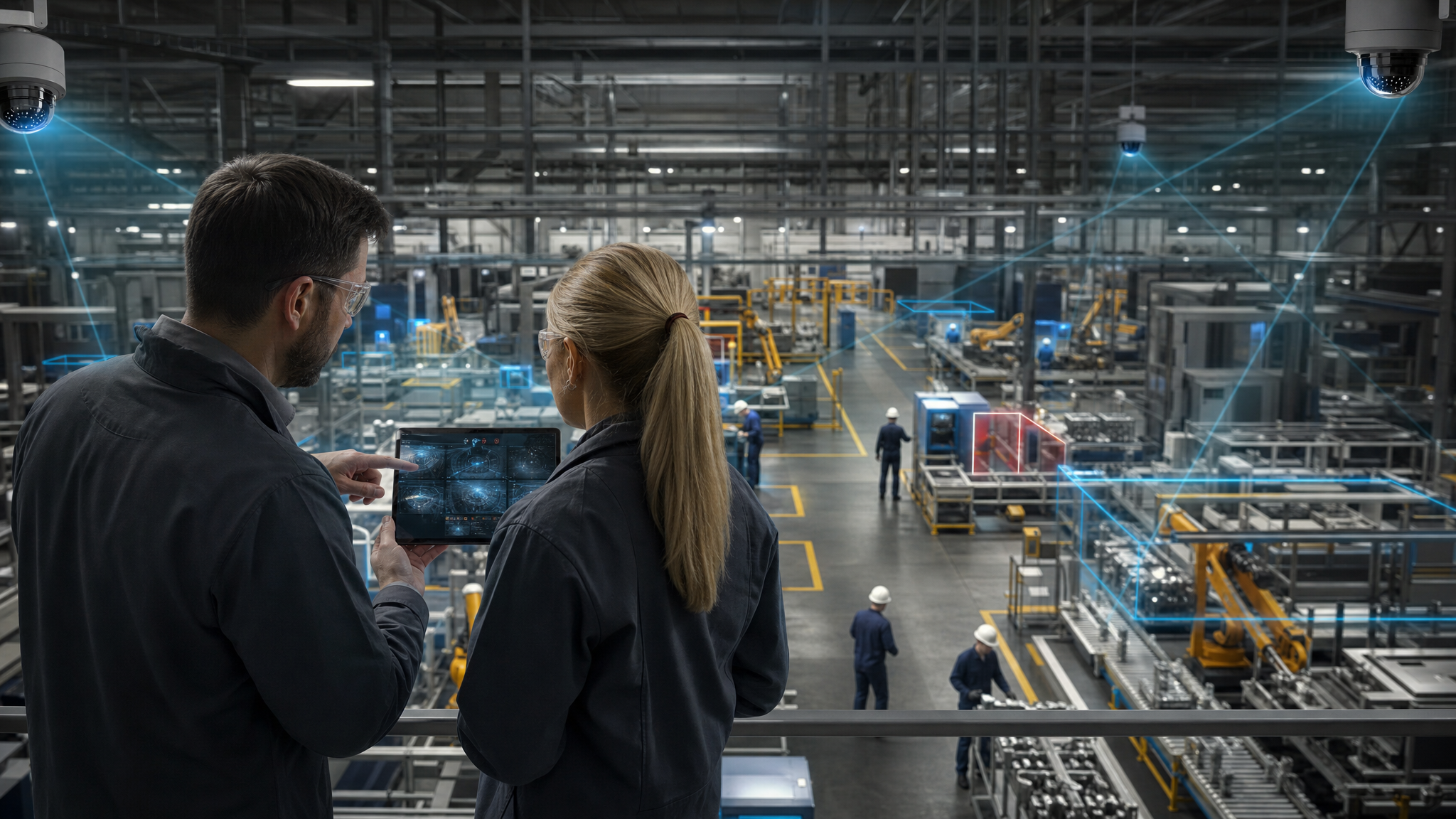


Enterprise root cause analysis video AI: a 2026 evaluation guide for manufacturing operations leaders
Your production data tells you what happened. It rarely tells you why it happened on the floor. A recent global survey found that a majority of organizations now use at least one AI capability, with operations and manufacturing among the most intensive areas of adoption (Source: McKinsey). At the same time, computer vision is expected to drive average productivity gains of more than 40% within a three-year horizon, with manufacturing decision-makers even more optimistic (Source: World Economic Forum). The decision in front of you is not whether to do root-cause analysis. It is which evidence base you trust to find the cause.
Key takeaways
- Manual RCA, traditional VMS review, and MES/ERP data each answer part of the question, but none captures the continuous visual context behind downtime, defects, and process drift.
- Video AI turns the cameras you already own into AI coworkers that evaluate every run against SOPs, surface variation, and link visual evidence to MES and ERP records.
- The strongest evaluation criteria are integration, searchable video, SOP drift detection, multi-site analytics, governance, and demonstrable KPI impact.
- Deployment is an architecture decision: cloud, hybrid, or on-prem, balanced against latency, bandwidth, data residency, and cybersecurity.
- A phased rollout (diagnose, pilot one or two lines, validate, scale) keeps risk low and standardizes the best shift across plants.
Why traditional root cause analysis leaves visibility gaps
Manufacturing root cause analysis has long combined structured tools (the 5 Whys, Ishikawa diagrams, Pareto charts) with system data and operator interviews. These methods work well for discrete, well-bounded problems. They strain in high-mix environments with frequent changeovers, complex material flow, and distributed networks spanning many sites.
Three gaps recur. First, visibility is intermittent. MES logs machine states and counts, but not the fine-grained human and material interactions that shape cycle time and changeover performance. Second, data sits in silos across MES, SCADA, CMMS, and quality systems, so investigations tend to follow whatever data is easiest to pull. Third, manual RCA leans on memory and interpretation, which invites recall bias and disagreement about basic facts.
The result is familiar. Chronic micro-stoppages stay unexplained. Best practices found on one line never reach the next plant. For a leader accountable for OEE and throughput across a network, that fragmentation is a strategic risk, not a footnote.
Key terms
- Root cause analysis (RCA): the structured practice of identifying the underlying driver of a problem, not just its symptom.
- SOP drift: the gradual deviation of actual work from documented standard operating procedures over time.
- OEE: overall equipment effectiveness, a composite of availability, performance, and quality.
- Video AI: computer vision and machine learning applied to camera streams to interpret work, material flow, and equipment states in context.
What video AI adds to enterprise root cause analysis
Think of your cameras the way you think of a seasoned line lead who never blinks. They already see the floor. Video AI gives them the ability to reason about what they see and to log it in a searchable record. That shift, from passive footage to AI coworkers that observe work in context, is what makes enterprise root cause analysis video AI different from a security archive.
Computer vision for manufacturing operations can estimate cycle times, track work-in-process accumulation, detect machine states, and recognize specific operator actions such as a setup change or a manual inspection. When an incident occurs, investigators search across time and space by event type instead of scrubbing hours of footage. The Spot AI platform approaches this by keeping full-resolution video on-prem and sending only metadata across the network, which keeps the search fast and the data footprint light.
More importantly, video AI shifts the emphasis from incident reconstruction to continuous process understanding. Instead of waiting for a severe failure to trigger an investigation, the AI Operations Assistant evaluates every run against your SOPs and flags drift within minutes. An analysis of industrial deployments confirms that camera-based AI increasingly complements traditional machine vision for higher-level cognition tasks (Source: Gartner).
Comparing four approaches to manufacturing root cause analysis
No single approach answers every question. The practical move is to understand where each one helps and where the visibility gap remains. Here is a side-by-side view, with the video AI approach as one column rather than the foregone pick.
| Approach | Where it helps | Visibility gap it leaves |
|---|---|---|
| Manual RCA (interviews, Gemba walks) | Team problem-solving, judgment, context for one-off events. | Limited temporal and spatial coverage; recall bias; micro-variation stays anecdotal. |
| Traditional VMS footage review | Evidence retrieval after a known incident. | Indexed by camera and time, not by operational event; no scene-level analytics; reactive and siloed. |
| MES/ERP-only analysis | Production, machine-state, and transactional records. | Blind to human execution, material flow, queueing, and SOP drift. |
| AI-powered video intelligence | Continuous context, run-by-run SOP evaluation, cross-site pattern detection. | Requires integration, governance, and change management to deliver value. |
The takeaway is not that one approach wins. It is that video AI fills the gaps the other three leave behind, especially when events involve people, line balance, setup, changeovers, or SOP drift.
How video AI detects SOP drift and shift-to-shift variation
Standard work encodes the best-known method. SOP drift is almost inevitable, because operators adapt instructions to real material and time pressure. Over months, those small adaptations harden into unofficial practices that may quietly raise risk or undercut a network-wide standard.
Video AI gives you a direct lens into how work actually runs. Models recognize the steps in a procedure, then map them to the documented SOP to flag where steps are skipped, compressed, or reordered. Across operators and shifts, the system builds distributions of step times and sequences, which reveals whether a performance gap comes from capability, workload, or process design.
Shift-to-shift differences become measurable rather than anecdotal. Instead of "the night shift is less experienced," you see that response times to stoppages run longer because support coverage is thinner. Peer-reviewed Safety 4.0 research shows computer vision can detect human presence, PPE compliance, and ergonomic risk in real time, which extends the same lens to safety and EHS investigations (Source: MDPI).
Manufacturing use cases that map to executive KPIs
Root cause analysis earns its keep when it moves a number a VP of Operations is accountable for. Here is how video AI connects common floor problems to those KPIs:
- Production downtime analysis: distinguish equipment failure from material shortage, slow alarm response, or troubleshooting sequence, tied to availability and OEE.
- Changeover optimization: break each changeover into discrete activities, measure variability across runs and sites, and standardize the fastest method.
- Quality defect root cause analysis: locate the steps where a defect likely originated and verify whether corrective actions are actually followed, tied to scrap and rework.
- Material flow bottleneck analysis: expose queueing and congestion that MES attributes to the wrong station, tied to throughput.
- Safety incident review: reconstruct the sequence and the near-misses that preceded it, tied to incident rate and workers' compensation cost.
- Shift variation: compare cycle times, micro-stoppage frequency, and changeover discipline across crews, tied to labor productivity.
The economic stakes are real. Regulators compile injury and illness data from hundreds of thousands of employer reports each year, underscoring the cost of incidents that better RCA aims to reduce (Source: BLS).
"We've added an incremental $15M a plant in throughput. Across 19 NA sites, it's like adding a whole extra plant, at zero capex."
VP Operations, Fortune 500 packaging leader
That outcome came from a focused changeover use case. The company cut changeover time on high-volume packaging lines from 28 minutes to 21 minutes over 6 months, a customer-reported 25% gain, and expanded from one pilot to five live plants with a plan to reach all 19 North American sites by the end of 2027.
Evaluation criteria for a VP of Operations
Treat video AI as an enabler of specific outcomes, not a standalone tool. Start by mapping your RCA pain points, then test any platform against the criteria below. Key questions to ask are:
- Integration: can it ingest line IDs, equipment tags, work orders, and shift codes from MES and ERP, and export structured events back into your analytics stack and CMMS?
- Searchable video: can teams filter by event type, location, and visual pattern instead of scrubbing footage?
- SOP drift detection: does it evaluate runs against standard work and quantify variation?
- Multi-site analytics: can corporate compare performance across plants while local teams act fast?
- Governance and privacy: role-based access, retention policies, and a system-improvement framing rather than punitive monitoring.
- Cybersecurity: encryption in transit and at rest, NDAA-compliant and SOC 2 practices, and edge processing that limits data exposure.
- Camera flexibility: a camera-agnostic approach that reuses existing IP cameras avoids rip-and-replace.
- KPI impact: demonstrable change in downtime, SOP adherence, or safety behavior before and after a pilot.
Consulting advisories on AI in operations stress aligning initiatives with business goals, building an integrated tech stack, and instituting responsible AI practices to realize value (Source: Deloitte). Spot AI is camera-agnostic and works with any IP camera, which is why most sites go live in days rather than months. You can see the named coworkers and integrations on the product overview.
Choosing a deployment architecture: cloud, hybrid, or on-prem
Architecture is a strategic choice that affects latency, bandwidth, data residency, and cybersecurity. The right answer depends on plant connectivity, regulatory environment, and IT capability, so compare the models against your constraints rather than chasing a default.
| Model | Strengths | Tradeoffs |
|---|---|---|
| Cloud | Elastic scale, centralized multi-site analytics, frequent model updates. | Data residency questions, latency, and bandwidth load when streaming raw video. |
| On-prem | Keeps data inside the plant, lower latency, easier data-localization compliance. | Harder to scale across sites; heavier local IT support. |
| Hybrid (Spot AI approach) | Edge keeps full-resolution video on-prem; only metadata moves to the cloud for aggregation. | Requires edge devices and a clear data-governance model per site. |
A hybrid, edge-first design balances bandwidth, latency, and privacy by processing video where it is captured and centralizing only derived insight. Spot AI uses an Intelligent Video Recorder so full-resolution video stays in the facility, which keeps deployments PCI-clean and the network burden low. Policy and industry reports on AI in manufacturing stress balancing innovation with governance, privacy, and cybersecurity as systems gain more influence over production (Source: World Economic Forum).
A phased framework to roll out video AI across plants
Complexity drops when you sequence the work. A phased path keeps risk low and turns early wins into network standards:
- Diagnose: with operations, engineering, maintenance, quality, safety, and IT, list the high-value RCA workflows that suffer from visibility gaps.
- Pilot: run one or two lines or cells with clear success criteria, such as reduced micro-downtime or tighter changeover consistency.
- Validate: measure KPI impact against a baseline, and choose your deployment model based on pilot results and constraints.
- Scale: standardize RCA workflows, refine governance, and propagate the best shift across plants with shared video evidence and coaching.
This mirrors the path the packaging leader above took: one pilot, then five plants, with a network rollout planned. You can review more manufacturing customer stories to see how teams sequenced their own deployments.
See how Spot AI approaches enterprise root cause analysis with video AI
If you are building an evaluation shortlist, start with the use case where visual context is missing most often, then test it against the criteria in this guide. Explore the AI Operations Assistant to see how existing cameras become AI coworkers that evaluate runs, surface drift, and help standardize the best shift across every site.
Frequently asked questions
What is AI root cause analysis in manufacturing?
AI root cause analysis applies computer vision and machine learning to camera streams and operational data to identify the underlying driver of a problem, not just its symptom. It evaluates how work actually runs, links visual evidence to MES and ERP records, and surfaces patterns across runs, shifts, and sites that manual review tends to miss.
How can enterprises use video AI for root cause analysis across manufacturing operations?
Enterprises time-synchronize camera feeds with MES events, tag cameras to equipment and areas, and correlate detected events such as stoppages or manual interventions with downtime, scrap, and defect records. This lets investigators jump from a system log straight to the moment in question and compare patterns across plants to standardize the best method.
What visibility gaps remain when manufacturers rely only on MES, ERP, or VMS data?
MES and ERP capture machine states and transactions but stay blind to human execution, material flow, queueing, and SOP drift. Traditional VMS stores footage indexed by camera and time, not by operational event, so analysts must scrub manually and the data is rarely linked to production systems. Video AI closes both gaps with searchable, scene-level analytics.
How does video AI help detect SOP drift and shift-to-shift variation?
Computer vision recognizes the steps in a procedure and maps them to the documented SOP, flagging skipped or compressed steps. By measuring step times across operators and shifts, it builds distributions that show whether a gap comes from capability, workload, or process design, turning anecdotes about shift differences into measurable evidence.
How should manufacturers choose between cloud, hybrid, and on-prem deployment?
Match the architecture to plant connectivity, data-residency rules, latency needs, and IT capacity. Cloud simplifies multi-site analytics but raises bandwidth and residency questions; on-prem keeps data local but is harder to scale. A hybrid, edge-first model processes video on-site and centralizes only metadata, balancing speed, privacy, and cybersecurity.
About the author
Dunchadhn Lyons, Director of AI Engineering. Dunchadhn Lyons leads Spot AI’s AI Engineering team, building real-time video AI for operations, safety, and security—turning video data into alerts, insights, and workflows that cut incidents and boost productivity.

