







The retail loss prevention industry generates more research, more vendor pitches, and more conference sessions each year than any single team can absorb. Yet the decisions that shape a company's security posture for the next three to five years often trace back to a handful of conversations at events like NRF Protect, the RILA Retail Asset Protection Conference, and working sessions hosted by the Loss Prevention Research Council (LPRC). Understanding how these organizations operate—and how to get practical value from them—helps LP leaders evaluate technology, benchmark programs, and build an internal business case for investment.
This guide breaks down the key organizations, ties them to the pain points that matter most to retail security teams, and gives you a framework for turning what you learn at conferences into measurable outcomes.
Key terms every LP professional should know
Before we get into how these groups influence which tools LP teams buy, here are a few key terms:
Term |
Definition |
|---|---|
LPRC |
The Loss Prevention Research Council—a membership-based research organization that tests technologies, publishes evidence-based findings, and facilitates collaboration among retailers, academics, and law enforcement |
LPCB |
The Loss Prevention Certification Board, operating under BRE Global, which independently tests and certifies security products and services against published performance standards |
RILA |
The Retail Industry Leadership Association, which hosts the annual Retail Asset Protection Conference and maintains the Asset Protection Leaders Council |
NRF Protect |
The National Retail Federation's annual conference dedicated to loss prevention, digital security, and asset protection |
ORC |
Organized retail crime—large-scale, coordinated theft and fraud carried out by professional networks, often with international connections |
Shrinkage (shrink) |
The gap between recorded inventory and actual stock on hand, driven by theft, fraud, and operational errors |
LPQ / LPC |
Loss Prevention Qualified and Loss Prevention Certified—industry credentials that establish baseline and advanced competency for practitioners |
Why conferences and research councils drive technology decisions
LP leaders rarely pick new technology because of a cold inbound email. Instead, the evaluation process follows a pattern: a pain point surfaces in the field, a peer mentions a potential solution at a conference, the team validates it against LPRC research or LPCB certification data, and a pilot gets funded.
Three institutional forces accelerate this cycle:
The LPRC provides controlled testing environments. The council maintains a prototype store facility where researchers evaluate emerging technologies under conditions that mirror actual retail operations. This means LP teams can review objective performance data—not just vendor demos—before committing budget.
RILA and NRF Protect create peer-validated intelligence. The RILA Retail Asset Protection Conference draws senior executives from retailers like Five Below, Gap Inc., H&M, PetSmart, and Wayfair, alongside law enforcement and technology providers. Sessions on topics like collaborative ORC strategies and total retail loss assessment give attendees a framework for comparing their own programs against industry benchmarks.
Certification bodies reduce procurement risk. LPCB certification requires initial type testing, ongoing quality management audits to ISO 9001, and periodic marketplace testing. For procurement teams, specifying LPCB-approved products demonstrates due diligence and reduces liability exposure.
The takeaway: loss prevention tech decisions are rarely made by one person. It flows through a network of research validation, peer endorsement, and standards compliance.
The pain points shaping LP technology evaluation in 2025
What are LP teams actually trying to solve when they walk the conference floor? The sticking points tend to cluster around five themes.
Pain point |
Why it matters |
Conference signal to watch |
|---|---|---|
Blind spots outside the store |
Parking lots, perimeters, and loading docks remain hard to monitor, inviting escalation |
Sessions on perimeter control and outdoor detection |
Coverage gaps across many locations |
Regional LP managers cover 30–40+ stores and cannot be everywhere |
Panels on remote monitoring and force multiplication |
High guard costs with variable results |
Traditional guard coverage is expensive and inconsistent |
Vendor demos showing automated deterrence and cost comparisons |
Alert fatigue and noise |
Too many false alarms drain time and erode trust in systems |
LPRC research on false-alarm rates and context-aware detection |
Difficulty proving ROI to executives |
LP leaders must "sell prevention" internally with credible data |
Case study presentations with before-and-after metrics |
These pain points explain why conference agendas have shifted heavily toward video AI, automated deterrence, and evidence workflow tools. LP teams are not browsing for novelty—they are looking for tools that solve specific, measurable problems.
How the LPRC advances evidence-based loss prevention
The Loss Prevention Research Council occupies a distinct role in the ecosystem. Unlike trade shows that mix education with sales, the LPRC prioritizes research rigor and collaborative knowledge development.
Several functions make LPRC membership particularly valuable for teams evaluating new technology:
Prototype store testing allows members to see how technologies perform in controlled retail conditions before broader deployment, reducing the risk of expensive pilots that fail to deliver.
Collaborative research initiatives address industry-wide obstacles—ORC pattern analysis, violence trend tracking, employee training effectiveness—through coordinated member participation.
Intelligence-sharing mechanisms give members advance notice of emerging threats and access to unpublished research data that informs strategic planning.
Industry roundtables connect practitioners facing similar problems, creating the peer validation that economic buyers need before approving enterprise-wide rollouts.
For LP leaders attending LPRC events, the most productive approach is to show up with a specific hypothesis to test. Rather than asking "What's new?", ask "Does the evidence support automated deterrence as a replacement for overnight guard coverage at our store format?" That specificity turns a conference visit into a procurement decision.
Tip: Before attending any LP conference, compile your top three measurable pain points (e.g., shrink rate by category, average investigation time, guard cost per location). Having concrete numbers lets you benchmark against peers and evaluate vendor claims with specificity rather than relying on general impressions.
RILA, NRF Protect, and the role of peer networks
The RILA Retail Asset Protection Conference and NRF Protect serve complementary functions. RILA tends to attract senior executives focused on strategy, legislation, and cross-company collaboration. NRF Protect casts a wider net, covering digital security, cybersecurity, and emerging technology alongside traditional LP topics.
Both conferences shape technology adoption through several mechanisms:
Cross-retailer intelligence sharing on ORC. Only 10% of offenders account for 68% of total retail crime losses (Source: NRF). Conferences facilitate the kind of cross-company coordination needed to identify and disrupt these concentrated networks. The Northern Nevada Organized Retail Crime Association (NNORCA) model—where LP staff at multiple retailers coordinated with law enforcement to prosecute a repeat offender linked to thefts exceeding $12,500 across several stores—illustrates what collaborative intelligence can achieve (Source: Washoe County DA).
Legislative advocacy. RILA maintains specialized councils that advocate for ORC legislation and law enforcement resources, giving attendees a direct line to policy discussions that affect their operating environment.
Cybersecurity integration. AI has emerged as the top cybersecurity concern for retailers, according to experts at the NRF Retail Law Summit (Source: NRF). Conferences increasingly address the overlap between physical LP and cyber risk, reflecting the reality that modern loss prevention spans both domains.
Professional credentials that signal program maturity
Certifications like LPQ and LPC do more than advance individual careers—they signal organizational commitment to evidence-based practice. The LPQ credential requires a written or oral examination and renewal every three years through continuing education or re-examination (Source: LPF). The LPC credential demands deeper experience and is common among senior practitioners overseeing enterprise-wide programs.
For organizations building or scaling LP teams, certification status carries practical implications:
Credential |
Level |
Renewal cycle |
Strategic value |
|---|---|---|---|
LPQ |
Entry-level |
Every 3 years |
Establishes baseline competency; accessible to career-changers |
LPC |
Advanced |
Ongoing CPD |
Demonstrates mastery of methodology, management, and strategic decision-making |
Teams staffed with certified professionals are better positioned to evaluate vendor claims critically, design effective pilots, and present credible business cases to finance leadership.
A practical framework for evaluating technology at conferences
Walking a conference floor with hundreds of vendors can feel like too much at once. The following framework helps LP teams focus their evaluation on what matters most.
Start with the pain point, not the product. Identify the top two or three operational problems from your own data—blind spots, alert fatigue, investigation time—before reviewing any vendor booth.
Ask for LPRC or third-party validation. Has the technology been tested in the LPRC prototype store or evaluated by an independent body? Peer-reviewed evidence carries more weight than a polished demo.
Demand pilot metrics with baselines. Any vendor claiming results should specify the unit, timeframe, and baseline. "Reduced incidents" means nothing without context.
Evaluate deployment flexibility. Retail formats vary. A solution that works in a big-box store may not fit a convenience or drug store footprint. Ask about camera-agnostic compatibility, outdoor-first deployment options, and phased rollout paths.
Map the workflow, not just the feature. The best technology is useless if it adds friction for store teams. Trace the full path from detection to deterrence to evidence to case closure.
Check integration with existing systems. Open APIs, webhook support, and compatibility with current VMS or POS platforms reduce implementation risk and accelerate time to value.
How All Star Elite turned conference-level insights into measurable results
All Star Elite, a multi-location sports apparel retailer with approximately 80 U.S. shopping-center stores, exemplifies the journey from problem identification to technology adoption. After deploying Spot AI's unified video AI platform, the retailer achieved results that would hold up in any conference case study session:
Cash shrink dropped from approximately 6% to 1%—an 83% reduction.
Merchandise shrink fell from 10–15% to approximately 6%.
Investigation efficiency improved by more than 50%, cutting incident resolution from hours to minutes using centralized case management and AI-powered search.
Law enforcement case timelines shortened from 2–3 months to roughly 1 month thanks to stronger video evidence and documentation.
Sales increased by 5–15% through data-driven product placement informed by people-counting and traffic analytics.
Read the full All Star Elite customer story for details on how the team built its internal business case.
These outcomes map directly to the pain points LP leaders bring to conferences: blind spots, investigation time, shrink reduction, and the ability to prove ROI to executives.
Considerations when adopting conference-sourced technology
No technology evaluation is complete without acknowledging limitations. Several factors deserve attention regardless of vendor:
Alert tuning takes time. Even advanced systems require ongoing calibration to minimize false positives and maintain credibility with operators. Teams should plan for a tuning period during initial deployment.
Coverage depends on camera placement. Video AI can only analyze what cameras capture. Effective deployment requires strategic placement at entrances, exits, POS areas, and high-shrink zones—not blanket coverage that creates data overload.
Organizational change management matters. Employees and store leaders need to understand how new systems support their safety and workflow, not just asset protection goals. Training and communication plans are as important as the technology itself.
Data quality shapes strategy. The NRF discontinued its long-running shrinkage survey after 2023, noting that traditional methodology no longer captured the changing nature of retail losses (Source: NRF). LP teams with granular, transaction-level data can make more precise loss attribution decisions than those relying on industry averages.
Key takeaway: When moving from conference research to deployment, define success before you start. Pick one high-visibility pilot location, set baseline metrics for shrink, investigation time, and alert accuracy, then measure over a 60–90 day window. This approach gives you the credible before-and-after data executives need to approve a broader rollout.
Turning conference intelligence into a scalable security program
The organizations covered in this guide—LPRC, LPCB, RILA, and NRF—exist to help LP professionals make better decisions. Their value compounds when teams approach them with clear objectives, specific hypotheses, and a willingness to test assumptions against evidence.
For teams ready to move from conference research to operational results, the path forward involves selecting a high-visibility pilot location, defining success metrics with baselines, and measuring outcomes over a defined period before standardizing across the portfolio.
Spot AI's AI Security Guard is built for exactly this approach: outdoor-first, camera-agnostic deployment that spots real threats, triggers automated deterrents like strobes and talk-downs, and delivers time-stamped case files—all without adding headcount. The platform can be live in under a week, giving pilot teams fast access to the data they need to build an internal business case.
See Spot AI in action
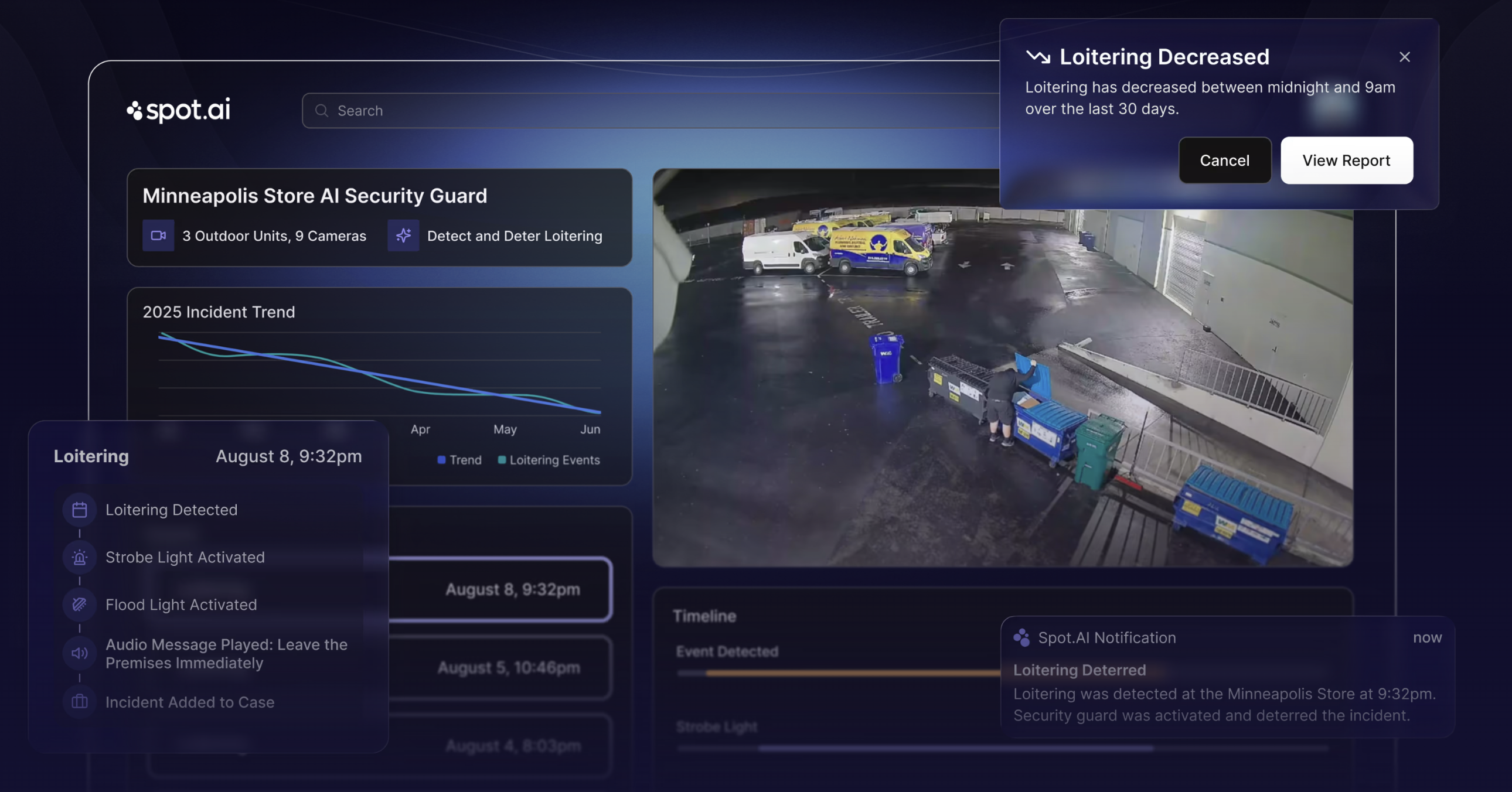
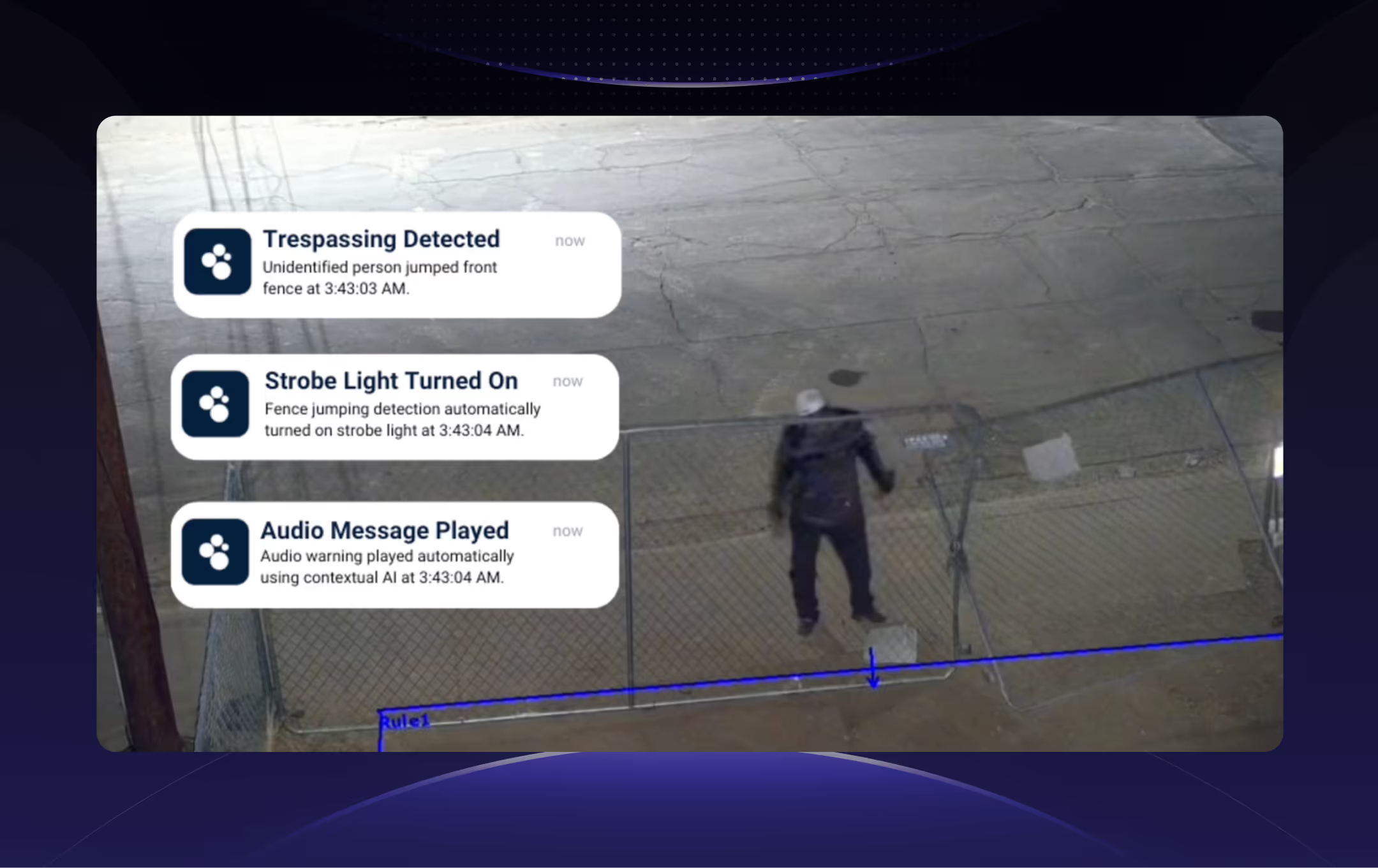

To see how Spot AI's AI Security Guard detects perimeter activity, triggers automated deterrence, and packages time-stamped evidence for faster investigations, request a demo.
"The technology has to serve a purpose beyond just having AI for AI's sake. What we've found with Spot AI is a partner that helps us enhance our operations in meaningful ways. The value goes beyond traditional ROI metrics - it's about creating a safer, more secure environment while maintaining the trust we place in our team."
Mike Tiller, Director of Technology, Staccato (Source: Spot AI Customer Story)
Frequently asked questions
What are the best practices for loss prevention in retail?
Effective loss prevention combines layered physical security, trained staff, strong internal controls, and technology that moves from recording incidents to detecting and deterring them. Start with a risk assessment that identifies high-shrink locations and merchandise categories, then concentrate investment where it generates the greatest return. Employee training should emphasize customer-service-based deterrence—approaching suspicious individuals with offers of assistance rather than confrontation. Point-of-sale exception reporting, regular cycle counts, and segregation of duties close internal fraud opportunities. Video AI adds a detection and deterrence layer that operates around the clock without adding headcount.
What are the benefits of joining the LPRC?
LPRC membership gives retail organizations access to controlled technology testing in a prototype store environment, unpublished research data, industry roundtables addressing specific operational problems, and advance intelligence on emerging threats. The council's emphasis on evidence-based practice means members can evaluate vendor claims against independent performance data rather than relying solely on sales presentations. Collaborative research initiatives also address industry-wide hurdles like ORC pattern analysis and violence trend tracking.
What current trends are impacting loss prevention in 2025?
Organized retail crime continues to grow in scale and sophistication, with shoplifting incidents up significantly since 2019 and violence during theft events increasing 17% between 2023 and 2024 (Source: NRF). Transnational criminal involvement has added complexity, with 66% of retailers reporting international ORC connections since 2024 (Source: NRF). On the technology side, video AI, RFID, and cloud-based analytics are shifting LP from reactive investigation to proactive detection and automated deterrence. Cybersecurity has also become inseparable from physical LP, as AI-powered phishing and brute-force attacks target retail data alongside merchandise.
What roles do loss prevention officers play in organizations?
Loss prevention officers serve as the operational backbone of retail asset protection. Their responsibilities span monitoring for theft and fraud, conducting investigations, managing evidence workflows, training store teams on security protocols, and collaborating with law enforcement on organized crime cases. As the profession has matured, LP roles increasingly require analytical skills—interpreting exception reports, managing video AI alerts, and presenting data-driven business cases to leadership. Certifications like LPQ and LPC formalize these competency expectations and create clear career advancement pathways.
How can organizations get LPCB certified?
LPCB certification applies to products and services rather than retail organizations directly. Manufacturers seeking certification must pass initial type testing, demonstrate quality management systems aligned with ISO 9001, undergo regular audit testing, and maintain compliance through ongoing surveillance inspections. For retail procurement teams, specifying LPCB-certified products reduces risk and demonstrates due diligence. Certified products are listed in the LPCB Red Book, which serves as a directory of approved suppliers.
About the author
Rish Gupta is CEO and Co-founder of Spot AI, leading the charge in business strategy and the future of video intelligence. With extensive experience in AI-powered security and digital transformation, Rish helps organizations unlock the full potential of their video data.

