




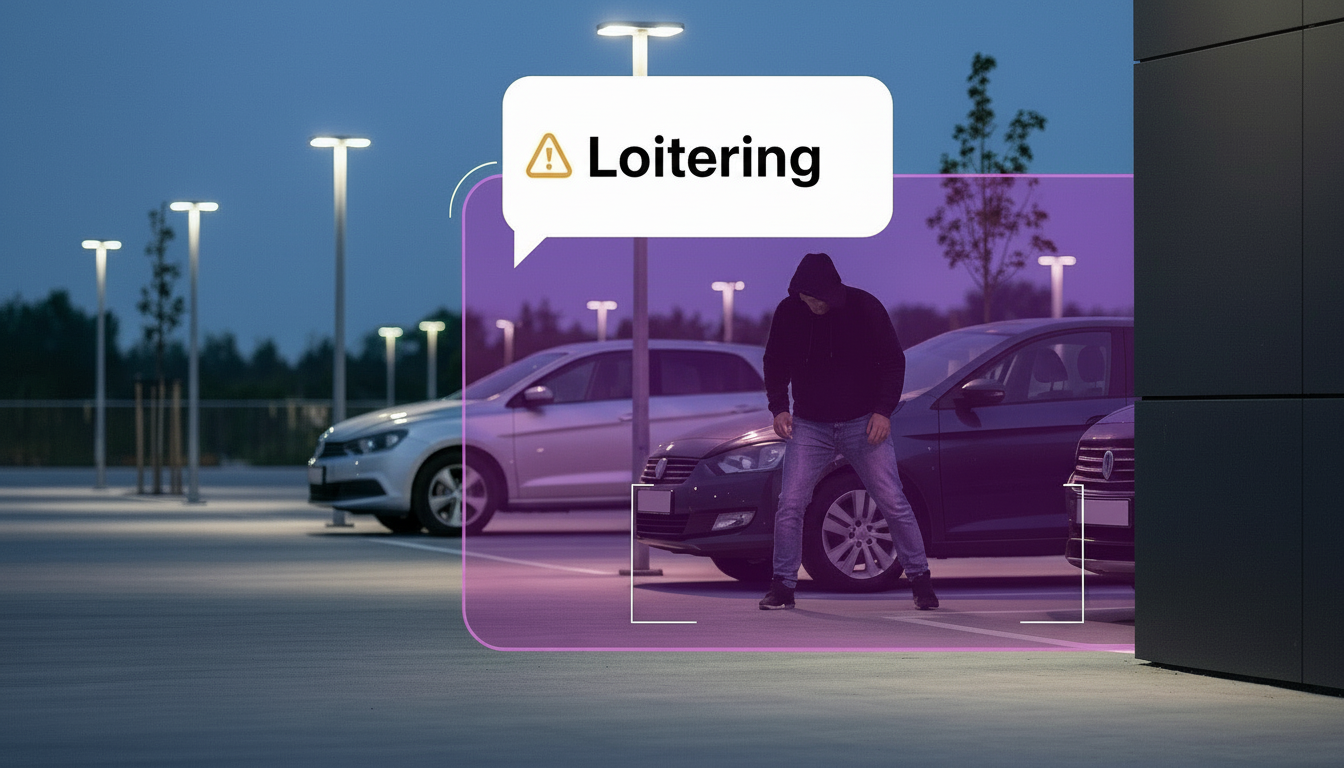


Parking lots are often the most vulnerable asset in a retail footprint. They're the first point of contact for customers and the primary staging ground for organized retail crime (ORC). While violent crime rates in major U.S. cities have stabilized or declined as of 2025, retail-specific risks have evolved. More than half of retailers now report increases in ORC-related theft and merchandise loss, with criminal groups frequently using parking areas to coordinate operations across borders (Source: TheStreet). For loss prevention leaders, these areas represent a massive gap in security coverage—a place where traditional video systems merely record incidents rather than deter them.
The shift from reactive recording to anticipatory intervention is critical. This article explores how to deter unwanted activity in parking lots with active deterrence, helping your video infrastructure move from passive recording to practical tools that mitigate risk, liability, and shrink.
Key terms to know
Before exploring strategies, here are the core technologies that drive modern parking lot security.
- Active deterrence: a security approach that uses technology to detect suspicious activity and intervene in real time through audio, visual, or physical responses to guard against a crime occurring or escalating.
- Video AI Agents: artificial intelligence software that analyzes video feeds to identify specific objects (people, vehicles), behaviors (loitering, running), and events in real time, distinguishing them from environmental noise like wind or animals.
- License plate recognition (LPR): technology that automatically captures and reads vehicle license plates, allowing systems to flag unauthorized vehicles or track repeat offenders.
- CPTED (crime prevention through environmental design): a multi-disciplinary approach to deterring criminal behavior through environmental design, such as lighting, landscaping, and access control.
The reality of retail parking lot risk
For Loss Prevention Directors and VPs, the parking lot is often the source of sleepless nights. The frustrations are well-documented: reactive systems that only provide evidence after a theft has occurred, overwhelming false alarm rates that train staff to ignore alerts, and the constant struggle to prove ROI on security investments.
The operational impact is severe. While specific vehicle crimes like catalytic converter theft have declined from their 2023 peaks, vehicle break-ins remain a persistent threat in specific regions (Source: Hawaiipolice Gov). The parking lot sets the tone for the entire store. If the perimeter feels unmanaged, bad actors escalate their behavior, testing entry points and evaluating response times.
Addressing core loss prevention pain points
To effectively deter unwanted activity in parking lots, security strategies must address the specific pain points faced by retail leadership.
- Moving from reactive to anticipatory: traditional cameras capture the aftermath. Active deterrence systems detect the behavior preceding the crime—such as loitering near high-value inventory or vehicles—and trigger a response before the damage is done.
- Minimizing false alerts: a major barrier to effective monitoring is the "boy who cried wolf" effect. Modern AI filtering for pets, vehicles, shadows, and weather events reduces nuisance alerts by 60–80%, ensuring teams only react to genuine threats.
- Closing coverage gaps: large, sprawling retail lots often have blind spots. Intelligent video analytics maximize camera effectiveness by tracking objects across views, ensuring even complex environments are monitored effectively.
How Video AI powers active deterrence
The foundation of any effective active deterrence strategy is the ability to understand what's happening in the video feed. Video AI Agents help standard cameras act as smarter sensors.
Real-time incident detection
Unlike legacy motion detection, which triggers on pixel changes, AI analytics classify objects and behaviors. This capability allows for precise detection rules that align with safety and security protocols.
- Loitering detection: AI can identify when a person or vehicle remains in a designated area longer than a set threshold. This is critical for identifying casing behavior often used by organized retail crime groups before an attack.
- No-go zones: virtual perimeters can be drawn around high-risk areas, such as loading docks or vehicle storage. If a person or vehicle enters these zones during off-hours, the system triggers a rapid alert.
- Vehicle and person classification: the system distinguishes between a customer walking to their car and a vehicle driving erratically. This context allows for tailored responses rather than generic alarms.
Shortening investigation time
For loss prevention teams, manual video review drains resources. Scrubbing through footage to investigate a single incident wastes valuable labor hours. AI-powered systems index video metadata, allowing operators to search for "red truck" or "person in blue shirt" and find relevant clips in seconds. This efficiency reduces investigation time from hours to seconds, freeing staff to focus on proactive mitigation.
Technologies and implementation strategies
Implementing active deterrence involves integrating various technologies to create a layered defense. These systems work together to detect, disrupt, and respond to incidents.
Audio and visual alert systems
The most direct form of deterrence is sensory feedback delivered without delay. When a potential offender knows they've been detected, the risk of apprehension often outweighs the potential gain.
- Visual deterrence: flashing red and blue strobe lights or floodlights can activate automatically when an incident is detected. This signals that the area is under active monitoring and improves nighttime visibility.
- Audio warnings: two-way audio or automated voice messages can play upon detection. Commands such as "You are in a restricted area, please exit" create a powerful psychological barrier that deters loitering.
- Mobile monitoring units: for high-risk periods like the holiday season, mobile units with elevated cameras and visible deterrents are now standard for retail parking lots (Source: Sdmmag).
License plate recognition (LPR) integration
LPR technology turns vehicle traffic into actionable data. By integrating LPR with active deterrence, retailers can automate access control and identify vehicles of interest. Modern LPR cameras operate effectively across diverse lighting conditions, capturing plates traveling at speeds exceeding 80 mph.
- Unauthorized vehicle alerting: systems can flag vehicles associated with previous thefts or organized crime rings. When these vehicles enter the lot, security teams receive a real-time notification.
- Automated access control: for secure employee lots or loading areas, LPR can grant access to authorized vehicles while triggering alerts for unauthorized attempts.
- Forensic evidence: in the event of a hit-and-run or theft, LPR provides high-resolution capture of license plates, even at night or high speeds, creating strong evidence for law enforcement.
Crime prevention through environmental design (CPTED)
Technology works best when paired with smart environmental design. CPTED principles focus on making the physical environment less conducive to crime.
- Lighting optimization: improved lighting reduces nighttime crime rates by 10–36%, with particularly strong effects on pedestrian safety (Source: Lightingdesignandspecification Ca). Smart lighting that brightens when motion is detected saves energy while reducing hiding spots.
- Clear sightlines: keeping sight lines clear by trimming vegetation and removing visual obstructions ensures that cameras and passersby have a clear view of the lot.
- Territorial reinforcement: clear signage indicating "Active Monitoring" or "AI Security in Use" establishes ownership and warns potential offenders that the site is managed and secure.
ROI and measuring success
For retail VPs, justifying the budget for advanced security systems requires demonstrating clear ROI. Active deterrence delivers value through multiple channels.
Minimizing shrink and liability
The direct cost of theft is only part of the equation. Liability claims from customers or employees injured in parking lot incidents can be substantial. Implementing documented, active security measures demonstrates fulfillment of the retailer's duty of care, substantially reducing exposure to negligence claims (Source: Rtrlaw).
- Minimizing theft: by mitigating crimes like catalytic converter theft—which can cost over $2,000 in replacement costs per incident—the system can offset costs by minimizing direct losses (Source: Consumer Reports).
- Insurance premiums: facilities with documented, active security measures may qualify for lower insurance premiums, as these measures can lower perceived risk exposure (Source: Aol).
- Operational efficiency: automated alerts and AI-powered search decrease the labor hours required for monitoring and investigation. Organizations deploying AI-powered remote monitoring report 40% first-year cost savings compared to traditional on-site security guard models.
Comparison: Spot AI vs. traditional systems
| Feature | Spot AI | Traditional Systems |
|---|---|---|
| Deployment Speed | Plug-and-play, live in minutes | Weeks of installation & wiring |
| Intelligence | AI Agents detect loitering, no-go zones | Passive recording only |
| Search Capability | Google-like search (seconds) | Manual scrubbing (hours) |
| Hardware | Camera-agnostic (works with existing) | Proprietary hardware lock-in |
| Access | Cloud dashboard, accessible anywhere | Local access only |
| Scalability | Unlimited users and locations | Limited by localized DVR/NVR |
Best practices for implementation
To successfully deter unwanted activity in parking lots with active deterrence, loss prevention leaders should follow a strategic implementation plan.
- Conduct a site assessment: identify high-risk areas, blind spots, and lighting deficiencies. Use incident data to prioritize zones that require immediate attention, specifically focusing on areas with a history of ORC casing activity.
- Integrate with existing infrastructure: modern solutions like Spot AI are camera-agnostic, meaning you can upgrade existing IP cameras with AI capabilities without a rip-and-replace project.
- Define clear rules: configure detection templates for specific behaviors. For example, set "Person Enters No-Go Zone" for loading docks after 10 PM and "Loitering" for store entrances.
- Establish response protocols: determine who receives alerts and what actions they should take. Automated audio responses can handle minor infractions, while verified security incidents can be routed to law enforcement.
- Monitor and adjust: regularly review system performance and false alarm rates. AI systems learn over time, allowing for continuous refinement of detection rules to maintain high accuracy.
Take action: the proactive approach to parking lot security
Parking lots don't have to be the weak link in your retail security strategy. By shifting from reactive recording to active deterrence, loss prevention leaders can create a safer environment for customers and employees while protecting the bottom line. The integration of Video AI, LPR, and active response mechanisms helps security cameras function as proactive tools. These systems operate continuously to detect potential incidents, discourage unwanted behavior, and provide the intelligence needed to make data-informed operational decisions.
"We have multiple uses for Spot AI and whether that's reviewing footage from our parking lots or getting a live feed from our offices Spot AI gives us the perfect tools to do this quickly and with precision."
- Daniel A., Systems and Programs Coordinator (Source: G2)
For enterprise retail operations, the move to active deterrence is a practical investment in safety and risk mitigation. See Spot AI's video AI platform in action—request a demo to explore how active deterrence can elevate your parking lot security.
Frequently asked questions
How effective are active deterrence systems in parking lots?
Active deterrence systems are highly effective when integrated with rapid response protocols. Organizations implementing integrated active deterrence (AI detection + audio/visual warnings) report incident reductions of 30–50% in pilot zones, with particularly strong results for deterring theft.
Can video analytics work with my existing parking lot cameras?
Yes. Advanced platforms like Spot AI are camera-agnostic, meaning they can connect to your existing IP cameras and upgrade them with AI capabilities. This allows you to implement active deterrence features like loitering detection and no-go zones without replacing your current hardware infrastructure.
What technologies best deter theft in parking lots?
A layered approach works best. This includes Video AI for behavioral detection (loitering, unauthorized access), License Plate Recognition (LPR) for tracking vehicles, and active response units (lights/audio) to deter offenders. Combining these with improved lighting and environmental design offers the strongest protection.
How does active deterrence lower liability for retailers?
Retailers have a duty of care to provide reasonable security. Implementing active deterrence demonstrates a forward-looking commitment to safety. By averting violent crimes and assaults in parking areas, retailers significantly lower the risk of negligence claims and high-cost litigation (Source: Rtrlaw).
What are the legal implications of using audio deterrence?
Using audio warnings to deter loitering or trespassing is generally legal on private property, provided it complies with local noise ordinances. Signage indicating that the area is monitored and that audio warnings may be used is recommended to ensure transparency and compliance.
About the author
Joshua Foster is an IT Systems Engineer at Spot AI, where he focuses on designing and securing scalable enterprise networks, managing cloud-integrated infrastructure, and automating system workflows to enhance operational efficiency. He is passionate about cross-functional collaboration and takes pride in delivering robust technical solutions that empower both the Spot AI team and its customers.

