




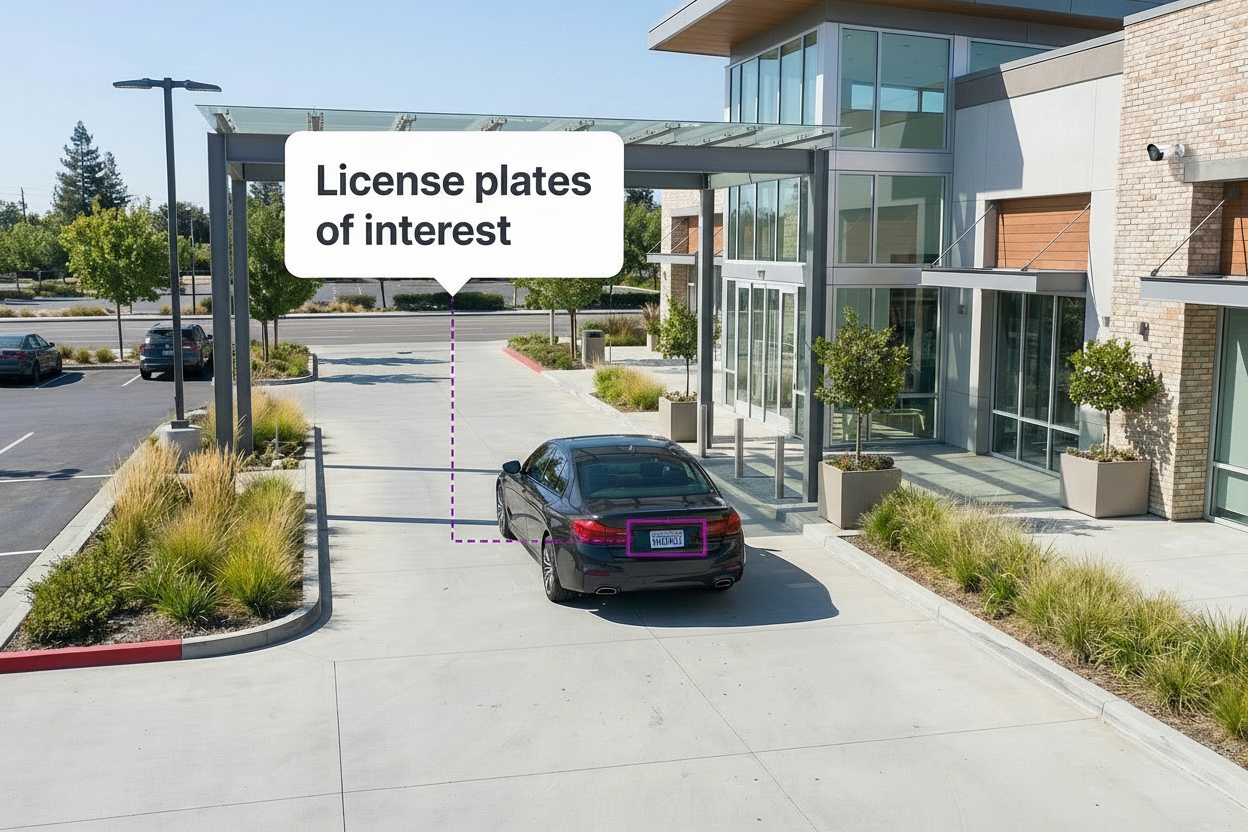


Using license plate recognition for proactive loss prevention in retail
Retail loss prevention leaders are working through the most volatile security environment in decades. Shoplifting incidents rose 18 percent year over year, fundamentally changing the risk profile for store associates and customers (Source: NRF). Violent incidents during theft events climbed 17 percent over the same period, so the traditional observe and report model no longer protects people or profits (Source: NRF). Teams stay stuck in a reactive cycle, reviewing footage of thefts that already happened while struggling to connect coordinated incidents across locations.
To break that cycle, forward-thinking operators turn the cameras they already own into proactive data sources. By pairing Video AI Agents with license plate recognition (LPR) technology, loss prevention professionals can flag high-risk vehicles before they park. This guide shows how to use LPR to identify vehicles of interest, track repeat offenders, and build a data-driven loss prevention strategy that delivers measurable return on investment.
Key takeaways
- License plate recognition converts standard camera feeds into searchable vehicle data, giving loss prevention teams lead time to act before an offender enters the store.
- A well-maintained watchlist of vehicles of interest turns the parking lot into an early-warning zone and supports active deterrence.
- Aggregating plate data across every location surfaces the multi-store patterns that signal organized retail crime, which now involves transnational groups for most retailers.
- Searchable video collapses case review from hours to minutes and builds defensible evidence packages for law enforcement.
- Spot AI is camera-agnostic, so LPR runs on the IP cameras a business already owns and integrates with POS and case management systems.
How license plate recognition works for retail
License plate recognition technology, often called LPR or ALPR, transforms standard video feeds into searchable text data. It turns perimeter cameras into AI coworkers that automatically capture, analyze, and log vehicle data without human intervention, and modern systems read plates reliably even in low light and difficult weather.
The process runs in four rapid stages:
- Image capture: cameras, often with infrared illumination, capture clear images of license plates day or night, keeping focus on vehicles moving at speed.
- Plate detection: AI-powered computer vision locates the plate within the frame, isolating it from the bumper and surrounding scene.
- Character recognition: optical character recognition converts the visual image into machine-readable text, handling non-standard fonts, mud, and difficult angles.
- Real-time analysis: the platform cross-references the plate against your custom watchlists and triggers an alert the moment it finds a match.
The full cycle happens in seconds, giving your team the lead time to act before a suspect reaches the doors.
Moving from reactive recording to proactive deterrence
The core flaw in legacy setups is latency. By the time a loss prevention manager reviews footage, the merchandise is gone and the offender has moved on to another location. That reactive posture creates a permanent disadvantage.
LPR technology shifts your security posture left of boom, acting before the incident escalates. By maintaining a watchlist of vehicles tied to prior thefts, organized retail crime (ORC) groups, or known bans, you create a digital perimeter around your property.
When a flagged vehicle enters the lot, the platform generates a real-time notification. That lets your team run pre-planned responses:
- Deploy resources: move security personnel to the entrance or high-value aisles right away.
- Alert staff: notify floor managers to provide aggressive hospitality to individuals entering from the vehicle.
- Trigger active deterrence: activate strobe lights or audio warnings in the parking lot to signal that the area is actively managed.
This capability turns the parking lot from a liability into a controlled zone, deterring theft attempts before they hit your shrink rate.
Building and managing a watchlist of vehicles of interest
A watchlist, sometimes called a hot-list, is only as strong as the data feeding it. The goal is a living record of vehicles tied to documented risk, not a static spreadsheet that ages out. Loss prevention teams get the most value when the list is sourced from real incidents and reviewed on a schedule.
Effective watchlists draw from a few consistent inputs:
- Closed and open cases: every documented theft or fraud event should contribute the associated plate to the list.
- Trespass and ban records: individuals formally banned from a location can be tied to their vehicles for entrance alerts.
- ORC intelligence sharing: plates flagged by regional retail crime networks extend your coverage beyond your own footprint.
- Behavioral flags: vehicles that loiter in non-customer zones or return at odd hours can be escalated for review before a loss occurs.
Governance matters here. Retailers should collect plate data only in public areas such as parking lots, document a clear loss prevention purpose, and set retention rules so the watchlist reflects current risk rather than an indefinite archive.
Detecting organized retail crime across locations
Organized retail crime is rarely random. It operates like a business, with coordinated groups, planned routes, and repeat targets. Sixty-seven percent of retailers reported transnational ORC group involvement in thefts against their companies within the past year, and 52 percent reported ORC-driven increases in shoplifting and merchandise theft (Source: NRF). Spotting those patterns by hand is nearly impossible for operators watching isolated feeds.
LPR technology excels at pattern recognition. By aggregating vehicle data across your entire enterprise, the system surfaces the anomalies that indicate coordinated activity.
Pattern indicating ORC | How LPR surfaces it |
|---|---|
Multi-store velocity | The platform flags vehicles visiting several locations in a short window (for example, three stores in four hours), a strong indicator of a booster run. |
Temporal anomalies | Vehicles detected entering the lot right after closing or before opening are flagged for review, suggesting reconnaissance or staging. |
Loitering and staging | Vehicles parked in non-customer zones such as fire lanes or rear loading docks for extended periods trigger alerts for potential getaway drivers. |
These insights let you build comprehensive evidence packages for law enforcement. Instead of reporting a single shoplifting incident, you can present a documented timeline of a felony-level conspiracy, which meaningfully raises the likelihood of prosecution.
From hours to minutes: ending the case-review bottleneck
Investigating a single organized retail crime case often means reviewing hours of video across many cameras and days. That manual work drains skilled labor, pulling district managers away from strategic priorities to stare at screens. When a ring hits multiple stores, the workload multiplies.
LPR platforms with cloud-native dashboards solve this by making video searchable. Instead of scrubbing timelines, investigators search for a specific plate across every location in seconds, cutting investigation time from hours to minutes.
Teams can quickly answer the questions that move a case forward:
- Show every visit by this vehicle across the district in the last 90 days.
- Which vehicles were present at Store A, Store B, and Store C during the recent theft spree?
- Generate a report of this vehicle's activity for law enforcement.
The operational impact is significant. All Star Elite, a multi-location retailer running 80 stores, used this unified approach to streamline investigations. By centralizing video data and case management, the retailer reduced incident resolution time from hours to minutes, cut merchandise shrink from roughly 15 percent to about 6 percent, and improved investigation speed by more than 50 percent (Source: Spot AI). Vehicle-recovery outcomes follow the same pattern: automotive group Don Franklin Auto recovered five of six stolen vehicles worth $130,000 each within one hour of the theft after delivering footage to responding officers in about four minutes (Source: Spot AI).
Key terms
- License plate recognition (LPR / ALPR): technology that reads and logs vehicle plates from standard camera feeds as searchable text.
- Organized retail crime (ORC): coordinated groups that steal merchandise for resale, often hitting multiple stores in planned runs.
- Shrink: inventory loss from theft, fraud, and error, measured as a percentage of sales.
- Watchlist (hot-list): a maintained list of plates tied to prior incidents, ORC groups, or trespass bans that triggers an alert when a vehicle returns.
Reactive footage review versus proactive vehicle intelligence
The difference between a legacy camera system and an LPR-driven loss prevention program is not resolution, it is timing and reach. The comparison below shows where proactive vehicle intelligence changes the outcome.
Capability | Reactive footage review | Proactive vehicle intelligence |
|---|---|---|
Timing | Review happens after the loss occurs. | Alerts fire as a flagged vehicle enters the lot. |
Case review | Hours of scrubbing across cameras and days. | Search a plate across every location in seconds. |
Cross-location view | Isolated feeds, patterns missed. | Enterprise-wide patterns surfaced automatically. |
Evidence | Single-incident clips. | Documented multi-store timelines for prosecution. |
Integrating LPR into the wider security ecosystem
A standalone LPR system creates data silos. To get the full value, vehicle data must flow into your broader operational systems. Modern Video AI Agents run on open architecture, so they act as a force multiplier for the stack you already have.
- Point-of-sale (POS) integration: correlating vehicle data with transaction logs helps surface complex fraud. If a vehicle tied to prior refund fraud enters the lot, the system can alert managers to enforce return policies during that window.
- Case management: LPR data should populate incident reports automatically, so every case file carries timestamped vehicle images and associated video clips as a defensible audit trail.
- Access control: for gated perimeters or distribution centers, LPR can automate entry for authorized logistics vehicles while flagging unauthorized attempts.
The financial case for vehicle intelligence
Security investments are often scrutinized as cost centers. In practice, the return on LPR technology is quantifiable through reduced shrinkage, labor savings, and risk mitigation. With clear metrics, the technology reads as a margin-protection tool rather than an expense. It also closes a well-documented gap: 64 percent of retailers report fewer than half of their store theft incidents to law enforcement, often because the evidence is too slow to assemble (Source: NRF).
Cost or benefit category | Financial impact |
|---|---|
Shrinkage reduction | Proactive deterrence works. All Star Elite used this technology stack to reduce cash shrink by 83 percent and merchandise shrink by roughly 60 percent (Source: Spot AI). |
Labor efficiency | Automated alerts reduce the need for dedicated monitoring, letting staff redeploy to high-value tasks. |
Investigation speed | Cutting case review from hours to minutes saves management wages and frees leadership for training and operations. |
Liability defense | Objective, timestamped evidence of vehicle and pedestrian movement supports a strong defense against false liability claims and can lower insurance exposure. |
Evolve your loss prevention strategy
The era of passive recording is over. As organized retail crime grows more sophisticated, loss prevention teams need tools that provide anticipatory intelligence. License plate recognition offers the leverage to secure the perimeter, identify repeat offenders, and dismantle criminal networks before they reach your doors. By pairing camera-agnostic Video AI Agents with your existing stack, you unify your security operations and deliver a safer environment for customers and staff.
Ready to turn the cameras you already own into proactive AI coworkers? Book a demo to see how Spot AI's AI Security Guard helps retail loss prevention teams reduce shrink and close cases faster.
Frequently asked questions
What are the benefits of using LPR for loss prevention?
The primary benefits include early detection of high-risk vehicles, drastically reduced case review times, the ability to track organized retail crime patterns across multiple locations, and measurable decreases in inventory shrinkage. Together they shift the team from reacting after a loss to acting before one occurs.
How can LPR technology help identify repeat offenders?
By maintaining a historical database of vehicle visits, LPR platforms let you link a specific vehicle to multiple theft incidents. Once a vehicle is flagged, the system alerts your team the moment it returns to any of your locations, enabling proactive intervention.
What are the legal implications of tracking vehicles with LPR?
Retailers must comply with state and local privacy regulations. Best practices include establishing strong data governance policies, collecting data only in public areas like parking lots, and using the data solely for documented security and loss prevention purposes. Always consult legal counsel regarding specific local requirements.
How do I integrate LPR systems with existing security measures?
Modern LPR solutions, like Spot AI, are camera-agnostic and feature open APIs. This lets them integrate with your existing IP cameras, POS systems, and case management software, creating a unified intelligence platform without ripping and replacing your current hardware.
How do I use LPR analytics to prioritize store audits?
LPR analytics enable data-driven auditing. If the platform flags a vehicle of interest visiting multiple stores in a single day, it signals coordinated activity. Loss prevention leaders can then prioritize those specific locations for follow-up and resource allocation.
About the author
Sud Bhatija is COO and Co-founder at Spot AI, where he scales operations and GTM strategy to deliver video AI that helps operations, safety, and security teams boost productivity and reduce incidents across industries.

