




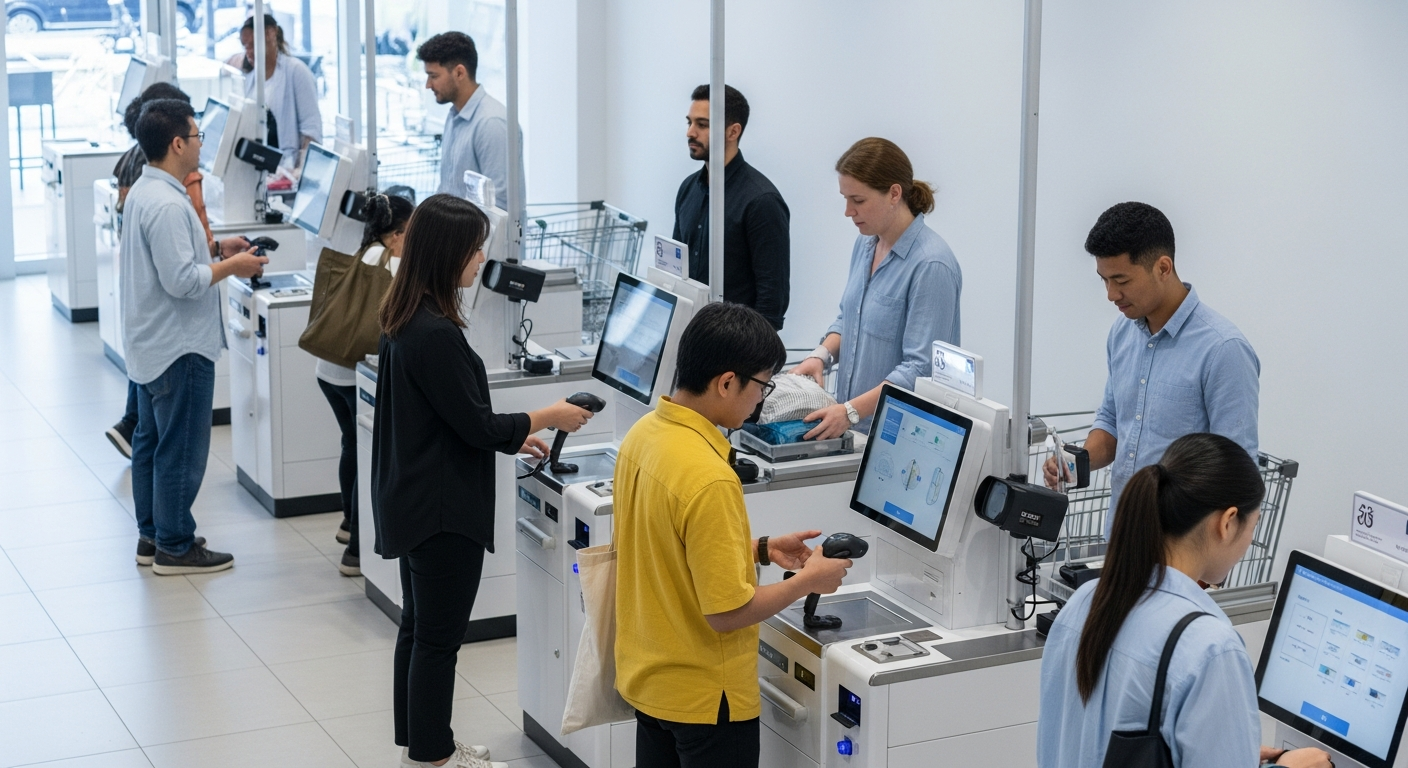


Retail leaders and asset protection directors face a complex trade-off in 2025. Self-checkout kiosks and unattended payment terminals are essential for managing labor costs and increasing throughput, but they introduce substantial vulnerabilities. The National Retail Federation's recent data indicates that retail shrinkage continues to impact margins significantly, with self-checkout environments contributing disproportionately to these losses (Source: National Retail Federation).
For asset protection teams, the challenge extends beyond catching shoplifters. They must manage a complex ecosystem of disconnected security systems, combat organized retail crime (ORC), and reduce the operational drag of manual investigations. Consider this: 99% of video footage is never reviewed, meaning most incidents go undetected until inventory audits reveal the damage. Traditional video systems that only record footage for post-incident review can't keep pace with modern retail fraud.
This guide explores how to monitor unattended checkouts and kiosks to lower shrink by leveraging Video AI Agents, integrating point-of-sale (POS) data, and adopting forward-looking operational strategies. By turning existing cameras into intelligent teammates, retailers can standardize security across locations and protect margins without compromising the customer experience.
Key terms to know
- Unattended checkout: A point-of-sale system where the customer scans and pays for items without direct cashier assistance, often supervised by a remote or floating attendant.
- Sweet-hearting: A form of employee fraud where a cashier or self-checkout host intentionally bypasses scanning items or applies unauthorized discounts for friends or family.
- Scan avoidance: A theft tactic where a customer intentionally fails to scan an item, often by leaving it in the cart or passing it around the scanner.
- Organized retail crime (ORC): Coordinated theft conducted by professional groups who resell stolen goods, often exploiting specific vulnerabilities like unattended kiosks across multiple locations.
- Video AI Agents: Technology that uses artificial intelligence to analyze video feeds in real time, detecting defined behaviors (like loitering or rapid movement) and sending alerts, acting as a force multiplier for staff.
The operational reality of unattended retail shrink
The shift toward self-service has altered the loss landscape. While labor costs decrease, the opportunity for both malicious and accidental loss increases. Recent research highlights that nearly one in three retail shrinkage incidents now involves some form of self-checkout manipulation.
For an asset protection director managing dozens or hundreds of locations, the core frustration is often the inability to see what's happening in real time. Traditional video systems provide evidence only after the damage is done. By the time a manager reviews footage of a barcode switch or a push-out, the inventory is gone and the opportunity for recovery is lost.
Common loss scenarios at kiosks
- Barcode manipulation: Sophisticated offenders swap barcodes from low-cost items onto high-value merchandise. ORC groups often target specific retailer technology deployments they've identified as vulnerable.
- Mis-scans and non-scans: Whether accidental or intentional, customers frequently fail to scan every item. Without real-time alerts, these errors go unnoticed until inventory audits reveal the discrepancy.
- Employee-assisted fraud: Internal theft remains a major driver of shrink. This includes employees overriding alerts at kiosks or allowing known associates to bypass payment.
- Concentrated ORC activity: Recent data reveals that 70% of stolen value comes from just 10% of persons of interest, indicating a highly concentrated pattern of loss driven by repeat offenders (Source: Auror Co).
Why traditional monitoring fails asset protection teams
Many retailers struggle with high shrink rates because their systems are reactive and disconnected, not because they lack cameras. The modern Asset Protection VP is plagued by false alarm fatigue and the sheer volume of data that can't be processed manually.
The limitations of legacy video systems
- Reactive capabilities: Standard camera systems only provide value after an incident occurs. They require hours of manual footage review to find a particular event, draining resources that could be used for proactive responses.
- False alarm fatigue: Older motion detection systems generate excessive noise, alerting staff to every shadow or harmless movement. This leads to staff ignoring alerts entirely, masking genuine incidents.
- Disconnected data: When video systems aren't integrated with POS or inventory data, blind spots emerge. A transaction might look legitimate on video, but without seeing the digital receipt data in the same view, fraud like barcode switching is tough to detect.
Operational technology for unattended checkout monitoring
To move from reactive responses to proactive shrink reduction, retailers are deploying a layered technology approach. This involves combining physical barriers with intelligent digital systems that act as a force multiplier for existing staff.
| Technology layer | Operational function | Impact on shrink |
|---|---|---|
| Video AI Agents | Real-time detection of behaviors like loitering, dwell time, and specific movements. | Cuts response time substantially by alerting staff to potential theft before it completes. |
| Computer Vision | Verifies that the item being scanned matches the product visually. | Mitigates barcode switching and mis-scans. |
| RFID & EAS | Tracks item-level movement through exits and creates alarm triggers. | Deterrent for push-outs; enables item-level visibility. |
| Smart Scales | Verifies item weight against the scanned SKU database. | Detects discrepancies in bagged items vs. scanned items. |
How Video AI Agents cut kiosk shrink
Video AI augments existing camera infrastructure to support the loss prevention team. Instead of simply recording, the system acts as a junior teammate, flagging defined risk indicators and notifying staff quickly.
1. Real-time behavior detection
Video AI Agents can be trained to recognize behaviors that precede theft. For example, Loitering detection identifies individuals who linger in high-value areas or near unattended kiosks without initiating a transaction. This allows staff to offer customer service—a proven deterrent—before a theft occurs. This proactive approach is critical as retailers report a 91% increase in violence compared to 2019, making non-confrontational early intervention vital for staff safety (Source: TheStreet).
2. Monitoring unattended areas
One of the specific challenges in retail is when a kiosk or service desk is left unstaffed. Spot AI's Unattended Checkout or Desk capability monitors these specific zones. If a customer approaches a kiosk but no staff member is present, or if a transaction is initiated at a closed terminal, the system sends a real-time alert to the floor manager. This guards against opportunistic theft at unmanned stations.
3. Combating organized retail crime (ORC)
ORC groups often scout locations before striking. Retailers have reported a 188% increase in license plate recognition (LPR) site deployments to combat this trend (Source: Auror Co). By using Person Enters No-go Zones analytics and vehicle attribute search, asset protection teams can receive alerts when unauthorized individuals or vehicles enter restricted areas like stockrooms or loading docks. Unified dashboards allow VPs to track suspicious patterns across multiple store locations, identifying if the same group is hitting different sites.
4. Cutting investigation time
Legacy systems require hours of scrubbing through footage to find an incident. Modern Video AI platforms use natural language search. An investigator can simply search for "person in red shirt near self-checkout at 2 PM," and the system retrieves the relevant clips in seconds. This capability can reduce investigation time by 50–70%, allowing teams to resolve more cases and improve recovery rates (Source: Businesswire).
Integrating video with POS for broader visibility
The most effective strategy for monitoring unattended checkouts involves bridging the gap between physical observation and digital transaction data. Integrating video AI with Point-of-Sale (POS) systems helps teams review transactions alongside video for faster, more accurate investigations.
Transaction-video correlation
When video analytics are integrated with POS data, transactions are time-stamped and linked to the corresponding video clip. If a transaction is voided, refunded, or heavily discounted, the system flags it as an exception. An investigator can then review the video clip associated with that specific transaction to verify if the void was legitimate or a case of sweet-hearting.
Identifying high-risk patterns
Integrated systems allow for batch analysis. Asset protection directors can run reports to see which specific kiosks, shifts, or employees have the highest rates of voids or "item not found" errors. This data-driven approach moves loss prevention from random spot checks to targeted coaching and intervention.
Operational best practices for unattended retail
Technology is most effective when paired with strong operational protocols. Lowering shrink requires a culture of operational excellence where staff are trained and empowered.
1. Training as a deterrent
Research indicates that customer service is one of the most effective theft deterrents. Staff stationed near unattended checkouts should be trained to engage customers, make eye contact, and offer assistance. This psychological barrier helps deter opportunistic theft.
2. Strategic store layout
Design the self-checkout area to minimize blind spots. Ensure that the attendant station has a clear line of sight to all kiosks. Place high-shrink items in areas with high visibility or require them to be processed at staffed lanes. Heatmaps from video analytics can reveal traffic flow issues, allowing you to optimize layout for both security and sales.
3. Standardizing response protocols
When a video AI system triggers an alert (e.g., "Loitering at Kiosk 3"), there must be a standardized operating procedure (SOP) for how staff respond. The response should be non-confrontational, such as asking, "Did you need help finding anything?" This approach balances security with customer experience.
Comparing video analytics solutions
For asset protection leaders evaluating technology, selecting a platform that scales easily and integrates with existing infrastructure is crucial.
| Feature | Spot AI | Traditional VMS | Pure Cloud Cameras |
|---|---|---|---|
| Deployment Speed | Simple setup; can be live quickly. | Weeks to months for cabling/servers. | Fast, but requires replacing all cameras. |
| Camera Compatibility | Camera-agnostic; works with existing IP/analog cameras. | Often proprietary or limited support. | Proprietary; requires buying their hardware. |
| AI Capabilities | Built-in AI agents (Loitering, Unattended Desk, PPE). | Often requires expensive add-on modules. | Basic motion detection; advanced AI costs extra. |
| Scalability | Supports many users; cloud dashboard for multi-site management. | Difficult to manage multi-site remote access. | Scalable but high bandwidth consumption. |
| Search | Natural language search (Google-like). | Manual scrubbing of timelines. | Varies; often limited retention. |
Spot AI enables retailers to use existing cameras with added video AI features, helping large deployments control costs.
Measuring ROI on unattended checkout monitoring
To justify the investment in video AI and monitoring technology, asset protection directors must demonstrate clear Return on Investment (ROI).
- Direct shrink savings: Retailers implementing comprehensive video analytics report cutting shrinkage by 15–30% within the first year (Source: Businesswire). All Star Elite, a multi-location sports apparel retailer, deployed Spot AI and reduced their cash shrink from approximately 6% to 1%—an 83% reduction. They also saw merchandise shrink drop from 10–15% to roughly 6% (Source: Spot AI).
- Labor efficiency: Automating monitoring allows retailers to lower guard spend. Instead of paying for a dedicated guard to watch a monitor, AI agents support continuous monitoring at a fraction of the cost.
- Investigation speed: Reducing investigation time saves thousands of dollars in administrative labor annually. All Star Elite improved their investigation efficiency by over 50%, cutting incident resolution from hours to minutes.
The path forward for asset protection
Monitoring unattended checkouts and kiosks to reduce shrink benefits from a shift from reactive monitoring to insight-driven workflows. By leveraging Video AI, retailers can uncover hidden operational risks, help deter theft, and streamline investigations.
Spot AI helps asset protection teams standardize security across shifts and sites, turning existing cameras into a coordinated monitoring system. This approach supports the bottom line and creates a safer, more efficient shopping environment.
See Spot AI in action
"Our business has a kiosk station that should always have a customer service attendant present to help customers through their selections and have a friendly inviting interaction. Spot AI can track the presence of people or lack thereof, and it puts all of the data into an easy to understand chart that can be quickly accessed and shared with the team at any given time to re-direct their focus and increase the customer experience. This description is only a small window of what Spot AI provides, the possibilities of other uses are coming up daily, providing great alert systems and security to run a safe healthy business."
- JAMIE M., District Manager of multiple high-volume automatic bay car washes
Ready to turn your cameras into a force multiplier for your loss prevention team? Request a demo to explore how video AI can help cut shrink and deliver real-time visibility across your retail locations.
Frequently asked questions
What are the best practices for monitoring unattended checkouts?
Best practices include integrating video monitoring with POS transaction data to correlate scans with video evidence, using AI analytics to detect non-scanning behaviors in real time, and positioning attendants to maintain clear lines of sight. Training staff on de-escalation and customer service is also critical for deterrence.
How can technology help cut shrinkage at self-checkouts?
Technology helps cut shrink by automating detection. Computer vision can verify that the item scanned matches the physical product, smart scales detect weight discrepancies, and video AI alerts staff to suspicious loitering or missed scans in real time, allowing for intervention before the customer leaves.
Do AI cameras help cut shrink at kiosks?
Yes, AI cameras significantly cut shrink by detecting behaviors that traditional cameras miss, such as scan avoidance gestures or barcode switching. They also minimize false alarms, ensuring staff only respond to genuine security events, which improves the overall effectiveness of the monitoring strategy.
What compliance requirements exist for unattended payment systems?
Unattended payment systems must comply with PCI DSS standards to protect cardholder data. This includes encrypting data transmission, avoiding storage of sensitive card information, and ensuring physical terminals are tamper-resistant. Video systems monitoring these areas must also adhere to privacy laws regarding data retention and employee monitoring.
About the author
Sud Bhatija is COO and Co-founder at Spot AI, where he scales operations and GTM strategy to deliver video AI that helps operations, safety, and security teams boost productivity and mitigate incidents across industries.

