




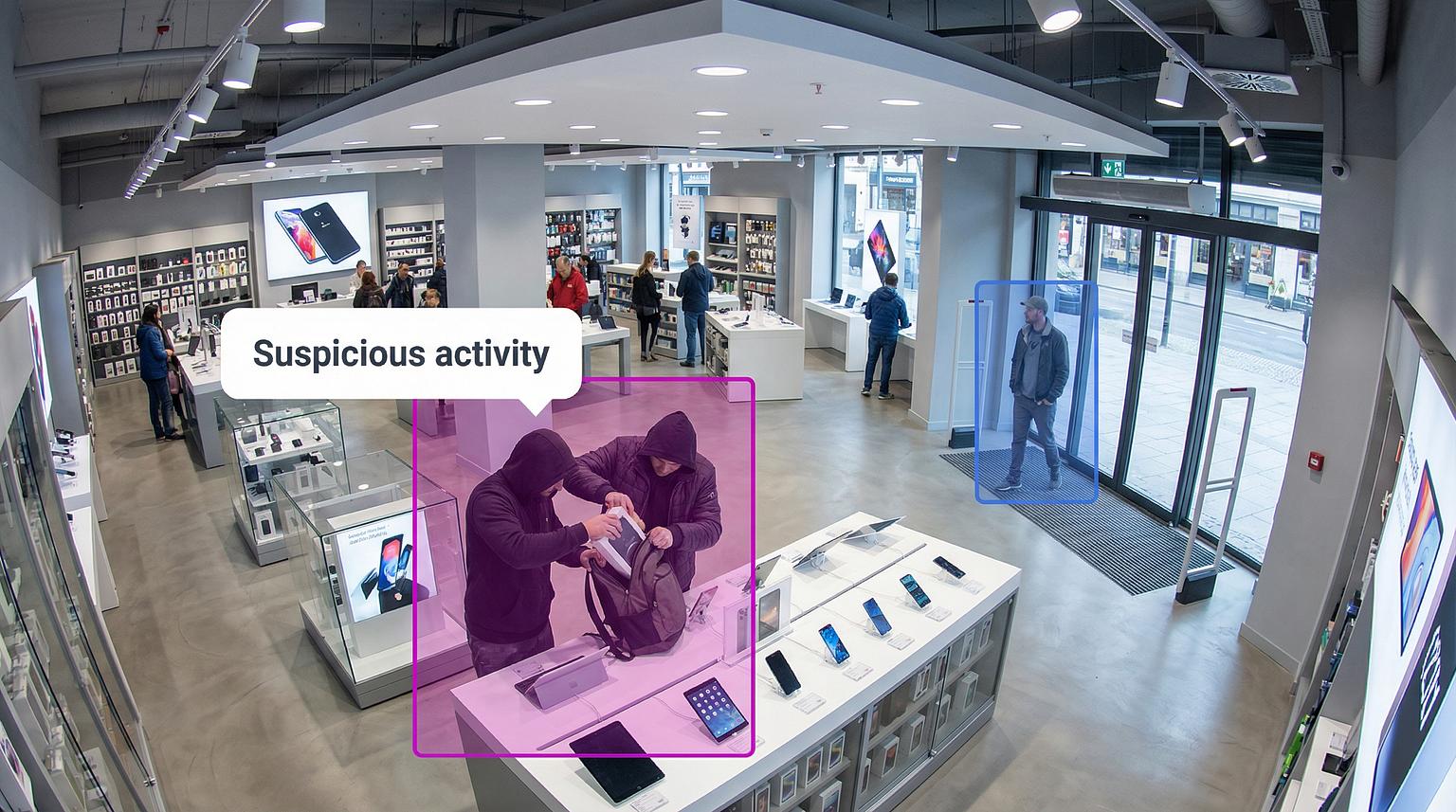


The anatomy of retail theft has shifted. It is no longer just a teenager slipping a candy bar into a pocket; it is a coordinated enterprise where teams of boosters hit multiple locations in a single day, moving merchandise through sophisticated fence networks before the shift report is even filed.
For Directors and VPs of Loss Prevention, the pain point isn’t just the volume of incidents—it’s the lack of connection between them. A vehicle loitering in a parking lot at Store A is treated as an isolated event, unrelated to the pushout theft at Store B thirty minutes later. This disconnection is the gap organized retail crime (ORC) rings exploit.
Traditional video systems record these events passively, leaving teams to piece together the narrative days later. To combat modern ORC, retail leaders are moving toward integrated outdoor-indoor intelligence—technology that connects the dots between the perimeter and the point of sale, turning isolated data points into actionable evidence of organized activity.
Key terms to know
- Organized retail crime (ORC): large-scale theft and fraud by groups of professional shoplifters (boosters) who steal merchandise for resale (fencing).
- License plate recognition (LPR): technology that reads and digitizes vehicle license plates to track entries, exits, and dwell times.
- Video AI agents: intelligent software that processes video feeds in real-time to detect specific behaviors, attributes, or anomalies.
- Attribute search: the ability to filter video footage by physical characteristics (e.g., "red truck," "person in blue hoodie") rather than just time.
The operational reality of modern ORC
Organized retail crime is a logistical operation that rivals legitimate supply chains in its efficiency. Criminal groups employ designated roles—pickers, lookouts, and drivers—to extract high-value goods systematically.
How ORC groups exploit operational gaps
- Speed and coordination: teams clear shelves and exit before store associates can react.
- Multi-store targeting: groups hit multiple locations in a region to keep theft amounts below felony thresholds at any single store.
- Perimeter exploitation: drivers position vehicles for rapid extraction, often loitering in fire lanes or blind spots.
- Return fraud: stolen goods are returned to different locations for cash or gift cards, exploiting policy loopholes.
The financial impact is staggering. Retailers reported a 90% increase in dollar loss due to shoplifting from 2019 to 2023 (Source: The Street). In Pennsylvania alone, a newly formed ORC unit surpassed 100 new investigations across 52 counties in its first year, seizing nearly $500,000 in stolen goods and cash (Source: Pennsylvania Office of Attorney General).
These statistics highlight a critical pain point for LP leaders: shrinking margins and rising incidents are outpacing the ability to staff guards or monitor screens.
Connecting the dots: from parking lot to point of sale
The most effective way to disrupt an ORC ring is to identify the pattern before the theft occurs. This requires moving your defensive perimeter outward.
Why the parking lot is your first line of defense
Most ORC events begin in the parking lot. A vehicle backs into a spot near the entrance, or a driver waits with the engine running. Traditional camera systems might record this, but they don't alert you to it.
By integrating License Plate Recognition (LPR) with general video systems, you create a digital perimeter. When a vehicle associated with a previous incident enters a property, the system recognizes the plate and alerts local staff without delay. This "left of boom" approach allows teams to position themselves preemptively rather than reacting to a pushout in progress.
Unifying data across the portfolio
The real power of unified intelligence lies in cross-site visibility. An ORC group might hit a grocery chain in one county and a hardware store in the next.
Spot AI enables this visibility through a cloud-native dashboard that centralizes data from all locations.
- Vehicle identification: detect a suspect vehicle at Store A.
- Portfolio-wide alert: flag that vehicle across all other locations in the region.
- Pattern recognition: identify that the same vehicle visits three specific stores every Tuesday between 2:00 PM and 5:00 PM.
This turns a series of "petty thefts" into a documented case of organized crime, providing law enforcement with the evidence needed for felony charges.
Reducing guard dependency with automated deterrence
Guards are expensive, inconsistent, and cannot be everywhere at once. For many retailers, maintaining 24/7 guard coverage at every high-risk location is financially unsustainable.
AI Security Guards offer a scalable alternative. Unlike passive cameras that simply record crime, these AI agents act as active teammates.
How AI security guards work
- Detection: the system identifies a person or vehicle loitering in a restricted zone (e.g., behind the store or near the loading dock) after hours.
- Deterrence: the system automatically triggers flashing strobes and plays a contextual audio message (e.g., "You are in a restricted area").
- Notification: an alert is sent to the LP team or remote monitoring center only if the threat persists.
This automated response creates a "managed environment" feel that discourages casual criminals and disrupts the comfort zone of ORC groups. It allows LP leaders to cut guard hours without sacrificing perimeter control.
| Feature | Traditional camera systems | Spot AI unified platform |
|---|---|---|
| Primary function | Passive recording | Active detection and deterrence |
| Search capability | Manual rewind and watch | Attribute search (color, vehicle, object) |
| Multi-site view | Siloed by location | Centralized cloud dashboard |
| Intelligence | None (pixel recording) | AI Agents (LPR, loitering, anomalies) |
| Deployment | Complex wiring and servers | Plug-and-play with existing hardware |
Accelerating investigations: turning hours into minutes
One of the biggest drains on Loss Prevention resources is the time spent investigating incidents. Reviewing footage to find a specific event can take hours—time that LP managers simply do not have.
With attribute search, investigators can bypass the timeline entirely. Instead of scrubbing through video, they can search for specific descriptors:
- "Red pickup truck"
- "Person wearing yellow shirt"
- "Backpack"
Research indicates that modern video search capabilities can decrease investigation time from 4-6 hours to just 30-60 minutes. This efficiency allows teams to build comprehensive case files for law enforcement faster, increasing the likelihood of merchandise recovery and successful prosecution.
Building a case for ROI
For VPs of Asset Protection, investing in new technology requires a defensible ROI. Unified outdoor-indoor intelligence delivers value through three primary levers:
- Shrink reduction: comprehensive loss prevention strategies can lower shrink by 15-30% (Source: SafetyCulture).
- Labor optimization: automated deterrence lowers the need for physical guards, and faster investigations free up LP managers to focus on training and strategy.
- False alarm reduction: AI verification can minimize false alarms by 30-50%, mitigating alarm fatigue and ensuring teams respond to genuine threats.
By connecting the dots between isolated incidents, retailers stop managing chaos and start engineering safer, more profitable environments.
Conclusion
Organized retail crime thrives on disconnection. It relies on the assumption that Store A doesn't know what happened at Store B, and that the camera in the parking lot isn't talking to the camera at the register. Unified outdoor-indoor intelligence breaks this model.
By leveraging Video AI Agents to detect threats at the perimeter, identify patterns across locations, and automate deterrence, LP leaders can regain control. It is time to stop reacting to incidents and start disrupting the networks behind them.
See how video AI can help you connect the dots across your retail locations.
Request a demo to experience Spot AI in action and explore how unified video intelligence can strengthen your perimeter.
"Before implementing this system, tracking tailgating relied entirely on human observation. Now we receive real-time alerts when someone holds the door open or if multiple people enter in quick succession, allowing us to address security protocols in real-time rather than after the fact."
— Mike Tiller, Director of Technology, Staccato (Source: Spot AI Customer Story: Staccato)
Frequently asked questions
What are the most effective methods for countering organized retail crime?
The most effective methods involve a layered approach that combines employee training, physical security measures, and advanced technology. Key strategies include integrating License Plate Recognition (LPR) to identify suspect vehicles at the perimeter, using AI video analytics to detect suspicious behaviors like loitering or unauthorized entry, and employing automated deterrence systems (lights and audio) to disrupt criminal activity before it escalates.
How can AI and video analytics reduce retail theft?
AI and video analytics curb retail theft by shifting security from reactive to anticipatory. Instead of just recording a theft, AI agents can detect specific threat indicators—such as a vehicle dwelling in a fire lane or a person entering a restricted stockroom—and trigger real-time alerts. This allows staff or security personnel to intervene in real-time. Additionally, AI streamlines investigations, allowing teams to quickly link suspects across multiple incidents and locations.
What are the latest statistics on organized retail crime?
Recent data highlights the growing scale of ORC. The National Retail Federation reported a 90% increase in dollar loss due to shoplifting from 2019 to 2023 (Source: The Street). Furthermore, cargo theft, which feeds the ORC supply chain, saw estimated losses surge 60% to nearly $725 million in 2023 (Source: Verisk).
How do different technologies integrate into existing retail security systems?
Modern unified platforms like Spot AI are designed to be "camera-agnostic," meaning they connect with existing IP cameras and infrastructure. This eliminates the need for a "rip-and-replace" overhaul. These platforms centralize data from various sources—video, access control, and LPR—into a single cloud dashboard, allowing for seamless management across hundreds of locations without requiring complex new wiring or proprietary hardware.
About the author
Rish Gupta
Rish Gupta is CEO and Co-founder of Spot AI, leading the charge in business strategy and the future of video intelligence. With extensive experience in AI-powered security and digital transformation, Rish helps organizations unlock the full potential of their video data.

