






AI monitoring systems for retail: top solutions in 2026
Retail theft stopped being a nuisance line item and became a board-level risk. U.S. retail shrink reached $112.1 billion in fiscal 2022, roughly 1.6% of sales, and the pressure has not eased since. (Source: NRF) Retailers reported an 18% jump in the average number of shoplifting incidents in 2024 versus 2023, alongside a 17% rise in threats or acts of violence over the same window. (Source: NRF) For loss prevention and asset protection leaders, the mandate has shifted: the goal is no longer to document an incident after it happens, but to deter it while it unfolds. This guide walks through the capabilities that separate the top AI monitoring systems for retail in 2026, and how to match them to your store formats.
Key takeaways
- AI monitoring systems for retail turn the cameras a store already owns into AI coworkers that detect intent, deter in real time, and package case-ready evidence.
- The strongest platforms deliver both security and operations value: shrink reduction plus people counting, dwell analytics, and layout insight from one system.
- Exception-based reporting ties video to point-of-sale data, so teams review flagged events instead of scrubbing hours of footage.
- A hybrid edge-to-cloud design keeps full-resolution video on-site and sends only metadata to the cloud, which supports fast, secure, PCI-clean deployments.
- All Star Elite cut cash shrink from 6% to 1% and sped investigations by over 50% after unifying cameras, cases, and analytics on Spot AI.
From passive recording to real-time deterrence
Legacy recording carries one structural flaw: it is reactive. A traditional camera builds a library of evidence for events that already cost the store inventory, revenue, or a frightened associate. In a high-shrink environment, that is a sunk expense. The 2026 shift is toward video security that acts the moment a pattern emerges, not hours later when a manager finally pulls the clip.
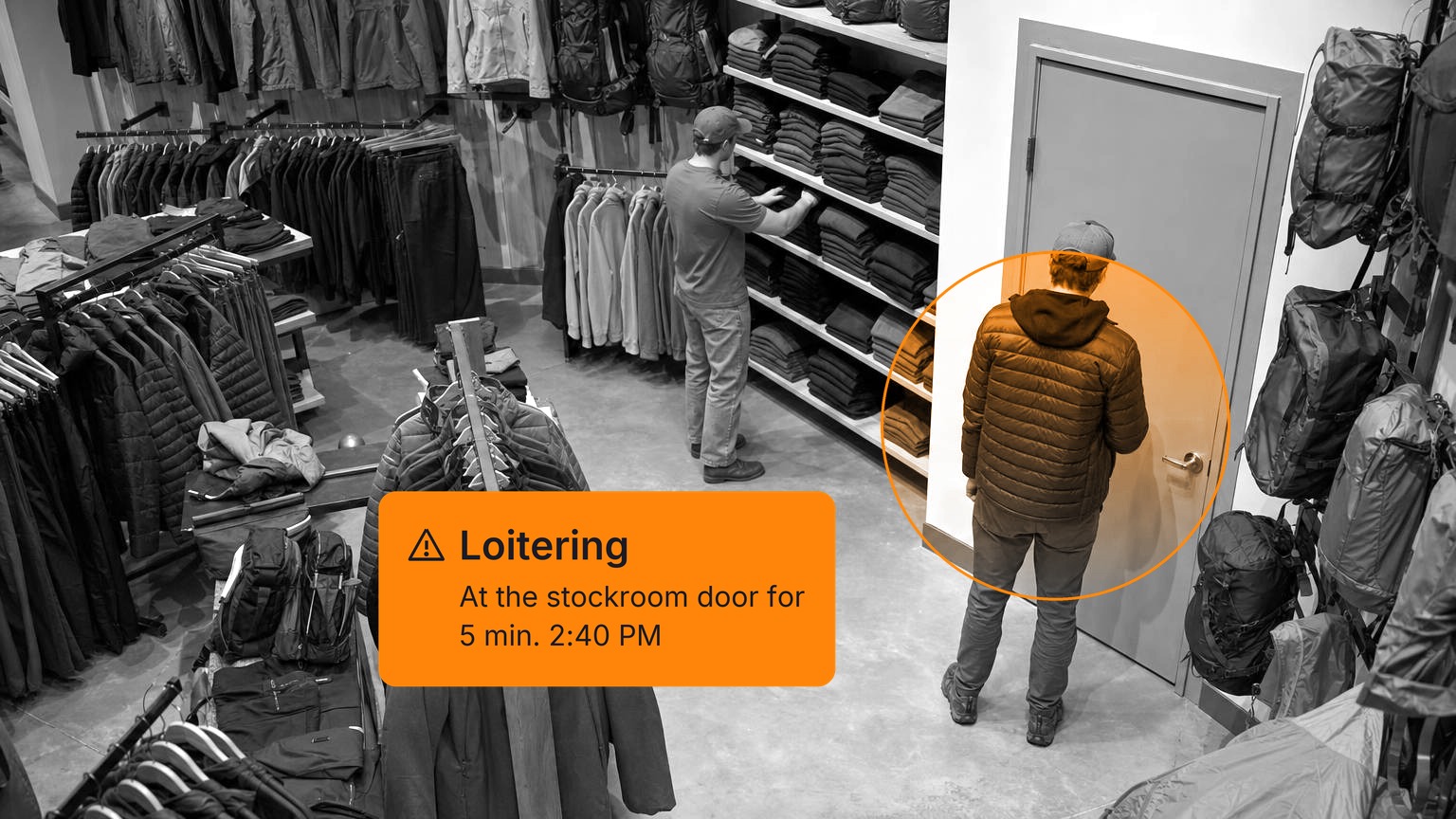
Modern video AI works as a force multiplier for a thin security team. Instead of asking a guard to stare at a wall of monitors, an AI Security Guard uses computer vision to read context, such as a person loitering by a stockroom door or a vehicle idling in a fire lane, and then triggers a graded response. Spot AI follows a detect, secure, deter flow: it identifies the events that matter, notifies the right people or a security operations center, and can play a natural-conversation AI talkdown, switch on strobe lights, or sound an alarm to move a trespasser along. That active layer is what makes a store a hard target rather than a soft one, and it is the capability legacy footage can never offer.
What separates an AI monitoring system from legacy cameras
Buyers evaluating retail video AI in 2026 are really comparing two operating models. One captures video for later; the other reasons over video as it happens. The table below maps the practical differences a loss prevention leader will feel day to day.
Capability | Legacy recording | AI monitoring system |
|---|---|---|
Primary role | Stores footage for after-the-fact review | Detects intent and acts while an event unfolds |
Response to a threat | Manual and reactive | Automated deterrence: talkdowns, lights, alerts |
Investigations | Scrub hours of video by hand | AI search returns the right clip in minutes |
Loss signals | Cameras and point-of-sale live in separate silos | Video tied to transaction data for exception-based reporting |
Operations insight | None | People counting, dwell time, and layout analytics |
Hardware | Tied to a single recorder or camera brand | Camera-agnostic, works with the cameras a store already owns |
Turning theft signals into loss prevention outcomes
The threat picture is not only larger, it is more coordinated. More than half of retailers reported that organized retail crime groups drove increases in phone scams (70%), digital and ecommerce fraud (55%), shoplifting and merchandise theft (52%), and cargo or supply-chain theft (50%). (Source: NRF) The human cost tracks alongside the financial one: 83% of retailers said levels of aggression and violence were the same or higher than the year before. (Source: NRF)
Video AI helps loss prevention teams get ahead of that pattern rather than chase it. Detection agents flag the behaviors that precede an ORC hit, such as coordinated groups staging near an exit, repeat license plates of interest in the lot, or a booster working a fixture. Real-time deterrence then interrupts the sequence before merchandise leaves the floor, which reduces both loss and the odds of a violent confrontation with staff. Eight in 10 retailers now report that violence tied to ORC incidents rose in the past year, so tools that de-escalate at the perimeter protect people, not just profit. (Source: Security Magazine)
Deterrence and de-escalation move together. When a system reads intent at the perimeter and responds with a talkdown or lights, it can move a would-be booster along before the encounter reaches an associate, which is why eight in 10 retailers now weigh violence reduction as part of their loss prevention case.
Operational intelligence beyond security
Security is only half the return. The same retail video AI that reads theft can surface the operational signals leaders otherwise lack in the physical store. That dual use matters because budgets are tight: 77% of retailers still allocate 5% or less of their technology spend to AI, though 39% expect that share to pass 10% within three years. (Source: NRF) A system that earns its keep on security and operations is far easier to justify. Key operational use cases include:
- People counting and conversion: accurate footfall data lets managers align staffing with real traffic peaks instead of guessing from sales history.
- Dwell time and merchandising: dwell and traffic-flow analytics show whether a promotional display pulls engagement or simply creates a bottleneck.
- Queue awareness: alerts fire when a checkout line crosses a threshold, so a floor lead can open a register before customers abandon the basket.
- Layout decisions: pattern data helps merchandising teams test placement and validate what actually lifts sales per square foot.
All Star Elite, a sports apparel retailer running 80 stores, used exactly this loop. Optimized placement of a best-selling jersey line pulled traffic into adjacent categories and lifted sales by 5% to 15%, a customer-reported outcome that came from the same platform handling its loss prevention.
Connecting video to the point of sale
Not all shrink walks in the front door. Register fraud and internal theft remain sensitive but material, and this is where point-of-sale integration earns its place. Pairing transaction data with video produces exception-based reporting, so a loss prevention analyst reviews only flagged events, such as an unusual void, an excessive refund, a no-sale drawer open, or a fake scan, instead of combing through a full day of footage.
Return fraud shows why this matters at scale. Consumers are expected to return $849.9 billion in merchandise in 2025, about 15.8% of annual sales, and 9% of all returns are fraudulent. (Source: NRF) In response, 85% of retailers now employ AI to detect or address return fraud. (Source: NRF) The threat is also getting more sophisticated: 69% of retailers experienced AI-enabled fraud in the past year, yet only 3% feel well prepared to address it. (Source: Deloitte) Tying video verification to the transaction record gives investigators the context to resolve a disputed return quickly and defensibly.
Hybrid edge-to-cloud architecture for IT and facilities
For the IT and facilities stakeholders who co-own the decision, the debate over on-prem versus pure cloud has largely settled on a hybrid model. Video processes locally on an Intelligent Video Recorder (IVR), which keeps latency low for real-time alerts, while only metadata and thumbnails cross the network for remote access and long-term retention. Because full-resolution video stays inside the building, the design carries a lighter bandwidth burden and stays PCI-clean.
Two practical advantages follow. First, camera-agnostic software layers analytics onto the IP cameras a store already owns (any ONVIF device), so retailers upgrade intelligence without a rip-and-replace project across hundreds of sites. Second, the hybrid approach keeps evidence available even when connectivity drops, since the IVR retains footage locally and syncs once the link returns. Spot AI's practices are NDAA-compliant and SOC 2 aligned, which matters to the security review that now gates most enterprise retail purchases.
Choosing a system: match capabilities to store format
The right mix of capabilities depends on what a given format loses and where. A convenience site fights after-hours risk in the lot; an apparel chain fights fitting-room shrink and ORC. Use the matrix below as a starting point, then weight it against your own incident data.
Store format | Top loss driver | Capabilities that matter most |
|---|---|---|
Big-box and department | Organized retail crime, high-value theft | Perimeter deterrence, license plate recognition, exception-based reporting, case management |
Specialty and apparel | Merchandise shrink, fitting-room theft | People counting, dwell analytics, AI search, exception-based reporting |
Convenience and fuel | After-hours risk, drive-offs | Outdoor deterrence, license plate recognition, real-time alerts |
Grocery and drug | Self-checkout fraud, ORC | Checkout monitoring, exception-based reporting, ORC pattern detection |
A short evaluation sequence keeps the selection grounded:
- Start with your own loss data, and rank formats by shrink rate and incident severity.
- Confirm the platform is camera-agnostic, so existing cameras stay in play across the fleet.
- Test real-time deterrence and AI search on your own footage during a proof of value.
- Validate point-of-sale integration for exception-based reporting before you scale.
- Check the security posture: NDAA compliance, SOC 2, and a hybrid design that keeps video on-site.
Key terms
- AI Security Guard: Spot AI's coworker for perimeter and interior protection that detects intent, deters in real time, and delivers case-ready evidence.
- Exception-based reporting: pairing point-of-sale data with video so teams review only flagged events, such as voids, refunds, and no-sale drawer opens.
- Camera-agnostic: software that runs on the IP cameras a store already owns (any ONVIF device), with no rip-and-replace.
- Shrink: inventory loss from theft, fraud, and error, measured as a percentage of sales.
What retailers report after the switch
Outcomes land best when they come from a peer. All Star Elite unified cameras, case management, and people counting on Spot AI across its 80 apparel stores. The retailer reported cutting cash shrink from 6% to 1%, an 83% reduction, and trimming merchandise shrink from a 10% to 15% range down to roughly 6%. Investigation efficiency improved by more than 50%, and law-enforcement case timelines shortened from two or three months to about one. Incident resolution that once took hours dropped to minutes through AI search. Treat these as customer-reported results, not guarantees, but they show the range a unified system can open up.
"The ability to formalize our incident reporting, have all our cases on one database, and attach videos to those cases has been a game changer…"
Andrew Gonzalez, Corporate Director of Loss Prevention and Safety, All Star Elite
Before you commit, run a proof of value on your own footage. Ask the vendor to show real-time deterrence, AI search, and point-of-sale exception reporting on your busiest store, and confirm the platform works with the cameras you already own. That single test tells you more than any spec sheet.
For a deeper look at the full category and how the leading options stack up, see our guide to the top audio and video systems for retail, and explore how video AI turns footage into data your team can act on. You can also review the full All Star Elite story alongside other retail customer stories.
Ready to see how an AI Security Guard protects both profit and people across your stores? Book a demo with Spot AI to watch video AI work on your own footage.
Frequently asked questions
Can I use my existing cameras with an AI monitoring system?
Yes. Camera-agnostic platforms like Spot AI run on most ONVIF-compliant IP cameras a store already owns. An Intelligent Video Recorder ingests the feeds and layers analytics on top, so you avoid the cost and disruption of a rip-and-replace project across your fleet.
What is the typical ROI for video AI in retail?
Results vary by format and starting shrink rate, so treat outcomes as customer-reported rather than guaranteed. Retailers often point to lower shrink, faster investigations, and reduced security staffing costs, plus operational gains from people counting and layout analytics. All Star Elite, for example, reported cutting cash shrink from 6% to 1% after unifying its systems on Spot AI.
What happens if my internet connection goes down?
A hybrid edge-to-cloud design keeps footage available during an outage. The Intelligent Video Recorder retains full-resolution video on-site and syncs to the cloud once connectivity returns, so you do not lose evidence when the link drops.
Which capabilities help detect organized retail crime patterns?
Detecting organized retail crime relies on a combination of video AI capabilities. The most effective systems pair intent-based detection of coordinated activity with license plate recognition, exception-based reporting against point-of-sale data, and case management that links related incidents across stores. Together they surface patterns a single camera view would miss.
How does exception-based reporting reduce internal loss?
Exception-based reporting ties point-of-sale data to video, so the system flags anomalies like a high-value void, a no-sale drawer open, or a refund with no customer present. Loss prevention teams then investigate only those flagged transactions in minutes, instead of watching random footage, which makes internal cases faster to resolve.
About the author
Amrish Kapoor is VP of Engineering at Spot AI, leading platform and product engineering teams that build the scalable edge-cloud and AI infrastructure behind Spot AI's video AI, powering operations, safety, and security use cases.

