




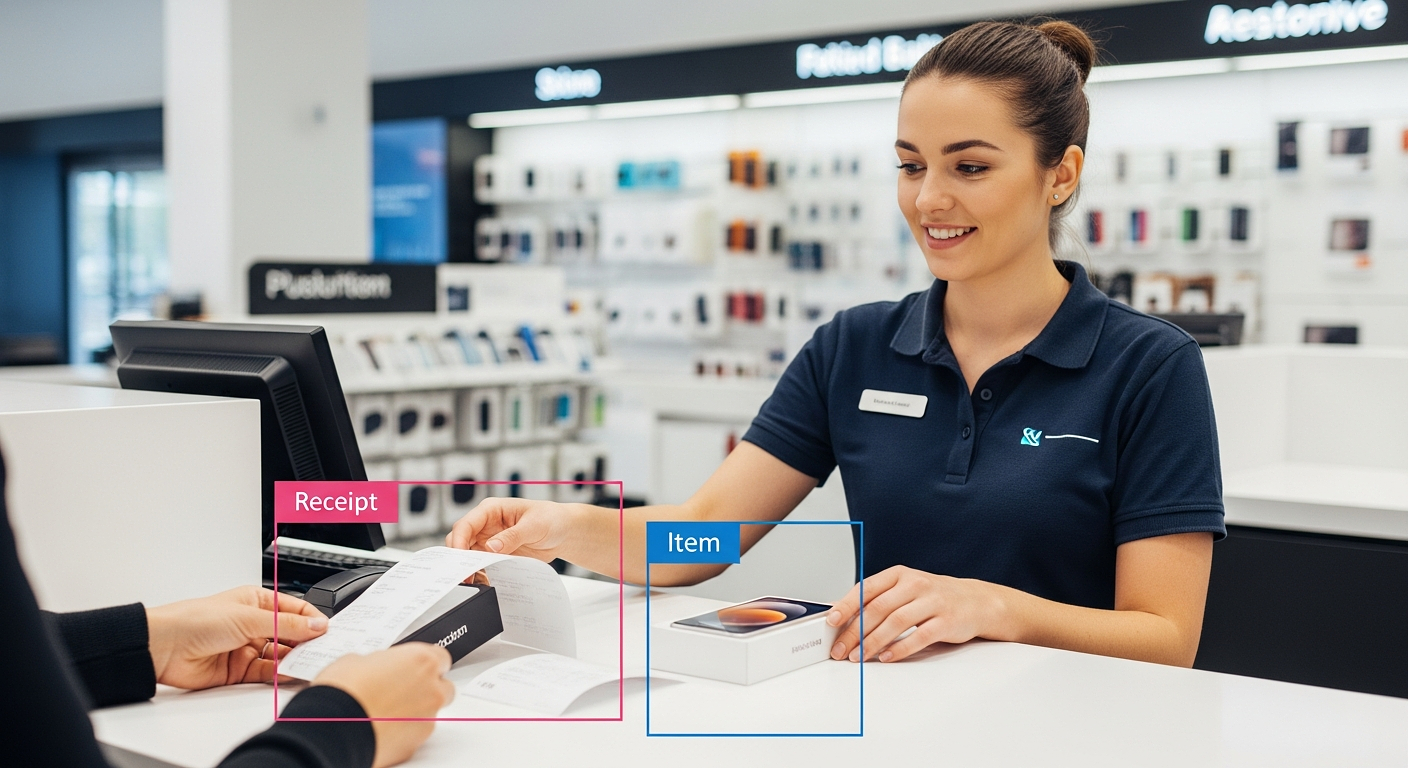


Retail shrinkage is no longer just a cost of doing business—it is a massive operational crisis that continues to grow. For Loss Prevention and Asset Protection leaders, the roadblock is not a lack of data; point of sale (POS) systems generate millions of transaction logs daily. The problem is the disconnect between those digital receipts and physical reality. A "void" on a receipt looks identical whether it was a legitimate correction or a cashier sliding cash into their pocket. A "return" looks the same in the database whether the customer handed back a product or an empty box.
This visibility gap at the register and service desk allows internal theft, return fraud, and process errors to accumulate unnoticed until inventory audits reveal the damage. Traditional video security systems offer little relief, forcing personnel to manually scrub hours of footage to find the few seconds that match a suspicious transaction timestamp.
Video AI agents are closing this gap by turning cameras into intelligent teammates that verify POS data in real time. By pairing transaction logs with visual evidence, retailers can move from reactive firefighting to insight-driven exception-based reporting (EBR). This approach does not just record shrinkage; it reveals the "who, what, and how" behind the numbers, enabling teams to standardize operations and protect margins without adding headcount.
Key terms to know
- Exception-based reporting (EBR): A data analysis technique that flags transactions falling outside normal patterns—such as excessive voids, high-dollar returns, or zero-dollar sales—to prioritize reviews.
- Point of sale (POS) video integration: The technical synchronization of transaction data with video footage, allowing analysts to search for specific receipt events (like "refund" or "void") and quickly view the corresponding video clip.
- Sweethearting: A form of internal theft where a cashier intentionally bypasses scanning an item or scans a lower-priced item to give a "discount" to a friend or family member.
- Video AI agents: Intelligent software that processes video feeds to detect specific behaviors or objects, acting as an always-on observer that can alert staff to anomalies in real time.
The disconnect between transaction data and visual reality
The retail industry faces a critical visibility limitation. While POS systems are excellent at recording what should have happened, they cannot verify what actually happened. This discrepancy is where the majority of point-of-sale loss occurs.
According to recent industry analysis, retail shrink costs the industry tens of billions of dollars annually, with projections indicating continued growth in losses. A substantial portion of this loss happens directly at the checkout counter.
The limitations of analyzing POS data in isolation include:
- Lack of context: A high number of voids might indicate theft, or it might simply mean a new cashier is struggling with the interface. Data alone cannot distinguish between malice and training gaps.
- Time-consuming verification: Without integration, verifying a suspicious refund requires an analyst to note the timestamp, walk to a DVR, search for the camera feed, and manually fast-forward to the event. This friction means most exceptions go uninvestigated.
- Sophisticated fraud methods: Modern internal theft often involves manipulating the transaction to look legitimate on paper. For example, "sweethearting" often involves scanning a cheap item while bagging an expensive one—a discrepancy that a receipt will never show.
How video AI agents corroborate point of sale data
Integrating video analytics with POS data transforms the review workflow from a manual hunt into a streamlined audit. Instead of randomly auditing shifts, loss prevention staff use video AI agents to confirm specific high-risk transactions automatically.
This integration works by creating a searchable index of video clips linked to transaction attributes. When a specific event occurs at the register, the system bookmarks the footage.
The verification workflow:
- Data ingestion: The system receives a real-time feed of transaction events (scans, voids, no-sales, returns) from the POS software.
- Visual pairing: Each transaction event is time-stamped and linked to the corresponding video segment from the overhead camera.
- Exception filtering: The AI filters these events based on pre-set risk criteria, such as "refunds over $50" or "voids with no customer present."
- Visual verification: Analysts can click on a specific line item in a digital receipt and without delay watch the video of that item being scanned (or not scanned).
This capability allows Loss Prevention teams to audit hundreds of exceptions in minutes rather than hours. By cross-referencing the physical action against the digital record, retailers can quickly confirm if a "return" involved a physical product or if a "no-sale" drawer open occurred while the lane was empty.
Top loss vectors addressed by POS integration
Deploying video AI agents at the point of sale directly mitigates the most common and costly forms of retail loss.
1. Sweethearting and scan avoidance
Sweethearting is notoriously difficult to detect with data alone because the transaction record often exists—it just reflects the wrong item or price. Video AI agents can detect when an item is placed in the bagging area without a corresponding scan event.
- The AI advantage: Systems can flag "scan-avoidance" behaviors where an item passes the scanner but does not register, or when the visual count of items in the bag exceeds the line item count on the receipt.
2. Fraudulent return detection
Return fraud is a rapidly growing risk, with some industry data indicating that as many as one in nine returns are fraudulent (Source: CBS News). Fraudsters often return stolen items for cash or return empty boxes.
- The AI advantage: Visual confirmation allows LP teams to see exactly what was placed on the counter during the return transaction. Advanced computer vision can even assist in identifying if the condition of the returned item matches the description, or if the customer behavior (such as "bracketing" or bulk returns) fits a fraud profile.
3. Self-checkout theft
Self-checkout stations are high-risk zones, with many retailers reporting significant increases in theft after implementation. The lack of direct supervision makes it easy for customers to skip scans or swap tags.
- The AI advantage: AI agents monitor self-checkout kiosks for "missed scan" events. If a customer places an item in the bag without scanning, the system can trigger a real-time alert to the attendant's handheld device or pause the transaction, allowing for a non-confrontational correction.
4. Internal theft and administrative error
Internal theft accounts for a significant portion of all retail shrink. This often manifests as "no-sale" drawer opens or voiding valid transactions to pocket the cash.
- The AI advantage: Exception-based reporting can automatically surface every instance of a drawer opening without a transaction. Video verification then confirms if the employee was making change or removing cash illicitly.
Operational efficiency beyond loss prevention
For the Economic Buyer, the value of video AI extends beyond catching thieves. It acts as a force multiplier for retail operations, helping teams optimize staffing and improve customer experience without adding labor costs.
1. Queue management and staffing
Long lines lead to abandoned carts and lost revenue. Video AI agents can measure queue lengths and wait times in real time.
- Actionable insight: When a line exceeds a predefined threshold (e.g., more than 3 people), the system alerts the store manager to open another register. This data also helps in planning future schedules based on actual traffic patterns rather than just sales data.
2. Reducing incident review time
The hidden tax on Loss Prevention teams is the time spent on case reviews. Traditional methods can take hours to resolve a single incident.
- Actionable insight: With intelligent search and POS integration, review time is reduced from hours to minutes. Analysts can search for "voids > $20" and review a playlist of clips, resolving cases faster and freeing up time for strategic initiatives.
3. Training and SOP adherence
Video evidence is a powerful coaching tool. It allows managers to identify training gaps, such as cashiers consistently struggling with specific produce codes or failing to check IDs for age-restricted purchases.
- Actionable insight: Rather than disciplinary measures, video data allows for targeted retraining. If an employee has a high rate of voids, a manager can review the footage to see if it is theft or simply a need for better training on the register interface.
Comparing traditional CCTV with video AI agents
The shift from passive recording to active intelligence represents a fundamental upgrade in capability.
| Feature | Traditional CCTV / VMS | Spot AI video agents |
|---|---|---|
| Data integration | None (video and POS are separate silos) | Unified (POS data syncs with video timeline) |
| Searchability | Manual rewind and fast-forward | Swift (search by receipt text, price, or event) |
| Alerting | Reactive (review footage after an incident) | Anticipatory (real-time alerts for EBR anomalies) |
| Investigation speed | Hours per incident | Minutes per incident |
| Hardware requirement | Proprietary cameras and recorders | Camera-agnostic (works with existing IP cameras) |
| Scalability | Difficult (requires local NVR management) | Cloud-native (manage unlimited sites from one dashboard) |
Real-world impact: All Star Elite case study
The theoretical benefits of POS integration translate directly into financial results for retailers. A compelling example is All Star Elite, a multi-location sports apparel retailer that deployed Spot AI to gain visibility into their operations.
Facing high shrink rates and operational inefficiencies, All Star Elite utilized Spot AI's platform to unify their video security and analytics. The results were measurable and notable:
- Shrink reduction: Cash shrink dropped from roughly 6% to 1%, representing an 83% reduction. Merchandise shrink also saw a substantial decrease from 10–15% down to 6%.
- Investigation speed: The team improved incident resolution efficiency by over 50%. By using AI search capabilities, they reduced incident resolution time from hours to minutes, allowing them to address issues as they arise rather than days later.
- Operational growth: Beyond security, the insights helped optimize product placement and staffing, contributing to a sales increase of 5–15%.
For a detailed look at their success, read the full story here: All Star Elite Case Study.
Building the financial case for implementation
For Loss Prevention executives, justifying the investment in new technology requires a clear path to ROI. Video AI agents deliver value through multiple financial levers.
- Direct shrink reduction: Reducing annual shrinkage can deliver a rapid return on investment. For a mid-sized retailer, even a fractional reduction in their shrink rate can represent hundreds of thousands of dollars in retained margin.
- Labor optimization: Automating the monitoring of checkout areas and service desks reduces the need for physical guards or dedicated surveillance staff. This allows retailers to reduce guard spend while increasing coverage consistency.
- False alarm reduction: AI filters out noise, ensuring that expensive resources are not wasted responding to false alarms or investigating non-events.
- Hardware savings: Because Spot AI is camera-agnostic, retailers can leverage their existing investment in IP cameras rather than ripping and replacing infrastructure. This significantly lowers the total cost of ownership (TCO) compared to proprietary systems.
Conclusion
The disconnect between digital transaction data and physical reality has long been a sanctuary for retail loss. By bridging this gap, video AI agents empower Loss Prevention leaders to corroborate point of sale data with irrefutable visual evidence. This technology shifts the department's posture from reactive data collection to forward-looking operational control.
Retailers who adopt this integrated approach are not just catching more theft; they are engineering safer, more efficient, and more profitable stores. By standardizing the verification process and automating the detection of anomalies, organizations can finally trust that the data on the receipt matches the reality in the bag.
Ready to validate your data?
Stop managing incidents and start engineering outcomes. Spot AI turns your existing cameras into a proactive loss prevention team that verifies transactions, deters theft, and standardizes operations across your entire fleet.
"When I show managers the video evidence of unsafe practices, they get it immediately. It's not just me telling them there's a problem - they can see it for themselves."
— Kevin, Unique Industries
Source: Spot AI Customer Stories
Request a demo to see Spot AI video agents in action and discover how they help validate point of sale data and reduce shrink.
Frequently asked questions
What is exception-based reporting and how is it used?
Exception-based reporting (EBR) is a method of data analysis that automatically flags transactions that deviate from the norm. In retail, it is used to identify potential fraud or training issues by highlighting unusual patterns, such as a high frequency of voids, returns, or zero-dollar transactions. When integrated with video, EBR allows analysts to quickly view the footage associated with these specific flagged events.
How do video analytics integrate with POS systems?
Video analytics integrate with POS systems by synchronizing the timestamp of transaction logs with the video feed. The system ingests data from the POS (like "item scanned" or "drawer opened") and overlays this text on the video or links it as searchable metadata. This allows users to search for specific transaction types (e.g., "Refund > $50") and swiftly watch the corresponding video clip.
What are effective strategies to reduce retail shrinkage?
Effective strategies include a layered approach of physical security, employee training, and technology. Integrating video AI with POS data is highly effective as it addresses internal theft and administrative error—two major sources of shrink. Additionally, using AI for perimeter security and self-checkout monitoring helps deter external theft and mitigate losses before they occur.
What is the ROI of implementing video surveillance systems?
The ROI of intelligent video surveillance comes from reduced inventory loss (shrink), lower review costs (labor savings), and operational improvements (optimized staffing). Many retailers see a full return on investment within 12 to 18 months through shrink reduction alone. Additional value is realized through reduced guard costs and improved sales conversion from better queue management.
About the author
Sud Bhatija
Sud Bhatija is COO and Co-founder at Spot AI, where he scales operations and GTM strategy to deliver video AI that helps operations, safety, and security teams boost productivity and reduce incidents across industries.

