




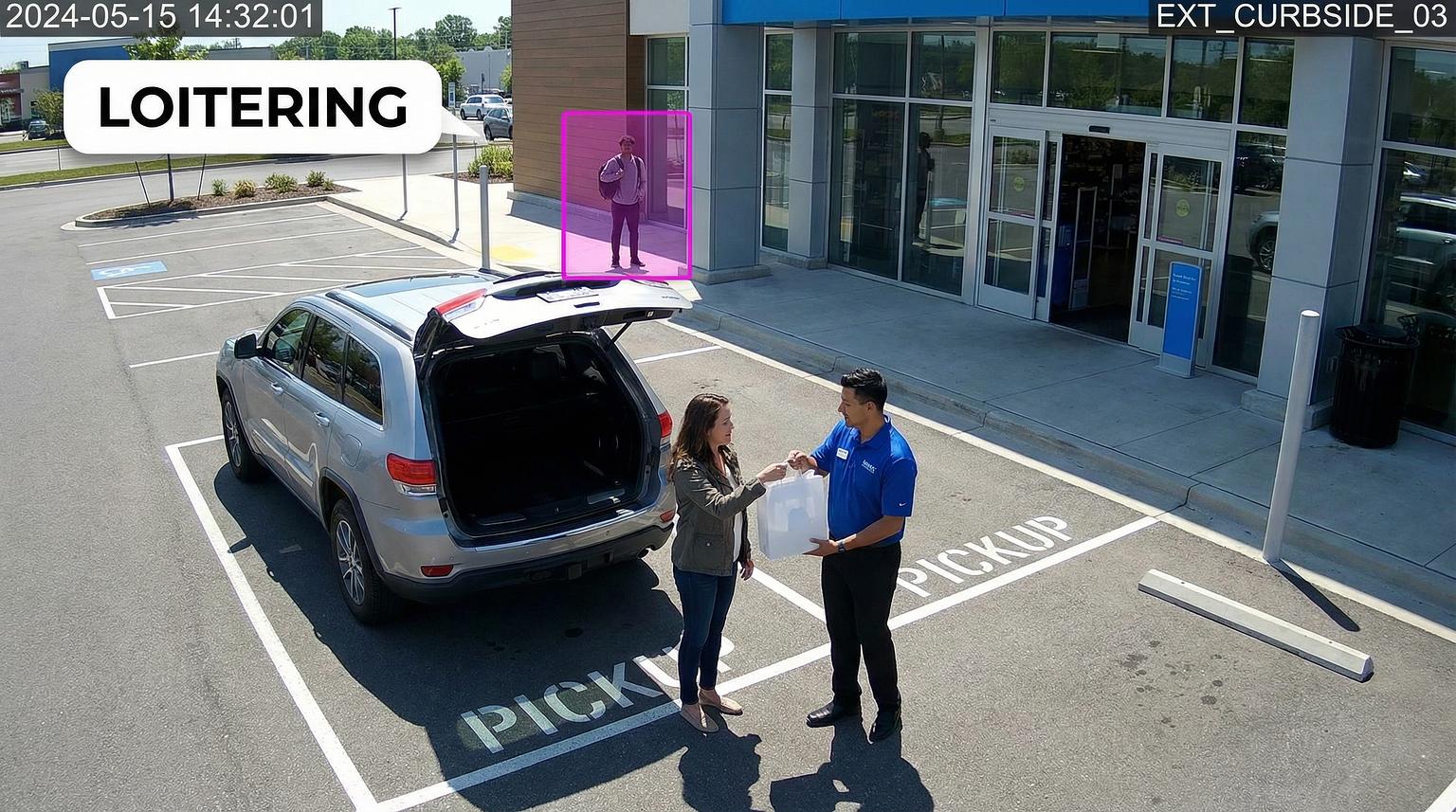


Managing the transition from "online order" to "trunk of the car" has become the defining hurdle for modern retail operations. What started as a convenience feature has evolved into a critical fulfillment channel, yet for many store and digital transformation leaders, curbside and BOPIS (Buy Online, Pickup In-Store) workflows remain chaotic, manual, and reactive.
Retailers are effectively asking store locations to function as both shopping destinations and local fulfillment centers—a dual role that existing infrastructure wasn't designed to support. This shift creates operational friction: staff members rushing to locate orders, customers waiting in designated bays with no acknowledgment, and merchandise exposed to theft during the handoff.
Video analytics for retail: enabling anticipatory operational control
Video analytics for retail is shifting this dynamic from reactive scrambling to forward-looking control. By transforming standard cameras into intelligent teammates, video AI agents provide the real-time visibility needed to secure the handoff, verify transactions, and protect staff at the perimeter.
Key terms to know
Before examining specific workflows, it is helpful to define the core technologies that drive retail operational efficiency:
- Video AI agents: intelligent software that processes video feeds to detect specific behaviors or anomalies (like a vehicle waiting too long or unauthorized access) and triggers real-time alerts.
- Edge computing: a processing architecture where video analysis happens locally at the store level rather than in the cloud. This ensures curbside pickup efficiency by eliminating latency, allowing for notifications without delay when a customer arrives.
- Vehicle attribute detection: the capability of retail AI cameras to identify vehicle characteristics (color, make, body type) to verify customer arrivals without requiring sensitive biometric data.
- BOPIS/BORIS: acronyms for "Buy Online, Pickup In-Store" and "Buy Online, Return In-Store," representing the critical handoff points where digital transactions meet physical operations.
The operational reality of the curbside handoff
For operations leaders, the parking lot has become the new store aisle—but one that is significantly harder to manage. The "handoff" is a vulnerability point where three critical risks converge: operational inefficiency, safety hazards, and inventory shrinkage.
Research indicates that inventory distortion—including out-of-stocks and overstocks—costs retailers hundreds of billions of dollars annually (Source: Shopify Enterprise). In a BOPIS context, this inaccuracy leads to the "ghost order" scenario: a customer arrives, but the item cannot be found, leading to long wait times and potential cancellations.
Furthermore, the physical handoff exposes staff to parking lot security risks. When associates walk merchandise out to vehicles, they leave the controlled environment of the store. Without automated threat detection retail capabilities, these employees are vulnerable to vehicle accidents or opportunistic theft during the exchange.
How video AI agents streamline curbside workflows
Deploying video intelligence software at the edge allows retailers to automate the coordination of curbside pickups. Instead of relying on customers to call the store or check in via an app, video AI agents act as an always-on observer that triggers the workflow the moment a vehicle enters a designated zone.
This pre-emptive approach improves curbside pickup efficiency in three specific ways:
- Automated arrival detection: cameras monitoring curbside bays detect vehicle presence on arrival. Vehicle attribute detection can match the car to the order details (e.g., "Red SUV in Bay 3"), alerting staff to stage the specific order before the customer even parks.
- Wait time tracking: customer wait time monitoring becomes automated. The system tracks exactly how long a vehicle has been dwelling in a pickup zone. If a wait time exceeds a defined threshold (e.g., 5 minutes), managers receive a real-time alert to intervene, preventing customer frustration.
- Queue management: during peak hours, queue management system retail analytics identify congestion. If the curbside lane is full, the system can notify operations leaders to reallocate staff from other departments to assist with handoffs, ensuring retail operational efficiency remains high.
| Feature | Manual Curbside Operation | AI-Enabled Curbside Operation |
|---|---|---|
| Arrival Trigger | Customer calls or uses app | Auto-detection of vehicle in zone |
| Verification | Staff asks for name/ID at car window | Vehicle attributes verified via video |
| Wait Time Data | Anecdotal / Complaints | Real-time dwell time analytics |
| Staffing | Reactive scrambling | Data-driven allocation based on queue depth |
Reducing shrink and protecting the perimeter
Retail loss prevention technology must extend beyond the front door. The perimeter—loading docks, emergency exits, and curbside zones—is often where organized retail crime solutions are most needed.
Retail shrinkage reduction at the curbside relies on verifying that the right product goes to the right car and that returns are legitimate.
- Visual verification of returns (BORIS): return fraud is a growing issue. Video analytics for retail can document the condition of an item the moment it is handed back at the curb or counter. AI agents can flag suspicious patterns, such as frequent high-value returns from the same vehicle or individual.
- Deterring loitering and scouting: ORC groups often scout locations or loiter in parking lots before attempting theft. Parking lot security cameras equipped with loitering detection can identify vehicles or individuals lingering in non-customer zones and trigger real-time retail security alerts to local staff.
- Staff safety monitoring: staff safety monitoring is critical during evening shifts. Video systems can detect if an associate is alone in the parking lot for an extended period or if a vehicle is driving aggressively near the pickup zone, enabling rapid escalation to security or management.
Optimizing BOPIS workflows with intelligent insights
Inside the store, BOPIS workflow optimization depends on speed and accuracy. The journey from "order received" to "staged for pickup" is often riddled with hidden bottlenecks.
Video search technology allows operations leaders to audit these workflows without watching hours of footage. By using intelligent video recorder capabilities, managers can search for specific order numbers or timeframes to see exactly where a delay occurred.
- Staging area management: cameras monitoring the BOPIS staging area ensure packages are organized correctly. Visual data intelligence can verify that an order was placed on the correct shelf, reducing the "can't find it" delays that kill customer experience.
- Abandonment alerts: if a staged order sits for too long, or if a customer enters the pickup area but leaves without their item, video analytics applications for a retail store can flag this as a potential service failure or theft risk.
- Heatmaps for layout: retail heatmaps reveal congestion points. If the BOPIS counter is blocking high-traffic aisles, retail data analytics provide the evidence needed to redesign the floor plan for better flow.
Why edge computing wins for retail operations
For retail safety and security applications that require rapid action, cloud-only systems often fall short due to latency. When a customer pulls up to the curb, the notification needs to be swift.
Edge video processing processes data locally on the device or an on-premise gateway. This approach ensures that automated threat detection retail and service alerts happen in real-time, regardless of internet bandwidth fluctuations.
Furthermore, camera-agnostic retail solutions allow businesses to leverage their existing infrastructure. There is no need to rip and replace functioning cameras; intelligent software can simply sit on top of the existing feed, turning legacy hardware into retail AI cameras. This significantly improves loss prevention ROI by minimizing hardware capital expenditure.
Conclusion
Securing the handoff is about more than just preventing theft; it is about engineering a predictable, safe, and efficient experience for both customers and staff. By integrating video analytics for retail into curbside and BOPIS workflows, leaders can close the visibility gaps that lead to shrink and service failures.
The shift to video AI agents offers a clear path to retail operational efficiency. It moves the store from a posture of reactive firefighting to one of proactive control, ensuring that every handoff is verified, every wait time is measured, and every associate is protected.
Ready to see video AI in action?
Discover how Spot AI transforms your existing cameras into intelligent teammates for safer, more efficient operations. Request a demo to experience the platform’s capabilities firsthand.
"We don't have security guards or metal detectors - we trust our employees. But we'd like to validate that trust when possible, especially given the nature of what we manufacture."
— Mike Tiller, Director of Technology, Staccato
Customer Story: Staccato
Frequently asked questions
How can video analytics improve loss prevention in retail?
Video analytics shifts loss prevention from reactive review to active deterrence. By detecting behaviors associated with theft—such as loitering in high-risk areas, unauthorized access to stockrooms, or suspicious vehicle activity at curbside—systems can alert staff in real-time. This allows for intervention before items leave the premise, significantly aiding in retail shrinkage reduction.
What are the best AI solutions for enhancing operational efficiency?
The most effective solutions are those that integrate with existing workflows to reduce manual effort. Video AI agents that offer queue management system retail capabilities, automated wait-time tracking, and vehicle attribute detection for curbside pickup are top drivers of efficiency. These tools automate the monitoring of service levels, allowing staff to focus on fulfillment rather than observation.
What technologies are most effective for curbside pickup operations?
Edge video processing and vehicle attribute detection are critical for curbside operations. Edge processing ensures zero-latency alerts when cars arrive, while attribute detection allows staff to identify orders based on the car's description without needing to scan a barcode at the window. This reduces customer wait time monitoring efforts and speeds up the handoff.
How do AI cameras contribute to reducing shrinkage?
Retail AI cameras contribute to reducing shrinkage by providing continuous, unbiased monitoring of critical handoff points. They can verify that returns are legitimate via visual inspection (reducing return fraud), ensure that BOPIS orders are picked up by the correct individual, and monitor staff adherence to safety and security SOPs at the back of the house.
About the author
Sud Bhatija
Sud Bhatija is COO and Co-founder at Spot AI, where he scales operations and GTM strategy to deliver video AI that helps operations, safety, and security teams boost productivity and reduce incidents across industries.

