




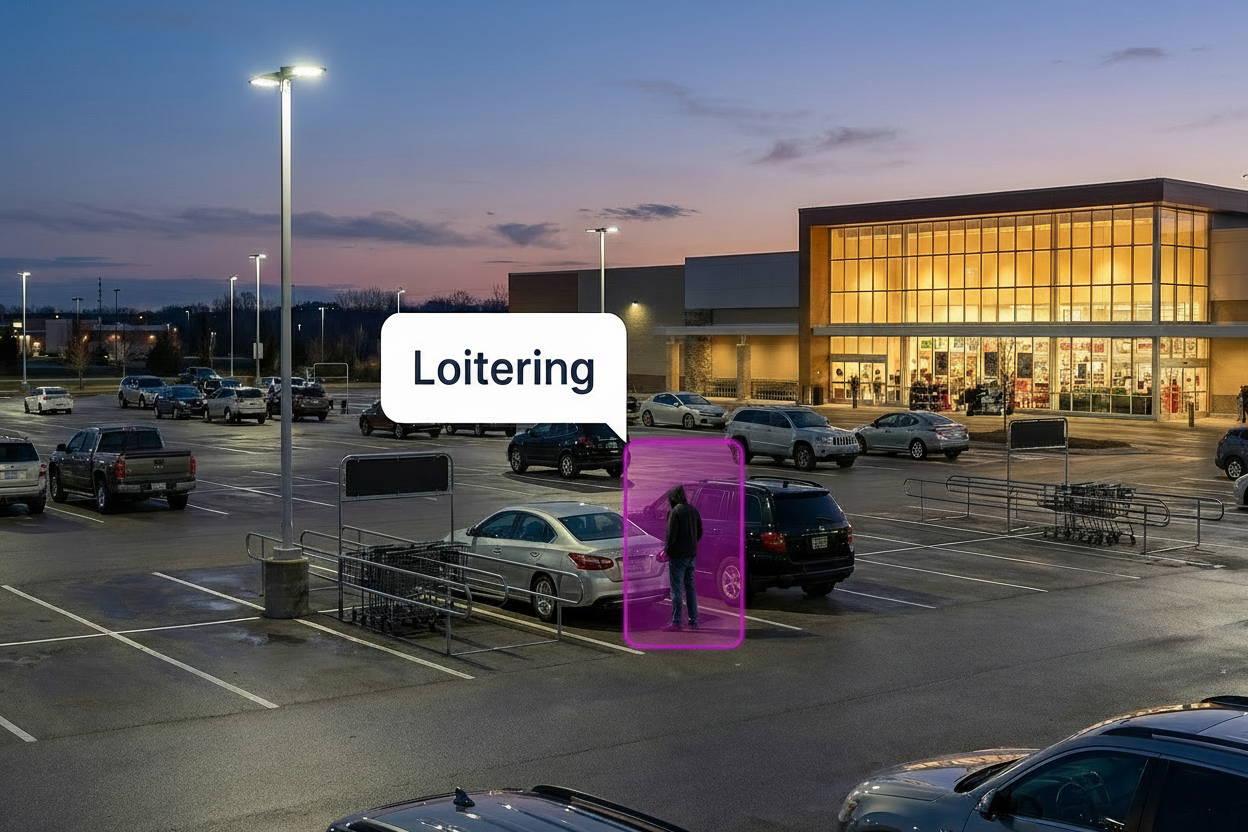


Loitering in retail parking lots: thresholds, night tuning, and a response ladder for 2026
Loitering in retail parking lots is two different problems, split by the clock. During trading hours it is often the visible front of an organized theft run, and after close it is usually the lead-in to a break-in. Organized theft is the pattern retailers report rising: 40% see higher rates of organized retail crime incidents and 37% see more walkout or pushout theft (Source: National Retail Federation). Spot AI's behavioral detection separates both patterns from ordinary lot traffic by reading dwell time, place, and time of day, and Spot AI's AI Talkdown answers in seconds, before anyone on staff has to walk outside.
Key takeaways
- Loitering in retail parking lots splits by the clock: near the entrance during trading hours it often fronts an organized theft run, and at the rear after close it usually precedes a break-in.
- Motion-triggered alerting fires on carts, headlights, and rain, so it cannot separate either pattern from ordinary traffic, while Spot AI's behavioral detection reads dwell, place, time, and movement.
- Give every zone two thresholds, one for trading hours and one for after close, and tighten the rear of the building the most.
- Spot AI's AI Talkdown escalates on its own, pairing strobes and horns with a spoken, context-aware message, so the first response in the lot is automated rather than an associate walking outside.
- A leading SOC platform integrated with more than 20 VMS platforms reports a single-digit false-positive rate on Spot AI, against about 50% on legacy VMS, a customer-reported figure worth testing on your own footage.
Key terms
- Behavioral detection: Spot AI's context-aware detection, which reads location, timing, movement patterns, and the relationships between people, vehicles, and objects rather than pixel change. It is how Spot AI tells a shopper returning a cart from someone checking car doors.
- Dwell threshold: the time a person or vehicle may stay in a defined zone before a detection fires. Spot AI's loitering agent flags whoever stays past it, so the threshold is the main setting an operator tunes.
- AI Talkdown: Spot AI's natural-conversation deterrence. It escalates through three levels that combine strobes and horns with a context-aware spoken message, which calls out what it sees and asks the person to leave.
Why loitering in retail parking lots is two different problems
Five minutes of standing still means one thing at 2 p.m. and another at 2 a.m., so each half of the problem gets its own zones, thresholds, and response.
During trading hours: the visible front of an organized theft run
An organized theft run needs the lot before it needs the store. A car backs into a space in the first rows or idles in the fire lane with a driver at the wheel. One or two people linger near the entrance, walk in and out without buying, or pass the doors several times to count staff and exits. Minutes later the same car carries the merchandise away. Each step looks like a customer waiting, which is why a camera that only records misses it.
Spot AI ships 15+ pre-trained video AI agents, and three carry this half of the problem: loitering, crowding, and license plates of interest, which lets a vehicle tied to an earlier incident raise an alert as it pulls in. Our guides to license plate recognition for retail loss prevention and parking lot security cameras cover the plate side and the wider set of behaviors that come before an incident.
After close: the lead-in to a break-in
After close, loitering moves to the rear of the building: the loading dock, the dumpster enclosure, the fence line, and the dark edge of the lot, where someone checks doors or tests a gate before trying one. The stakes shift from merchandise to people. OSHA lists poorly lit stores and parking areas, and solo work at isolated sites, among the risk factors for late-night retail workers, and recommends security escorts to parking areas in evening or late hours (Source: OSHA). The person most exposed is the closing associate walking to a car, and the same dwell beside parked vehicles is where car break-ins in retail parking facilities begin.
Why motion-triggered alerting cannot tell loitering from a shopping cart
Motion-triggered alerting asks one question: did pixels change. In a retail lot the answer is yes all day. A loose cart rolls across two rows in the wind, headlights sweep the storefront, and rain streaks the lens, and to a motion rule each one looks like a person trying a door. Teams turn sensitivity down until the alerts stop, and at that point the rule misses the incidents it was installed for.
Spot AI's behavioral detection asks what the object is, where it is, how long it has stayed, and what it is next to. Four signals separate loitering from traffic:
- Dwell: how long a person or vehicle stays inside one zone, not whether it moved.
- Place: five minutes on the entrance bench and five minutes at the dock door are different events.
- Time: dwell that reads as ordinary at noon reads as risk after close.
- Relationship: a person beside a running car, or walking between parked cars, is not the same event as a person alone.
Reading those signals together is how Spot AI's behavioral detection tells a delivery truck from a vehicle casing the lot, on any ONVIF IP camera already covering it. For the mechanics of zones and tracking, see how loitering detection works with video AI.
Dwell-time and threshold table for retail parking lot zones
The values in this table are illustrative starting points for a pilot, not Spot AI defaults and not measured norms. Each zone gets a tighter value after close, when fewer people have a reason to be there.
Zone | Trading hours: illustrative starting point | After close or overnight: illustrative starting point | Suggested first automated step |
|---|---|---|---|
Entrance approach and storefront | 5 minutes for a person | 60 seconds for anyone | Spot AI sends the manager on duty a clip by day; after close, AI Talkdown addresses the person directly |
First rows and fire lane | 3 minutes for an occupied, idling vehicle | 2 minutes for any vehicle | Spot AI flags the vehicle and checks its plate against license plates of interest |
Outer rows and cart corrals | 20 minutes | 10 minutes | Spot AI logs the event for review by day; after close, strobes and horns come on |
Fuel islands and forecourt | 10 minutes at a pump | 5 minutes | Spot AI alerts the counter and starts AI Talkdown at the island, so the clerk stays inside |
Loading dock, dumpster enclosure, and rear wall | 10 minutes outside delivery windows | 30 seconds for any presence | Spot AI starts AI Talkdown and sends the loss prevention lead the clip |
Staff parking row | 15 minutes for a person in the row | Any presence in the 30 minutes before the closing walk-out | Spot AI alerts the closing lead before anyone leaves the building |
Treat every value above as an illustrative starting point: run it for two weeks against your own footage, then keep, tighten, or loosen it zone by zone.
Watch for repeat passes as well as long stays. Someone who walks past the doors several times never breaks an entrance dwell threshold, so when a vehicle flags in the fire lane, open the entrance clips from the same minutes.
Day against night tuning
A camera that performs well by day is not automatically a good night camera. A 2025 study of 38 cameras installed under Detroit's Green Light Project found significant differences in camera effectiveness between day and night, with night effectiveness closely linked to the number of surrounding streetlights (Source: Journal of Criminal Justice). Lighting helps on its own, within limits: Chile's Public Lighting Replacement Programme was associated with reductions of 18.97% to 58.12% in public disturbances and 19.25% to 30.48% in public alcohol consumption, while violent robberies showed no significant decrease (Source: Frontiers in Sociology). Light shrinks the low-level disorder that gathers in a dark lot, but it does not answer someone who has already decided to try the door.
Five steps turn that into a schedule:
- Split each zone's schedule where the lot's meaning changes: at close, plus the time the closing crew needs to reach their cars.
- Check every camera's night image before setting a night threshold, and fix dark spots first.
- Tighten the rear of the building hardest after close, and give 24-hour sites a night schedule anyway, because overnight trading still changes who has a reason to be in each zone.
- Write exceptions for known activity, such as scheduled deliveries, cart retrieval, and the closing walk-out, instead of raising a threshold for everyone.
- Change one threshold at a time, per camera rather than per site, and compare a week of alerts before and after.
Our guide to designing deployable coverage for retail lots and forecourts covers siting and the overnight profile of a 24-hour site, and our guide to convenience store security cameras covers the store side, from forecourt to register.
A response ladder by site type
Active deterrence for retail stores works as a ladder, not a single alarm: the cheapest step that ends the event fires first, and a person arrives only when the event stays or comes back. Spot AI follows the retail sequence of detect, deter, investigate, and resolve across four rungs:
- Record: Spot AI's loitering agent flags the event and clips it, and nobody is interrupted.
- Deter: Spot AI combines strobes, horns, and AI Talkdown, a context-aware message that describes what it sees and asks the person to leave.
- Notify: Spot AI sends the clip to the manager on duty, the loss prevention lead, or a remote monitoring contact by text, email, Slack, or Teams.
- Dispatch: a patrol, a guard, or law enforcement goes to the lot.
Spot AI runs the first three rungs automatically and in seconds, and resolves routine events without a person in the loop, while the fourth rung stays a person's decision. That order matches OSHA's late-night retail guidance, which says training should limit workers from intervening in altercations unless enough staff, emergency response teams, or security personnel are available (Source: OSHA). A person is also the most expensive rung: covering one lot around the clock takes 168 staffed hours a week, more than four full-time schedules before relief and overtime, and the median annual wage for security guards was $38,020 in May 2025 (Source: U.S. Bureau of Labor Statistics). Our comparison of remote monitoring, remote guarding, and automated deterrence sets those options side by side, and our guide to active deterrence workflows for retail parking lots covers standardizing the ladder across stores.
Site type | Trading hours | After close or overnight | Who goes outside |
|---|---|---|---|
24-hour convenience and fuel store | Spot AI flags forecourt and entrance dwell, alerts the counter, and runs AI Talkdown at the pumps | Spot AI runs strobes, horns, and AI Talkdown at the rear and the dark edge of the lot | Nobody on shift; a remote contact reviews the clip and calls law enforcement if someone stays |
Specialty or apparel store in a strip center | Spot AI sends the manager clips of entrance dwell, with no audio at the front while shoppers are present | Spot AI runs the full ladder at the rear and sends the center's patrol the clip | The center's patrol or law enforcement, never the closing staff |
Large-format specialty store with a big surface lot | Spot AI watches the fire lane and first rows for staged vehicles and the outer rows for gatherings | Spot AI runs the ladder to dispatch for any presence at the dock and rear wall | An on-site guard where one is posted, otherwise a patrol sent on the clip |
Distribution center or staff lot | Spot AI flags vehicles that stop in the yard or staff rows outside shift change | Spot AI runs strobes and AI Talkdown at the fence line and the dock | A security escort at shift change, and a patrol for anything that stays |
Where a lot or forecourt has no usable cameras, a pole-mounted unit with a loudspeaker and LED flood lighting, deployed through VigilanteX, Spot AI's deployment partner, fills the gap and reports into the same Spot AI dashboard. VigilanteX's LunaVue solar wireless nodes reach the parts of the lot with no power or cabling, and VigilanteX describes them as reporting into that same dashboard.
Outdoor coverage is where retail deployments typically start. A specialty beauty retailer with more than 3,000 locations needed to keep employees safe in unmanned parking lots at its distribution centers and to track yard truck traffic, and third-party guards covered only part of that at significant cost. It began its Spot AI deployment with parking-lot deterrence and yard vehicle counting across six distribution centers, and is now scoping cameras inside the buildings. The account is customer-reported.
"Spot AI is easy to use, IT is happy it's web-based and connects to our cameras inside, and our employees feel safer in their parking lots."
Mike T., Specialty Beauty Retailer (3,000+ locations)
The false-positive trade-off, and how to test it
Every threshold in the table is a point on a curve. Tighter, and Spot AI's loitering agent flags sooner with more nuisance alerts; looser, and alerts fall but the warning before an incident gets shorter. The symptoms show which side of the curve a zone sits on:
- Too tight: the team dismisses most alerts from one zone without opening the clip, so loosen it by one step or add an exception for the activity behind it.
- Too loose: incidents surface in the morning review that never raised a flag, so replay them and note the value that would have fired.
- About right: alerts are rare enough that each one gets opened, and replayed incidents show a flag with minutes to spare.
The detection layer sets where the curve starts. A leading SOC platform integrated with more than 20 VMS platforms reports a single-digit false-positive rate on Spot AI, against about 50% on legacy VMS. The figure is customer-reported rather than a lab benchmark, so the fair test is your own footage: replay your last ten after-hours incidents through the proposed thresholds and count how many would have flagged with time to respond.
Detection also has limits worth stating plainly. Lighting caps what any camera reads after dark, coverage stops at the edge of each field of view, and escalations still need a person's judgment. None of it explains why someone is sleeping in the lot, which is the part policy has to carry.
Vagrancy and people experiencing homelessness: a policy built on behavior
Vagrancy is the word many older policies use, but it describes a status, and a status is the wrong trigger for a camera or a rule. Retailers continue to report increases in homelessness-related disruptions and guest-related incidents (Source: National Retail Federation), and a rule written around what happens, where, and when is easier to apply fairly and to defend. Five practices keep policy and detection aligned:
- Write each rule as a behavior, a place, and a time, such as no overnight sleeping in vehicles in the outer rows after close, or no open flame at the dumpster enclosure.
- Apply the same threshold to every person and vehicle in a zone, so detection never turns on who someone appears to be.
- Script the talkdown to name position and action and to state the rule in one sentence; our guide covers what a voice-down message should say. Spot AI's AI Talkdown calls a person out by clothing and behavior, which keeps the message about what is happening.
- Keep a referral route for repeat overnight presence, such as a local outreach contact, so enforcement is not the only tool.
- Record each step with the clip, time, and zone, so any trespass notice rests on a consistent record.
Write the after-close rules first. The rear of the building, the loading dock, and the closing walk-out carry the clearest signal and the highest stakes for staff, and a tight threshold there costs the least in nuisance alerts.
The quickest way to settle a threshold is to test it on footage you already have. Book a demo with your hardest after-close site in mind, and Spot AI can run it on that existing video. Our customer stories show how other operators sequenced their rollout.
Frequently asked questions
How long does someone have to stay before it counts as loitering?
Spot AI treats loitering as dwell past a zone's threshold rather than as a legal line, because local ordinances define loitering and trespass in their own terms. A posted limit, such as customer parking only while the store is open, gives staff and detection the same rule to point to. Where no limit is posted, record why each threshold value was chosen.
Do talk-down cameras make people leave a parking lot?
Spot AI's AI Talkdown is built to interrupt an event early: it pairs strobes and horns with a spoken message that describes what it sees, which tells the person they have been noticed. When someone stays or returns, the next step is a person, either a remote contact with the clip or a patrol, rather than a louder message. Track repeat presence by zone for 30 days to see whether the ladder is working.
How do you cut false alarms from parking lot cameras at night?
Spot AI's behavioral detection classifies what moved and how long it stayed, so moving shadows, blowing debris, and animals are far less likely to register as loitering than on a pixel-change rule. A burned-out pole light changes what a camera sees overnight, so schedule a monthly night check of every lot camera. Keep day and night alert counts separate in review, because a zone that is quiet by day and noisy at night usually has a lighting problem, not a threshold problem.
What can a store do about people sleeping in cars in its lot?
Spot AI recommends posting the overnight rule at each lot entrance, so drivers read it before the talkdown ever has to say it. Trespass notices and towing follow local ordinances, so confirm the steps with counsel before they enter the policy. Mapping where overnight stays happen often points to a dark or sheltered corner worth fixing first.
Do you need new cameras to add loitering detection to a parking lot?
Spot AI works with the cameras a business already owns, any ONVIF IP camera, and legacy analog units connect through the Intelligent Video Recorder (IVR), so most sites go live in days rather than months. New hardware earns its place only where a zone has no usable view after dark, and there a pole, wall, or trailer-mounted unit can close the gap without trenching new cable.
About the author
Sud Bhatija is COO and Co-founder at Spot AI, where he scales operations and GTM strategy to deliver video AI that helps operations, safety, and security teams boost productivity and reduce incidents across industries.

