




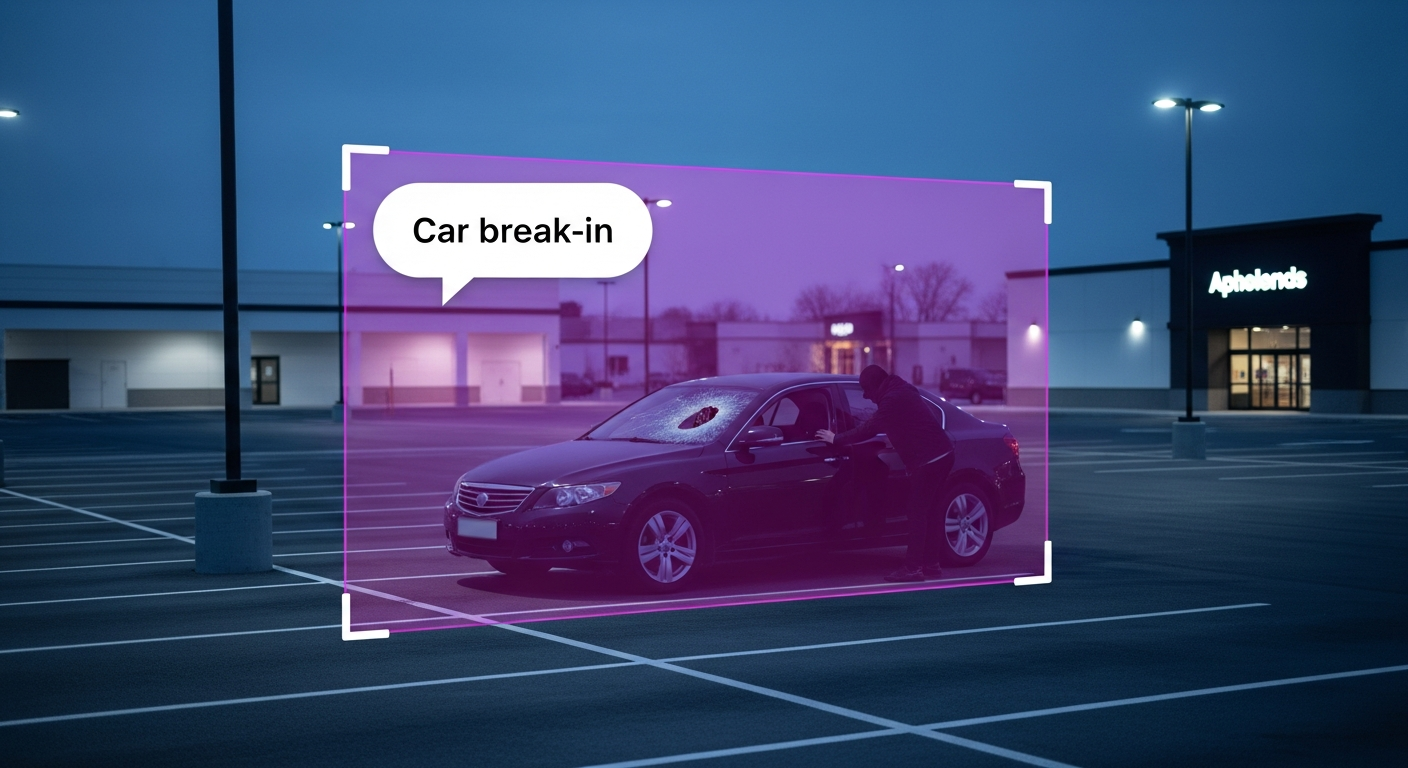


Retail parking facilities represent one of the most substantial vulnerabilities in the loss prevention landscape. For loss prevention leaders, the challenge extends far beyond simple theft—it encompasses vehicle break-ins, organized retail crime staging, catalytic converter theft, and liability exposure. Traditional video systems often fail to address these risks effectively because they are reactive, recording incidents only after the damage is done. This leaves teams sifting through hours of footage to investigate crimes that have already occurred rather than preventing them. To detect and deter car break-ins in retail parking facilities effectively, organizations must shift from passive recording to active detection using a layered approach of physical security, operational protocols, and intelligent technology.
Key terms to know
- Video AI Agents: intelligent software that analyzes video feeds in real time to detect specific behaviors, such as loitering or unauthorized entry, and alerts staff immediately.
- License Plate Recognition (LPR): technology that automatically reads and logs vehicle license plates to identify known threats or track vehicle history within a facility.
- Active deterrence: security measures designed to intervene in real time—such as audio warnings or strobe lights—to discourage criminal activity before it escalates.
- Organized retail crime (ORC) staging: the practice of criminal groups using parking lots to plan, coordinate, and consolidate stolen goods from multiple retail locations.
The evolving threat landscape in retail parking
The security environment for retail parking has shifted dramatically over the last two years. Understanding these specific threats is essential for loss prevention directors seeking to justify investments in advanced detection systems.
Seasonal crime spikes and operational risks
Parking lot crime exhibits distinct seasonal patterns, especially during peak retail periods. Recent data from California indicates that vehicle-related crimes spike significantly in December, with theft from motor vehicles reaching an average rate of 32.3 per 100,000 residents—exceeding the national average by 55% (Ocnjdaily). This surge often coincides with extended operating hours and reduced visibility due to winter darkness, creating a convergence of risk factors that demands proactive planning.
Organized retail crime and catalytic converter theft
Parking facilities now function as key staging areas for coordinated theft rings. Organized retail crime groups actively scout facilities to identify coverage gaps, often using parking lots to consolidate stolen goods. Catalytic converter theft remains a persistent specialized threat. While legislative efforts have helped, approximately 14,000 catalytic converters were stolen in 2024 (Consumer Reports). These incidents occur rapidly—often in minutes—and cause extensive vehicle damage, creating liability concerns and damaging the customer experience.
Environmental and physical security foundations
Technology works best when built upon a solid foundation of physical security and environmental design. Loss prevention teams must address these baseline factors to eliminate easy opportunities for criminals.
Optimizing lighting for detection and safety
LED parking lot lights offer 50% to 80% energy savings compared to traditional fixtures, lowering utility costs while improving visibility (Ledlightingsupply).
- Maintain adequate brightness: facilities requiring video security recording should aim for lighting levels of 10 or more foot-candles to improve image quality (Ledlightingsupply).
- Use high CRI LEDs: high Color Rendering Index (CRI) lighting of 70 to 80+ provides more accurate color rendering, which is critical for identifying vehicle colors and suspect descriptions (Ledlightingsupply).
- Eliminate shadows: position fixtures to minimize dark corners and ensure consistent coverage across the entire pavement surface.
Access control and perimeter definition
- Deploy license plate recognition (LPR): LPR systems create detailed entry and exit logs that help establish a vehicle's history, recording when vehicles enter and depart.
- Utilize bollards: automatic retractable bollards provide flexible access management, while fixed bollards protect high-value infrastructure (Bollardbros).
- Segment traffic: separating employee, delivery, and visitor entrances allows security teams to focus monitoring resources more effectively on high-risk zones.
How to detect and deter car break-ins in retail parking facilities with Video AI
Modern security strategies transform cameras from passive recorders into active teammates that assist staff in real time. By leveraging Video AI Agents, loss prevention teams can surface potential precursors to crime—such as loitering or scouting—so staff can respond quickly.
Real-time anomaly and behavior detection
Video AI analytics uses machine learning to automatically recognize objects, people, and behaviors. This capability addresses the core pain point of reactive systems by flagging incidents in real time.
- Loitering detection: identify individuals lingering near vehicles or in restricted areas for extended periods. This serves as a proxy to identify workers in unsafe areas or unauthorized personnel on-site.
- Vehicle enters no-go zones: detect vehicles entering restricted areas, fire lanes, or loading docks.
- Crowding detection: alert staff when groups form in unusual areas, which can indicate coordinated theft staging or potential altercations.
- Person enters no-go zones: monitor perimeters and back-of-house areas to guard against unauthorized access to high-danger or secure zones.
Reducing false alarms with context-aware intelligence
A major pain point for security leaders is the high rate of false alarms from legacy motion detection. Advanced Video AI distinguishes between likely threats and harmless motion—a person walking through a parking lot versus a plastic bag blowing in the wind, or normal vehicle circulation versus suspicious loitering. This makes alerts more relevant and actionable. Storage Asset Management (SAM) deployed Spot AI to address break-ins across 50 unstaffed locations. By replacing manual review with automated alerts for loitering and perimeter breaches, they detected intruders at 1 AM, alerted police immediately, and saw zero subsequent break-ins after the arrest (Spot AI).
Accelerating investigations with smart search
Manual investigation processes drain valuable time. Video AI platforms index footage by metadata, allowing operators to search for "red truck" or "person in blue shirt" and jump to the exact moment. This capability cuts investigation time from hours to minutes, allowing teams to share evidence with law enforcement faster.
Active deterrence and remote intervention
Detection is only half the battle—deterrence mitigates losses. Active deterrence measures communicate to potential offenders that they are being watched, changing their risk calculation.
Remote video monitoring and audio intervention
Remote video monitoring integrated with two-way audio enables specialists to intervene in real time. When suspicious behavior is detected, operators can use contextual talkdowns to engage directly with individuals on-site, deterring criminal activity before it escalates.
- Rapid response: operators can issue verbal warnings the moment suspicious behavior is detected.
- Cost efficiency: live video monitoring costs are frequently one-third the amount of employing a security guard to work onsite.
- Verified response: verified incidents are prioritized by law enforcement, addressing the issue of police ignoring non-verified alarms.
Mobile surveillance units for high-risk periods
For seasonal spikes or temporary construction, mobile units offer flexibility. These trailer-mounted systems are equipped with high-definition cameras, loudspeakers, and onboard power. They provide a highly visible deterrent without the capital expense of permanent infrastructure.
Comparison of top video security solutions
When selecting a solution to protect retail parking facilities, consider deployment speed, flexibility, and total cost of ownership.
| Feature | Spot AI | Traditional VMS | Cloud-only cameras |
|---|---|---|---|
| Deployment speed | Plug-and-play (minutes) | Slow (requires cabling/servers) | Moderate (depends on bandwidth) |
| Camera compatibility | Works with most IP cameras | Proprietary / Lock-in | Proprietary / Lock-in |
| AI capabilities | Built-in Video AI Agents | Limited or requires add-ons | Basic motion detection |
| Search speed | Seconds (fast, keyword-based search) | Hours (Manual rewinding) | Minutes (depends on connection) |
| Bandwidth usage | Low (Hybrid Edge/Cloud) | N/A (Local storage) | High (Constant upload) |
| User limit | Unlimited users | Per-seat licensing | Per-user fees |
Operational protocols and staff training
Technology must be supported by clear operational procedures. Loss prevention strategies for parking lots require integrating security into daily retail operations.
- Develop incident response playbooks: establish clear procedures for staff to follow when AI alerts are triggered. This helps teams respond rapidly and consistently to potential threats.
- Train staff on behavioral awareness: use scenario-based training to help staff recognize subtle cues of suspicious activity, such as diversion tactics or unusual routing requests.
- Conduct regular security audits: walk through facilities at different times of day to assess lighting, blind spots, and camera views.
- Integrate security with operations: use parking lot cameras to monitor operational efficiency, such as cart retrieval or curbside pickup wait times, adding value beyond security.
ROI and business justification
Justifying security investments requires demonstrating measurable financial returns. For loss prevention VPs, the goal is proving that security drives profit rather than draining it.
Reducing guard costs
A single full-time security guard costs approximately $20,000 per month when accounting for salary and benefits. By replacing or augmenting guards with Video AI and remote monitoring, retailers can achieve 24/7 coverage at a fraction of the cost.
Preventing high-value incidents
A single vehicle break-in or catalytic converter theft generates losses in the thousands of dollars, plus reputational damage. Averting even a few such incidents annually through active deterrence validates the investment.
Insurance premium savings
Insurance carriers recognize that comprehensive security systems lower claim frequency. Some insurers offer premium discounts of 5% to 10% for facilities that implement documented security measures (Mammothsecurity).
Shift from reactive to proactive parking lot security
Securing retail parking facilities requires a shift from reactive documentation to proactive deterrence. By combining environmental design with advanced Video AI, retailers can detect and deter potential car break-ins earlier. This layered approach—leveraging real-time alerts, LPR, and active deterrence—addresses key pain points for loss prevention leaders: improving alert accuracy, shortening investigation time, and demonstrating ROI. Organizations that implement these comprehensive strategies protect assets while creating a safer environment for customers and employees, directly supporting the retail brand's reputation and bottom line.
"We have multiple uses for Spot AI and whether that's reviewing footage from our parking lots or getting a live feed from our offices Spot AI gives us the perfect tools to do this quickly and with precision."
- Daniel A., Systems and Programs Coordinator (G2)
Want to see how Video AI Agents work in real retail environments? Request a demo with Spot AI and experience the platform's capabilities firsthand.
Frequently asked questions
What are the best practices for securing parking lots?
Effective parking lot security relies on a layered defense. This includes maintaining LED lighting with high CRI for visibility, controlling access points with LPR and bollards, and deploying AI-powered video systems to detect loitering or unauthorized entry in real time. Regular security audits and staff training on incident response protocols are also essential.
How can technology improve parking lot security?
Technology shifts security from reactive to proactive. Video AI Agents detect suspicious behaviors like loitering or crowding quickly, sending real-time alerts to staff. License Plate Recognition (LPR) tracks vehicle history and identifies known plates, while smart search capabilities cut investigation time from hours to minutes.
What are effective loss prevention strategies for retail environments?
Beyond theft detection, effective strategies integrate security data with operational metrics. This involves using video data to monitor SOP adherence, tracking time-stamped evidence for liability claims, and deploying visible deterrence measures like mobile security units to discourage organized retail crime staging.
How do AI solutions enhance monitoring in parking facilities?
AI solutions supplement passive monitoring with active analysis. Instead of requiring a guard to watch every screen, AI analyzes feeds for specific events—such as a person entering a no-go zone or a vehicle parked in a fire lane. This minimizes nuisance alarms by adding context and helps security teams focus on higher-confidence incidents.
What are the compliance requirements for parking lot security systems?
Compliance varies by jurisdiction but generally involves data privacy and retention policies. Organizations must ensure video systems meet state-specific privacy laws regarding audio recording and notification. Data retention policies (typically 30 to 90 days) must balance investigation needs with privacy rights, and systems should maintain detailed audit logs of who accesses footage.
About the author
Sud Bhatija is COO and Co-founder at Spot AI, where he scales operations and GTM strategy to deliver video AI that helps operations, safety, and security teams boost productivity and reduce incidents across industries.

