




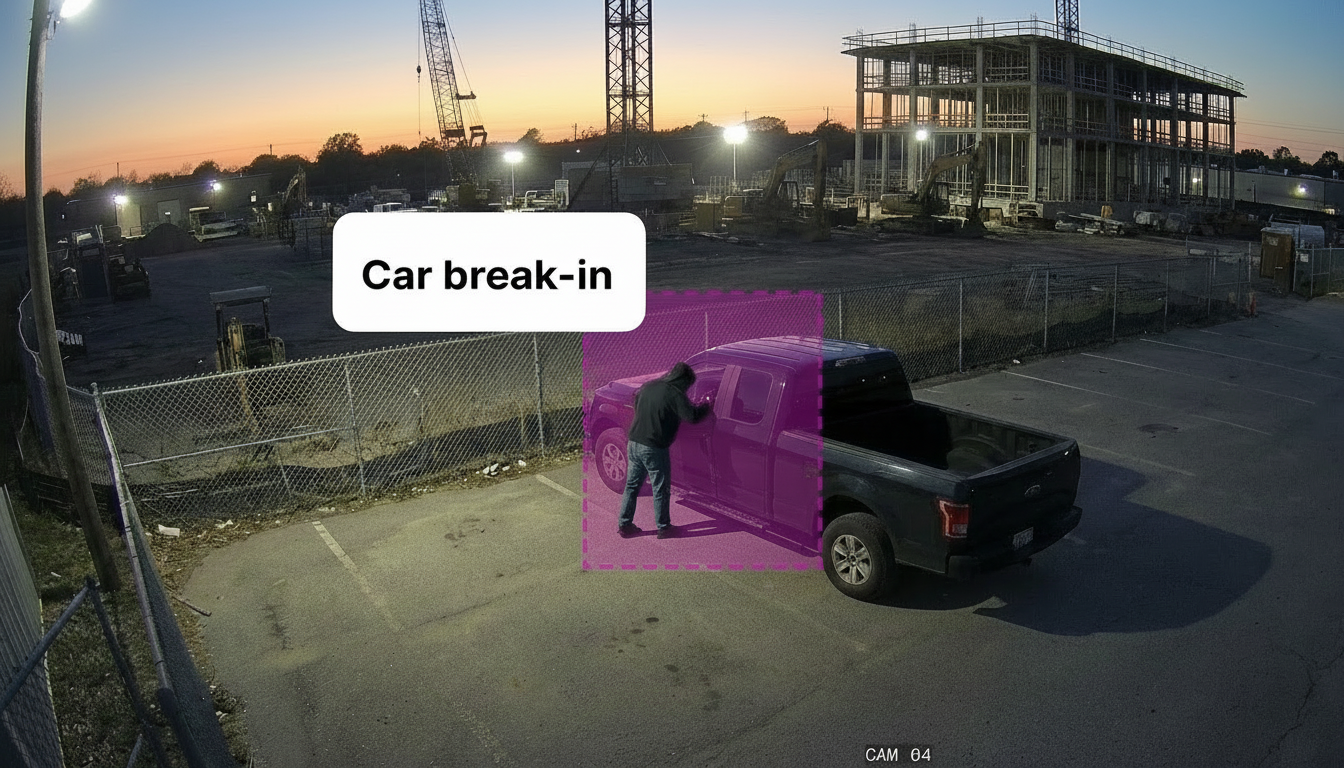


For a site superintendent, few things disrupt the morning schedule like arriving at the job site to find shattered glass in the parking lot or a missing skid steer. You are responsible for keeping the project on time and under budget, but vehicle theft and break-ins create cascading delays that ruin your Schedule Performance Index (SPI) and inflate your Cost Performance Index (CPI).
In the first half of 2025 alone, vehicle thefts reached 334,114 reported cases across the United States (Source: Lot Guard). While you focus on coordinating trades and ensuring safety compliance, criminals are actively targeting the vehicles and equipment essential to your operations. The impact goes beyond the replacement cost; it involves insurance premium hikes, administrative headaches, and the loss of crew productivity.
Traditional security measures often fail to address these pain points effectively. You might be frustrated by reactive video systems that only record evidence after the damage is done, or motion sensors that generate so many false alarms that your team stops paying attention. This article outlines a practical plan to detect and deter car break-ins, moving from reactive documentation to earlier risk detection and response.
Understanding the pain points for site superintendents
Managing security on a dynamic construction site is vastly different from securing a static building. You face specific frustrations daily that complicate vehicle protection. Here is how modern video AI technology addresses the core sticking points identified by construction leaders.
- The pain point: reactive systems that miss the crime
Traditional camera systems capture footage but do not deter theft. You often discover a break-in hours after it happened, leaving you with nothing but a recording of the loss.
The solution: Video AI helps cameras act as a smarter monitoring tool. Features like Vehicle enters no-go zones send prompt alerts when an unauthorized vehicle breaches a perimeter, so you can respond quickly. - The pain point: excessive false alarms
Standard motion detection cannot distinguish between a stray dog, a blowing tarp, or a thief. This leads to alert fatigue, where genuine threats are ignored.
The solution: Intelligent algorithms differentiate between normal site activity and actual risks. By using Loitering detection, the system identifies suspicious behavior patterns—like someone lingering near employee vehicles—without flagging every passing car. - The pain point: time-consuming manual review
When an incident occurs, you lose hours manually scrubbing through footage to find evidence, taking you away from critical site management tasks.
The solution: Smart search capabilities allow you to search for specific attributes (e.g., "red truck" or "person without hard hat") across all cameras quickly. This significantly shortens investigation time. - The pain point: poor visibility into equipment location
Without intelligent tracking, you cannot monitor where high-value assets are located or who is accessing them after hours.
The solution: Vehicle/forklift absent detection alerts you when equipment moves from its designated storage zone, providing real-time visibility into asset usage.
The operational impact of vehicle theft in 2025
Understanding the scope of the threat is the first step in mitigation. The landscape of vehicle crime has shifted, with specific models and regions seeing higher activity.
Data from the first half of 2025 indicates that specific vehicles are primary targets. The Hyundai Elantra accounted for 11,329 thefts, followed closely by the Hyundai Sonata and Honda Accord (Source: Lot Guard). If your crew or subcontractors drive these models, your parking areas possess a higher risk profile.
Regional variances also dictate your risk level. The District of Columbia reported 373.09 thefts per 100,000 residents in early 2025, with California and Nevada also reporting significantly high rates (Source: Lot Guard). Furthermore, cargo theft is rising, with incidents up 10% in the first half of 2025 compared to the previous year (Source: American Security Force).
The operational cost extends beyond the stolen asset. A single stolen skid steer can cost over $50,000 to replace, but the project delay costs can reach tens of thousands of dollars per day due to work stoppages and emergency rental rates (Source: Latium Tech).
Identifying vulnerabilities in parking and storage areas
To effectively guard against car theft on construction sites, you must identify the environmental and operational gaps criminals exploit.
- Inadequate lighting
Over 70% of crimes in parking facilities occur in poorly lit areas (Source: Gateway LED). Temporary lighting is often insufficient, creating shadows and blind spots that provide cover for thieves. - Monitoring coverage gaps
Fixed cameras fail to adapt as the site evolves. As cranes move and material piles shift, blind spots emerge. Additionally, cameras that only record without active monitoring during nights and weekends leave sites vulnerable when no personnel are present. - Predictable staffing patterns
Thieves conduct reconnaissance to learn your schedule. They target shifts with skeleton crews, such as nights and weekends, knowing that response times are slower. - Unauthorized access points
On large sites with multiple subcontractors, controlling every access point is difficult. Without strict access control, unauthorized vehicles can blend in with legitimate traffic.
Physical security infrastructure and environmental controls
Before deploying advanced technology, you must establish a baseline of physical security. These measures raise the effort required to commit a crime.
Lighting strategies for deterrence
Lighting is the most cost-effective physical deterrent. Effective parking lot lighting can lower crime rates by 30% to 50% (Source: Gateway LED).
| Lighting type | Characteristics | Estimated crime decrease |
|---|---|---|
| LED Systems | High efficiency, 15,000 lumens, wide coverage. | ~60% |
| High-Intensity Discharge | Very bright (20,000 lumens), high energy use. | ~50% |
| Motion-Activated | Adapts to occupancy, surprises intruders. | Varies based on implementation |
(Source: Gateway LED)
Implementing motion-activated LED systems ensures that dark corners are swiftly illuminated when movement is detected. This not only startles potential thieves but also improves the image quality for your video systems.
Perimeter and access control
Quality fencing is essential. Chain link panels with galvanized steel provide visibility while restricting access. For high-risk areas, establishing designated parking zones allows you to concentrate your security efforts rather than monitoring dispersed vehicles.
Implementing a check-in system for vehicles adds another layer of protection. Whether through manned gates or automated solutions, documenting who enters and exits creates an audit trail that discourages internal theft and identifies unauthorized visitors.
Real-time video technology for car break-in detection
Modern video technology has evolved from passive recording to intelligent detection. For a general superintendent, this can mean moving from only reviewing footage after the fact to responding to activity as it happens.
AI-driven detection capabilities
Cloud-based video platforms use AI to analyze feeds in real-time. Unlike traditional motion detection, these systems classify objects and behaviors.
- Vehicle and person detection
The system distinguishes between a person, a vehicle, and general motion. If a person enters a designated "No-go Zone" around parked vehicles after hours, the system triggers a real-time alert. - License plate recognition (LPR)
LPR technology captures license plate numbers, makes, and models in real-time. This allows you to automatically flag unauthorized vehicles or recognize vehicles associated with previous incidents. - Behavioral analytics
Advanced systems detect loitering. If a vehicle or person lingers in a sensitive area for longer than a set duration, the system flags this as suspicious activity, helping security personnel investigate promptly.
If you are looking to upgrade your site's capabilities, you can learn how Spot AI can help improve site security.
Mobile and remote monitoring solutions
Construction sites are temporary and often lack hardwired infrastructure. Mobile monitoring trailers powered by solar energy support continuous monitoring without needing a fixed power connection. These units can be relocated as the site layout changes, helping minimize unmonitored areas.
Cloud-based dashboards allow you to view footage from multiple sites on a single device. This remote capability is vital for superintendents managing several projects, enabling you to verify site security from anywhere.
Comparison: Spot AI vs. traditional security measures
When selecting construction site security solutions, it is helpful to compare modern Video AI against legacy methods.
| Feature | Spot AI | Traditional systems | Security guards |
|---|---|---|---|
| Deployment speed | Plug-and-play with existing cameras; live in minutes. | Complex wiring and setup; days to weeks. | On-the-spot, but limited by staffing availability. |
| Detection type | Proactive: Real-time AI alerts for loitering and no-go zones. | Reactive: Records footage for later review. | Active: Can intervene but has limited field of view. |
| Search capability | Google-like search for specific events/objects. | Manual rewinding and scrubbing. | N/A (Relies on memory/logs). |
| Scalability | Supports many users and sites on one dashboard. | Difficult to scale; often siloed systems. | Expensive to scale (linear cost increase). |
| Cost structure | Lower overall cost; uses existing hardware. | High upfront hardware and maintenance costs. | High recurring labor costs. |
Best practices for deterring vehicle theft on construction sites
To build a reliable security posture, integrate technology with operational protocols.
- Conduct a risk assessment
Evaluate the specific threats for your site location. Projects in high-theft jurisdictions like California or Texas require enhanced measures compared to lower-risk areas. - Implement "defense in depth"
Layer your security. Use perimeter fencing to restrict access, lighting to expose intruders, and video AI to detect breaches. Integrated systems where motion lights trigger alongside video recording create a robust deterrent. - Standardize parking zones
Require all personal vehicles and light equipment to park in designated, well-lit, and monitored zones. This simplifies monitoring and makes unauthorized presence obvious. - Establish response protocols
Define clear actions for when an alert is triggered. Who receives the notification? Who contacts law enforcement? Rapid audio warnings through camera speakers can deter thieves effectively. - Preserve evidence automatically
Ensure your system automatically archives footage of detected incidents. Cloud-based systems mitigate data loss even if local hardware is damaged.
Recovering from an incident
Despite best efforts, incidents can occur. A rapid response minimizes loss.
- Rapid notification
Contact law enforcement immediately with vehicle descriptions and last known locations. - Evidence collection
Use your video platform to quickly export time-stamped clips of the incident. Organized video evidence significantly improves investigative efficiency. - Insurance documentation
Submit detailed claims supported by video evidence and inventory logs. This accelerates processing and validates the claim.
Securing Your Site for Operational Continuity
For construction superintendents, protecting vehicles and equipment is not just about security—it is about operational continuity. A stolen truck or broken window means downtime, missed deadlines, and budget overruns. By moving away from reactive recording and using Video AI, you can detect risks in real-time, help deter criminal activity, and maintain the efficiency of your job site.
See how Spot AI’s video AI platform can help secure your construction site—request a demo to experience the technology in action.
Frequently asked questions
What are the best practices for deterring vehicle theft at construction sites?
Effective deterrence involves a layered approach: utilizing perimeter fencing, ensuring adequate LED lighting (preferably motion-activated), designating specific parking zones, and deploying video AI systems that detect unauthorized entry and loitering in real-time.
How can technology enhance security for vehicles on job sites?
Technology enhances security by supporting automated monitoring. AI-driven cameras can identify vehicles and people, read license plates, and alert staff to suspicious behavior quickly, reducing the reliance on constant human observation.
Are AI cameras effective for construction site theft deterrence?
Yes, AI cameras can help minimize false alarms and enable a swift response. Unlike standard motion sensors, AI can distinguish between a person and environmental movement, helping security teams focus on likely issues.
What are the common causes of vehicle break-ins at construction sites?
Common causes include poor lighting, lack of active monitoring during nights and weekends, predictable staffing schedules, and unrestricted access to parking areas. Addressing these vulnerabilities significantly lowers risk.
How do I deter car break-ins at my construction site after hours?
To deter after-hours break-ins, deploy mobile monitoring units with AI analytics that trigger alerts for configured movement in "No-go Zones." Combine this with audio deterrents and ensure the parking area is well-lit to discourage criminals from approaching.
About the author
Sud Bhatija is COO and Co-founder at Spot AI, where he scales operations and GTM strategy to deliver video AI that helps operations, safety, and security teams boost productivity and reduce incidents across industries.

