




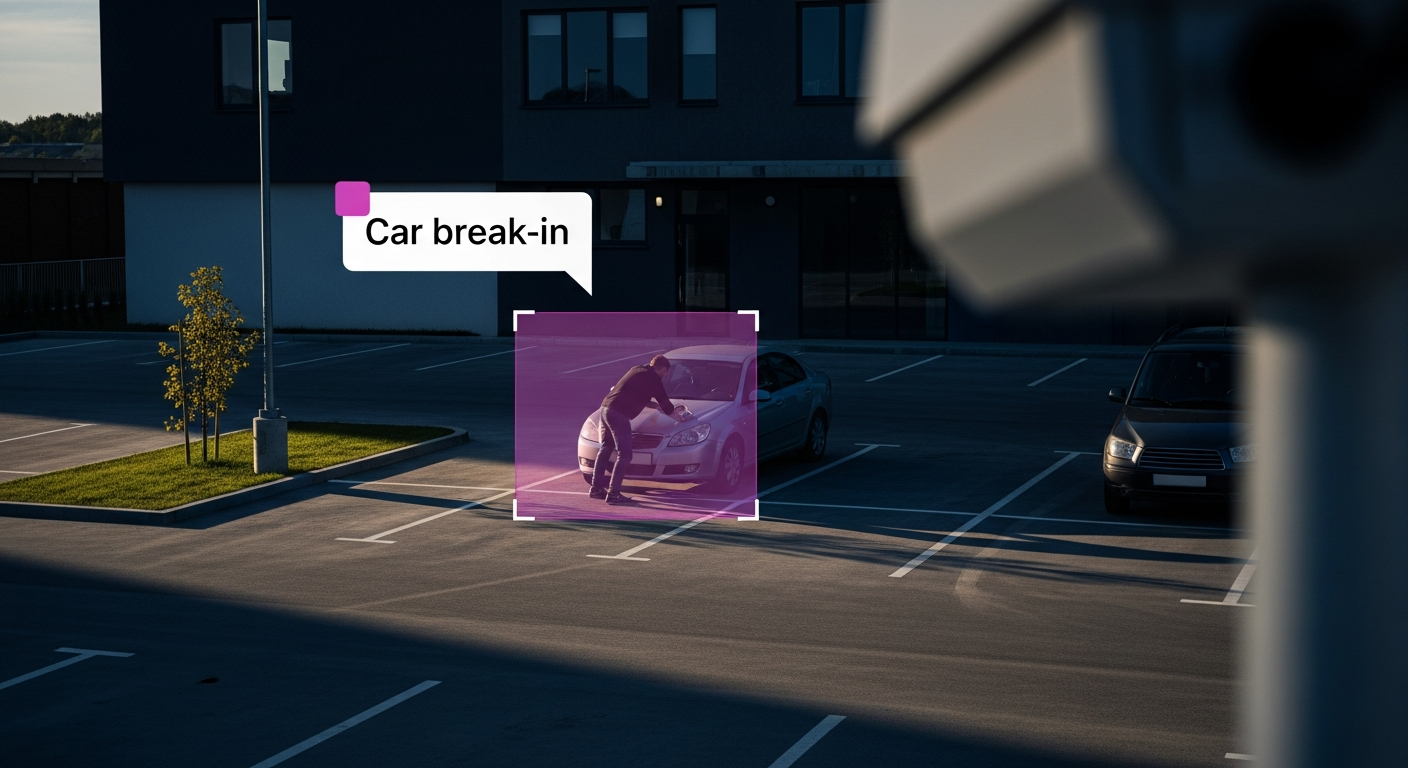


Parking lots are the unmanaged edge of retail operations—critical infrastructure where customer safety, asset protection, and liability management converge, yet often the hardest zone to monitor effectively. For leaders responsible for loss prevention and asset protection, these spaces create a dangerous blind spot. While the store interior is tightly controlled, the exterior remains vulnerable to organized retail crime (ORC) staging, vehicle theft, and costly liability claims.
The core challenge is the latency of traditional parking lot security. Relying on manual patrols or retroactive video scrubbing traps security teams in a reactive cycle—constantly fighting fires rather than preventing them. By the time an incident is reported, the damage is done. A unified video AI platform shifts this dynamic, transforming existing parking lot security cameras into proactive data sources. By turning raw video into actionable insights, retail organizations can resolve incidents faster, minimize liability exposure, and standardize security operations across their entire fleet without adding headcount.
The high cost of reactive parking lot management
For retail enterprises, the economic impact of parking lot incidents extends far beyond the initial loss of inventory or property. The total cost of risk includes liability claims, insurance premiums, legal fees, and reputational damage.
1. Liability and personal injury claims
Personal injury incidents are a leading source of liability claims in parking facilities. In 2024, the retail industry recorded workplace injury costs totaling $176.5 billion, with slip-and-fall incidents remaining a primary driver of premises liability exposure (U.S. Bureau of Labor Statistics). Without timely, high-quality video evidence to verify lot conditions—such as snow removal status, lighting functionality, or pavement conditions—at the exact moment of an incident, retailers often face settlement pressure for claims that could otherwise be defended with objective evidence.
2. Vehicle-related theft and vandalism
While general motor vehicle theft decreased by 17 percent from 2023 to 2024, specific high-value targets remain vulnerable. Catalytic converter theft has shown resilience against broader crime trends, with 2025 data indicating a resurgence of approximately 250–300 incidents annually in some major cities (Lansing City Pulse). These crimes often occur in unsecured lots where undercarriages are accessible, typically executing within minutes—far faster than the rotation of traditional parking lot security guard alternatives.
3. ORC coordination and seasonal spikes
Organized retail crime networks increasingly use parking lots as staging grounds. According to 2024 industry data, more than 52% of retailers reported increases in theft tied to ORC groups, who use parking areas for vehicle coordination and target reconnaissance before executing in-store operations (National Insurance Crime Bureau). This trend intensifies during holiday peaks, when retail parking lot theft prevention becomes critical to protecting both merchandise and customer confidence.
Why manual investigation processes fail
The traditional approach to parking lot security assessment relies heavily on manual observation and retrospective investigation. For a manager responsible for dozens of sites, this model is unscalable.
The inefficiency of manual review
Investigating a single incident using legacy systems creates a labor-intensive bottleneck. Investigators must manually retrieve footage from local DVRs, scrub through hours of video to find a specific event, and export clips using cumbersome software. By the time evidence is ready, the opportunity for recovery or apprehension has passed. Parking lot incident investigation timelines that stretch into hours drain resources that should be focused on prevention.
Incomplete evidence and coverage gaps
Legacy systems often suffer from coverage gaps and blind spots. Without automated health alerts, a camera might be offline for weeks without anyone noticing until an incident occurs—a scenario known as "video blindness." Modern cloud-based parking lot security standards now demand real-time health monitoring to ensure compliance and continuous recording.
Alert fatigue
Alert fatigue is the top concern for security operations centers (DevOps Digest). Motion-based detection systems are notorious for high false alarm rates—rain, shadows, or blowing debris trigger alerts constantly. This noise causes security teams to ignore notifications entirely, undermining the credibility of the security system and slowing response to genuine threats.
Accelerating resolution with a unified video AI platform
A unified video AI platform addresses these bottlenecks by centralizing video data and applying intelligence to detection and search. This technology allows loss prevention teams to resolve incidents faster by automating the most time-consuming parts of the investigation process.
| Feature | Traditional Video Systems | Unified Video AI Platform |
|---|---|---|
| Search Method | Manual scrubbing (hours) | Natural language search (seconds) |
| Detection | Generic motion (high false alarms) | Context-aware AI (people, vehicles) |
| Access | Local/VPN required | Cloud-native, accessible anywhere |
| Scalability | Hardware-dependent | Plug-and-play, camera agnostic |
| Retention | Local storage limits | Hybrid cloud with automated legal hold |
1. Reducing investigation time from hours to minutes
Video AI platforms use forensic video search for parking capabilities. Instead of watching hours of footage, an investigator can search for specific attributes—"red truck" or "person in blue shirt"—or filter by behaviors like loitering in a specific zone. This allows retail loss prevention operations to achieve significantly faster investigation resolution compared to manual protocols.
2. Real-time incident detection
Rather than waiting for a report to be filed, Video AI Agents monitor feeds 24/7. Templates such as "Vehicle Enters No-go Zones" or "Loitering" trigger real-time parking lot alerts. If a vehicle pulls up to a loading dock after hours, or if an individual is loitering near employee vehicles, the system notifies the security team immediately. This allows for intervention while the incident is in progress.
3. Automated documentation and chain of custody
Defending against liability claims requires reliable, well-documented evidence. Unified platforms automate footage preservation. When an incident is flagged, the system automatically retains the relevant video, preventing it from being overwritten by standard retention cycles. This helps reduce the risk of spoliation sanctions, which can occur if evidence is lost after a litigation hold is triggered.
Proactive risk-reduction strategies for parking lots
Moving from reactive recording to forward-looking risk reduction means leveraging AI to identify risk precursors. By mapping specific AI capabilities to common retail challenges, LP leaders can build a more resilient security posture.
1. Deterring loitering and organized crime
Organized retail crime groups frequently use parking lots as staging areas. They may sit in vehicles to watch store operations or identify targets. Automated loitering detection serves as a force multiplier for security teams.
Spot AI Solution: The "Loitering" AI agent detects individuals or vehicles remaining in a specific area for a set duration. Security can then dispatch a guard or trigger a voice-down system to deter potential misconduct. This parking lot crime deterrence strategy prevents the lot from becoming a permissive environment.
2. Managing unauthorized access
Restricted areas—loading docks, employee-only parking zones—are frequent targets for theft. Managing unauthorized parking and securing perimeters are critical for asset protection.
Spot AI Solution: "Person Enters No-go Zones" and "Vehicle Enters No-go Zones" templates create virtual perimeters. If a vehicle enters a restricted area after hours, an alert is sent immediately. This is particularly effective for detecting vehicle break-ins and catalytic converter theft attempts in fleet parking areas.
3. Mitigating premises liability
Verifying that a parking lot was safe and properly maintained (plowed, salted, or well-lit) is the best defense against costly liability claims. Resolving parking lot accidents requires objective proof of due diligence.
Spot AI Solution: When a personal injury claim is filed, video AI provides swift retrieval of footage to investigate the incident. Using smart search, teams can find video of a reported event in minutes to verify lot conditions at the exact time it occurred. Time-stamped video evidence of maintenance crews servicing the lot provides objective proof of due diligence—essential for reducing parking lot liability claims.
Managing multi-location security at scale
For retailers with dozens or hundreds of locations, standardization is the key to efficiency. A unified video AI platform centralizes management, allowing a small team of investigators to cover many locations effectively.
1. Centralized dashboard visibility
Loss Prevention Directors can view the health and status of all cameras across all sites from a single dashboard. This eliminates the need to log into separate systems for each store and enables rapid identification of offline cameras or coverage gaps, helping maintain high uptime for critical views.
2. Consistent SOP adherence
Parking lot safety extends beyond crime prevention to operations. Are cart corrals being emptied? Are trash compactors secured? Parking lot safety for employees and customers depends on consistent execution.
Spot AI Solution: Using "SOP Adherence" tracking, regional managers can audit site compliance remotely. This saves travel time for field managers while ensuring brand standards and safety protocols are maintained across the fleet.
3. Data-driven resource allocation
By analyzing parking lot activity heatmaps—such as where loitering occurs most frequently—leaders can make data-backed decisions. If one store shows a spike in parking lot incidents on Friday nights, security guard shifts can be adjusted specifically for that window, making better use of budget and reducing security guard costs.
Comparing video AI solutions for retail
When selecting a platform to resolve parking lot incidents faster, evaluate vendors based on deployment speed, flexibility, and total cost of ownership. The parking lot security system cost must be weighed against the operational savings generated.
| Feature | Spot AI | Traditional NVR/DVR | Cloud-Only Cameras |
|---|---|---|---|
| Camera Compatibility | Works with most IP cameras | Proprietary lock-in | Proprietary lock-in |
| User Limit | Unlimited users | Per-user licensing | Per-user licensing |
| Search Speed | Seconds (AI-indexed) | Slow (Manual fast-forward) | Variable (Bandwidth dependent) |
| Bandwidth Usage | Low (Edge processing) | High (if remote viewing) | High (Constant upload) |
| Deployment | Plug-and-play (<1 week) | Complex wiring/setup | Complex replacement |
| AI Capabilities | Built-in AI Agents | Limited/None | Subscription tiers |
Why Spot AI stands out:
- Camera agnostic: No need to rip and replace existing wireless parking lot security cameras or wired infrastructure. Spot AI connects to your current hardware, quickly adding AI capabilities.
- Faster search: Resolve inquiries in minutes instead of the typical four to eight hours per case.
- No user limits: Give access to store managers, regional LP leaders, and operations teams without extra costs.
Why video AI is an operational necessity
The shift from reactive observation to intelligent video analytics for parking lots is an operational necessity for modern retail. By resolving parking lot incidents faster with a unified video AI platform, Loss Prevention leaders can protect their margins, help keep customers safe, and demonstrate the value of their security programs.
Organizations implementing these systems report significant drops in both incident rates and investigation duration. For retailers facing rising crime rates and liability costs, video AI offers the speed and intelligence required to stay ahead.
Frequently asked questions
How can video AI help with parking lot incidents?
Video AI automates the detection of suspicious behaviors like loitering or unauthorized entry, alerting security teams in real time. It also drastically cuts investigation time by allowing users to search video footage by keywords (e.g., "red car," "person running") rather than manually scrubbing through hours of recording.
What are the legal implications of parking lot accidents?
Property owners have a legal duty to maintain safe premises. Liability claims for personal injury incidents or inadequate security can be costly. Video AI helps defend against these claims by providing objective, time-stamped evidence of lot conditions and maintenance activities, and ensures evidence is preserved to avoid spoliation sanctions.
How does a unified video AI platform improve response times?
By consolidating feeds from multiple locations into a single dashboard and using AI to filter out false alarms, these platforms help security personnel focus on verified incidents. This can accelerate response times from many minutes for traditional patrols to seconds for AI alerts.
Can I use my existing parking lot cameras with video AI?
Yes. Platforms like Spot AI are camera-agnostic. They connect to your existing IP cameras, regardless of brand, and process the video feed at the edge to add AI capabilities. This avoids the high cost of ripping and replacing functioning hardware.
What is the ROI of video AI for loss prevention?
ROI is driven by minimizing shrink, lowering investigation labor costs (saving hours per incident), decreasing liability payouts from false claims, and operational improvements like optimized guard staffing. Many organizations see a rapid return on investment.
Take action
"We have multiple uses for Spot AI and whether that's reviewing footage from our parking lots or getting a live feed from our offices Spot AI gives us the perfect tools to do this quickly and with precision."
— Daniel A., Systems and Programs Coordinator (G2)
Want to see how Spot AI can help you resolve parking lot incidents faster? Request a demo to experience our video AI platform in action.
About the author
Sud Bhatija is COO and Co-founder at Spot AI, where he scales operations and GTM strategy to deliver video AI that helps operations, safety, and security teams boost productivity and reduce incidents across industries.

