






Controlling access to restricted zones is a foundational requirement for manufacturing security, safety, and compliance. Yet, for the professionals tasked with securing these environments, the obstacle is twofold: how to effectively monitor for unauthorized personnel without disrupting the production continuity that drives the business. Traditional security methods often create friction, pitting operational availability against robust security controls and leaving teams to manage a complex web of isolated platforms.
The consequences of unauthorized access are severe, ranging from intellectual property theft and production downtime—which can cost UK manufacturers up to £1.36 million per hour—to serious safety incidents (Source: ITPro). For OT and IT security professionals, the core frustration lies in the inability to unify legacy security solutions with modern operational technology (OT) infrastructure, creating blind spots where risks go undetected. This article explores how to bridge that gap, moving from reactive monitoring to more proactive detection of unauthorized personnel in restricted manufacturing zones.
The core hurdles of monitoring restricted zones in manufacturing
Securing a dynamic manufacturing environment is fundamentally different from securing a standard IT office. The constant movement of people, materials, and machinery, combined with the presence of sensitive legacy OT systems, creates a unique set of obstacles.
A primary roadblock is the inability to connect security platforms with OT infrastructure. Legacy video systems often operate in silos, disconnected from Manufacturing Execution Systems (MES) and SCADA platforms. This lack of connectivity means security and operational data cannot be correlated, making it tough to manage a complete picture of an incident. For example, an access control log might show an authorized entry, but it can't verify if that person is adhering to standard operating procedures (SOPs) once inside the zone.
This leads to another substantial hurdle: balancing security requirements with production continuity. Every security measure must be carefully weighed against its potential impact on operations. Traditional IT security responses, like network scans or automatic system shutdowns, can inadvertently halt a production line or trigger a safety system failure, creating a constant tension between implementing necessary controls and maintaining uptime.
Furthermore, many teams face budget constraints for security improvements. Justifying investments in new technology is difficult without clear, quantifiable ROI, especially when competing for funds against projects with direct production benefits. This is compounded by a persistent skills gap in OT-specific security expertise, leaving many teams understaffed and ill-equipped to manage the converged IT/OT landscape.
A modern approach: leveraging video AI for unauthorized personnel detection
Instead of relying on siloed, reactive systems, modern manufacturing security uses video AI to turn existing camera infrastructure into a more intelligent detection system. Unlike basic motion triggers, which flag any movement and create a high volume of false positives, video AI analyzes footage to understand context and identify specific, unauthorized behaviors.
This approach directly addresses the core obstacles faced by security and network professionals by creating an added security layer that minimizes disruption.
| Feature | Traditional Monitoring | Spot AI Video AI Platform |
|---|---|---|
| Detection Method | Basic motion triggers, manual review | AI-powered behavioral analytics (loitering, no-go zones) |
| Alerts | High volume of false alarms, leading to alert fatigue | Context-aware, real-time alerts on specific events |
| Integration | Operates in a silo; difficult to connect with OT systems | Open APIs for integration with access control and MES |
| Investigation | Manual video scrubbing, hours to find an event | Keyword and event search; find incidents in minutes |
| Operational Impact | Can require disruptive network changes | On-prem hardware bridge maintains air-gap from OT network |
Key strategies for monitoring unauthorized personnel
An effective strategy for monitoring restricted zones combines technology, process, and people. By integrating AI-powered video with other security layers, manufacturing organizations can build a resilient defense against unauthorized access.
1. Implement AI-powered video analytics
AI video analytics systems serve as the core of a modern security strategy. These platforms use deep learning models to detect relevant events rather than passively record footage.
Spot AI’s Video AI Agents are pre-trained to identify specific behaviors that indicate unauthorized presence, including:
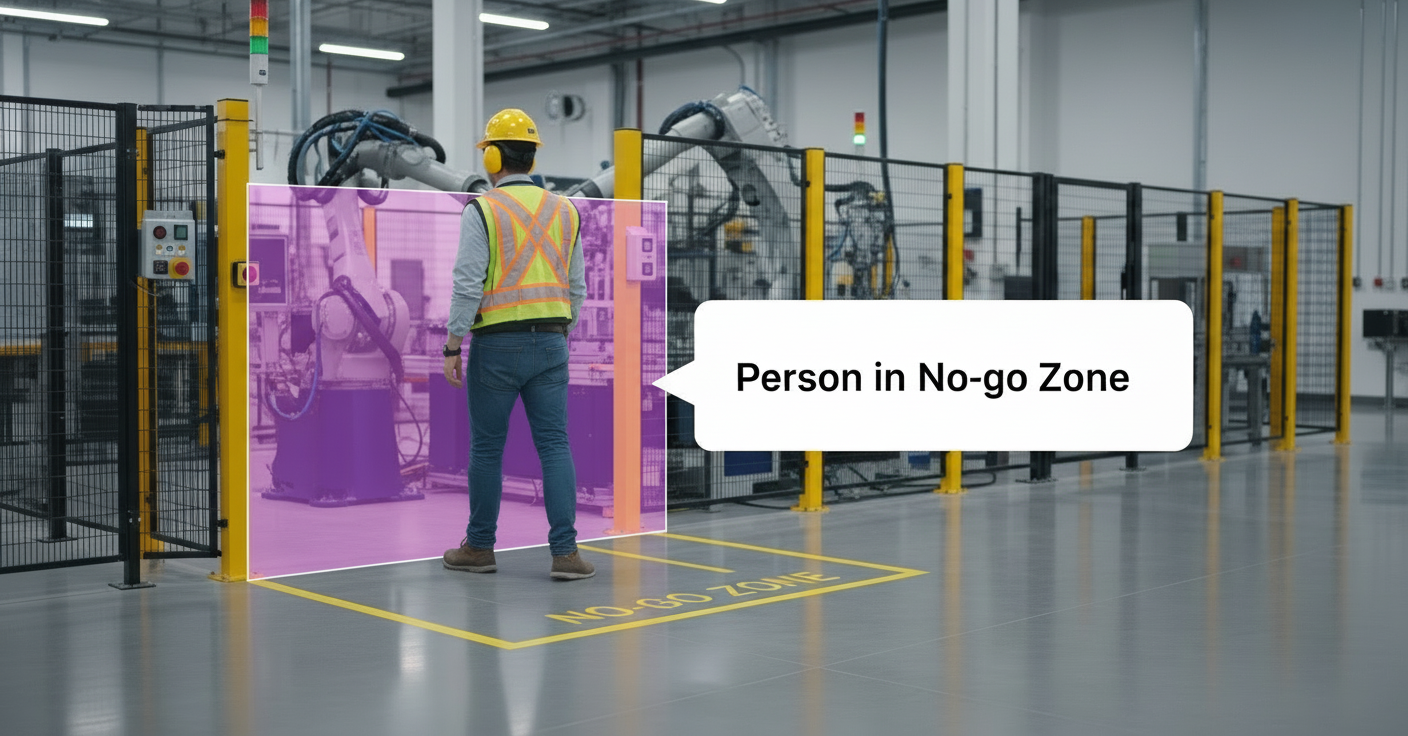
- Person enters no-go zones: Automatically detects and alerts when an individual enters a predefined restricted area, such as a space with active machinery or hazardous materials.
- Loitering: Flags individuals dwelling in a sensitive area for an unusual length of time, which can be an indicator of a potential insider risk or an external actor planning a breach.
- Unauthorized entry: Monitors access points and alerts teams when someone attempts to enter a restricted zone without proper credentials, such as bypassing a turnstile or entering through an unsecured door.
- Tailgating: Identifies instances where an unauthorized person follows an authorized individual through a secure access point.
Because these AI models are pre-trained and run on an intuitive platform, they empower existing security teams to deploy advanced analytics without needing specialized AI expertise, directly addressing the OT security skills gap.
2. Integrate video AI with access control systems
A major weakness in traditional security is the disconnect between access control systems and video monitoring. A log might show a badge was used, but it provides no context on who used it or what they did next.
Connecting your video AI platform with access control systems creates an integrated security workflow. When an access event occurs—valid or invalid—the system can automatically pull the corresponding video footage. This delivers several key benefits:
- Visual verification: Immediately verify that the person using the access card is the authorized holder.
- Accelerated investigation time: Instead of manually correlating timestamps between two different platforms, investigators can see the access event and video evidence in a single interface.
- Real-time context: If an invalid card is used, security teams receive an alert with a live video feed, allowing them to assess the situation and respond in seconds.
Spot AI’s open API enables this integration, allowing it to connect with existing access control and other platforms to create shared operational visibility without compromising network segmentation.
3. Establish and monitor restricted zones with a zone-based architecture
Effective security relies on network segmentation to contain vulnerabilities. The Purdue Model provides a framework for this, creating hierarchical security zones to control communication between IT and OT networks. An industrial demilitarized zone (DMZ) acts as a buffer, allowing necessary data to flow while limiting attack paths.
Video AI helps enforce these digital and physical boundaries. Using a feature like no-go zones, teams can draw virtual boundaries around restricted areas directly on the video feed. If a person or vehicle crosses into one of these zones, the system triggers a timely alert. This allows security professionals to enforce segmentation policies in the physical world and gain visibility into compliance gaps without impacting production infrastructure or network performance.
Best practices for implementation
A successful unauthorized personnel detection program requires a foundation of clear processes and policies.
- Start with a comprehensive asset inventory. You cannot protect what you cannot see. Conduct a full discovery of all OT assets, including PLCs, HMIs, and network devices, to address blind spots.
- Define clear role-based access controls (RBAC). Align permissions with operational responsibilities. This simplifies administration and ensures employees, vendors, and contractors only have access to the areas and platforms necessary for their jobs.
- Develop robust employee and contractor training. Educate your entire workforce on security policies, including procedures for accessing restricted zones, escorting visitors, and reporting suspicious activity. Social engineering remains a primary vector for gaining initial access.
- Ensure compliance with evolving standards. For defense contractors, CMMC 2.0 compliance is now a contractual requirement, mandating stringent access controls to protect Controlled Unclassified Information (CUI). Similarly, ensure your video systems are NDAA-compliant to meet federal requirements.
Evolve your security from reactive to more proactive
Monitoring for unauthorized personnel in restricted manufacturing zones no longer has to be a trade-off between security and productivity. By augmenting your existing cameras with a Video AI platform, you can create an intelligent, forward-thinking security solution that detects anomalies in real time without disrupting critical OT networks. This approach not only strengthens your security posture, but also provides quantifiable ROI by mitigating incidents, accelerating investigations, and helping minimize costly production downtime.
Want to see Spot AI’s video AI platform in action? Book a demo to explore how you can monitor restricted zones and strengthen security—without disrupting operations.
Frequently asked questions
What are the best practices for guarding against unauthorized access in manufacturing?
Best practices include implementing a layered security approach combining physical access controls, network segmentation based on the Purdue Model, role-based access control (RBAC), and AI-powered video analytics for real-time detection. This should be supported by comprehensive employee training on security policies and incident reporting.
How can video AI enhance security in restricted areas?
Video AI enhances security by transforming passive monitoring into an active system. It uses behavioral analytics to detect specific unauthorized activities in real time, such as a person entering a no-go zone, tailgating through a secure door, or loitering near sensitive equipment. This enables early intervention before an incident escalates.
What technologies are most effective for monitoring unauthorized personnel?
The most effective approach integrates multiple technologies. This includes modern access control platforms (using multi-factor authentication), AI-powered video analytics for behavioral detection, and network monitoring tools that can identify anomalous activity on OT networks. Unifying these platforms provides a comprehensive view of facility security.
What compliance standards should manufacturing companies adhere to for security?
Key standards include ISO 27001 for information security management, the NIST Cybersecurity Framework for risk management, and OSHA for machine guarding and physical safety. Defense contractors must also comply with CMMC, and any organization using federal funds should ensure their video equipment is NDAA-compliant.
How can video analytics improve overall factory security?
Video analytics improve factory security by automating the detection of security risks and safety-related events. Beyond flagging unauthorized personnel, analytics can support reviews related to SOP adherence, detect missing PPE, and identify unsafe behaviors like running near machinery. This provides a dual benefit of strengthening security while also improving operational safety and efficiency.
What is the best video security system for industrial facilities?
The most effective video security solution for an industrial facility is a platform that delivers timely, relevant insights. An ideal system uses AI to automatically detect specific behaviors like a person entering a no-go zone, providing contextual alerts that help reduce alert fatigue. It should also integrate with existing access control and operational platforms via open APIs to create a unified view of security events. Critically, it must preserve network integrity during deployment and allow teams to accelerate investigations with simple, event-based search.
About the author
Joshua Foster is an IT Systems Engineer at Spot AI, where he focuses on designing and securing scalable enterprise networks, managing cloud-integrated infrastructure, and automating system workflows to enhance operational efficiency. He is passionate about cross-functional collaboration and takes pride in delivering robust technical solutions that empower both the Spot AI team and its customers.

