




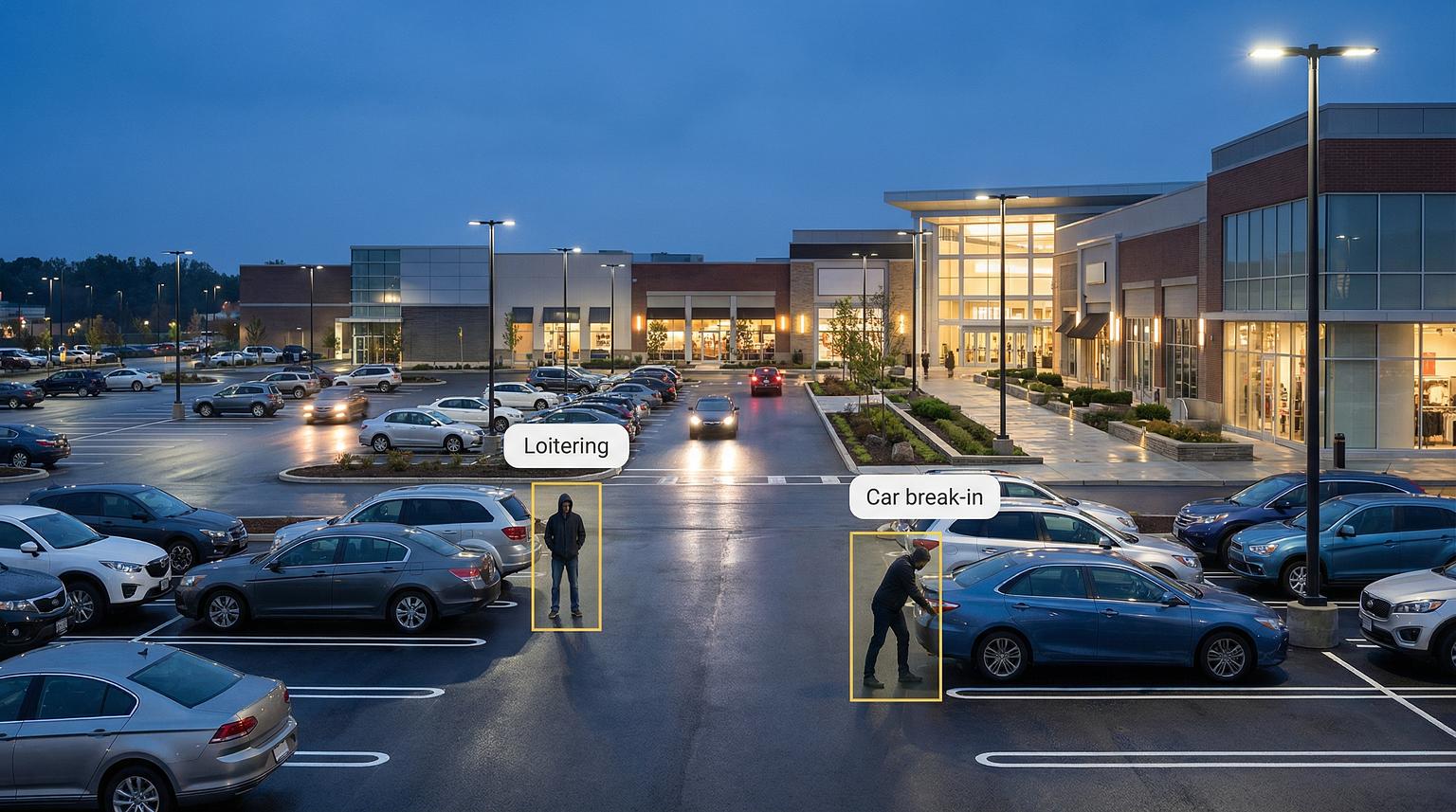


Parking lots account for a disproportionate share of retail security incidents—yet most shopping centers still treat them as an afterthought, covered by a handful of aging cameras and the occasional guard patrol. The gap between what happens outside the store and what teams can actually respond to creates an opening that organized retail crime (ORC) groups, opportunistic thieves, and after-hours trespassers exploit daily. For operations leaders and technical evaluators responsible for keeping malls safe, the question is no longer whether to invest in parking lot security but how to build a system that detects, deters, and documents—without ballooning headcount or creating more noise for already-stretched teams.
This guide breaks down the technology, staffing model, and operating procedures that make mall and shopping center parking lot security work in 2025.
Key terms to know
Before we get into the tactics, a few definitions help frame the discussion:
Term |
Definition |
|---|---|
Perimeter control |
Physical and electronic measures that restrict unauthorized access to a property's outer boundary—fences, gates, bollards, and camera coverage at entry/exit points |
Context-aware detection |
Video AI that analyzes multiple objects and surrounding conditions before deciding whether to alert, reducing nuisance alarms |
Optical character recognition applied to camera images to read and log vehicle registration plates automatically |
|
Alert fatigue |
The exhaustion caused by too many low-value or false alarms, which leads security teams to ignore or delay response |
Dwell time |
The length of time a person or vehicle remains in a specific zone—abnormally long dwell times can signal loitering or staging activity |
Remote monitoring |
Centralized oversight of multiple properties via networked video feeds, staffed by trained security professionals off-site |
Why parking lots are the weakest link in mall security
Shopping center parking lots combine several factors that make them attractive targets:
Large, open areas with limited natural oversight. Surface lots and multi-level garages spread across acres, creating zones where criminal activity can occur far from any staffed entrance.
Multiple entrances and exits. Unlike a single-door retail store, a mall parking facility may have dozens of vehicle and pedestrian access points—each one a potential blind spot.
Shared responsibility between property management and tenants. Ambiguity over who owns parking lot security often means nobody owns it fully, leaving gaps in coverage and response.
Predictable traffic patterns. Evening shopping hours, weekend surges, and seasonal peaks concentrate vehicles and shoppers in ways that criminals can time and exploit.
After-hours vulnerability. When stores close, foot traffic drops to near zero, but the lot remains accessible—making it a staging ground for vehicle break-ins, catalytic converter theft, and ORC reconnaissance.
Shoplifting incidents surged 93% from 2019 to 2023, with retailers reporting an additional 19% increase from 2023 to 2024 (Source: Capital One Shopping). A significant share of that activity starts—or ends—in the parking lot, where stolen goods are loaded, getaway vehicles wait, and lookouts stage.
When the lot looks uncontrolled, bad actors test boundaries. Customers and employees feel less safe, morale drops, and shoppers avoid the location—especially during evening hours when extended retail operations depend on foot traffic.
Camera placement strategy for surface lots and multi-level garages
How do you cover a sprawling parking facility without putting a camera on every pole? The answer lies in strategic placement that prioritizes high-risk zones and funneling points.
Priority zones for camera coverage
Priority |
Zone |
Why it matters |
|---|---|---|
1 |
Main vehicle entrances and exits |
Captures every plate entering or leaving; ideal for LPR integration |
2 |
Pedestrian walkways between lot and store entrances |
Transition zones where customers carry purchases and are most vulnerable |
3 |
Remote corners and overflow sections |
Low foot traffic and poor lighting make these prime locations for vehicle break-ins |
4 |
Loading docks and service corridors |
Access points that bypass customer-facing security entirely |
5 |
Stairwells and elevator lobbies (multi-level) |
Enclosed spaces with limited sight lines where incidents escalate quickly |
6 |
Adjacent perimeter fencing and access gates |
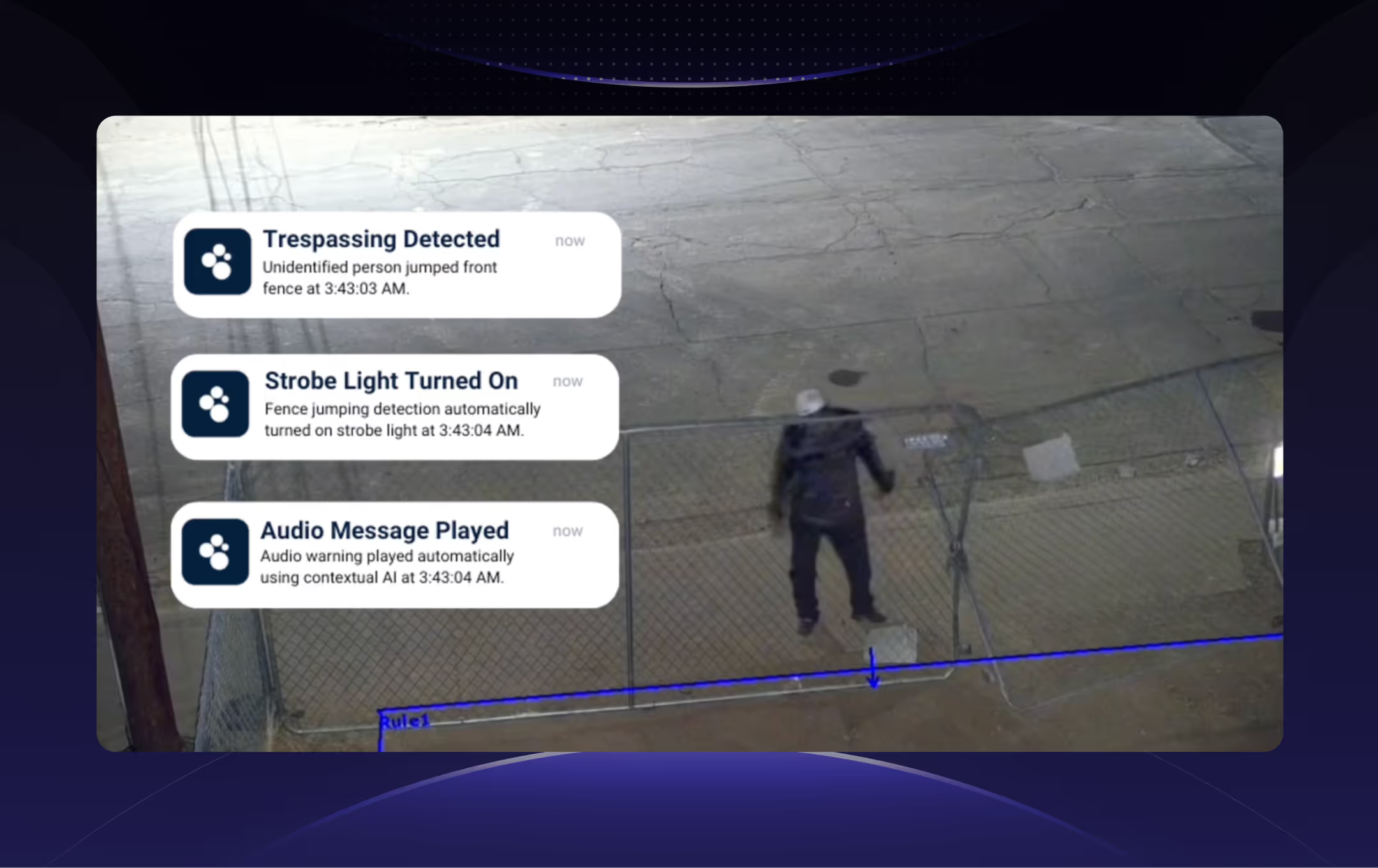
First line of defense against after-hours trespass and fence-jumping |
Fixed, mobile, and hybrid deployments
Fixed camera infrastructure delivers continuous coverage of designated zones and works well for entrances, loading docks, and stairwells where the threat profile stays consistent. Pan-tilt-zoom (PTZ) cameras add flexibility—a single PTZ unit mounted centrally can cover an area equivalent to several fixed cameras and zoom in for plate or clothing detail when an alert fires.
Mobile units—trailer-mounted camera systems that stand eight to twenty feet tall—address a different problem entirely. They can be repositioned in minutes to respond to emerging crime clusters, seasonal parking shifts, or construction-related layout changes. Their height and visibility also serve as a strong visible deterrent. Many operate on solar power and cellular connectivity, eliminating dependency on facility wiring and reducing installation complexity for facilities teams concerned about infrastructure burden.
The strongest mall deployments combine all three: dense fixed coverage at high-risk chokepoints, PTZ cameras for flexible mid-range coverage, and mobile units that shift to the hotspots as threats move.
How video AI turns passive cameras into active deterrence
Traditional cameras record what already happened. Teams review footage after an incident, spending hours scrubbing through video to find a relevant clip. That reactive approach leaves parking lots unprotected in the moments that matter most.
Video AI changes the equation by analyzing feeds in real time and acting on what it detects. A context-aware system distinguishes between a delivery driver walking a normal route and a person moving slowly through a parking row, stopping at multiple vehicles. It can identify loitering in restricted zones, unauthorized entry after hours, and crowding near store entrances—then trigger automated responses before a situation escalates.
That difference matters when LP teams are already stretched thin. Instead of adding headcount to watch more screens, video AI triages real threats and filters out nuisance alarms so security operators can focus on incidents that require human judgment.
Capability |
What it does |
Parking lot application |
|---|---|---|
Loitering detection |
Flags people or vehicles lingering beyond a set dwell time |
Identifies after-hours staging, ORC reconnaissance, or vehicle break-in attempts |
Unauthorized entry |
Detects movement in restricted zones outside business hours |
Catches fence-jumping, loading dock intrusion, or access to closed garage levels |
License plates of interest |
Matches plates against watchlists in real time |
Alerts when a vehicle tied to a previous incident returns to the property |
Crowding |
Monitors density thresholds in defined areas |
Flags unusual gatherings near store entrances or in isolated lot sections |
Suspicious activity |
Analyzes behavioral patterns that deviate from normal traffic |
Surfaces coordinated group movement or repeated circling through parking rows |
Spot AI's AI Security Guard applies this approach across every connected camera. It watches feeds around the clock, triages real threats, and fires off deterrents—strobes, floodlights, and talk-downs—so on-site guards and SOC operators can focus on verified incidents rather than chasing false alarms. The system filters more than 90% of nuisance alarms, which directly addresses the alert fatigue that makes traditional remote monitoring ineffective.
Tip: When evaluating video AI platforms, prioritize context-aware detection over simple motion alerts. Systems that analyze multiple objects and surrounding conditions before firing an alert can filter more than 90% of nuisance alarms—dramatically reducing alert fatigue and letting your team focus on real threats instead of chasing false positives.
Personnel deployment: matching human presence to technology
AI detects. Your team responds. The most capable camera system in the world adds limited value if no one acts on what it surfaces.
Defining guard roles for parking lot coverage
Security personnel in mall parking environments serve multiple functions beyond the visible patrol:
Active deterrence patrols. Uniformed guards on foot, in golf carts, or in vehicles create visible control presence that discourages opportunistic crime.
Alert response. When video AI flags an incident, guards serve as the "last mile" responders who investigate, de-escalate, or coordinate with law enforcement.
Environmental assessment. Guards identify broken lighting, damaged fencing, blocked sight lines, and other physical vulnerabilities during routine patrols.
Evidence preservation. Trained personnel document incidents properly—capturing witness statements, preserving scene integrity, and tagging time-stamped footage for investigation.
Balancing on-site staff with remote monitoring
Staffing every parking lot entrance 24/7 is cost-prohibitive for most shopping centers. Remote monitoring extends coverage by placing trained specialists at a centralized facility where they observe feeds from multiple properties simultaneously. When suspicious activity appears, remote operators can issue audio warnings through on-site speakers, dispatch local guards, or contact law enforcement directly.
This model proves especially valuable during low-staffing windows—late evenings, early mornings, and the gap between closing and overnight security shift changes—when parking lots are most vulnerable. Spot AI positions its AI Security Guard at roughly one-third the fully-loaded cost of 24/7 guard coverage, making around-the-clock deterrence accessible for properties that previously relied on periodic patrols alone.
The key: remote monitoring must connect to on-site response. An alert without a responder is documentation, not deterrence.
Access control and physical perimeter management
Cameras and guards address detection and response. Physical barriers address access—limiting who can enter, where they can go, and how quickly they can exit.
Effective perimeter management for mall parking lots includes several layers:
Bollards at storefront entrances to block vehicle ramming attacks and smash-and-grab getaway routes.
Controlled access gates for staff parking areas, loading docks, and after-hours garage levels.
Perimeter fencing with electronic monitoring to detect fence-cutting or climbing attempts.
LED lighting upgrades that eliminate dark spots where break-ins cluster—and that support camera image quality after sunset.
Defined pedestrian pathways that funnel foot traffic past camera coverage zones and away from isolated areas.
Physical barriers must balance security with operational flow. Gates that create long vehicle queues during peak hours frustrate customers and reduce retail traffic. Bollard placement that eliminates accessible parking spaces creates compliance issues. Professional security assessment identifies the configuration that achieves protection without disrupting the shopping experience.
Lessons from real-world mall security implementations
The District at Tustin Legacy in Tustin, California, experienced a high-profile jewelry store smash-and-grab that exposed gaps in real-time monitoring and perimeter control.
Management responded with a multi-phase overhaul completed within six months:
Upgraded from standard cameras to over 150 high-resolution units with AI analytics for motion detection and loitering alerts across every storefront entrance, parking aisle, and high-value tenant zone.
Installed LPR systems at all major entrances and exits, integrated with a shared alert dashboard accessible to Tustin Police dispatch.
Expanded security personnel from daytime-only to round-the-clock teams using golf carts and vehicles for rapid lot coverage.
Added bollards and reinforced planters at storefronts to block vehicle ramming.
Upgraded LED lighting to eliminate dark spots that previously facilitated break-ins.
Established a dedicated mobile app for real-time incident reporting and coordinated monthly training drills with local police.
The results: smash-and-grab attempts dropped significantly following implementation, effectively eliminating successful jewelry store thefts. Arrest rates for parking lot incidents improved due to LPR-enabled identification. Customer surveys documented an increase in perceived safety, supporting higher foot traffic during evening hours.
Smaller properties can achieve meaningful results with targeted investments. A multi-tenant plaza in the same city substantially reduced vehicle break-ins using motion-activated floodlights, perimeter fencing with electronic gates, LPR at the single main entrance, and shared nightly vehicle patrols contracted across nearby plazas.
The takeaway: comprehensive integration—not any single technology—drives measurable crime reduction.
Practical considerations before deploying parking lot security
No system is without limitations. Teams evaluating or upgrading mall parking lot security should account for several factors:
Storage and retention trade-offs. Higher-resolution cameras generate more data. H.265 compression significantly reduces storage volumes compared to older H.264 standards, but retention policies still need to balance investigation timelines against storage costs and applicable regulations.
Network bandwidth planning. PTZ cameras consume variable bandwidth as they pan, tilt, and zoom. Video management systems must accommodate these spikes without dropping frames during active incidents.
Cybersecurity hygiene. Networked camera systems require regular patching, strong access authentication, and network segmentation. A compromised camera system can disable monitoring, corrupt evidence, or expose captured data.
Weather and environmental durability. Outdoor cameras and mobile units face temperature extremes, rain, dust, and vibration. Equipment rated for the specific climate and mounting conditions avoids premature failure and maintenance headaches.
Role-based data access. Not every team member needs access to every feed. Implementing least-privilege permissions—where a parking lot guard sees live feeds but not LPR search data, for example—reduces misuse risk and simplifies compliance audits.
Comparing parking lot security approaches for shopping centers
Criteria |
Traditional camera + guard model |
Video AI with automated deterrence (e.g., Spot AI) |
Camera-only (no analytics or response) |
|---|---|---|---|
Detection speed |
Depends on guard attention and patrol timing |
Context-aware detections with less than 1-second alert latency |
Recording only; no real-time detection |
After-hours coverage |
Requires 24/7 staffing or leaves gaps |
Around-the-clock automated monitoring and deterrence |
Records but no one watches or responds |
False alarm management |
Guards investigate every alert manually |
Filters more than 90% of nuisance alarms before they reach operators |
Not applicable—no alerting capability |
Scalability across locations |
Linear cost increase per property |
Centralized dashboard manages multiple sites with the same team |
Scales hardware but not response capability |
Infrastructure requirements |
Wiring, guard stations, patrol vehicles |
Works with existing IP cameras; mobile units use solar and cellular |
Wiring and storage only |
Incident documentation |
Manual reports, inconsistent quality |
Automated clips, case files, and time-stamped logs |
Raw footage requires manual review |
Building a parking lot security program that scales
For multi-property retail operators, the goal is centralized policy with flexible local implementation. Core security standards—incident response procedures, evidence handling, data retention, and training requirements—should be uniform across all properties. Site-specific variables like lot size, tenant mix, and local crime patterns determine how those standards are implemented at each location.
Cross-property intelligence sharing amplifies the value of every individual deployment. When LPR data, incident logs, and behavioral patterns flow into a centralized platform, security teams can recognize coordinated ORC activity across multiple malls that individual properties would never detect in isolation.
Spot AI's cloud dashboard supports this model by connecting cameras across locations into a unified view. Teams search and resolve incidents in minutes rather than hours, share clips and case files across properties, and maintain consistent audit trails without managing separate systems at each site. The platform works with any existing IP camera—no rip-and-replace required—and deploys in under a week.
Key takeaway: The most effective parking lot security programs layer strategic camera placement, video AI with automated deterrence, trained personnel for rapid response, and physical barriers—all connected through a centralized platform that shares intelligence across properties. No single technology solves the problem alone; comprehensive integration drives measurable crime reduction.
Extend your parking lot coverage without adding headcount
Mall parking lot security is an operational discipline, not a one-time technology purchase. The shopping centers that achieve the strongest outcomes combine strategic camera placement, video AI that acts on what it detects, trained personnel positioned to respond, physical barriers that control access, and integrated systems that share intelligence across properties.
If parking lot incidents keep spilling into the store and your team cannot watch every camera, request a demo to see how Spot AI's AI Security Guard detects loitering, reduces nuisance alerts, and triggers talk-downs, lights, and strobes in real time.
See Spot AI in action

"We've set up the system to understand normal versus abnormal behavior. If someone's in our lobby showcase area after hours, or if there's unusual movement patterns around sensitive areas, the system alerts us immediately."
Mike Tiller, Director of Technology, Staccato — Source: Spot AI Customer Stories – Staccato
Frequently asked questions
What are the best security measures for retail parking lots?
The most effective approach layers multiple measures rather than relying on any single technology. Strategic camera placement at entrances, exits, and high-risk zones forms the foundation. Video AI analytics add real-time detection of loitering, unauthorized entry, and suspicious behavior patterns. Physical barriers like bollards, controlled-access gates, and upgraded LED lighting reduce opportunity for criminal activity. Trained security personnel—whether on-site guards, mobile patrols, or remote monitoring specialists—provide the human judgment needed to respond when alerts fire. Properties that integrate all of these layers consistently outperform those that invest heavily in only one.
How long is security footage retained in malls?
Retention periods vary by jurisdiction and operator policy. Most security professionals recommend retaining footage long enough to accommodate the majority of investigation timelines while managing storage costs. Newer H.265 video compression significantly reduces storage requirements compared to older standards, making longer retention more practical. Retention policies should be developed with legal counsel familiar with applicable local regulations and automated within the video management system to enforce consistent deletion schedules.
What types of cameras are most effective for shopping centers?
The answer depends on the specific zone. Fixed cameras with at least 1080p resolution work well for entrances, stairwells, and loading docks where the field of view is defined and consistent. PTZ cameras excel in open parking areas because they can cover wide zones and zoom in for plate or clothing detail when needed. For nighttime coverage, cameras with wide dynamic range and infrared capability maintain image quality in low-light conditions and areas with extreme lighting contrast (like garage entrances where bright sunlight meets dark interiors). Mobile trailer-mounted units add flexible, repositionable coverage for large surface lots or temporary high-risk zones.
What are the roles and responsibilities of mall security personnel?
Mall security teams handle far more than visible patrols. Their core responsibilities include conducting regular sweeps of parking areas and building perimeters, responding to alerts generated by video analytics or access control systems, documenting incidents with proper evidence preservation, coordinating with law enforcement when situations warrant police response, and identifying environmental vulnerabilities like broken lighting or damaged fencing. In operations that use remote monitoring, on-site guards serve as the rapid-response arm—investigating flagged activity and de-escalating situations that remote operators detect through camera feeds.
About the author
Sud Bhatija is COO and Co-founder at Spot AI, where he scales operations and GTM strategy to deliver video AI that helps operations, safety, and security teams boost productivity and reduce incidents across industries.

