




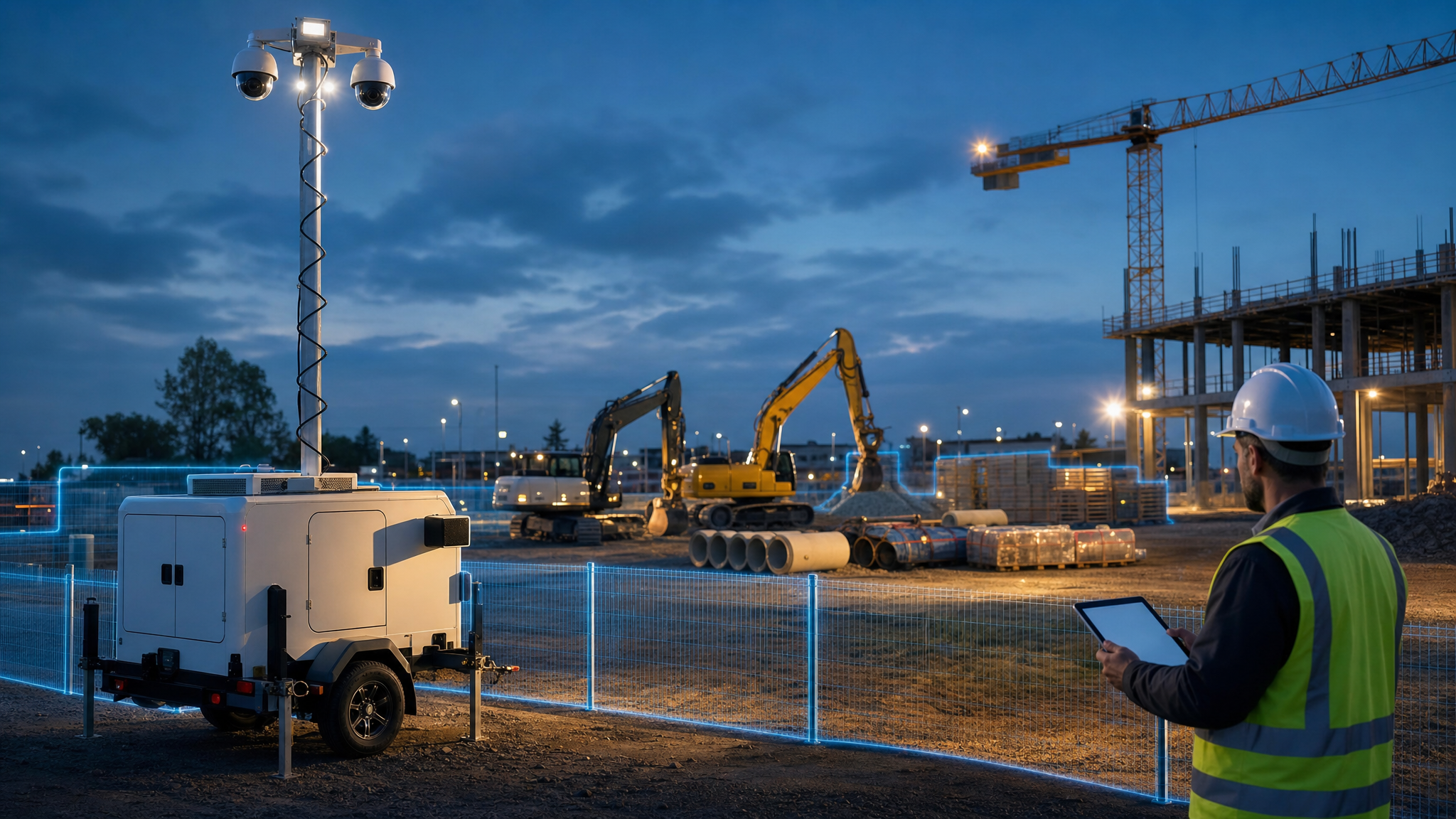


Mobile surveillance trailer cost for construction: a 2026 budgeting and ROI guide
When a jobsite holds seven or eight figures in equipment yet has no permanent power or network, project executives face a tricky budgeting question. How much does a mobile surveillance trailer cost, and how do you prove it earns its keep against guards, theft, and schedule risk? This guide breaks trailer cost into clear categories, walks through a simple ROI formula built for construction realities, and shows where AI video intelligence fits. The goal is a framework you can fill with your own quotes and loss history, not a one-size-fits-all price.
Key takeaways
- Treat mobile surveillance trailer cost as a composite of hardware, monitoring, connectivity, power, and incidentals, not a single monthly rate.
- Site risk, coverage needs, retention period, power source, and connectivity are the biggest pricing drivers.
- Guard programs are the main benchmark: continuous 24/7 coverage on one site can run well into six figures a year before overhead (Source: BLS).
- ROI = (avoided loss + guard savings + operational gains - total trailer cost) / total trailer cost, modeled with your own numbers.
- AI video intelligence can triage events, cut review labor, and turn footage into searchable, time-stamped evidence.
What a mobile surveillance trailer is
A mobile surveillance trailer is a towable, self-contained camera tower built for temporary or semi-permanent sites without reliable power or network. A typical unit pairs a wheeled chassis with a telescoping mast, an onboard power system (batteries plus solar panels or a generator), cellular or satellite connectivity, and a camera payload of fixed, pan-tilt-zoom, or thermal lenses. Many add lights, speakers, or gate hardware.
The functional role is threefold. The trailer gives you a high vantage point across open areas where building-mounted cameras are not yet practical. It delivers power and connectivity independent of the site's temporary utilities. And it stays mobile, so coverage moves with the job as it phases from civil works to vertical build to commissioning. That mobility is central to cost thinking, because a single asset can serve several sites in sequence.
Where trailers differ most from passive cameras is what happens after a camera sees something. Older setups record and wait for someone to review the tape. AI video intelligence platforms like Spot AI treat those camera feeds as AI coworkers that detect activity in context, flag perimeter breaches or after-hours loitering, and index footage so investigations take minutes instead of hours.
Key terms
- Mobile surveillance trailer: a towable, self-powered camera tower for temporary or remote sites.
- Backhaul: the connection (cellular, satellite, or wired) that carries video and alerts off-site.
- Edge processing: analyzing video on the device so only metadata or selected clips cross the network.
- Total cost of ownership (TCO): the full lifetime cost including monitoring, data, maintenance, and relocation, not just rental.
What affects mobile surveillance trailer pricing
Because units are sold by many providers in different markets and configurations, no single national average rental rate is reliable. Treat trailer cost as a composite you derive from itemized quotes. Several factors reliably move the number across markets.
- Site risk profile: high-theft corridors may carry higher rates, hardened enclosures, and heavier monitoring.
- Coverage requirements: mast height, camera count, and PTZ versus fixed lenses all change hardware cost.
- Retention period: 30, 90, or longer days of recorded video drives storage and cloud costs.
- Power source: solar and battery reduce fuel logistics but can raise upfront hardware cost.
- Connectivity: cellular is cheaper where coverage is strong; remote sites may need satellite or Starlink backhaul.
- Monitoring level: local recording only, remote monitoring center, or AI-assisted event triage.
Remote jobsites, larger laydown yards, night work, high-value materials, and multi-phase projects all push the cost model upward because they raise either coverage needs or monitoring intensity.
Hidden operating costs to budget for
Headline rental is only part of the picture. Power systems need cleaning, inspection, and occasional battery or panel replacement; a failed power system leaves a site blind at the worst moment. High-resolution video can consume real bandwidth, so data plans and edge-recording strategy matter. Towing, repositioning, tire and brake maintenance, and the chance the trailer itself is targeted all belong in your total cost of ownership.
The National Insurance Crime Bureau notes that heavy equipment often lacks standardized anti-theft systems and is frequently left in unsecured areas, recommending hidden disabling devices, tracking, and serial-number recording (Source: NICB). The same logic applies to the trailer: factor in insurance, deductibles, and how risk is split between you and the rental provider.
Solar and cellular considerations for remote jobsites
Solar surveillance trailer cost looks higher upfront but can win over long deployments. Solar plus battery storage removes fuel cost and generator noise, which suits clean-energy and rural infrastructure projects. The catch is design: array size and battery capacity must match the draw of cameras, connectivity, and lights, with margin for shading and seasonal low-sun periods.
For short jobs of a few weeks, a generator-based trailer may be simplest. For multi-month or multi-year deployments, a mobile solar surveillance trailer often delivers lower total cost of ownership and avoids fuel supply risk. On connectivity, most units use cellular modems and record continuously at the edge while sending only event clips off-site. In areas with weak signal, satellite links or Starlink construction site security setups may be the only viable path, at higher per-unit data cost.
Security trailer versus guards, and trailer versus passive cameras
Guards are the most common benchmark. They bring human judgment, patrols, and emergency response, but their cost scales with hours. The U.S. Bureau of Labor Statistics reported a national median hourly wage for security guards in the high teens in May 2023, with upper-quartile pay above twenty dollars an hour (Source: BLS). Because 24/7 coverage needs more than one full-time equivalent per post, continuous guard presence on a single site can easily exceed six figures a year once fringe, supervision, and vendor markup are included (Source: BLS).
Trailers and guards are not mutually exclusive. Many teams run hybrids: trailers as wide-area eyes, guards for specific shifts or high-risk windows. The table below compares neutral tradeoffs, not vendor products.
| Factor | Mobile surveillance trailer | Security guards | Fixed or passive cameras |
|---|---|---|---|
| Cost scaling | Per unit and per monitoring level | Scales directly with hours | Upfront install, lower long-run cost |
| Mobility | High, redeployable across sites | High, but tied to staffing | Low once installed |
| Infrastructure needed | Self-powered, no grid required | None | Permanent power and cabling |
| Evidence record | Time-stamped, searchable with AI | Reports vary by observer | Recorded, manual review |
Against fixed cameras, trailers cost more per unit but deploy in hours, move when layouts change, and redeploy to the next job, spreading their cost across a portfolio. A common pattern is phasing: trailers cover early civil work and laydown yards, then fixed cameras take over long-term monitoring once permanent power and structure exist.
How to calculate mobile surveillance trailer ROI for a construction project
Start with a clear time horizon and scope, then use a simple formula:
ROI = (Total benefits - Total costs) / Total costs
Total benefits include avoided theft and vandalism loss, reduced guard hours, and operational or safety gains such as faster claims and fewer disputes. Total costs include trailer rental or amortized purchase, monitoring fees, connectivity, power upkeep, and incidentals.
A worked example with placeholder numbers
Use this only as a method. Plug in your own loss history, guard budget, and quotes.
- Baseline expected theft and vandalism loss without enhanced coverage: $100,000 per year.
- Expected loss reduction from a trailer with monitoring and signage: 50%, so avoided loss is $50,000.
- Guard reduction from two night guards to one: estimated $60,000 saved over the year.
- Operational benefits (reduced rework, cleaner claims evidence): a conservative $10,000.
- Total trailer cost (rental, monitoring, connectivity, incidentals): $70,000.
Total benefits are $50,000 + $60,000 + $10,000 = $120,000. Total costs are $70,000. ROI = (120,000 - 70,000) / 70,000, or roughly 71% for the year. Run conservative, base, and optimistic scenarios to find your break-even, and remember these figures are illustrative, not promised.
Where AI video intelligence changes the math
The decision set is shifting because of labor and technology trends. Deloitte's 2024 engineering and construction outlook points to strong activity in manufacturing, transportation, and clean energy alongside persistent labor constraints, which makes remote monitoring more attractive (Source: Deloitte). Staffing nights and weekends at distant sites is hard, so software that watches feeds in context fills the gap.
AI video intelligence acts as a force multiplier. Instead of people watching many streams, the system triages events, flags only what matches risk patterns, and reduces false alarms, so limited staff oversee more cameras. With an AI Security Guard for construction sites, trailer feeds detect intent in context, can trigger deterrence actions such as lights, sirens, or natural-conversation talk-down, and preserve time-stamped, case-ready evidence. One construction team frames the value this way:
"[Spot AI] gives us the visibility and real-time insights needed to uphold the highest standards of safety and efficiency... we are redefining how we create safer, more streamlined environments and manage project oversight."
Luke Misgen, Safety Director, AECOM Hunt
Because Spot AI is camera-agnostic and works with any IP camera, existing pole, wall, and trailer cameras can join the same system, and most sites go live in days. You can read more in the Spot AI customer stories.
If you want a deeper view of how cameras become AI coworkers across a jobsite portfolio, the Spot AI articles library is a good next stop. The most defensible decision comes from your own numbers: pull a quote, map your risk hotspots, and run the ROI formula above before you commit.
Frequently asked questions
How much does a mobile surveillance trailer cost to rent for a construction site?
There is no reliable single national rate, because pricing depends on configuration, risk, and monitoring level. Build your estimate from itemized quotes covering hardware, monitoring, connectivity, power, and incidentals. Compare that total to guard costs and expected loss rather than judging the headline rental fee alone.
What factors affect construction site security trailer cost?
The main drivers are site risk profile, coverage requirements (mast height and camera count), video retention period, power source, connectivity type, and monitoring intensity. Remote locations, large laydown yards, night work, and multi-phase projects tend to raise the total. Itemized quotes make these layers visible.
Is a solar surveillance trailer more cost-effective for remote jobsites?
Often, yes, for longer deployments. Solar removes fuel cost and generator noise, which helps on remote infrastructure projects, though it can raise upfront hardware cost. Assess it over your full deployment period and include the reliability value of uninterrupted 24/7 coverage where law-enforcement response is slow.
When is a security trailer more cost-effective than hiring guards?
Guard costs scale with hours, and continuous 24/7 coverage on one site can exceed six figures a year before overhead (Source: BLS). When one or more trailers reduce guard posts or shift hours while keeping risk acceptable, ROI can be positive. Many teams use a hybrid model rather than full substitution.
How do you calculate ROI for construction site security?
Use ROI = (total benefits - total costs) / total costs over a defined horizon. Total benefits combine avoided loss, guard savings, and operational gains; total costs cover rental, monitoring, connectivity, power, and incidentals. Model conservative, base, and optimistic scenarios with your own project data.
About the author
Sud Bhatija is COO and Co-founder at Spot AI, where he scales operations and GTM strategy to deliver video AI that helps operations, safety, and security teams boost productivity and reduce incidents across industries.

