




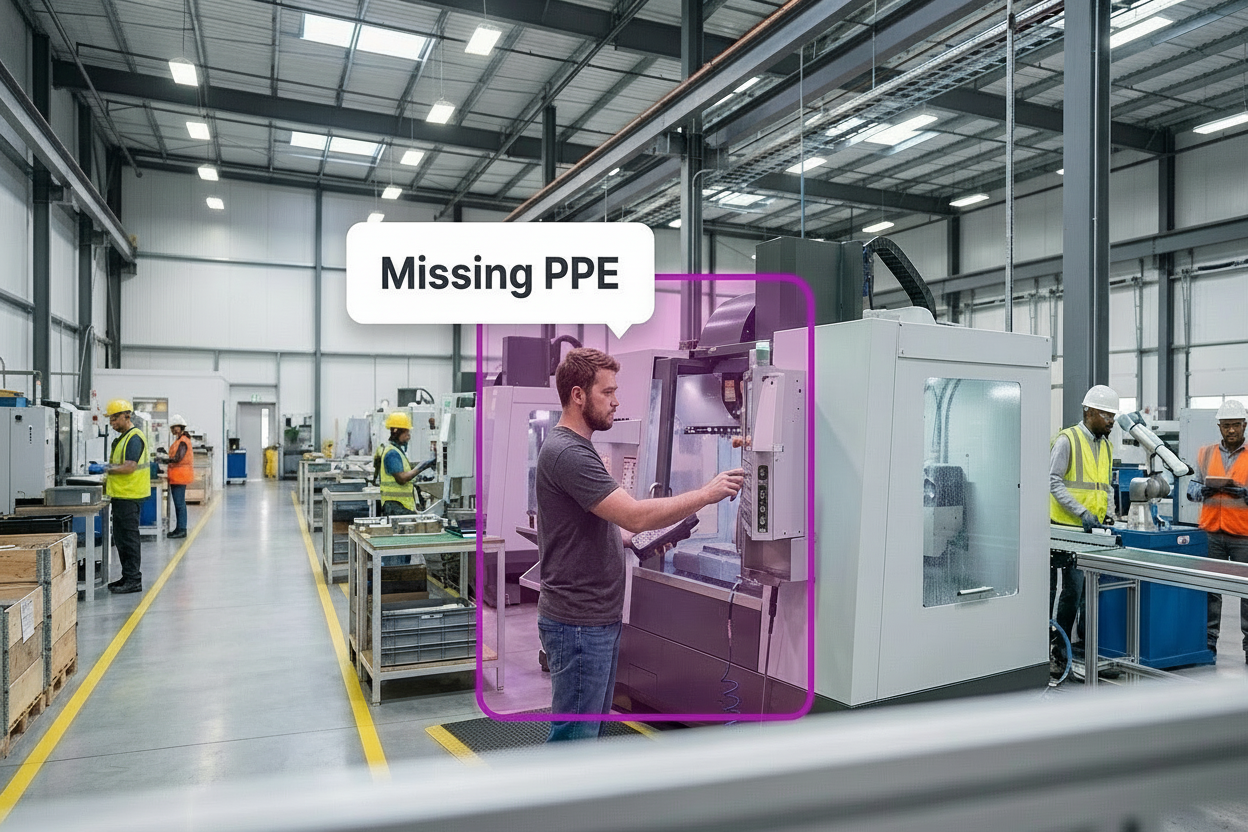


Managing safety compliance across a single manufacturing facility is complex; managing it across ten, twenty, or fifty sites creates an exponential hurdle in visibility and standardization. For VPs of Operations and Project Executives, the inability to see what is happening on the plant floor in real time creates a reactive cycle of incident response rather than forward-looking risk management.
Recent industry data reveals that nearly 60% of manufacturing leaders cite visibility gaps in safety and security data as their top operational risk (Source: Trackforce). These gaps result in inconsistent PPE usage, disconnected data silos, and an inability to prove compliance to insurance carriers, ultimately eroding project margins and increasing liability.
Creating a unified, multi-plant view of safety compliance requires moving beyond spreadsheet-based tracking and periodic site visits. It demands a digital transformation that integrates video AI, centralized reporting, and automated workflows to consolidate fragmented data into a centralized, shared view.
Understanding the basics
Before discussing the strategy for multi-plant visibility, it is helpful to define the core technologies and frameworks involved.
Video AI agents: intelligent software that analyzes video feeds in real time to detect specific objects (like hard hats or vests) and behaviors (like entering a no-go zone), providing continuous assistance to safety supervisors.
Lagging indicators: retrospective metrics that measure past performance, such as Total Recordable Incident Rate (TRIR) or Days Away, Restricted, or Transferred (DART).
Leading indicators: anticipatory metrics that forecast future safety performance, such as proactive hazard reporting frequency, safety training completion rates, and PPE compliance percentages.
OSHA PSM (Process Safety Management): a regulatory standard (29 CFR 1910.119) requiring rigorous management of hazards associated with processes using highly hazardous chemicals (Source: Inspectioneering).
Computer vision: a field of artificial intelligence that enables computers and systems to derive meaningful information from digital images, videos, and other visual inputs.
Solving the VP of Operations' core challenges
Leaders responsible for multi-site operations face specific frustrations that manual compliance methods cannot address. The gap between corporate safety policy and plant-floor reality often leads to increased insurance premiums and wasted management time.
Operational Challenge | The Traditional Reality | The Video AI Solution |
|---|---|---|
Multi-Site Blind Spots | Executives cannot maintain real-time visibility across 10-20 active sites simultaneously, creating anxiety about compliance when not physically present. | Unified Fleet Dashboard: A single interface provides near real-time visibility across plants, enabling leaders to monitor 20+ sites and quickly identify higher-risk locations. |
Reactive Incident Response | Safety violations are discovered days or weeks later, often after an injury has occurred or during a retrospective audit. | Real-Time Alerts: AI Agents can detect safety violations (e.g., missing PPE) in near real time and send alerts to site supervisors for on-the-spot coaching, supporting a more proactive approach. |
Investigation Time Drain | Project Managers spend hours or days scrubbing footage to investigate incidents, pulling them away from high-value operational work. | Intelligent Search: Teams can search video data by keyword (e.g., "show me all vest violations") to find specific events in minutes, not hours. |
Insurance Premium Costs | Rising insurance premiums due to an inability to prove pre-emptive risk management to carriers. | Automated Compliance Reports: Systems can generate documentation showing proactive safety measures, which may help during premium negotiations (results can vary). |
Disconnected Data | Safety metrics, project management data, and video footage live in separate silos, hindering strategic decision-making. | Open API Integration: Video intelligence connects with existing platforms (like Procore or Autodesk), creating a unified operational view. |
The operational challenge of multi-plant safety compliance
Manufacturing organizations operating multiple facilities confront a fundamentally different compliance landscape than single-location operations. The primary obstacle is not just establishing safety protocols, but ensuring they are interpreted and executed consistently across every shift and every site.
Inconsistent execution: a shift running during daylight hours at one facility might execute safety protocols differently than a night shift at another site, yet both must maintain identical compliance levels.
Manual verification gaps: operations managers have historically relied on periodic plant visits and retrospective incident investigations—approaches that inherently miss compliance gaps between inspection points.
Systemic risk exposure: a safety lapse affecting one worker at one facility often represents a systemic procedural weakness affecting hundreds of workers across all facilities. Without unified data, these systemic risks remain hidden until a major incident occurs (Source: Trackforce).
Regulatory framework and multi-employer worksite rules
Navigating the regulatory environment is critical for multi-plant operations, particularly regarding OSHA standards and contractor management.
OSHA Process Safety Management (PSM)
For facilities handling hazardous chemicals, OSHA standard 29 CFR 1910.119 establishes strict compliance obligations. This includes requirements for process hazard analysis, operating procedures, and mechanical integrity maintenance (Source: Inspectioneering). In a multi-plant context, maintaining version control of process safety information across sites is a significant logistical hurdle.
The General Duty Clause and AI
OSHA’s enforcement priorities for 2025 are shifting toward anticipatory risk identification. The agency is increasingly encouraging organizations to implement artificial intelligence and machine learning systems that analyze safety data to identify patterns and potential hazards sooner (Source: Fisher Phillips). This aligns with the General Duty Clause, which obligates employers to keep workplaces free from recognized hazards.
Multi-employer liability
When contractors or suppliers work at manufacturing facilities, the facility owner often bears responsibility for overall site safety. A safety failure by a contractor at one plant can trigger enforcement action against the facility owner across all locations if systemic issues are identified (Source: Trackforce).
Leveraging Video AI for PPE compliance
PPE compliance is often the first line of defense in industrial safety, yet it is notoriously difficult to enforce manually. Video AI helps use existing camera infrastructure as an active compliance tool.
How Video AI detection works
Advanced video analytics platforms use computer vision to monitor high-risk areas continuously.
Capture: High-resolution cameras cover production lines, loading docks, and hazardous zones.
Analyze: AI processing engines, trained on industrial datasets, analyze video frames to detect specific PPE items like hard hats, safety vests, and harnesses.
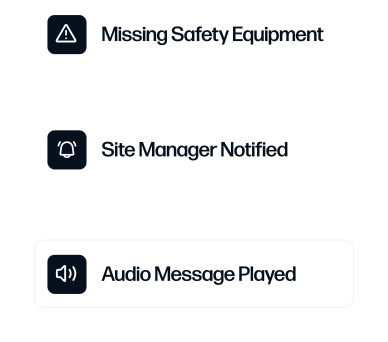
Alert: When a violation is detected, the system sends a timely notification to the floor supervisor or safety manager.
Document: The event is time-stamped and saved, creating an audit-ready record without manual paperwork.
Moving from observation to behavioral intelligence
Automated systems provide insights that manual observation cannot match. For example, if video analytics reveal that night shift PPE violations consistently occur in a specific production area, management can investigate whether inadequate lighting or poor equipment fit is the root cause. This allows for targeted training rather than blanket admonishments.
Centralized data integration and reporting architecture
To create a true multi-plant view, data must flow from the plant floor to a central decision-making hub. Disconnected systems where safety data lives in spreadsheets and video footage lives on local DVRs make enterprise-wide visibility impossible.
The power of unified dashboards
Real-time multi-site reporting dashboards allow corporate leadership to view aggregated safety scores with minimal delay.
Drill-down capability: leaders can view high-level metrics and then drill down into repeat failures across specific regions or individual plants to identify struggling locations.
Data standardization: centralized platforms ensure that every facility captures identical information in consistent formats, enabling valid comparisons across locations.
Access control: hierarchical access ensures frontline workers see operational data while corporate leadership gains enterprise-wide visibility.
Integration with enterprise systems
Modern safety strategies require integrating safety data with broader operational workflows. Video AI platforms should connect with Enterprise Resource Planning (ERP) and Quality Management Systems (QMS). This integration allows safety metrics to be correlated with production data, helping leaders understand if rushing production is leading to safety shortcuts.
Defining safety KPIs for multi-site operations
Effective management requires measuring the right data. While Total Recordable Incident Rate (TRIR) is a standard metric, it is a lagging indicator—it tells you what happened, not what will happen.
Leading indicators for forward-looking management
To mitigate incidents, VPs of Operations should focus on leading indicators that forecast future performance.
Proactive hazard reporting: high frequency of proactive hazard reporting often indicates a healthy safety culture where workers feel empowered to speak up.
Safety training completion: tracking certification currency ensures employees maintain required credentials across all sites.
PPE compliance rate: the percentage of time workers are properly equipped, as measured by AI detection systems.
Engagement scores: companies with higher engagement scores report 70% fewer safety incidents, making culture a critical leading indicator (Source: ScreenCloud).
Lagging indicators for benchmarking
Lagging indicators remain necessary for regulatory reporting and insurance purposes.
DART rate: Days Away, Restricted, or Transferred rates allow for standardized comparison across facilities and against industry benchmarks.
Incident costs: the total financial impact of accidents, including medical expenses and lost productivity.
Implementation roadmap: from pilot to enterprise scale
Deploying a multi-plant safety system requires a structured approach to ensure adoption and value.
Assessment Phase: Evaluate current safety performance and infrastructure. Identify facilities with elevated injury rates and assess existing camera coverage for AI compatibility.
Pilot Deployment: Deploy the solution at a single high-risk facility. This proof-of-concept phase allows frontline workers to gain hands-on experience and generates data to validate ROI.
Expansion Phase: Expand deployment to additional high-risk areas and integrate with existing safety management platforms. This typically takes 8-12 weeks (Source: Spot AI).
Standardization: Consolidate successful configurations across all facilities to create a centralized monitoring dashboard and standardized compliance metrics.
ROI and the business case for safety intelligence
Investing in safety technology is not just an operational expense; it drives measurable financial returns. Organizations implementing EHS systems for over five years have achieved an average ROI of 239% (Source: Wolters Kluwer).
Quantifiable financial benefits
Lower incident costs: For every dollar invested in safety, organizations typically save four to six dollars through fewer costly incidents (Source: Wolters Kluwer).
Insurance considerations: showing proactive risk management with documented reports may help during premium negotiations, though actual outcomes vary by carrier and context.
Productivity gains: Less disruption from incidents means less downtime for investigations. Intelligent search can cut investigation time from hours to minutes in many cases (Source: Spot AI).
Comparing Video AI solutions
Feature | Spot AI | Traditional VMS | Human Guards |
|---|---|---|---|
Deployment Speed | Plug-and-play; live in under a week. | Weeks or months of cabling and configuration. | Long hiring and training cycles. |
Hardware Flexibility | Camera-agnostic; works with existing IP cameras. | Often requires proprietary hardware lock-in. | N/A |
Multi-Site View | Unified cloud dashboard for unlimited sites. | Requires VPNs or complex port forwarding. | Disconnected daily reports from each site. |
Search Capability | Google-like search for events and objects. | Manual scrubbing of timeline bars. | Reliance on memory and handwritten logs. |
Cost Structure | Scalable software model. | High upfront hardware costs. | High recurring hourly labor costs. |
Unifying Safety Compliance for Strategic Advantage
For VPs of Operations and Project Executives, the status quo of fragmented, reactive safety management is no longer sustainable. The risks—financial, legal, and operational—are simply too high.
By adopting a multi-plant view of safety compliance powered by Video AI, leaders can better coordinate operations across sites and create a more unified view of performance.
This transition treats safety as a strategic priority, not just a compliance task. It helps teams identify hazards earlier, can streamline investigation workflows to save management time, and provides data that may help when negotiating insurance premiums.
Ultimately, it aims to help more workers, on every shift and at every plant, return home safely by mitigating risk.
Want to see how video AI brings all your safety data together? Request a demo to experience Spot AI in action.
Frequently asked questions
What are the best practices for ensuring safety compliance across multiple plants?
Best practices include establishing standardized procedures applicable to all sites, implementing centralized data dashboards for near real-time visibility, and utilizing technology like Video AI to help automate parts of compliance checks. Phased implementation and consistent training are also critical for adoption (Source: Spot AI).
How can technology improve PPE compliance in manufacturing?
Technology improves PPE compliance by providing continuous, unbiased monitoring. Video AI systems can detect missing gear in near real time and alert supervisors, allowing for on-the-spot coaching rather than retrospective punishment (Source: Spot AI).
What are the common challenges in multi-site safety compliance?
Common pain points include inconsistent interpretation of safety rules across sites, disconnected data silos that block corporate visibility, and the administrative overhead of manual reporting. Managing contractor safety and varying regulatory environments adds further complexity (Source: Trackforce).
How do centralized reporting systems enhance safety management?
Centralized reporting systems consolidate data from all facilities into a single view, enabling leaders to identify systemic trends, benchmark performance between sites, and ensure accurate regulatory reporting. This eliminates data fragmentation and supports strategic decision-making (Source: Spot AI).
What role does video analytics play in safety compliance?
Video analytics automates the detection of safety hazards, such as PPE violations or unauthorized entry into dangerous zones. It converts passive video footage into active intelligence, reducing investigation time and supporting earlier risk mitigation (Source: Spot AI).
About the author
Sud Bhatija is COO and Co-founder at Spot AI, where he scales operations and GTM strategy to deliver video AI that helps operations, safety, and security teams boost productivity and reduce incidents across industries.






.png)
.png)
.png)