







For a plant director managing high-speed metals packaging lines, the pressure to maintain throughput while accommodating an increasing number of SKUs is a daily reality. You are likely balancing the need for aggressive Overall Equipment Effectiveness (OEE) targets against the operational drag of frequent product switches. In high-mix manufacturing environments, facilities consistently experience significant capacity losses annually, primarily due to operational inefficiencies like changeovers rather than fundamental production constraints.
The difference between a profitable shift and a missed target often comes down to how efficiently your teams transition from one product specification to the next. Traditional methods such as stopwatches, clipboards, and reactive firefighting leave managers with blind spots. You cannot fix what you cannot see, and you cannot optimize what you do not measure accurately.
This is where optimizing changeover in metals packaging with data-backed video insights improves operations. By turning existing camera infrastructure into a useful data source, plant leaders can see waste in their processes, standardize execution across shifts, and apply SMED (Single-Minute Exchange of Dies) to recover capacity.
Key terms to know
Single-Minute Exchange of Dies (SMED): a lean production method for reducing waste in a manufacturing process. It provides a systematic way of converting an internal setup (which can only be done when the machine is stopped) to an external setup (which can be done while the machine is running).
Overall Equipment Effectiveness (OEE): a common metric for measuring manufacturing productivity. It identifies the percentage of manufacturing time that is productive based on Availability, Performance, and Quality.
Video AI: technology that uses computer vision to analyze video footage in real-time to detect events, track behaviors, and identify anomalies without human intervention.
Manufacturing Execution System (MES): a computerized system used in manufacturing to track and document the transformation of raw materials to finished goods.
The high cost of inefficient changeovers in metals packaging
In the metals packaging industry, changeover processes represent one of the largest hidden sources of lost production capacity. A single unoptimized changeover can consume significant production time, leaving expensive capital equipment idle and leading to downstream delays.
For a plant manager, the costs extend beyond the direct downtime. Inefficient changeovers generate secondary waste, including scrap material from extended setup trials and increased overtime labor to recover lost production.
The financial impact of cutting changeover time
Addressing this inefficiency can deliver meaningful value. Research shows that facilities adopting integrated data-driven approaches to changeover optimization often see decreases in downtime.
Consider the impact on a single production line:
Baseline: a facility operating automatic packaging machinery with an 80-minute changeover time.
Optimization: through systematic SMED application and data insights, the facility cut changeover time to 9 minutes.
Result: This 71-minute improvement per event saved 3.55 hours of production time daily (assuming three changeovers).
Revenue: at a production rate value of $2,000 per hour, this created $7,100 in additional daily revenue per line.
Why traditional monitoring fails the plant manager
Despite investing in various monitoring systems, many plant managers find themselves responding reactively. You might receive a call at 2 a.m. regarding a line stoppage that occurred hours earlier, with limited visibility into the root cause.
The limitations of manual tracking
Inconsistent Data: manual logs are often completed at the end of a shift, relying on operator memory rather than fact.
The "Third Shift" Blind Spot: procedures that are followed strictly during the day shift often drift during off-hours when management is not present.
Lack of Granularity: a log might say "mechanical adjustment," but it fails to capture that the operator spent 20 minutes searching for a specific tool before making the adjustment.
Video AI helps address these accountability gaps by providing objective, time-stamped records of key steps in the process. It supports fact-based continuous improvement.
Leveraging video AI for SMED and process optimization
Optimizing changeover in metals packaging with data-backed video insights begins with visibility. Video AI helps teams run continuous time studies without requiring a person to stand with a stopwatch.
Mapping the changeover process
To apply SMED effectively, you must distinguish between internal activities (machine stopped) and external activities (machine running). Video analysis allows you to:
Identify Waste: detect inefficiencies such as operators walking to distant tool cribs or waiting for material staging while the machine is down.
Validate External Prep: verify that materials and tools are staged before the line stops, converting internal time to external time.
Benchmark Best Practices: compare changeover execution between your top-performing shift and underperforming teams to identify training gaps.
By analyzing this visual data, plants can implement physical changes—such as quick-release mechanisms or staged carts—that directly cut downtime. Implementation of these quick-change technologies can yield substantial annual value from cutting downtime.
Standardizing execution across every shift
One of the core frustrations for operations directors is the variability in execution. Shift A might hit the 30-minute target, while Shift C consistently takes 60 minutes due to "process drift."
The role of the Changeover Coach
Spot AI’s Changeover Coach module addresses this by helping highlight process steps as they occur. It uses video to support standardization and coaching.
Real-Time Tracking: the system monitors the start and stop times of critical changeover phases, providing live visibility into progress.
SOP Review: it helps teams review whether standard operating procedures were followed and where steps may have been missed.
Shift Recaps and Scorecards: automated reports highlight deviations and successes, allowing managers to coach teams based on data rather than assumptions.
This approach aligns with lean manufacturing principles. By displaying performance metrics on shop-floor visual management boards, facilities create healthy competition and transparency that drives continuous improvement.
Enhancing quality assurance and cutting scrap
In metals packaging, the changeover isn't complete until the line is producing quality product. Rushing the setup often leads to alignment issues, resulting in defects like surface scratches, edge warping, or dimensional variances in aluminum containers.
Automated defect detection during startup
Modern video analytics systems can analyze production at line speed, detecting defects with high accuracy.
Real-Time Feedback: if a sealing jaw is misaligned during setup, the system alerts the operator without delay, helping avoid thousands of units of scrap.
Traceability: inspected products can be logged with a timestamp and image, creating an audit trail for regulatory compliance.
Material-Specific Analysis: advanced computer vision models are trained to handle the reflectivity and texture of aluminum, distinguishing between acceptable surface variations and genuine defects.
Operations that adopt comprehensive video analytics for quality have cut rework rates by 20-35 percent through early-stage defect detection (Source: Scanflow).
Integrating video insights with MES and maintenance workflows
Data silos create integration nightmares for plant leadership. When video data lives separately from your Manufacturing Execution System (MES) or maintenance logs, you lack a holistic view of plant performance.
Breaking down the silos
Integrating video AI with MES and IoT sensors creates a unified operational picture.
Accelerated Root Cause Analysis: integrated systems allow teams to access video footage, defect classifications, and machine parameters without delay. In one case, this cut root cause analysis time from 2.8 hours to 35 minutes (Source: Vantron Technology).
Condition Monitoring: IoT sensors monitor vibration and temperature to flag abnormal readings. When combined with video, teams can visually check the condition of a machine component before scheduling downtime.
Automated Workflows: if the video system detects a safety hazard or process deviation, it can automatically trigger a work order in the MES, ensuring the issue is tracked and resolved.
Comparing video analytics solutions for manufacturing
When selecting a partner for optimizing changeover in metals packaging with data-backed video insights, it is critical to choose a platform that scales with your enterprise needs.
Feature | Spot AI | Traditional monitoring systems | Generic AI Analytics |
|---|---|---|---|
Deployment Speed | Quick to deploy (often minutes) | Weeks to months | Varies, often complex |
Hardware Compatibility | Works with existing IP/analog cameras | Proprietary lock-in | Often requires specific cameras |
Changeover Optimization | Dedicated "Changeover Coach" module | Manual review only | Generic motion detection |
User Interface | Cloud-native, intuitive dashboard | Clunky, on-prem servers | Requires technical expertise |
Search Capability | Google-like search for events | Fast-forward/Rewind | Limited metadata search |
Scalability | Scales to many users and locations | Limited by DVR channels | High bandwidth costs |
Spot AI stands out by offering a camera-agnostic platform that deploys swiftly, allowing you to use your existing infrastructure to realize value quickly.
Ensuring worker safety during changeovers
Changeovers are high-risk periods. Operators are entering machine guarding, handling heavy dies, and working with high-pressure systems. Balancing efficiency with safety is a primary hurdle for plant directors.
Anticipatory safety monitoring
Video AI supports a zero-harm culture by detecting hazards in real-time.
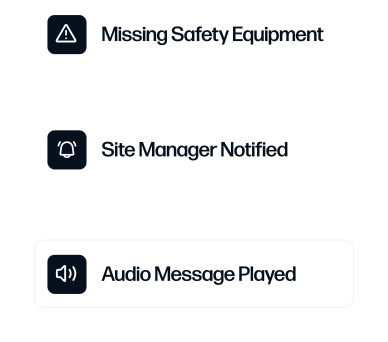
PPE Compliance: automatically detect if operators are wearing required cut-resistant gloves or hard hats during maintenance tasks.
No-Go Zones: alert supervisors if personnel enter restricted areas while machinery is still energized.
Lockout/Tagout Verification: provide visual evidence that safety protocols are followed before internal maintenance activities begin.
This capability helps lower OSHA recordable incidents and protects your most valuable asset—your workforce.
Driving operational excellence
The path to optimizing changeover in metals packaging with data-backed video insights is not about replacing your workforce; it is about empowering them. By eliminating blind spots, standardizing best practices, and integrating quality control, you can make changeovers a more efficient part of operations.
Potential benefits include shorter downtime, lower scrap rates, and improved OEE. Operationally, the goal is a more consistent, predictable, and safe operation across shifts and product mix.
See how Spot AI’s video AI platform can help you optimize changeovers and boost productivity. Book a demo to experience the technology in action.
Frequently asked questions
What are the best practices for optimizing changeover times in metals packaging?
Best practices include implementing Single-Minute Exchange of Dies (SMED) to separate internal and external activities, using video analysis to identify and eliminate waste, standardizing procedures across all shifts, and utilizing real-time dashboards to track performance against targets. Pre-staging materials and using quick-release tooling are also critical physical improvements.
How can video analytics improve quality assurance in manufacturing?
Video analytics improves quality by enabling in-line inspection at line speed, lessening the reliance on sampling. It can detect defects like scratches, dents, or misalignments as they happen, allowing for swift corrective action. This helps cut scrap and limit defective products from reaching customers.
What technologies are available for cutting downtime in packaging plants?
Key technologies include Video AI for process visibility, Manufacturing Execution Systems (MES) for workflow coordination, IoT sensors for proactive maintenance, and advanced production scheduling software to optimize run sequences. Integrated, these tools significantly cut both planned and unplanned downtime.
What are the key performance indicators for packaging efficiency?
The most critical KPIs include Overall Equipment Effectiveness (OEE), Changeover Time (measured from last good part to first good part), Unplanned Downtime percentage, First Pass Yield (quality), and Schedule Adherence. Tracking these metrics provides a comprehensive view of plant efficiency.
Can Spot AI work with my existing cameras?
Yes. Spot AI is designed to be camera-agnostic. It connects to your existing IP or analog cameras, turning them into intelligent data sources without the need for a costly "rip-and-replace" project.
About the author
Sud Bhatija is COO and Co-founder at Spot AI, where he scales operations and GTM strategy to deliver video AI that helps operations, safety, and security teams boost productivity and reduce incidents across industries.






.png)
.png)
.png)