




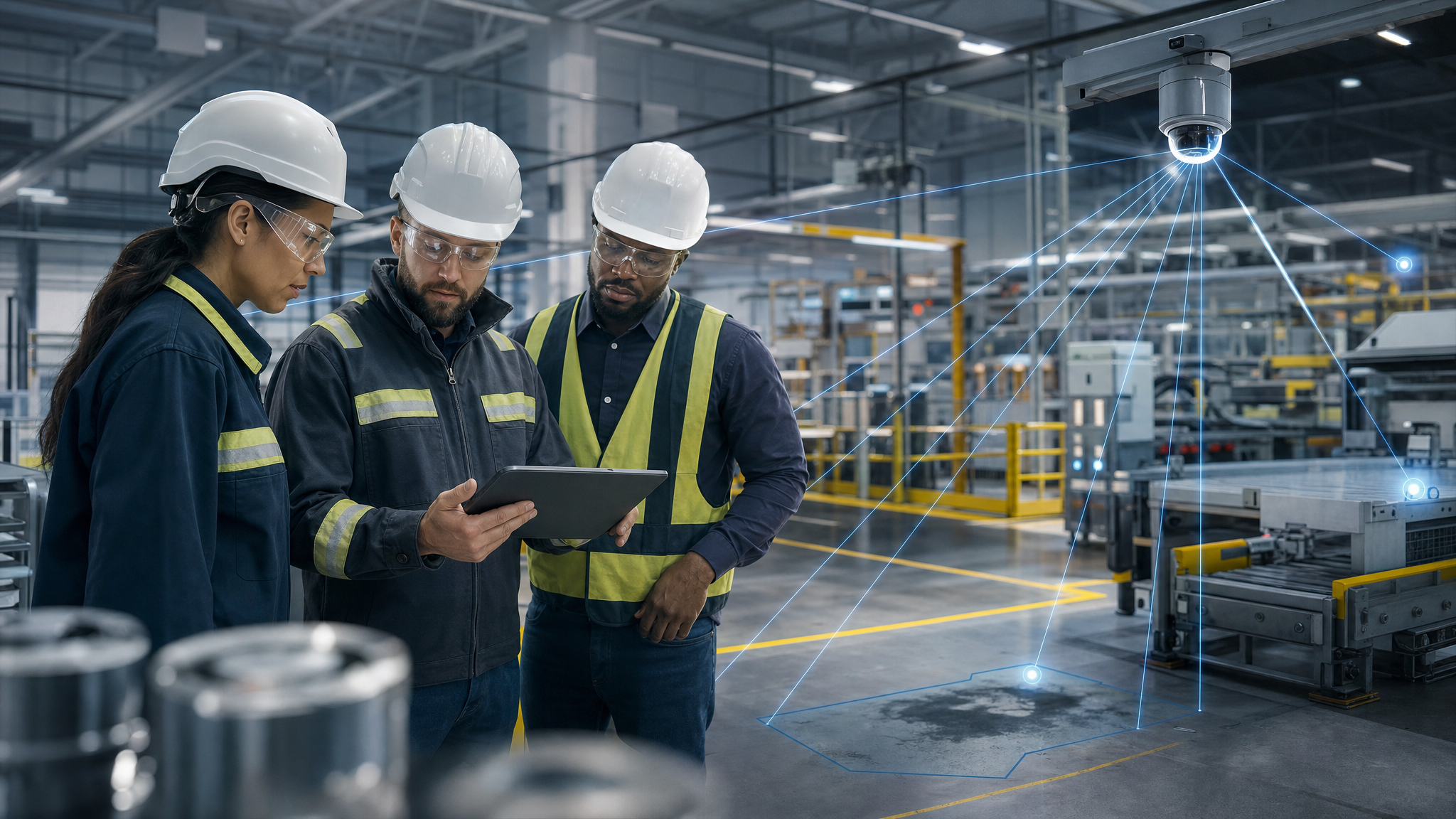


OSHA incident investigation video evidence: a 2026 field guide for manufacturing EHS teams
How should an OSHA incident investigation use video evidence? The short answer: video should help your team reconstruct what happened, validate witness accounts, and surface the process gaps behind an event, never serve as a tool to assign blame. In fast-moving production environments, accurate reconstruction is hard, because conditions change in seconds and memories blur. This guide walks through a practical, non-punitive workflow for preserving footage, building a timeline, and turning what you see into corrective actions that hold up under scrutiny.
Key takeaways
- Video is one evidence source among many; pair it with interviews, photos, maintenance logs, and training records.
- Preserve footage fast, before automatic overwrite, and capture a window before and after the event from multiple angles.
- Document chain of custody for every clip: camera ID, time range, who extracted it, storage location, and any exports.
- Use video to find system-level contributors (layout, guarding, procedures, production pressure), not individual fault.
- Translate findings into a corrective action table with owners, due dates, and follow-up verification.
Where video fits in OSHA's incident investigation philosophy
OSHA frames an incident investigation as the process of examining a workplace fatality, injury, illness, or close call to find hazards and program gaps, then correcting them to prevent recurrence. The agency cautions that it is "far too easy, and often misleading, to conclude that carelessness or failure to follow a procedure alone was the cause of an incident," because that view hides deeper deficiencies in equipment, training, or procedures (Source: OSHA).
That philosophy shapes how video should be used. Footage should not just answer "who did what." It should help investigators understand how the system allowed a condition or behavior to exist. In a forklift and pedestrian near miss, video may show whether a line of sight was blocked by staged pallets, whether floor markings were maintained, and whether warning measures were used. Interviews then reveal the informal shortcuts workers take, and why.
The scale of the challenge is real. The U.S. Bureau of Labor Statistics reported 5,070 fatal work injuries across all industries in 2024, a 4 percent decrease from 2023, alongside roughly 2,488,400 total recordable nonfatal cases (Source: BLS). Each serious event deserves a thorough look, and video can make that look more complete.
Key terms
- Chain of custody: the documented history of who handled a piece of evidence, when, and why, kept to protect its integrity and authenticity.
- Root cause analysis: a structured method for identifying the underlying system failures behind an incident, not just the immediate trigger.
- Recordable incident: a work-related injury or illness that must be logged under OSHA recordkeeping rules.
- Work-as-done vs. work-as-imagined: the gap between how a task actually happens on the floor and how a written procedure assumes it happens.
How to preserve video footage after a workplace incident
Medical care and hazard control always come first. Once the scene is stabilized, your team should identify which cameras may have captured the event and lock that footage before it is overwritten. Many systems recycle storage after a set retention window, so a serious incident should trigger an immediate hold or export to secure storage.
OSHA's broad investigative authority under Section 8 of the Occupational Safety and Health Act lets compliance officers inspect workplaces and records during reasonable times and in a reasonable manner (Source: OSHA). Assume relevant footage may be requested. Preserving it is sound risk management, not just compliance.
Capture a generous window. Footage from hours before a machine guarding event may show whether guards were adjusted during setup or whether a pre-shift inspection occurred. Post-event footage shows how the response unfolded. A practical preservation sequence looks like this:
- Confirm the incident, its rough time, and location from any available footage.
- Identify all cameras with possible coverage, including fixed, machine-mounted, and mobile devices.
- Lock or extend retention on those channels, or export copies to a controlled repository.
- Record camera IDs, locations, and the exact time ranges of interest.
- Log every action so chain of custody stays intact.
What goes in an OSHA-ready incident investigation file
Statutory recordkeeping is the floor. Covered employers maintain the OSHA 300 Log, the 300A Summary, and the 301 Incident Report, with many establishments submitting summary data electronically through the Injury Tracking Application (Source: OSHA). Those forms describe the injury, but they do not document your investigation, so you need more.
A complete file should weave video into a broader evidence set. The table below shows how the pieces fit together.
| Evidence type | What it documents |
|---|---|
| Video clips and evidence log | Sequence, conditions, and timing, cross-referenced by clip ID |
| Witness statements | Worker perceptions, constraints, and informal practices |
| Photos and scene sketches | Physical layout, debris, equipment position |
| Maintenance and training records | Equipment history and competency context |
| Root cause report and corrective actions | Reasoning, owners, due dates, and verification |
Your investigation report should explicitly note that video was reviewed, which cameras and time periods were examined, the key observations, and where clips are stored. NIST research on digital forensics stresses reliable retrieval, storage, and analysis of electronic data so evidence stays trustworthy and reproducible (Source: NIST). Treat a video evidence log with the same seriousness as the incident form itself.
Using video for root cause analysis without creating a blame culture
Video can help or hurt depending on how you point it. A vivid clip can tempt managers to fixate on one apparent mistake. The discipline is to ask what in the environment, design, or organization made the observed behavior likely. If footage shows a worker reaching around a guard to clear a jam, the system question is whether jams are frequent, whether the procedure for safe clearing is practical, and whether production pace pushes operators to improvise.
Manufacturing scenarios where this framing pays off include:
- Machine guarding and lockout tagout: whether interlocks were defeated and whether non-routine servicing happened on an energized machine.
- Forklift and pedestrian flow: whether walkways are marked, whether staging blocks aisles, and whether blind spots force improvisation.
- Slips, trips, and struck-by events: whether spill response was timely and whether exclusion zones were honored. NIOSH reports that falls led to 805 worker fatalities and 211,640 nonfatal injuries with days away from work in private industry in 2020 (Source: NIOSH).
- Ergonomic events: whether loads, reach distances, or workstation design drive awkward postures. NIOSH guidance emphasizes designing tasks to fit worker capabilities (Source: NIOSH).
Two cautions matter. First, guard against hindsight bias: because you know the outcome, the sequence looks obvious in replay. Consider what information the worker actually had in the moment. Second, avoid over-reliance on footage. Video often lacks audio, covers limited angles, and misses internal equipment conditions, so pair it with interviews, physical evidence, and records.
Turning video review into corrective actions
Video review only matters if it changes something. Map each observation to a causal factor, separating the immediate trigger from underlying contributors such as design flaws, unclear procedures, or production pressure. Then document fixes in a corrective action table tied to the investigation file, with columns for the hazard, the evidence source (including clip references), the root cause category, the action, the owner, the due date, and the completion status.
Where cameras already cover an area, footage also supports verification. After new traffic routes or barriers go in, your team can review later video to confirm forklifts and pedestrians use the intended paths and that near misses have dropped. This closes the loop between investigation and improvement, and it builds leading indicators from near-miss and behavior trends rather than waiting on injury counts.
As footage volumes grow, AI-enabled video can help safety teams find relevant clips faster and surface recurring hazards across sites. Tools in this space, including Spot AI's video AI platform and its AI Safety Manager, are designed to flag conditions like PPE gaps and zone violations and to organize incident evidence. The role of AI here is to prompt human investigation, not to replace EHS judgment, worker interviews, or OSHA compliance work. Firearms manufacturer Staccato applied this approach across an 800-acre Texas campus, using Video AI Agents for PPE compliance and forklift hazard identification after a forklift accident underscored the need for stronger safety monitoring.
"We needed something that could transform our camera system from a passive recording tool into a proactive partner in safety and security."
Mike Tiller, Director of Technology, Staccato
Building a workflow that holds up
The strongest investigations treat video as a teammate to interviews, physical evidence, and records, not a substitute for any of them. When footage is preserved quickly, logged with clear chain of custody, and read through a system-level lens, it helps your team understand work as it is actually done and coach safer practices without pointing fingers. That is how reactive review becomes faster, clearer incident learning. For a deeper look at proactive hazard detection, see Spot AI's writing on video AI for workplace safety.
Frequently asked questions
Can OSHA request security camera footage during an investigation
Yes. OSHA's authority under Section 8 of the OSH Act lets compliance officers inspect records, which can include relevant video, during reasonable times and in a reasonable manner (Source: OSHA). Assume footage tied to a serious incident may be requested, and preserve it promptly.
How long should we keep video evidence for an OSHA matter
OSHA requires injury and illness records to be retained for at least five years after the calendar year of the incident (Source: OSHA). Aligning incident-related video retention with that window is a reasonable practice, since the footage may stay relevant for inspections or claims.
How do we preserve footage right after a workplace incident
After medical care and hazard control, identify every camera with possible coverage, lock or extend retention on those channels, and export copies to a controlled repository. Capture a window before and after the event, then log camera IDs, time ranges, and who handled each clip to maintain chain of custody.
What documentation belongs in an OSHA-ready investigation file
Include the OSHA 300, 300A, and 301 records, plus the incident report, witness statements, photos, scene sketches, equipment and maintenance logs, training records, a video evidence log, and the root cause report with corrective actions (Source: OSHA). The file should show your reasoning, not just the outcome.
How does video support root cause analysis without blaming workers
Use footage to ask system questions: did the layout, guarding, procedure, or production pace make the observed behavior likely? OSHA's guidance warns against stopping at individual carelessness and urges a focus on underlying causes (Source: OSHA). Involving workers in the review keeps the process learning-focused.
About the author
Dunchadhn Lyons, Director of AI Engineering. Dunchadhn Lyons leads Spot AI's AI Engineering team, building real-time video AI for operations, safety, and security, turning video data into alerts, insights, and workflows that cut incidents and boost productivity.

