




Most retail incidents don't start inside the store. They start in the parking lot, where vehicles idle in fire lanes, individuals scope entrances, and organized groups stage before walking through the front door. Yet the majority of camera systems point inward, leaving the perimeter as the least-monitored, highest-risk zone in a retail operation.
For teams responsible for loss prevention across dozens of locations, the parking lot represents a coverage gap that compounds every other security problem. Loitering escalates into confrontation. Entrance scoping precedes organized theft. Vehicle-based casing goes unnoticed until merchandise is already gone. The question isn't whether parking lot incidents affect shrink. It's how early those incidents can be detected and deterred before they reach the storefront.
This article breaks down the threat behaviors that start in the parking lot, the camera and detection technologies built to catch them early, and the active deterrence workflows that help teams interrupt incidents before they reach the storefront. It also covers the practical side of a rollout (camera selection, total cost of ownership, placement, liability, KPIs, and a multi-site checklist) so teams can choose what fits their portfolio without tying up budget too early.
Key terms for parking lot security technology
Several terms appear throughout this article. Defining them upfront helps frame the technology and operational concepts that follow:
- Parking lot security cameras: fixed or mobile camera systems deployed specifically in outdoor parking environments to monitor vehicle and pedestrian activity, capture license plates, and support incident investigation.
- Camera tower: a mobile, elevated platform housing cameras, lighting, and often solar power. Towers can be deployed quickly and repositioned as risk patterns shift.
- License plate recognition (LPR): camera-based technology that captures vehicle plate images and uses optical character recognition (OCR) to extract plate numbers, then checks them against configured watchlists.
- Context-aware AI: video AI that analyzes multiple objects and the surrounding situation before deciding whether to alert, reducing nuisance alarms compared to basic motion detection.
- Active deterrence workflow: a response sequence in which video AI detects a specific behavior, confirms it, and triggers audio or visual deterrents before anyone has to step in.
- Loitering detection: an analytics template that flags people or vehicles lingering in defined zones beyond a set time threshold.
- Tailgating: when an unauthorized vehicle follows closely behind an authorized one through a controlled access point.
Why parking lot incidents are a growing operational burden
Parking lots are where shrink, staff exposure, and the customer experience collide. When incidents cluster in these areas, the ripple effects reach well beyond the lot itself.
Organized retail crime (ORC) uses parking lots as staging areas. In the National Retail Federation's 2025 study, 67% of retailers reported the involvement of a transnational ORC group in thefts against their company during the past year. Parking environments serve as coordination points where vehicles gather before merchandise enters secondary fencing networks.
Violence during theft is increasing. In the same NRF study, threats or acts of violence during shoplifting or theft events rose 17% in 2024 versus 2023. Source: National Retail Federation Incidents involving the threat, display or use of a weapon rose 16%, and 83% of respondents said shoplifters' aggression and violence were the same as or higher than a year earlier. Source: National Retail Federation
Operational disruption compounds the loss. Each parking lot crime pulls staff off the floor to manage vehicle damage reports, coordinate with police, and file insurance claims, diverting resources from revenue-generating activities. A single high-profile incident can spill onto social media and erode trust across the region.
Parking lot threat |
Operational impact |
Downstream risk |
|---|---|---|
Vehicle-based casing |
Undetected pre-theft staging |
In-store ORC execution |
Fire-lane parking / idling |
Blocked emergency access, getaway positioning |
Smash-and-grab facilitation |
Entrance scoping |
Offenders mapping store layout and staffing |
Targeted theft or confrontation |
After-hours loitering |
Vandalism, vehicle break-ins |
Insurance claims, customer attrition |
Tailgating at access points |
Unauthorized vehicle entry |
Loading dock theft, trespass |
Five parking lot threat behaviors and how to detect them
Effective parking lot security starts with recognizing the specific behaviors that precede incidents. Each behavior below maps to a detection method that shifts response from after-the-fact review to timely intervention.
1. Fire-lane parking and idling vehicles
Vehicles parked in fire lanes or idling near entrances often serve as getaway positioning for organized theft. They also block emergency access. AI-powered video analytics can flag vehicles that remain stationary in designated no-parking zones beyond a configurable time threshold, alerting teams before the situation escalates. A vehicle left for days is a separate problem: see abandoned vehicle detection for retail parking lots.
2. Entrance scoping
Individuals who repeatedly approach, observe, and leave store entrances without entering are often mapping staffing patterns and camera positions. Loitering detection templates identify people lingering near entry points beyond normal dwell times, surfacing these patterns for review.
3. Tailgating at controlled access points
In parking structures or gated lots, unauthorized vehicles following authorized ones through barriers represent a common access control failure. Advanced barrier gate systems with anti-passback settings can detect and flag tailgating. Video analytics add a verification layer by confirming whether each vehicle entering is credentialed.
4. Loitering and after-hours trespass
People or vehicles lingering in parking areas after business hours correlate strongly with vandalism, vehicle break-ins, and catalytic converter theft. Replacing a stolen catalytic converter may cost a vehicle owner $2,500 or more. Source: Security Magazine Loitering detection paired with automated deterrence (strobes, floodlights, or audio talk-downs) can interrupt this activity before damage occurs. For more, see our guides to loitering and vagrancy in retail parking lots and overnight and after-hours retail security.
5. Vehicle-based casing and coordinated group activity
Multiple vehicles circling a lot, or the same vehicle appearing across several store locations, signals organized casing. LPR technology tracks repeat vehicles and cross-references them against watchlists.
Tip: When deploying parking lot cameras, prioritize coverage of fire lanes and entrance zones first. These are the two areas where the highest-risk pre-incident behaviors (getaway positioning and entrance scoping) most frequently occur. Pairing loitering detection with automated deterrents like strobes and audio warnings can interrupt threats before they escalate, even when no staff is on-site.
From detection to deterrence: building an alert workflow that acts
Detection only matters if it leads to a fast, consistent response. The gap between "we saw it on camera" and "we stopped it before it reached the store" depends on a well-designed escalation workflow.
What is an active deterrence workflow
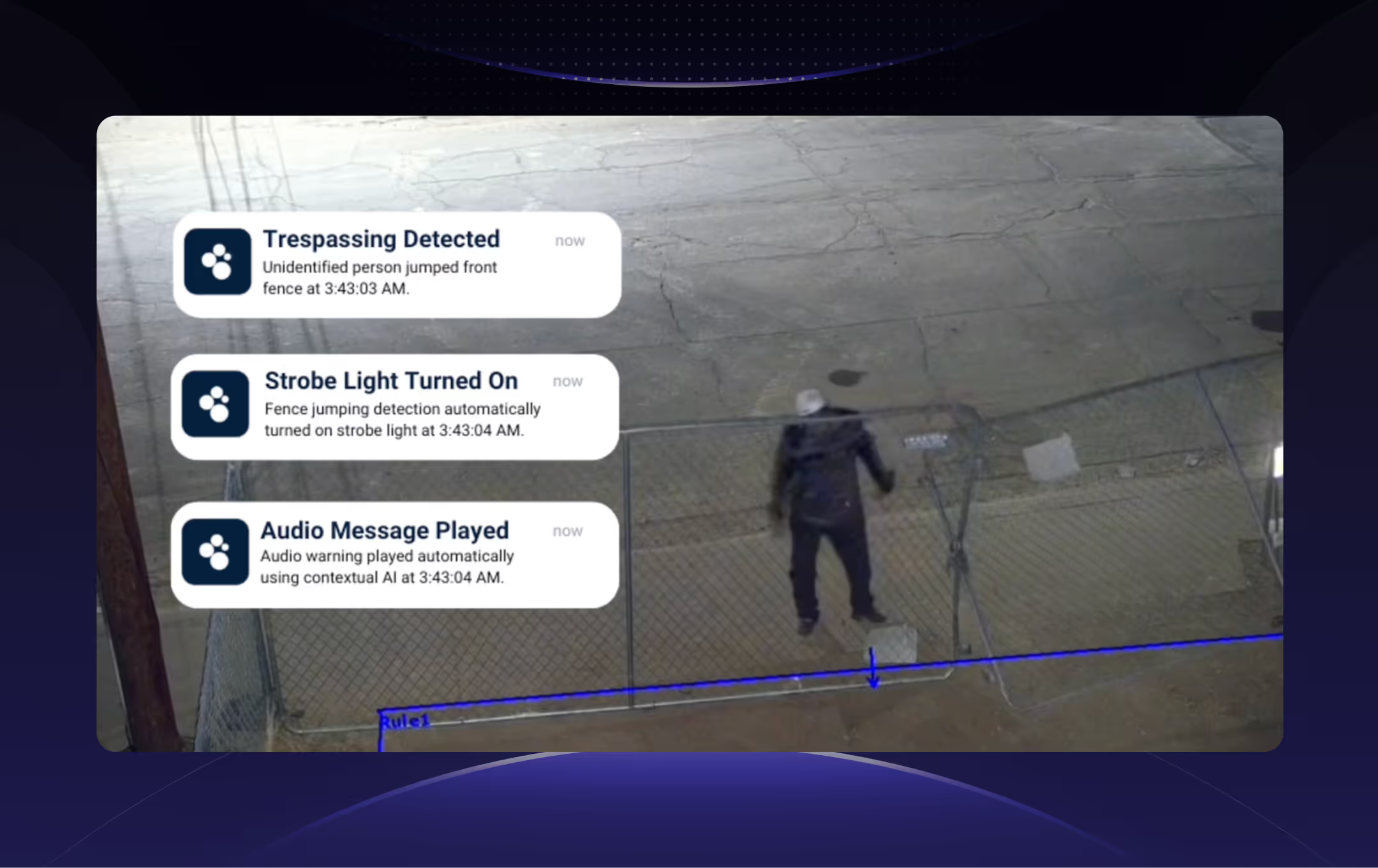
An active deterrence workflow is an operational framework that combines intelligent detection, real-time verification, and timely intervention to interrupt suspicious behavior in a parking lot before it escalates. Where passive systems document an incident, an active deterrence workflow aims to change what the person in the lot does next. It runs in three phases. Detection spots a specific behavior rather than any motion. Verification confirms the alert is genuine. Intervention uses audio and visual deterrents to prompt the person to leave.
Spot AI automates this sequence on every connected camera, so one LP team can hold the same deterrence standard at many lots.
In practice, the sequence runs in five stages, with intervention split into an automated first response and two levels of human escalation:
- Detection: Video AI identifies a behavioral trigger (loitering, fire-lane violation, entrance scoping, or tailgating) using context-aware analytics rather than simple motion sensing.
- Verification: The system triages the alert, filtering nuisance alarms from genuine concerns. AI-based video analytics produce fewer false alarms than basic motion sensors.
- Automated first response: For verified detections, the system fires off deterrents: strobe lights activate, floodlights illuminate the area, or a recorded audio warning plays. This automated layer acts when staffing is thin: nights, weekends, and holidays.
- Human escalation: If the behavior persists, the alert routes to a monitoring professional or on-site team member with a clean incident log, time-stamped clips, and contextual detail. This verified package supports faster decision-making.
- Law enforcement dispatch: When escalation warrants it, the monitoring team contacts law enforcement with video evidence, clear timelines, and detailed incident context, significantly improving response quality compared to unverified reports.
This workflow matters because manual monitoring breaks down quickly. Operators watching multiple video feeds lose attention the longer they watch, increasing the risk of missed incidents. Automated detection and triage remove that bottleneck.
Workflow stage |
Action |
Outcome |
|---|---|---|
Detection |
Context-aware AI flags behavioral trigger |
Early identification of threat precursors |
Verification |
AI triages alert, filters nuisance alarms |
Fewer false alarms |
Automated response |
Strobes, floodlights, or audio talk-downs activate |
Deterrence without human intervention |
Human escalation |
Verified clip + incident log sent to operator |
Faster, better-informed decision |
Law enforcement dispatch |
Video package shared with dispatch |
Higher-quality response from authorities |
Three core components of a parking lot security workflow
Three components turn that sequence into settings a team configures:
- Intelligent detection. Context-aware video AI separates a customer walking to their car from someone casing vehicles. Loitering detection flags an ORC lookout or a driver waiting for accomplices. No-go zones put virtual perimeters around loading docks and after-hours entrances, and license plate recognition flags vehicles tied to earlier incidents.
- Automated intervention. Once an alert is verified, speed decides the outcome. An automated or live talk-down ("You are in a restricted area. Please leave now.") removes the anonymity offenders count on, and strobes or floodlights show the lot is managed. If the person stays, the workflow escalates to on-site staff or police.
- Centralized visibility and standardization. One cloud dashboard across all locations means a vehicle entering a no-go zone triggers the same protocol in every region. The same view shows which stores and shifts need tuning first.
Spot AI runs all three on the cameras a retailer already owns.
Choosing the right parking lot security cameras for your environment
Camera selection depends on lot geometry, risk profile, and whether the deployment is permanent or flexible. Five camera types serve distinct roles in parking lot security, and most lots need a mix of them.
Camera type |
Best for |
Range |
Key advantage |
|---|---|---|---|
Bullet |
Entry/exit points, perimeter lanes |
Long range |
Long-range detail, visible deterrent |
Turret |
Supplementary zone coverage |
Shorter range, wider angle |
Discreet, higher weather resistance |
PTZ (pan-tilt-zoom) |
Large lots, dynamic tracking |
Variable (operator-controlled) |
Covers wide areas with fewer units |
Dome |
Wide overview of lot sections and storefronts |
Shorter range, wide angle |
Discreet and vandal resistant, but weak at reading plates at night |
LPR (specialized) |
Entry and exit lanes where vehicles slow |
Narrow, focused on one lane |
Plate reads for watchlist and repeat-vehicle alerts |
Bullet cameras excel at capturing detailed footage from distance, making them the primary choice for large parking lots, perimeter monitoring, and entry/exit funnels. High-performing models carry weather-resistance (IP) and impact (IK) ratings, with infrared arrays for low light.
PTZ cameras reduce the total number of units needed by allowing remote adjustment of angle, tilt, and magnification. When integrated with AI tracking, they can automatically follow moving subjects across camera fields, which is valuable for tracking suspicious vehicles across a large surface lot.
Night vision capability is non-negotiable for parking environments. Full-color night vision delivers superior detail for identifying vehicle colors and suspect clothing compared to infrared-only systems. However, performance degrades in fog, heavy rain, or snow, a factor worth accounting for in geographic planning.
Use dome cameras for overview duty, since infrared glare off reflective plate paint can wash out plates at night. A zoomed-in PTZ leaves the rest of its view unwatched, so pair it with fixed cameras. Spot AI works with standard IP and ONVIF cameras, including those a store already has (see adding AI to a camera network you already own).
Mobile camera towers: flexible coverage for shifting risk patterns
How do you cover overflow lots, seasonal parking areas, or locations where fixed infrastructure is impractical? Mobile camera towers address this gap.
Key operational advantages of mobile towers include:
- Rapid deployment: Units can be operational quickly, with no permanent electrical service, fiber, or network modifications required.
- Infrastructure independence: Solar-powered units with battery storage operate entirely off-grid, eliminating utility hookup requirements and fuel costs during normal conditions.
- Repositioning flexibility: As incident patterns shift between stores, seasons, or special events, towers move with the risk. This adaptability is especially relevant for teams managing variable parking lot utilization across a region.
- Visible deterrence: Standing well above the parked cars and occupying only one parking space, towers signal active monitoring to everyone in the lot.
A cellular or satellite link also takes electrical permits, trenching, and network extensions out of the plan. Retailers rent, lease, or buy these units from a security provider. Spot AI can run on their cameras as it does on fixed ones, processing video at the edge so the link carries alerts and metadata, not a constant stream. See our mobile security trailer buyer's guide and our rent, lease, or buy comparison.
For teams weighing rental versus purchase, the decision hinges on deployment duration and portfolio size:
Factor |
Rental model |
Purchase model |
|---|---|---|
Capital commitment |
Low (variable cost) |
Higher upfront, lower long-term |
Best for |
Seasonal spikes, pilots, single-site |
Multi-year, multi-location programs |
Repositioning |
Included in service |
Requires internal logistics |
Long-term economics |
Ongoing fees |
Approaches zero after amortization |
Total cost of ownership: every cost line to budget
Camera prices are one line in a parking lot program's total cost of ownership (TCO). Compare every option on the same lines:
Cost line |
Fixed cameras |
Mobile unit |
|---|---|---|
Hardware |
Cameras, poles, and mounts |
Purchase, or a rental or lease fee |
Installation |
Trenching, cabling, and electrical work |
Delivery and setup only |
Power and data |
Wired power and network drops |
Solar and battery upkeep, plus a cellular or satellite plan |
Software and monitoring |
Video AI subscription, plus in-house or remote monitoring |
The same, per unit |
Storage |
Grows with camera count, resolution, and retention days |
The same, plus data sent off site |
Maintenance |
Lens cleaning, angle checks, and firmware |
Panel, battery, and mast checks, plus moves |
Then weigh the blended cost of cameras, video AI, and remote response against guard hours for the same window, as our guide to extending parking lot protection without the payroll does.
Placement strategy and environmental design
Camera technology only performs as well as its placement allows. Strategic positioning follows a priority framework based on where threats originate and move through the parking environment.
Critical coverage zones, in order of priority:
- Entry and exit points: Cameras positioned at building access doors should capture facial-level detail, not bird's-eye views from excessive height. Placing cameras beside signage encourages subjects to look toward the lens.
- Vehicle lanes and pedestrian paths: Coverage of driving lanes captures vehicle descriptions, license plates, and movement patterns.
- Secluded areas and blind spots: Offenders target low-visibility zones for staging, stashing equipment, or accessing buildings through secondary entry points. Systematic coverage eliminates these zones of opportunity.
- Perimeter boundaries: Weatherproof models rated IP65 or higher, installed under eaves or awnings, cover the building's outer edge. Adequate outdoor lighting is essential for nighttime visibility.
Lighting is as important as cameras. Uniform LED coverage across the entire lot, including corners and pedestrian paths, eliminates the dark spots that create both camera blind spots and crime opportunity. Pockets of shadow undermine both detection capability and customer confidence. Motion-activated fixtures add a dual benefit: energy savings during quiet hours and an alert signal when after-hours activity occurs.
A lighting audit at each store should confirm three things:
- Every fixture works, with no burned-out or flickering lamps.
- Stairwells, pedestrian paths, and emergency call stations are lit.
- Motion-activated fixtures ignore wind-blown vegetation and animals.
Physical barriers round out the environmental design. Bollards protect storefronts from vehicle ramming. Barrier gates with anti-passback settings address tailgating. Maintained landscaping with trimmed sightlines removes hiding spots. Together, these elements follow Crime Prevention Through Environmental Design (CPTED) principles, making the lot feel managed, which itself deters testing and escalation.
Map each detection zone to an alert rule
A detection zone is an area of the camera view where a specific behavior triggers an alert. Incidents cluster in predictable places, so each zone gets its own rule:
Zone |
Why incidents cluster there |
Alert rule |
|---|---|---|
Fields nearest the entrance |
Most break-ins and confrontations |
Loitering near cars, car break-in |
Remote corners and overflow lots |
Staging goes unseen |
Dwell past a set time |
Curbside pickup and loading zones |
Merchandise sits outside |
No-go zone after hours, such as after 10 PM |
Drive aisles shared with anchor stores |
Neither tenant watches them |
Repeat vehicles, plates of interest |
Fence lines and the back of the building |
After-hours access to docks |
Fence jumping, unauthorized entry |
Spot AI ships pre-trained video AI agents for each of these behaviors, so the zone map becomes the alert configuration.
Minimizing liability and improving safety in the parking lot
Retailers generally owe customers and staff reasonable care in areas they control, and a claim after a lot assault or break-in often turns on what the retailer knew and did. Documented measures (lighting, visible cameras, and a defined response) help show that care, and video helps only when it is handled as evidence:
- Preserve it. Hold footage tied to an incident or claim outside the normal retention cycle. Once litigation is likely, lost footage can bring spoliation sanctions.
- Verify conditions. Time-stamped video shows whether the lights were on and the lot was maintained when an incident was reported.
- Keep a chain of custody. Log who exported each clip, when, and for whom, and keep the original file.
Spot AI keeps each case in one place with its time-stamped clips attached, so LP, legal, and claims teams share one record. Automated deterrents also spare associates from walking into the lot to confront someone.
Measuring success: KPIs and ROI for parking lot security
Report the same KPIs monthly against a baseline from the prior 12 months of incidents:
KPI |
How to measure it |
What it shows |
|---|---|---|
Incident rate |
Lot incidents per store per month, by type |
Whether behavior is changing |
Shrink |
External theft and shrink, set against lot incidents by store |
Whether the program reaches the P&L |
Response time |
Detection to first deterrent and to escalation, by shift |
Where coverage is thin |
Alert quality |
Verified share of alerts, nuisance alarms per camera |
Whether tuning works |
Investigation time |
Hours per case, AI search against manual review |
Labor returned to LP |
Claims |
Lot claims, and the share with usable video |
Liability exposure |
Report ROI in the same terms: losses avoided, hours saved, and claims closed with video.
Best practices for implementation: a multi-site rollout checklist
Roll out in this order:
- Assess each lot. Walk the perimeter, run the lighting audit, map coverage and blind spots, and pull the incident baseline.
- Set zones and rules. Map each zone to its alert rule, with tighter thresholds at loading docks and other high-value areas.
- Write the response protocol. Decide who gets each alert, when a talk-down is enough, and when police are called.
- Pilot, then tune. Start at the highest-incident store (see the pilot section below) and review alerts weekly until thresholds settle.
- Standardize and scale. Copy the tuned rules to the next wave of stores as a template, check camera health from one dashboard, and train staff to verify alerts.
Considerations before deploying parking lot video technology
No technology deployment is without trade-offs. Teams evaluating parking lot security investments should weigh several factors:
- Environmental limitations: Night vision range degrades in fog, heavy rain, and snow. LPR accuracy drops when vehicles pass at steep angles or high speeds, or when plates are bent, dirty, or partially obscured.
- Coverage expectations: Even advanced camera systems cannot eliminate all blind spots. Coverage depends on camera count, placement, and lot geometry. Realistic expectations avoid disappointment and support better planning.
- Maintenance requirements: Regular maintenance requires a dedicated operational budget for lens cleaning, angle adjustments, software updates, and equipment inspection. Neglected systems lose effectiveness quickly.
- Compliance obligations: NFPA 730, the National Fire Protection Association's Guide for Premises Security, covers parking facilities, including security planning, vulnerability assessment, physical security, and access control. Source: Security Magazine ADA accessibility standards also apply to camera and barrier placement near accessible spaces.
- Integration complexity: Camera systems deliver the most value when connected to existing access control, incident management, and loss prevention workflows. Standalone deployments create data silos that slow investigation and reduce coverage efficiency.
- Audio deterrence rules: Before enabling talk-downs, check local noise ordinances and post signage at lot entrances stating that the area is monitored and that audio warnings may be used.
Key takeaway: The most effective parking lot security programs layer three elements together: context-aware AI detection that filters out nuisance alarms, automated deterrents (strobes, floodlights, audio) that act instantly without waiting for staff, and a structured escalation workflow that routes verified incidents to the right responder with time-stamped evidence. This combination closes the gap between detection and action, even across dozens of locations with limited on-site personnel.
How Spot AI extends parking lot protection across a retail portfolio
For teams managing 20, 30, or 40+ stores, the core obstacle isn't choosing the right camera. It's scaling consistent coverage and response without proportionally scaling headcount. Spot AI's AI Security Guard addresses this by turning the outdoor cameras a retailer already owns, and any it adds later, into active agents that detect, deter, and document parking lot activity.
Context-aware detection, not just motion alerts. Spot AI's platform applies multi-object, context-aware AI to distinguish between a delivery driver and an unauthorized individual, or between a customer loading groceries and someone casing an entrance. This means fewer false alarms, so operators focus on incidents that actually require attention. A leading SOC platform integrated with more than 20 VMS platforms reports a single-digit false-positive rate with Spot AI, versus about 50% on legacy VMS.
Automated deterrence that acts when staffing is thin. When the AI Security Guard verifies a threat, it fires off deterrents (strobe lights, floodlights, and audio talk-downs) without waiting for a human to reach for the radio. This automated response covers second shift, third shift, and weekends when on-site personnel are limited or absent.
Faster investigation and case closure. Time-stamped clips, clean incident logs, and case files compile automatically. Instead of scrubbing hours of footage, teams search for specific events and share verified video packages with law enforcement or insurance adjusters in minutes.
Camera-agnostic, fast to deploy. Spot AI works with existing IP cameras, with no rip-and-replace required. The system can be live in under a week, making it practical for rapid pilots at high-incident locations before committing to a portfolio-wide rollout.
Scalable across the region. A unified cloud dashboard shows what's happening at every location in one place. One LP professional can monitor parking lot activity across dozens of stores, expanding coverage without adding badges.
Proven on unstaffed perimeters. Storage Asset Management runs about 50 storage facilities with no on-site staff and uses Spot AI's after-hours alerts, which notify local law enforcement directly. At one facility, Spot AI detected intruders at about 1 AM, and police arrived while the break-in was in progress. After the arrest was publicized, the company reported no further break-ins there. The system works with the company's existing cameras.
Strengthen your parking lot perimeter with a focused pilot
The fastest way to evaluate parking lot security is to start with your highest-incident store. Identify the store with the highest overnight incident count, deploy a focused pilot, and measure before-and-after results over 30 to 60 days. Track incident frequency, alert verification rates, investigation time, and staff feedback on how secure the lot feels.
If the team is stretched across too many locations with too few resources, request a demo to see how Spot AI's AI Security Guard detects parking lot threats, verifies alerts, and documents incidents across every site.
See Spot AI in action

"Before implementing this system, tracking tailgating relied entirely on human observation. Now we receive instant alerts when someone holds the door open or if multiple people enter in quick succession, allowing us to address security protocols in real-time rather than after the fact."
Mike Tiller, Director of Technology, Staccato
Frequently asked questions
What are the most effective security measures for retail parking lots
Effective parking lot security layers multiple elements: high-resolution cameras at entry/exit points and perimeter zones, uniform LED lighting that eliminates dark spots, mobile patrols for visible human deterrence, access control at gated areas, and emergency communication devices.
How do parking lot security cameras reduce shrink
Parking lot cameras serve four functions: deterrence through visible presence, early threat detection when paired with video AI analytics, incident documentation for investigation and insurance claims, and tactical intelligence such as license plates, vehicle descriptions, and behavioral patterns that supports timely response. Integration with LPR identifies repeat vehicles displaying suspicious behavior and tracks patterns across multiple store locations. AI analytics detect behavioral precursors like loitering and entrance scoping, enabling intervention before incidents move inside the store.
What is an active deterrence workflow for parking lot security
An active deterrence workflow is a detect, verify, and intervene sequence that interrupts suspicious behavior in a parking lot before it becomes an incident. Video AI spots a specific behavior, such as loitering, and the alert is confirmed as genuine. A talk-down, strobes, or floodlights then prompt the person to leave, and the response escalates to staff or police if they stay. Spot AI runs this workflow on the cameras a retailer already owns and logs every event with time-stamped video.
What should teams consider when evaluating parking lot security costs
Costs vary based on lot size, camera count, and technology complexity. Mobile camera tower rentals require lower upfront capital for short-term deployment, while purchased systems for small-to-medium lots involve significant initial investment for equipment and installation. Professional round-the-clock monitoring and regular annual maintenance add to the ongoing operational budget. Purchase models favor long-term, multi-location programs, while rental models suit seasonal coverage or technology pilots.
What compliance standards apply to parking lot video systems
NFPA 730, the National Fire Protection Association's Guide for Premises Security, covers parking facilities, including security planning, vulnerability assessment, physical security, and access control. ADA standards govern accessible parking space placement and require that security infrastructure does not obstruct accessible routes. Retention policies should specify a minimum of 30 days for standard operations, with extended retention for active investigations. Role-based access controls and secure storage protect recorded footage and associated metadata.
About the author
Sud Bhatija is COO and Co-founder at Spot AI, where he scales operations and GTM strategy to deliver video AI that helps operations, safety, and security teams boost productivity and reduce incidents across industries.

