






How to choose a perimeter security camera for industrial and construction sites in 2026
The decision in front of most Security Directors is not whether to add cameras to the fence line. It is whether those cameras can actually detect intent, verify the threat, and prompt action in seconds, or whether they will simply record footage you review the morning after the copper is already gone. Property offenses still occurred at a rate of 1,835.1 per 100,000 persons in 2024 (Source: Bureau of Justice Statistics). For an active jobsite full of tools, fuel, and heavy equipment, that risk lands directly on your KPIs: incident volume, asset loss, response time, and guard spend.
This guide lays out a practical framework for comparing the main approaches to perimeter intrusion detection, then offers an evaluation checklist you can run against any option.
Key takeaways
- A perimeter security camera earns its keep only when it can detect intent in context, verify the event, trigger deterrence in seconds, and package case-ready evidence.
- Passive recording and motion-only alerts generate noise. Video analytics for intrusion detection classify people, vehicles, line crossing, and loitering to cut false alarms.
- Guards, monitored trailers, sensors, and AI perimeter security cameras should be compared on detection accuracy, false alarm risk, deterrence speed, scalability, evidence quality, and total cost of coverage.
- Perimeter sensors and fence breach detection add value in a layered architecture, but they typically need video to verify context and reduce nuisance alarms.
- Cloud-connected and hybrid architectures support multi-site visibility and remote investigation. Spot AI's AI Security Guard can turn cameras you already own into AI coworkers for real-time monitoring and deterrence.
What a perimeter security camera actually needs to do
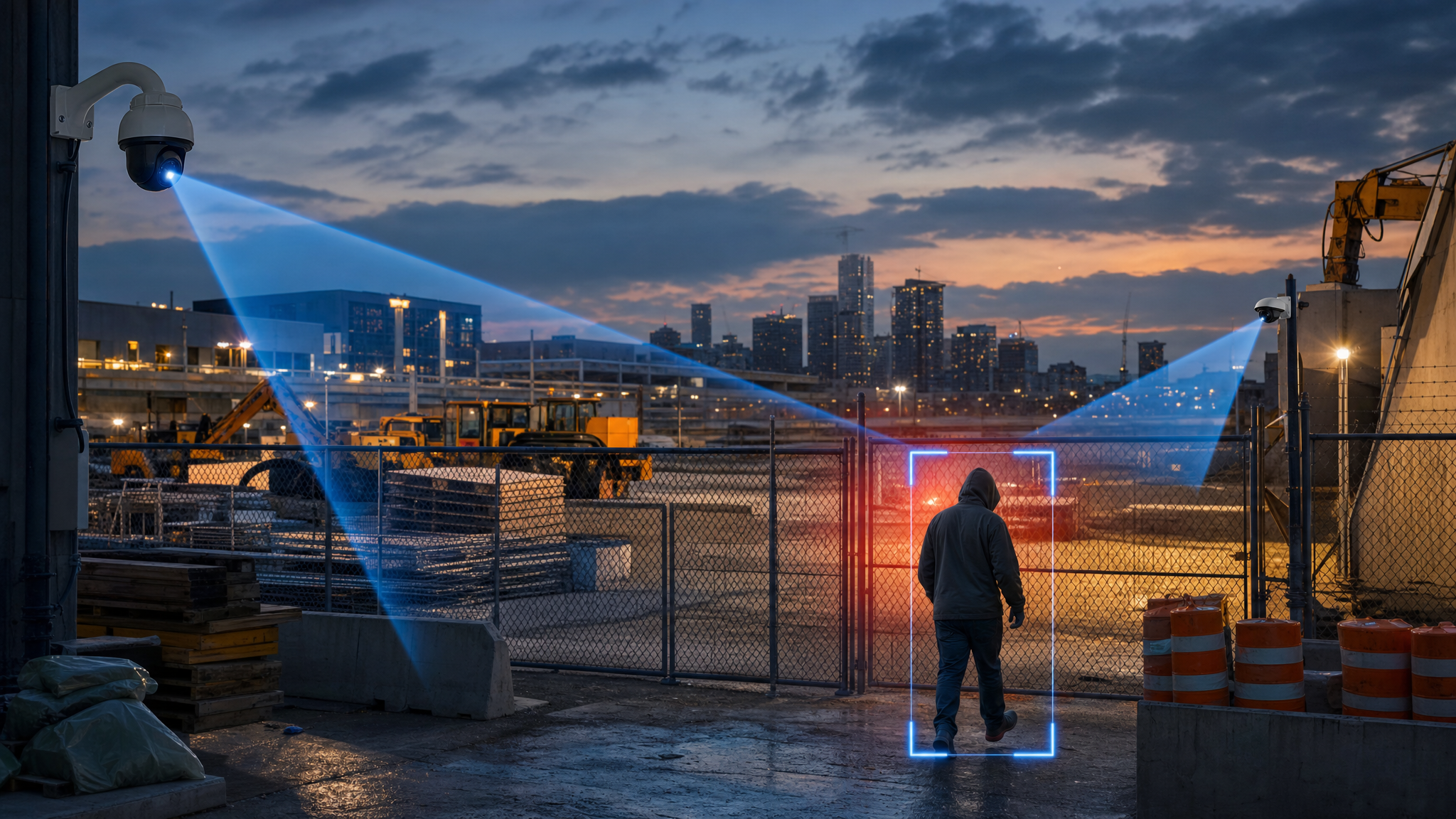
In a jobsite or industrial context, a perimeter security camera is a device positioned to watch gates, fence lines, laydown yards, fuel areas, loading docks, and equipment storage. The hardware is only half the story. Security Magazine's guidance on intelligent perimeter defense argues that effective solutions layer physical barriers, detection devices, video, and analytics so each camera plays a defined role: detection, verification, and evidence, rather than acting as a standalone recorder (Source: Security Magazine).
Think of it like a smoke detector versus a sprinkler. A passive camera is a smoke detector that only beeps after you smell the fire. A capable perimeter security system detects the smoke, verifies it is real, and acts. That is the bar.
Four jobs define a strong perimeter intrusion detection setup:
- Detect intent in context. Distinguish a person climbing a fence at 2 a.m. from a raccoon, a passing headlight, or a tarp moving in the wind.
- Verify the threat. Confirm what is happening with timestamped video before anyone wakes a guard or calls 911.
- Deter in seconds. Trigger lights, sirens, or a natural-conversation talk-down while the intruder is still at the fence.
- Resolve with evidence. Produce searchable, organized, case-ready clips so investigations take minutes, not hours.
Passive cameras versus AI perimeter security cameras
The clearest fork in the road is between passive recording and video AI perimeter security. A passive camera streams to a recorder and waits for someone to look. Motion-based alerts are a small step up, but they fire on anything that moves, which floods operators with noise.
Forrester's research on the expanding physical security portfolio identifies video analytics and video-surveillance-as-a-service as key categories reshaping the field, reflecting a clear shift beyond passive cameras toward systems that interpret video and classify events (Source: Forrester). A peer-reviewed survey of abnormal behavior detection in intelligent video surveillance concludes that advanced analytics can model unusual movement and crowd behavior in real time, distinguishing normal from suspicious activity rather than flagging any motion at all. That is the functional gap between a motion sensor and AI perimeter security cameras.
Spot AI's AI Security Guard follows a detect, secure, deter workflow. It classifies people, vehicles, loitering, line crossing, and zone entry, then can trigger protective actions: notify the right team, switch on strobes, play an automated talk-down, or escalate to a security operations center. Your existing cameras stop being passive recorders and start acting as AI coworkers that watch the fence in real time.
When to add perimeter sensors and fence breach detection
Cameras are not the only tool. Perimeter sensors and fence breach detection (vibration, contact, beam break, radar) can add precision where vision alone struggles. ASIS International's coverage of perimeter innovations describes organizations using software-defined zones and sensor "cages" to alarm on intrusions before offenders reach a fence or door (Source: ASIS International).
Sensors shine in specific conditions:
- Long fence lines where a single camera cannot cover the full run with usable detail.
- Remote laydown yards and material storage far from reliable power or network drops.
- Low-visibility zones where fog, dust, or distance limit visible-light cameras.
The catch is verification. Security Magazine notes that cable-based sensors and radar provide precise location, speed, and direction data that cameras cannot, but recommends integrating them with video so a breach is both detected and visually confirmed (Source: Security Magazine). A sensor that alarms without video gives you a beep and a guess. Pair it with classified video and you get a verified event. Treat sensors as one layer in a perimeter detection system, not a replacement for cameras or response.
Comparing the main perimeter intrusion detection approaches
Security Directors are usually weighing several operating models at once: passive cameras, motion alerts, perimeter sensors, human guards, monitored trailers, and AI-powered camera intelligence. The table below compares these approaches against the criteria that move your KPIs. Spot AI's approach appears as one reference column, not a vendor scorecard.
| Approach | Detection accuracy | False alarm risk | Deterrence speed | Scalability | Evidence quality |
|---|---|---|---|---|---|
| Passive cameras (record only) | Low, relies on manual review | Not applicable, no alerts | None in real time | High, but value drops at scale | Footage exists but is slow to find |
| Motion-based alerts | Low to moderate | High, fires on any movement | Limited, alert fatigue sets in | Moderate | Moderate, noisy clips |
| Perimeter sensors / fence breach | Moderate to high for breach events | Moderate without video verification | Fast alarm, slow context | Moderate, needs cabling or radar | Low without paired video |
| Human guards | Variable, depends on coverage | Low, but coverage gaps exist | Fast where present | Hard to scale across sites | Inconsistent reporting |
| Monitored trailers | Moderate to high in covered zones | Depends on analytics quality | Fast within trailer range | Limited by physical units | Good in covered areas |
| AI perimeter cameras (Spot AI AI Security Guard) | High, classifies intent in context | Low, context-aware detections | Real-time talk-down, lights, sirens | High, uses existing IP cameras | Timestamped, searchable cases |
SDM Magazine's coverage of remote video monitoring notes that monitored video lets centralized stations oversee many sites at once, verify alarms, and coordinate response (Source: SDM Magazine). The best programs blend approaches. Most teams find that AI camera intelligence does the heavy lifting on detection and deterrence while guards or trailers cover specific high-value zones.
Cloud, on-prem, or hybrid architecture for multi-site portfolios
Where your video and analytics live matters as much as the camera. Deloitte's analysis of cloud infrastructure strategy predicts enterprises will increasingly adopt hybrid architectures, using cloud for scalable workloads and centralized management while keeping local control where latency, data sovereignty, or resilience demand it (Source: Deloitte).
Here is the practical breakdown for distributed construction and industrial operations:
- Cloud-connected: Strong for multi-site visibility, remote investigation, fast evidence sharing, and analytics across dispersed jobsites. Forrester notes video-surveillance-as-a-service is expanding the physical security portfolio for exactly this reason (Source: Forrester).
- On-prem: Appeals where local retention, bandwidth control, or existing infrastructure matters. Evaluate it against remote access, maintenance burden, and analytics limits.
- Hybrid edge-to-cloud: Keeps full-resolution video in the facility and sends only metadata across the network, which keeps bandwidth low and deployments fast.
Spot AI uses a hybrid edge-to-cloud approach. The Intelligent Video Recorder keeps full-resolution video on-prem while heavier reasoning load-balances to the cloud. For remote and changing jobsites, pole, wall, and trailer-mounted units plus Starlink back-haul extend coverage to fuel tanks, laydown yards, and gates without trenching new cable.
Key terms
- Perimeter intrusion detection: The practice of identifying unauthorized entry across a site boundary using cameras, sensors, analytics, and response workflows.
- Context-aware detection: Video analytics that classify people, vehicles, loitering, and line crossing rather than alerting on any motion.
- Case-ready evidence: Timestamped, organized, searchable video that lets teams resolve an incident in minutes instead of hours.
- Hybrid edge-to-cloud: An architecture that keeps full-resolution video on-prem and sends only metadata to the cloud for analysis and multi-site visibility.
Construction-specific coverage that matters after hours
Jobsites are not static. Layouts shift, temporary fencing moves, materials relocate, and subcontractor traffic changes weekly. Construction site perimeter security has to adapt to that churn while still protecting the assets thieves target most.
Map your coverage to real risk zones:
- Gates and access points: Tailgating and unauthorized entry after hours.
- Fence lines: Climbing, cutting, and breach attempts along long runs.
- Laydown yards and material storage: Copper, lumber, and staged materials.
- Equipment storage: Heavy machinery and high-value tools.
- Fuel tanks and loading areas: High-value, high-risk targets for theft.
One verified example shows what real-time AI deterrence looks like in the field. A top 5 EV charging network in North America rolled out Spot AI's autonomous copper-theft deterrence from 0 to 120 sites in about a year. Each incident had created roughly $5,000 in cable replacement cost plus lost revenue and station downtime. Autonomous actions, including bull horns and strobes, trigger within seconds before a cable is cut.
"We've reduced incidents by 80% without any kind of human monitoring."
Jeremy N., Sr. Manager of Operations & Maintenance, Top 5 EV charging network (North America)
An evaluation checklist for Security Directors
Run any perimeter security camera system through these criteria and tie each one to a KPI you already report. The strongest options are camera-agnostic, so you can reuse cameras you already own. Spot AI works with any IP camera (Avigilon, Pelco, Axis, Hanwha, any ONVIF) with no rip-and-replace, and most sites go live in days, not months.
- Detection accuracy: Does it classify intent in context, or just flag motion? Maps to incident volume.
- False alarm risk: Will operators trust the alerts? Maps to false alarm reduction and operator time.
- Deterrence speed: Can it trigger talk-down, lights, or sirens in seconds? Maps to response time and asset loss.
- Evidence quality: Does it produce timestamped, searchable cases? Maps to investigation speed.
- Scalability: Can it extend to remote and temporary sites without new trenching? Maps to coverage and total cost.
- Architecture fit: Cloud, on-prem, or hybrid for your multi-site portfolio?
- Hardware flexibility: Does it reuse existing cameras or force replacement? Maps to total cost of coverage.
- Compliance: Is it NDAA-compliant and SOC 2, with secure-by-design practices?
- Guard spend optimization: Can it augment guards and reallocate budget?
If you want to see how AI Security Guard turns existing cameras into AI coworkers for fence lines, gates, and laydown yards, explore how Spot AI approaches perimeter security or read more about real-world deterrence in the Spot AI customer stories.
Frequently asked questions
How do perimeter security cameras detect intruders
Basic cameras detect movement and leave interpretation to a person. AI perimeter security cameras use video analytics to classify what they see, distinguishing a person climbing a fence from a passing vehicle or animal. A peer-reviewed survey on intelligent video surveillance found that advanced analytics can identify unusual movement in real time rather than flagging any motion. That context is how modern systems cut false alarms.
What is the difference between a passive camera and an AI-powered perimeter intrusion detection system
A passive camera records footage for later review and takes no action. An AI-powered system detects intent in context, verifies the event with video, and can trigger deterrence such as a talk-down, strobe lights, or a siren in real time. Forrester's research highlights this shift from passive cameras toward analytical systems that interpret video and classify events.
When should a site use perimeter sensors in addition to cameras
Add perimeter sensors or fence breach detection for long fence lines, remote yards, and low-visibility zones where vision alone struggles. Security Magazine recommends integrating sensors with video so a breach is both detected and visually confirmed. Sensors give precise location and direction, while video supplies the context and evidence to verify the alarm.
How do cloud and on-prem perimeter camera systems compare for multi-site operations
Cloud-connected systems support multi-site visibility, remote investigation, and analytics across dispersed sites. On-prem systems suit local retention and bandwidth control. Deloitte predicts most enterprises will adopt hybrid architectures that keep local control where latency or resilience demand it while using the cloud for scalable management and reporting.
What criteria should I use to compare guards, trailers, sensors, and AI cameras
Compare each option on detection accuracy, false alarm risk, deterrence speed, scalability, evidence quality, and total cost of coverage. Then tie each criterion to a KPI you already track, such as incident reduction, response time, asset loss, and guard spend. Most strong programs blend approaches, with AI cameras handling detection and deterrence while guards or trailers cover specific high-value zones.
About the author
Dunchadhn Lyons, Director of AI Engineering. Dunchadhn Lyons leads Spot AI’s AI Engineering team, building real-time video AI for operations, safety, and security—turning video data into alerts, insights, and workflows that cut incidents and boost productivity.

