




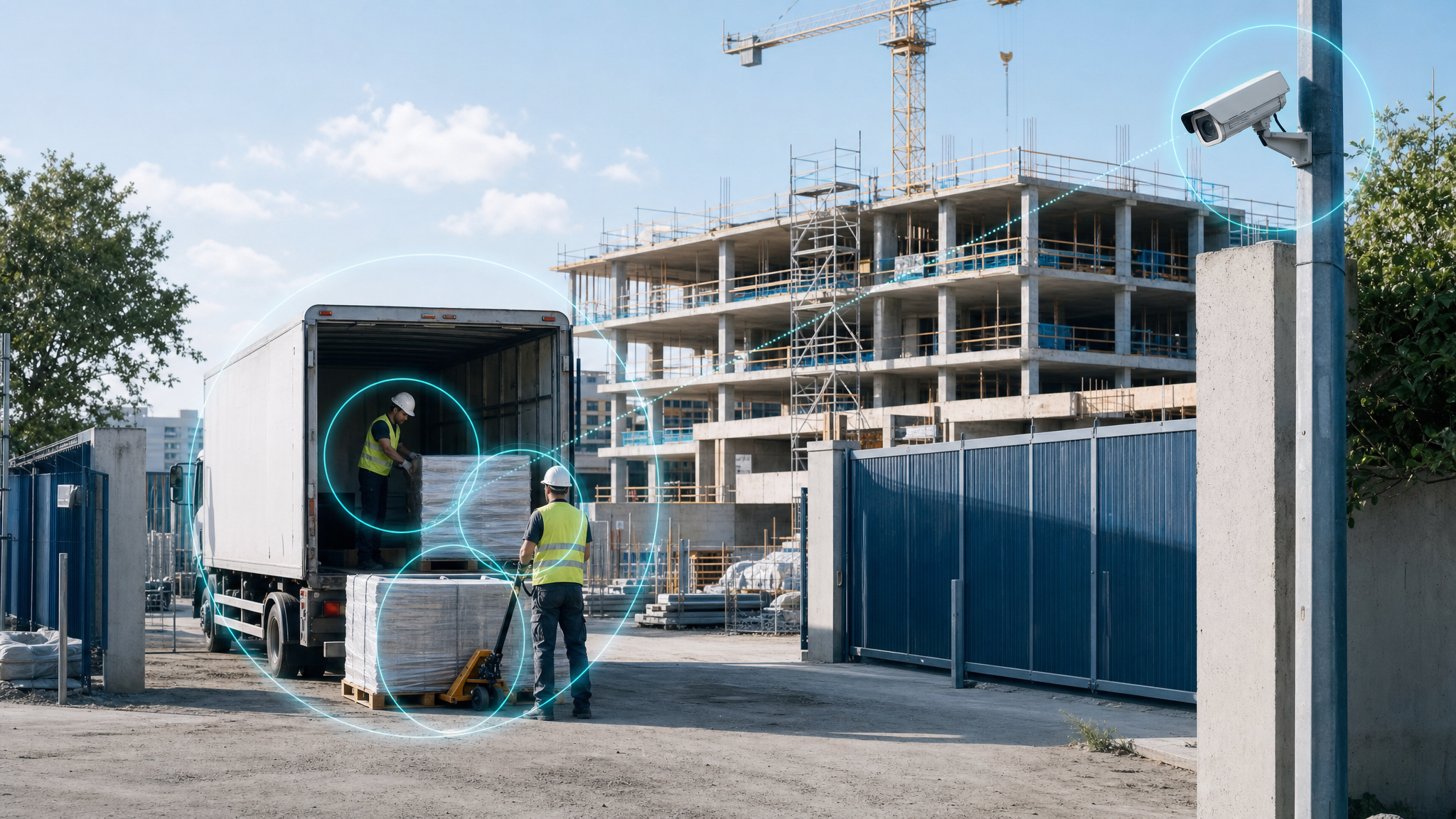


Proof of delivery video verification for construction: a 2026 decision guide
Every delayed steel shipment or short concrete load puts your schedule and margin at risk, and the proof you need to resolve a dispute often lives in the gaps between a signed ticket and a driver's photo. Construction input prices rose 1.4% in February 2024, 0.4% in March, and 0.5% in April, which makes every missing or damaged material claim more consequential for your budget (Source: Deloitte). Meanwhile, 82% of companies report their supply chains are affected by new tariffs, adding inventory and sourcing complexity that makes knowing where materials actually are even harder (Source: McKinsey). This guide gives you a buyer-ready framework for choosing how to verify deliveries with video.
Key takeaways
- Proof of delivery video verification uses time-stamped jobsite footage to confirm what arrived, when, where, and in what condition.
- Signed tickets and driver photos confirm a delivery happened but rarely capture the full chain of events around it.
- Useful video evidence needs a clear timestamp, camera location, searchable history, and preserved clips before and after the arrival.
- AI-assisted review surfaces vehicle arrivals and unloading activity so project managers stop scrubbing hours of raw footage.
- Evaluate architectures (cloud, on-prem, hybrid) against retention, bandwidth, multi-site access, and deployment speed.
What is video proof of delivery in construction
Video proof of delivery is the practice of using jobsite cameras to confirm a material delivery through time-stamped footage rather than paper records alone. It answers four questions a delivery ticket cannot: did the truck arrive, when did it arrive, where did it unload, and did the goods look usable. For schedule-critical loads like steel, HVAC equipment, prefabricated components, and rentals, that context decides whether you eat a delay or recover it through a charge-back.
Standard delivery records fail in predictable ways. A signed ticket proves someone signed, not that the right quantity arrived. A driver-submitted photo shows one angle at one second, often before the load is fully staged. Manual gate logs depend on a person being present and accurate during a busy receiving window. When a supplier dispute lands weeks later, those records leave you arguing from memory.
Why delivery tickets and driver photos fall short
Documentation quality increasingly decides who wins construction disputes, and material delivery timing, quantities, and condition sit at the center of many of them (Source: Arcadis). Ad hoc photo evidence struggles in that environment because it is a single point, not a chain of events.
Consider the common failure modes on a live jobsite:
- A driver photographs a full pallet, then the wrong materials are unloaded at a different gate.
- A signed ticket confirms quantity on paper, but a short count surfaces during install.
- An after-hours delivery lands with no one at the gate to confirm condition.
- Damaged material arrives, gets staged, and the cause is contested between carrier and crew.
Continuous, contextual capture beats isolated snapshots because best practice requires managing materials across every phase, from transport to on-site storage and use (Source: Frontiers). Video records the arrival, the unloading, and the staging as one connected sequence.
What makes video evidence reliable enough to resolve a dispute
Courts and stakeholders scrutinize how video was collected, handled, and stored, which means a documented chain of custody is vital to its trustworthiness (Source: Frontiers). For a jobsite, that translates into a few practical qualities. Reliable delivery video carries a clear, accurate timestamp. It identifies the camera and location, so you can prove which gate or laydown area you are watching. It preserves clips before and after the delivery moment, not just the second of arrival.
Searchability matters as much as capture. If finding a 4 a.m. arrival from three weeks ago takes a half-day of scrubbing, the evidence is technically present but practically useless. The most defensible records combine accurate time-stamped delivery video with an event history a project manager can query in minutes.
How AI camera delivery verification reduces manual footage review
The job most project managers want to avoid is watching raw footage. Video AI changes the work by surfacing the relevant moments instead of asking you to find them. The AI video analytics market is projected to grow from USD 8.50 billion in 2025 to USD 28.76 billion by 2030, a 27.6% annual rate that reflects how widely teams now rely on automated video analysis to flag events like vehicle arrivals (Source: MarketsandMarkets).
Applied to deliveries, an AI coworker can detect a truck entering the gate, tag the arrival with a timestamp, and preserve the clip automatically. When a dispute opens, you search by event rather than by hour. That shift matters because operations leaders are investing in automation specifically to surface exceptions without manual monitoring (Source: PwC).
This is where Spot AI frames the standard worth holding any system to: cameras you already own should act as AI coworkers that surface arrivals, tag context, and build case-ready evidence, not passive recorders waiting for someone to review them. The AI Operations Assistant and broader platform are built around that detect-and-surface workflow.
Comparing proof-of-delivery approaches against the criteria that matter
The decision is not "video or no video." It is which combination of records gives you defensible, searchable evidence with manageable effort. The table below compares common approaches against the criteria construction leaders should weigh: evidence quality, timestamp accuracy, location context, searchability, and dispute-readiness.
| Approach | Evidence quality | Timestamp and location context | Searchability | Dispute-readiness |
|---|---|---|---|---|
| Paper or signed tickets | Confirms a signature, not quantity or condition | Manual, prone to error | Low, paper-based | Weak when condition is contested |
| Driver-submitted photos | Single angle, single moment | Depends on device, often no location proof | Low, scattered across carriers | Limited, no chain of events |
| Mobile checklist workflow | Structured but depends on staff input | Good if completed accurately | Moderate, by record | Better, still no live footage |
| Basic CCTV review | Full footage, no event tagging | Timestamped, location known | Low, manual scrubbing | Strong if you can find the clip |
| AI-assisted video verification | Full context, arrival and unloading tagged | Time-stamped and camera-located | High, search by event | Strong, case-ready clips |
A step-by-step workflow for video proof of delivery
Here is a practical workflow that uses cameras you may already have on gates, laydown areas, and access points. The goal is a repeatable receiving process, not another manual checklist.
- Map your coverage. Identify which cameras see each entry point, laydown area, and unloading zone. Temporary gates and changing site layouts mean this map updates as the build progresses.
- Surface the arrival. Let Video AI detect vehicle entry and tag the timestamp automatically, so a 6 a.m. or after-hours delivery is flagged without a person watching the gate.
- Preserve the relevant clips. Capture footage before, during, and after the arrival to document the full chain of events, including staging and unloading.
- Confirm unloading context. Review the tagged clip to verify where the load went and how it looked, then attach notes for quantity or condition exceptions.
- Build the case-ready record. Organize the time-stamped clips, camera location, and notes into one exportable record you can share with a supplier or carrier when a dispute opens.
This workflow turns delivery exception management into a few minutes of focused review rather than a footage hunt. It also creates a construction delivery audit trail that holds up when a charge-back is challenged.
Cloud, on-prem, or hybrid: matching architecture to jobsite reality
Architecture decides how fast you deploy, how much footage you keep, how much it burdens IT, and how well it scales across temporary and remote jobsites. Leading owners are standardizing digital tools across projects to improve transparency and multi-site control, which favors approaches that travel well between sites (Source: McKinsey).
| Criterion | Cloud | On-prem | Hybrid edge-to-cloud (Spot AI approach) |
|---|---|---|---|
| Deployment speed | Fast, internet-dependent | Slower, hardware setup | Live in days, reuses existing cameras |
| Bandwidth burden | High, streams full video off-site | Low, stored locally | Low, full-resolution video stays on-site, only metadata leaves |
| Retention | Flexible, ongoing cost | Limited by local storage | Local full-resolution plus searchable cloud metadata |
| Multi-site access | Strong, anywhere access | Weak, site-bound | Strong, one view across jobsites |
| IT burden | Low maintenance, network reliant | Higher, on-site upkeep | Low, camera-agnostic, no rip-and-replace |
A hybrid edge-to-cloud model fits jobsite reality well: full-resolution footage stays on-site for evidence integrity, while searchable metadata enables remote jobsite delivery monitoring across every project. Spot AI's hybrid architecture is camera-agnostic and works with any IP camera, which matters when you are reusing whatever cameras are already mounted on temporary poles.
How a construction team puts this to work
AECOM Hunt uses Spot AI for site safety and project oversight, applying the same live visibility that powers delivery verification to broader jobsite accountability.
"[Spot AI] gives us the visibility and real-time insights needed to uphold the highest standards of safety and efficiency. We are redefining how we create safer, more streamlined environments and manage project oversight."
Safety Director, AECOM Hunt
The thread connecting safety oversight and delivery verification is the same: cameras that surface what happened, when, and where, so leaders act on facts instead of after-the-fact searches. With Deloitte forecasting the industry will need roughly 499,000 new workers by 2026, any system you choose must be usable by crews with varying technical skill (Source: Deloitte).
Key terms
- Proof of delivery video verification: Using time-stamped jobsite footage to confirm what arrived, when, where, and in what condition.
- Chain of custody: The documented record of how video was captured, stored, and handled, which underpins its trustworthiness in a dispute.
- Case-ready evidence: Organized, time-stamped clips with camera location and context, packaged so you can share them when a delivery is contested.
- Hybrid edge-to-cloud: An architecture that keeps full-resolution video on-site while sending only searchable metadata to the cloud.
A short checklist for evaluating delivery verification systems
Before you commit, score any option against these criteria:
- Evidence quality: full context around the arrival, not a single frame.
- Timestamp and location accuracy: provable down to the gate or laydown area.
- Searchability: find an event in minutes, not hours.
- Retention and clip sharing: keep what you need and export it cleanly.
- User permissions and multi-site visibility: one view across jobsites with role-based access.
- Deployment and bandwidth: live in days, reusing existing cameras where possible.
If you want to see how a Video AI approach handles arrivals, tagging, and case-ready evidence in practice, explore how Spot AI approaches proof of delivery video verification and review real deployments in its construction customer stories.
Frequently asked questions
How can construction teams use video verification for proof of delivery
Construction teams use cameras on gates and laydown areas to detect a vehicle arrival, tag it with a timestamp, and preserve clips before and after unloading. Video AI surfaces the arrival automatically, so a project manager confirms quantity and condition in minutes. The result is a searchable, time-stamped record that holds up when a supplier or carrier disputes the delivery.
What makes video evidence reliable enough to resolve a delivery dispute
Reliable delivery video carries an accurate timestamp, identifies the camera and location, and preserves footage before and after the arrival. A documented chain of custody is vital to its trustworthiness, since how video was collected and stored is scrutinized in disputes (Source: Frontiers). Searchability completes the picture, because evidence you cannot find quickly offers little practical value.
How does AI camera delivery verification reduce manual footage review
AI detects relevant events like a truck entering a gate and tags them, so project managers search by event instead of scrubbing hours of footage. Operations leaders are investing in this kind of automation to surface exceptions without manual monitoring (Source: PwC). That turns a half-day footage hunt into a few minutes of focused review.
What is the difference between driver-submitted photos and continuous jobsite video
A driver photo is a single angle at a single moment, often before the load is fully staged and without proof of location. Continuous jobsite video records the arrival, unloading, and staging as one connected chain of events. Best practice favors managing materials across every phase, so contextual capture beats isolated snapshots (Source: Frontiers).
What should construction leaders evaluate when choosing a delivery verification system
Weigh evidence quality, timestamp and location accuracy, searchability, retention, clip sharing, permissions, and multi-site visibility, along with deployment speed and bandwidth. Because the industry will need roughly 499,000 new workers by 2026, the system must be usable by crews with varying technical skill (Source: Deloitte). Compare cloud, on-prem, and hybrid architectures against your jobsite realities.
About the author
Sud Bhatija is COO and Co-founder at Spot AI, where he scales operations and GTM strategy to deliver video AI that helps operations, safety, and security teams boost productivity and reduce incidents across industries.

