




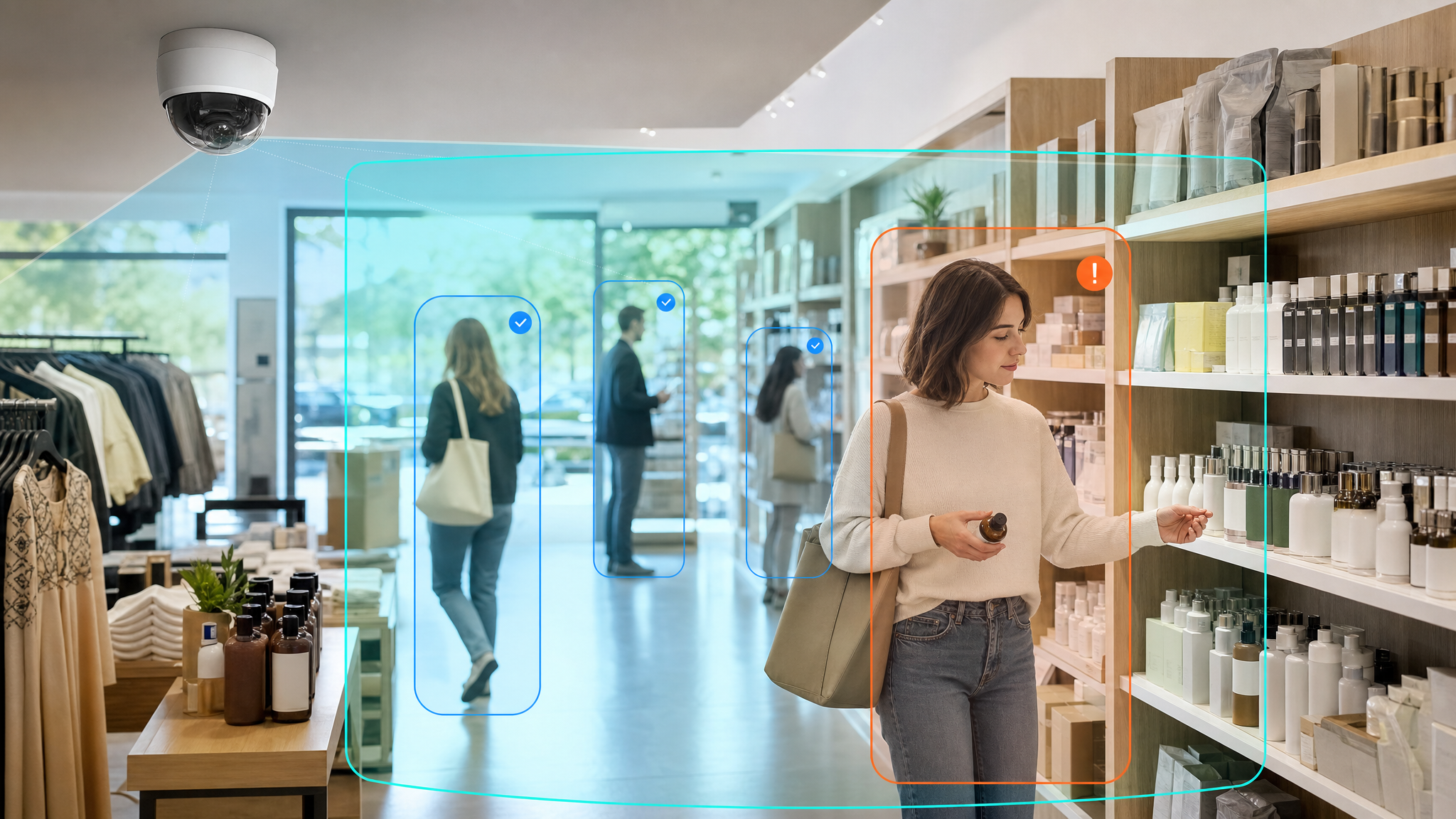


How to reduce false positives in security video AI in 2026
Retail loss prevention teams do not need more alerts. They need alerts they can trust. When a video system pings a Director of Loss Prevention every time a shadow shifts in a parking lot or a cart rolls past an entrance, the team learns to ignore the feed, and that is when real incidents slip through. This guide explains why false positives happen in security video AI and how to reduce them without missing the events that matter.
Key takeaways
- False positives happen when systems react to motion instead of reasoning about objects, behavior, location, and time.
- Context-aware video AI evaluates business rules and intent-like patterns, which can sharply cut nuisance alerts compared with motion-only triggers.
- Retail spaces need site-specific tuning, because normal activity at a receiving door differs from normal activity in a back room.
- Tiered escalation and human review separate low-confidence events from urgent incidents and protect your team from alert fatigue.
- Track verified alert rate, false positive rate, and mean time to review so you can prove the system is improving over time.
What false positives in security video AI actually are
A false positive is an alert for something that is not a real security event. A swaying tree, a delivery truck at a receiving door, an employee restocking after hours, or a customer pausing to read a sign can all trigger an alarm if the system only watches for pixel change. Each one pulls an operator away from work that matters.
The scale of the problem is well documented. Security Magazine reports that false alarms have become a $3.2 billion industry issue, with estimates that more than 90 percent of notifications from many security systems are false (Source: Security Magazine). When that much noise reaches a small loss prevention team, confidence in the feed erodes fast.
Alert fatigue is the operational risk underneath the noise. An ACM study of security operations centers found that 54 percent of teams feel overwhelmed by alerts and 55 percent lack confidence in prioritizing or responding to them (Source: ACM). For retail loss prevention, that translates into slower triage, distracted store associates, and missed organized retail crime.
Why video analytics create false alarms in retail environments
Most false alarms trace back to environmental noise and benign motion. A criminology analysis of burglar alarms in the UK found that 30 percent were triggered by insects and 10 percent by pets, a clear example of how non-threatening movement drives alerts (Source: Urban Institute). In a store, the equivalents are shopping carts near entrances, shadows in parking lots, and routine delivery activity at loading docks.
The Urban Institute's evaluation of false burglar alarms shows that most false activations stem from user errors, visitors, and equipment problems rather than actual criminal activity (Source: Urban Institute). Camera conditions matter too. A synthesis of CCTV evaluations by Cornell University emphasizes that effectiveness depends on lighting quality, camera coverage, and whether the monitored area is clearly defined (Source: Cornell University). Poor placement and bad lighting increase misclassification and nuisance alerts.
Key terms
- False positive: an alert for activity that turns out to be benign, such as a delivery truck or a swaying branch.
- Context-aware detections: alerts that weigh object type, behavior, location, time, and business rules instead of raw motion.
- Alert fatigue: the loss of attention and trust that happens when a team receives too many low-value alerts.
- Edge-to-cloud processing: a setup where the camera or site handles fast detection while the cloud supports search, cross-site analysis, and model improvement.
How context-aware detections differ from motion detection alerts
Motion detection flags any pixel change in the frame. It cannot tell a person from a passing car or a thief from a stocker. Context-aware video AI evaluates what the object is, how it behaves, where it appears, and when, then checks that against your rules before it ever sends an alert.
The accuracy gap is measurable. Research on spatiotemporal feature enhancement networks for abnormal behavior detection reached an average accuracy of 0.85 and cut false alarm rates to 0.10, reducing false positives by up to 50 percent versus traditional 3D-CNN and RNN methods (Source: ScienceDirect). Richer context, not more sensitivity, is what lowers the noise.
In practice, this is the shift from "something moved" to "a person is loitering near the entrance after closing." Security Magazine describes how modern retail video analytics now track contextual anomalies such as loitering, late-night trespassers, and repeated approaches to a store without entering (Source: Security Magazine). That is the foundation of a usable retail security feed.
Context-aware models can cut false positives by up to 50 percent compared with motion-only methods (Source: ScienceDirect). The lever is better reasoning about objects and behavior, not turning sensitivity down across the board.
Practical levers to reduce false positives without missing real incidents
Effective false alarm reduction depends on both model quality and operational design. The most useful levers are configuration choices a loss prevention team controls. Key steps are:
- Define the event that matters. Name the specific behavior for each area, such as fence jumping at the perimeter or tailgating at a receiving door, so the system has a clear target instead of "any movement."
- Map zones to real risk areas. Draw detection zones around the loading dock, the back room, and the cash wrap, and add exclusion areas where benign motion is constant, such as a busy sidewalk edge.
- Tune thresholds by location and time. A parking lot at noon and the same lot at 2 a.m. call for different rules. Use after-hours schedules so an employee restocking before opening does not trigger an intrusion alert.
- Improve camera positioning and visibility. Fix angles, glare, and dark spots first, since the Cornell synthesis ties detection quality directly to lighting and coverage (Source: Cornell University).
- Use object and behavior criteria. Apply line-crossing rules, dwell-time thresholds, and object classification so a cart and a person are treated differently.
- Build escalation tiers. Route low-confidence events to a review queue and high-confidence incidents to immediate store or remote-monitoring action.
- Validate with human review. Visual verification keeps quality high. A Salt Lake City study found that requiring visual verification before police dispatch cut alarm responses by 86 percent and burglaries by 26 percent (Source: Urban Institute).
- Create feedback loops. Have the team label alerts as useful, nuisance, duplicate, or missed so detection rules sharpen over time.
A note of caution on tuning: lowering sensitivity across the board reduces false positives but creates false negatives. Tune for the specific risk in each area instead of dialing everything down.
Retail-specific examples across the store and yard
Normal behavior changes from one zone to the next, so the rules should too. A few common patterns:
- Entrances: carts and customers move constantly, so loitering detection should weigh dwell time and repeated approaches rather than any motion.
- Checkout areas: focus on behavior near registers and back-of-house transitions instead of every shopper who pauses.
- Stockrooms and back rooms: after-hours access matters more than daytime traffic, so schedules carry the load.
- Receiving doors and loading docks: scheduled delivery windows can suppress alerts during known activity while flagging off-hours approaches.
- Parking lots: shadows and headlights cause noise, so object classification separating people, vehicles, and license plates of interest reduces nuisance alerts.
- After-hours monitoring: this is where intrusion detection earns its keep, and where context-aware rules prevent the early-morning restock from waking the whole team.
Edge-to-cloud processing and why it helps
Where the analysis runs affects both speed and oversight. Edge processing supports fast event detection at the camera or site, while cloud intelligence supports centralized search, cross-site analysis, model improvement, and investigation workflows. For a multi-location retailer, that balance is the difference between local responsiveness and enterprise-wide visibility.
| Capability | Edge processing | Cloud processing |
|---|---|---|
| Detection speed | Low-latency at the camera or site | Adds network time |
| Bandwidth load | Keeps full-resolution video local | Best for metadata and clips |
| Cross-site analysis | Limited to the local site | Centralized search and trends |
A hybrid model captures both. Spot AI's Video AI platform keeps full-resolution video on-prem and sends only metadata across the network, which keeps deployments fast and PCI-clean while supporting centralized loss prevention oversight.
Detect, deter, and document with an AI Security Guard approach
The highest-value systems do three things in order. They detect relevant incidents in context, trigger deterrence actions when appropriate, and preserve evidence for investigation. This detect, deter, and document pattern is the core of an AI Security Guard workflow, where context-aware detections surface meaningful events, deterrence actions like talk-down, lights, and sirens respond in real time, and timestamped video builds case-ready records.
One specialty beauty retailer with more than 3,000 locations rolled out outdoor security across six distribution centers, starting with parking-lot deterrence and yard vehicle counting where third-party guards only partly solved the problem.
"Easy to use, IT is happy it's web-based, and our employees feel safer in their parking lots."
Mike T., Director of Asset Protection, Specialty beauty retailer (3,000+ locations)
How to measure improvement in false positive reduction
You cannot manage what you do not measure. NIST's TRECVid event detection evaluations normalize false alarm errors by the amount of video processed and use Detection Error Tradeoff curves to show missed detections and false alarms together (Source: NIST). That principle, measuring false positives as a rate rather than a raw count, applies directly to retail video security analytics.
The metrics worth tracking include:
- Verified alert rate: the share of alerts confirmed as real events.
- False positive rate: false alerts as a portion of total alerts, watched over time.
- Missed incident review: a regular check for events the system should have caught.
- Mean time to review: how long it takes an operator to triage an alert.
- Response SLA: time from a verified incident to action.
- Duplicate alert volume: repeated alerts for one event, which inflate noise.
- Investigation documentation quality: whether each case carries clear, timestamped evidence.
Visual verification before dispatch cut alarm responses by 86 percent and burglaries by 26 percent in one study (Source: Urban Institute). Pair human review with a verified alert rate metric to prove your false positive program is working.
A quick audit checklist for your AI alert strategy
Use this list to pressure-test your current setup:
- Is a specific event defined for each camera, or are you alerting on raw motion?
- Do detection zones and exclusion areas match the real risk in each space?
- Are thresholds tuned by location and time, including after-hours schedules?
- Have you fixed camera angles, glare, and lighting before blaming the model?
- Do escalation tiers separate low-confidence events from urgent incidents?
- Does a human verify high-stakes alerts before a response is dispatched?
- Are you tracking verified alert rate, false positive rate, and mean time to review?
- Does every case close with timestamped, searchable video evidence?
Reducing false positives is less about one perfect model and more about pairing context-aware detection with disciplined operational design. Start with the events that matter, tune by zone and time, and close the loop with human feedback. For a deeper look at how detection turns into action, see Spot AI's writing on AI Security Guard and related articles on video AI for security.
Frequently asked questions
How can security teams reduce false positives in security video AI?
Define the specific event for each camera, map detection zones to real risk areas, and tune thresholds by location and time. Add tiered escalation and human verification, then build feedback loops where the team labels alerts as useful, nuisance, duplicate, or missed. This combination lowers noise while keeping sensitivity to real incidents.
Why do video analytics create false alarms in retail environments?
Most false alarms come from benign motion and environmental noise, such as shadows, carts, deliveries, and after-hours restocking. The Urban Institute found that most false activations stem from user errors, visitors, and equipment problems rather than crime (Source: Urban Institute). Poor camera placement and lighting make misclassification worse.
What is a good way to measure the false positive rate of video AI alerts?
Measure false positives as a rate relative to total video processed, not as a raw count, which is the approach NIST uses with Detection Error Tradeoff curves (Source: NIST). Track verified alert rate, false positive rate, mean time to review, and duplicate alert volume over time.
How do context-aware AI security alerts differ from motion detection alerts?
Motion detection flags any pixel change, while context-aware detections weigh object type, behavior, location, time, and business rules before alerting. Research on spatiotemporal models showed up to a 50 percent reduction in false positives versus traditional motion-based methods (Source: ScienceDirect).
How can retail loss prevention teams reduce false alarms without missing real incidents?
Tune for the specific risk in each zone rather than lowering sensitivity everywhere, since broad reductions create false negatives. Pair context-aware detection with visual verification, which one study tied to an 86 percent drop in alarm responses and a 26 percent drop in burglaries (Source: Urban Institute).
About the author
Dunchadhn Lyons, Director of AI Engineering. Dunchadhn Lyons leads Spot AI’s AI Engineering team, building real-time video AI for operations, safety, and security—turning video data into alerts, insights, and workflows that cut incidents and boost productivity.

