







Retail shrinkage now costs U.S. retailers an estimated $47.8 billion annually, with shoplifting incidents surging 93% between 2019 and 2023 and climbing another 19% from 2023 to 2024 (Source: National Retail Federation). Against that backdrop, choosing the right loss prevention technology is no longer optional—it's how you protect margin, deter theft before it escalates, and keep control of the parking lot and perimeter.
Even so, the buying process can get messy fast. Multiple stakeholders—LP leadership, IT and facilities teams, procurement—each bring different criteria to the table. How do you align those perspectives, structure a credible pilot, and build a rollout plan that scales? This buyer's checklist lays out the evaluation criteria, pilot framework, and rollout considerations that help buying committees move from a shortlist to outcomes they can prove.
Key terms to know before evaluating loss prevention software
A shared vocabulary keeps every stakeholder on the same page during vendor conversations. The following terms appear throughout this checklist:
Term |
Definition |
|---|---|
Shrinkage (shrink) |
Total inventory loss from external theft, internal theft, fraud, and administrative errors, typically expressed as a percentage of revenue |
Coordinated, multi-store theft operations often run by professional networks |
|
Software that flags unusual POS transactions—excessive voids, no-sale drawer opens, abnormal refund patterns—for investigation |
|
Electronic article surveillance (EAS) |
Tag-and-alarm systems at store exits that detect undeactivated merchandise |
Total cost of ownership (TCO) |
The full financial picture: hardware, software licensing, implementation, training, and ongoing support over a defined period |
False-alarm rate |
The percentage of system alerts that turn out to be non-events, driving alert fatigue when too high |
Context-aware detection |
AI that evaluates behavior and surrounding conditions—not just motion—before generating an alert |
Why the buying committee needs a shared checklist
Loss prevention technology touches every part of the organization. LP leaders care about shrink reduction and deterrence at scale. IT and facilities teams need to confirm network security, uptime, and deployment practicality. Procurement focuses on unit economics, contract flexibility, and vendor risk. Without a shared evaluation framework, each group applies different standards, and the process stalls.
A structured checklist solves three problems at once:
- It aligns stakeholders around the same criteria before vendor demos begin, reducing back-and-forth later.
- It surfaces deal-breakers early—integration gaps, bandwidth constraints, inflexible pricing—so teams avoid investing weeks in a vendor that cannot meet baseline requirements.
- It creates a documented decision trail that LP leaders can present to finance and operations when requesting budget approval.
Evaluation criteria for retail loss prevention technology
AI accuracy and false-alarm rates
The single biggest driver of adoption—or abandonment—is whether the system generates useful alerts. Traditional motion-triggered cameras flood security operations center (SOC) operators with nuisance alarms. Context-aware AI cuts the noise by weighing what's happening around a person or vehicle before it sends an alert.
When evaluating vendors, ask for documented false-alarm rates and the methodology behind them. A platform that drastically reduces nuisance alarms gives LP teams better signal with less noise. Equally important: ask how the system handles edge cases like delivery drivers versus unauthorized visitors, or employees working late versus after-hours trespass.
Integration with existing systems
Most retailers already operate POS platforms, inventory management systems, access controls, and existing camera infrastructure. The right loss prevention software should connect to what you have—not force a rip-and-replace.
Key integration questions to bring to every vendor conversation:
- Does the platform support your specific POS system natively, or does it require custom API development?
- Is the video platform camera-agnostic, or does it lock you into proprietary hardware?
- Can the system ingest real-time transaction feeds, or does it rely on end-of-day batch uploads that create detection delays?
- How does the platform consolidate data across multiple store locations into a single dashboard?
Real-time POS integration matters because batch feeds introduce 8–24 hour gaps between a fraudulent transaction and its detection (Source: Flooid). That delay gives organized theft rings time to hit additional locations before anyone notices the pattern.
When evaluating integration capabilities, prioritize platforms that offer real-time POS feeds over batch uploads. An 8–24 hour detection delay gives organized theft rings time to hit multiple locations before anyone spots the pattern. Also confirm the platform is camera-agnostic—proprietary hardware requirements inflate TCO and limit future flexibility.
Scalability across locations
A solution that works in a few pilot stores but cannot expand across the entire portfolio creates more problems than it solves. Evaluate whether the vendor supports phased rollout—starting with a handful of high-risk stores and expanding based on measured results.
Scalability also means consistent performance across different store formats. A platform deployed in a small specialty shop should deliver the same detection quality in a massive big-box environment, even if the camera count and layout differ significantly.
Form factor and deployment flexibility
Outdoor coverage is where many retailers have the biggest blind spots—especially in parking lots and at the perimeter. Parking lots and perimeters are often the first place ORC groups probe before entering a store. If the lot feels unmanaged, bad actors test boundaries.
Evaluate whether the vendor offers flexible deployment options—solar-powered units, mobile trailer systems, or plug-and-play hardware that avoids trenching and heavy cabling. For indoor applications, confirm that the system works with existing IP cameras and does not require a complete infrastructure overhaul.
Total cost of ownership
Sticker price tells only part of the story. A thorough TCO analysis accounts for hardware, software licensing, implementation services, staff training, ongoing support, and infrastructure upgrades.
The following framework helps procurement teams compare vendors on equal footing:
TCO component |
What to include |
Watch for |
|---|---|---|
Hardware |
Cameras, recorders, edge devices, mounting, cabling |
Proprietary camera requirements that inflate cost |
Software licensing |
Per-store or per-camera subscription fees |
Volume discount tiers and minimum commitments |
Implementation |
Integration, configuration, professional services |
Whether implementation is vendor-led or requires a third party |
Training |
Initial staff training plus ongoing refreshers |
Whether training materials are included or billed separately |
Support |
Help desk, SLA response times, 24/7 availability |
Whether premium support tiers carry additional fees |
Infrastructure |
Network bandwidth upgrades, cloud storage |
Bandwidth requirements for real-time video AI processing |
How to structure a loss prevention technology pilot
Selecting pilot locations
Pilot stores should represent the range of operational conditions across your portfolio—not just the easiest wins. If shrinkage varies by store size, merchandise category, or geography, select a handful of locations that reflect those differences.
Equally important: choose stores where local management is engaged and willing to follow new procedures. Pilot success depends as much on staff adoption as on technology performance. Locations with committed leadership accelerate learning and produce more reliable data.
Before launching, confirm that pilot sites have adequate camera infrastructure, POS connectivity, and network bandwidth to run the solution at full capability.
Defining KPIs that matter
Every pilot needs a clear scorecard. Without predefined success metrics, the evaluation devolves into subjective impressions rather than defensible data. The following KPIs give each stakeholder group the numbers they need:
KPI |
What it measures |
Who cares most |
|---|---|---|
Shrinkage rate change |
Percentage-point improvement vs. baseline |
LP leadership, finance |
Incident detection rate |
Increase in detected theft or fraud events vs. prior period |
LP leadership |
Investigation time |
Hours saved per case through faster search and evidence retrieval |
LP teams, operations |
Response time |
Minutes from detection to staff intervention or automated deterrence |
LP teams, store operations |
False-alarm rate |
Percentage of alerts that require no action |
IT, SOC operators |
Staff adoption |
Training completion rate and procedure adherence scores |
Operations, HR |
Guard-cost offset |
Reduction in contracted guard hours or overtime |
Procurement, finance |
Setting a realistic timeline
Rushing a pilot compresses learning and produces unreliable results. A realistic pilot timeline provides enough runway from kickoff to evaluation to gather meaningful data:
- Phase 1: infrastructure preparation. Deploy hardware, configure integrations, and test data flows between POS, video platform, and inventory systems.
- Phase 2: policy configuration and training. Set detection rules, alert thresholds, and escalation protocols. Train store staff and management on new procedures.
- Phase 3: active pilot. Run the system in pilot stores. Monitor for technical issues, collect performance data, and gather staff feedback weekly.
- Phase 4: optimization and tuning. Adjust detection rules based on false-alarm rates. Refine staff procedures based on operational feedback. Document what works and what needs adjustment.
- Phase 5: evaluation and decision. Compile results against KPIs. Calculate ROI. Present recommendations for full rollout, system adjustments, or vendor change.
Planning the rollout from pilot to enterprise
Building the business case for scale
Pilot data is the foundation of your internal business case. Frame results in terms that resonate with each stakeholder:
- For finance: Present shrinkage reduction as recovered margin. Even a conservative percentage-point improvement on annual revenue recovers significant capital each year.
- For operations: Quantify investigation hours saved and guard-cost offsets. If the system drastically reduces manual video review, that frees LP staff to focus on deterrence rather than post-incident review.
- For IT: Document network impact, uptime metrics, and integration stability from the pilot period. A clean pilot with minimal IT escalations removes the biggest blocker to approval.
Phased deployment reduces risk
Enterprise rollout does not need to happen all at once. A phased approach—starting with the highest-risk stores and expanding in waves—lets teams refine procedures, adjust detection rules, and build internal expertise before scaling to the full portfolio.
A typical phased rollout follows this sequence:
- Wave 1: Expand from pilot stores to the next highest-risk locations. Validate that pilot learnings transfer to new store formats.
- Wave 2: Roll out to the next tier of stores, incorporating adjustments from Wave 1. Begin standardizing detection rules and escalation protocols across regions.
- Wave 3: Complete enterprise deployment. Establish centralized reporting dashboards and quarterly business reviews to track ongoing performance.
Key takeaways for a successful phased rollout:
- Start with your highest-shrink locations in Wave 1 so you can demonstrate measurable ROI quickly and build internal momentum for broader deployment.
- Standardize detection rules and escalation protocols across regions during Wave 2—inconsistent configurations across stores undermine centralized reporting.
- Establish quarterly business reviews from Wave 3 onward to track ongoing performance and catch configuration drift before it erodes results.
Considerations and limitations to keep in mind
No loss prevention technology eliminates shrink entirely. A few realities to factor into expectations:
- AI detection improves over time but is not flawless. Systems require tuning as store layouts change, seasonal traffic patterns shift, and criminal tactics evolve. Plan for ongoing optimization, not a set-and-forget deployment.
- AI Agents back up your team—they don't replace them. Trained staff who understand threat patterns and de-escalation techniques remain essential. The best outcomes come from pairing capable technology with well-coached employees.
- Inputs determine performance. Inaccurate POS data, inconsistent inventory records, or gaps in camera coverage undermine even the most advanced analytics. A pre-implementation data audit is worth the investment.
How All Star Elite used video AI to cut shrink across 80 stores
All Star Elite, a multi-location sports apparel retailer with 80 U.S. shopping-center stores, deployed Spot AI's unified video AI platform to address both loss prevention and operational efficiency.
The results were measurable. Merchandise shrink fell from 10–15% to approximately 6%, and cash shrink dropped from roughly 6% to 1%—an 83% reduction. Investigation efficiency improved by more than 50%, with incident resolution time dropping from hours to minutes using AI-powered search and centralized case management. People-counting dashboards gave leadership visibility into traffic flow, contributing to the data-backed decision to close three underperforming stores. Optimized product placement—including repositioning best-selling Kobe Bryant jerseys—contributed to 5–15% sales increases.
Read the full All Star Elite customer story for details on their deployment and results.
Vendor comparison: what to prioritize in 2025
When comparing loss prevention solutions, structure the evaluation around criteria that directly address the pain points identified during your needs assessment. The table below compares Spot AI against common solution categories:
Evaluation criteria |
Spot AI |
Transaction monitoring platforms |
ORC intelligence platforms |
On-site guard services |
|---|---|---|---|---|
Deployment speed |
Rapid deployment; camera-agnostic |
Extended timeline (POS integration) |
Extended timeline |
Moderate timeline |
Hardware flexibility |
Works with any IP camera; no camera lock-in |
Software-only (requires existing POS) |
Software-only |
Labor-based |
Outdoor/perimeter coverage |
Solar, mobile trailer, and fixed options with automated deterrence |
Not applicable |
Limited |
Guard patrol dependent |
False-alarm management |
Context-aware AI drastically reduces nuisance alarms |
Rule-based thresholds |
Incident correlation |
Human judgment |
Scalability |
Cloud dashboard across unlimited locations |
Per-store licensing |
Multi-store correlation |
Linear headcount scaling |
Investigation speed |
Attribute search and time-stamped clips reduce review from hours to minutes |
Exception reports flag transactions |
Cross-store pattern matching |
Manual observation |
TCO at scale |
Significantly lower than the fully-loaded cost of 24/7 guard coverage |
Per-transaction or per-store SaaS fees |
Per-location SaaS fees |
Highest ongoing labor cost |
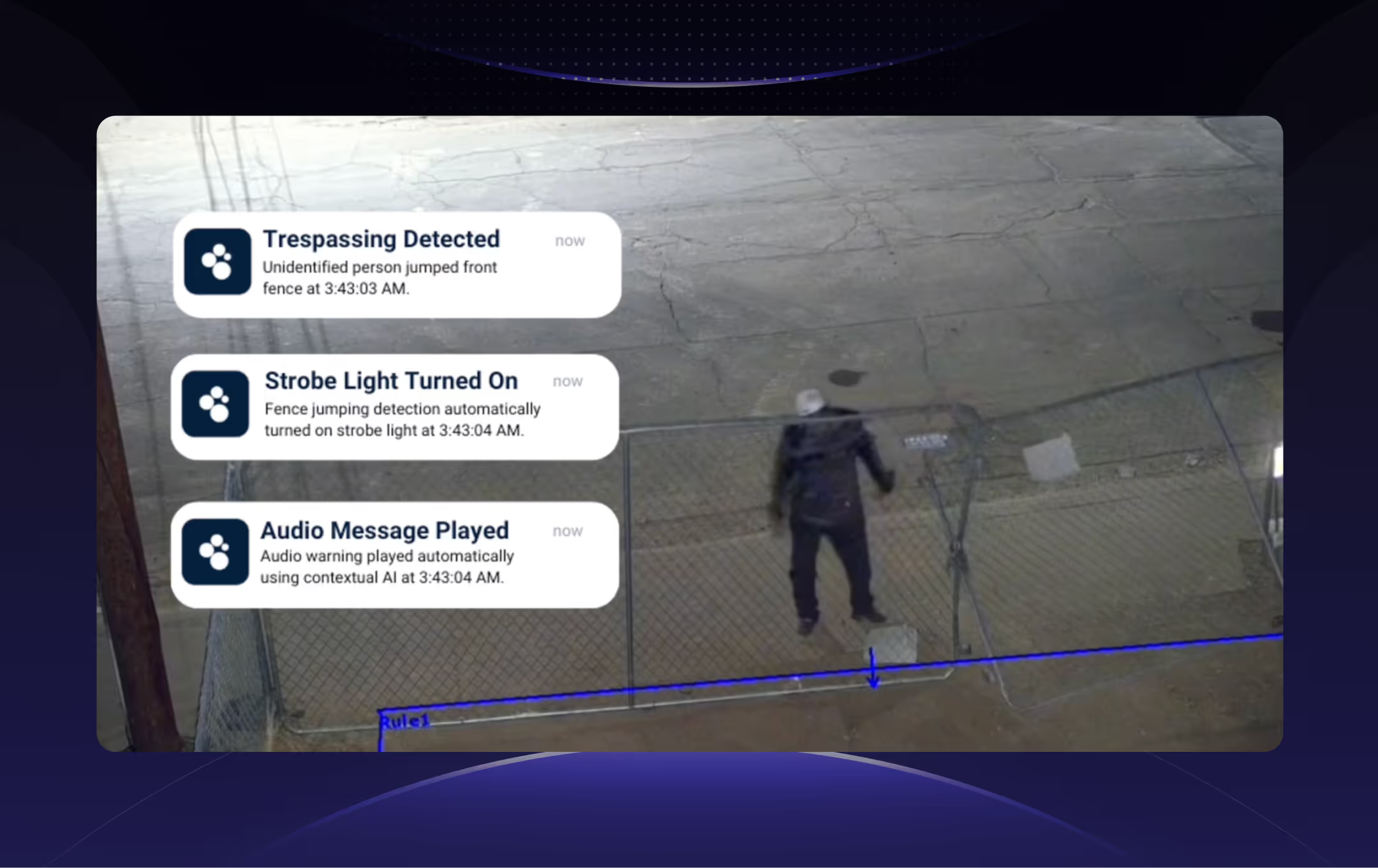
Spot AI differentiates on three fronts: it works with existing cameras (no rip-and-replace), it extends coverage to parking lots and perimeters with automated deterrence (strobes, talk-downs), and it consolidates video, alerts, and case files into a single cloud dashboard. For teams stretched across dozens of stores, that consolidation means covering more locations without adding headcount.
Your next step: from checklist to action
The fastest path from evaluation to lower shrink is a disciplined pilot with clear KPIs and aligned stakeholders. Use this checklist to align your buying committee, shortlist vendors against criteria that matter, and design a pilot that produces defensible data.
If your team wants to see how Spot AI's video AI can extend perimeter coverage and speed up investigations across your store portfolio, request a demo to review key workflows, deployment options, and what it looks like to get live quickly.
See Spot AI in action


"The question was, 'how do we get more out of our existing systems?'. We needed something that could transform our camera system from a passive recording tool into a proactive partner in safety and security."
Mike Tiller, Director of Technology, Staccato
Frequently asked questions
What are the best loss prevention software options for retail
The best option depends on the specific problem you are solving. Transaction monitoring platforms like Flooid's Loss Prevention Engine excel at POS fraud detection. ORC intelligence platforms like Auror connect incidents across stores and support law enforcement collaboration. Video AI platforms like Spot AI extend coverage to parking lots and perimeters with automated deterrence while consolidating alerts and case files into a single dashboard. Most effective deployments layer multiple capabilities rather than relying on a single vendor.
How do loss prevention technologies reduce shrink
Loss prevention technologies reduce shrink by shifting from post-incident review to earlier detection and active deterrence. Video AI identifies suspicious behavior—loitering, coordinated group activity, after-hours trespass—and can trigger automated responses like strobes and talk-downs before theft escalates. Transaction monitoring flags unusual POS patterns such as excessive voids or no-sale drawer opens. RFID tracking identifies where inventory losses occur across the supply chain. Together, these layers address external theft, internal theft, and administrative errors.
What are the costs associated with implementing loss prevention solutions
Costs vary by solution type and scale. Software-only platforms typically run on per-store or per-transaction subscription models. Hardware-intensive solutions like RFID require upfront infrastructure investment plus ongoing tag costs. Implementation services—integration, configuration, training—add to Year 1 expenses. When calculating TCO, include ongoing support, storage, and infrastructure maintenance alongside licensing fees. A phased rollout spreads capital expenditure and reduces financial risk compared to a single enterprise-wide deployment.
What methods are most effective for loss prevention in retail
The most effective approach layers multiple methods. Physical deterrents (improved lighting, open floor plans, perimeter barriers) create psychological barriers. Technology systems (video AI, EBR, RFID) detect and flag incidents in near-real time. Staff training in de-escalation and loss prevention awareness remains essential—trained employees who understand threat patterns and reporting protocols contribute to deterrence that technology alone cannot deliver. The combination of visible deterrence, capable detection, and well-coached teams produces the strongest outcomes.
How long does a typical loss prevention technology pilot take
A well-structured pilot spans several months from infrastructure preparation through evaluation and decision. This includes dedicated phases for hardware deployment and integration testing, configuration and training, active operation, optimization and tuning, and final evaluation. Compressing this timeline risks producing unreliable data. Extending it unnecessarily delays the ROI that justified the investment.
About the author
Sud Bhatija is COO and Co-founder at Spot AI, where he scales operations and GTM strategy to deliver video AI that helps operations, safety, and security teams boost productivity and reduce incidents across industries.

