






Between 2022 and 2025, retail establishments accounted for nearly 25 percent of all workplace homicides in the United States — the highest concentration of any single industry. (Source: Building Security Services) That statistic changes what loss prevention teams are really managing. The job is no longer just about recovering merchandise. It's about keeping people out of harm's way while still maintaining a credible deterrent against theft.
The traditional "approach and engage" model — where LP staff physically confront suspected shoplifters — puts associates directly in the path of escalation. Organized retail crime (ORC) crews are more aggressive. Customers caught stealing react with shame, fear, or hostility. And firearms account for 83 percent of all workplace homicides. (Source: Building Security Services) The takeaway is clear: asking employees to physically intervene creates risk that no amount of recovered merchandise can justify.
This article breaks down how LP teams are resolving that central tension — the mandate to protect inventory and protect people — by making remote deterrence the first response, not a last resort. It covers the regulatory landscape shaping these decisions, the operational frameworks behind effective workplace violence prevention plans, and the role video AI plays in making deterrence scalable across dozens of locations.
Key terms to know
Several concepts appear throughout this article. Defining them upfront helps frame the discussion:
Term | Definition |
|---|---|
Workplace violence prevention plan (WVPP) | A documented system combining governance, training, detection, and response protocols designed to reduce the frequency and severity of violent incidents in a workplace |
De-escalation | Communication-based techniques that reduce the likelihood of a confrontation becoming physical — using calm language, non-threatening body language, and active listening |
Remote deterrence | Automated or centrally managed responses — such as audio talk-downs, strobe lights, and law enforcement alerts — triggered without requiring any on-site employee to physically engage |
ORC (organized retail crime) | Coordinated theft operations, often involving multiple individuals, that target high-value merchandise and may include intimidation or violence to deter employee intervention |
Contextual talk-downs | Situation-specific audio responses delivered through speakers connected to video systems — distinguishing between, say, a delivery driver and an unauthorized person in a restricted area |
Silent panic button | A discreet alert device (wearable or app-based) that notifies security teams without audible signals that could escalate an already volatile situation |
Why the "approach and engage" model is breaking down
The data is unambiguous. The U.S. Bureau of Labor Statistics recorded 458 workplace homicides in 2023 and 524 in 2022 — the highest count since 2011. (Source: Building Security Services) Nearly one in four of those fatalities occurred while the victim was working in a retail setting.
Beyond fatal incidents, the Bureau documented 57,610 nonfatal workplace violence cases requiring time off or job modifications across the 2021–2022 period. (Source: Building Security Services) For LP teams, every confrontation with a suspected shoplifter now carries a measurable probability of escalation — particularly when customers feel cornered, accused, or physically blocked from leaving.
The psychological dynamics compound the risk. When someone is confronted about suspected theft, they frequently experience shame and defensiveness that manifests as aggression. LP personnel who open with accusatory language or blocking tactics can inadvertently trigger fight-or-flight responses. ORC crews add another layer: they deliberately employ intimidation, threats, and physical aggression to deter employee intervention during theft execution.
The result is a widening gap between what LP teams are expected to do (stop loss) and what they can safely do (observe, document, deter). Closing that gap requires a deterrence-first operating model.
What New York's workplace violence laws mean for retail operations nationwide
New York has the most detailed workplace violence prevention requirements for retail, and many national retailers are treating them as the baseline—even in other states.
Earned Safe and Sick Time Act (ESSTA) expansion
The amended ESSTA, effective February 2026, explicitly recognizes workplace violence as a legitimate reason for employees to use protected time off. (Source: Epstein Becker Green) Employees who experience threatening customer interactions now have statutory protection for time needed to report incidents, consult with legal counsel, work with law enforcement, or seek counseling.
Key operational implications for LP teams include:
Employers must provide at least 32 hours of unpaid protected time off available on the first day of employment and the first day of each calendar year.
Employees involved in workplace violence incidents may take leave without standard accrual requirements.
NYC employers must post and distribute updated Notices of Employee Rights in languages spoken by at least 5 percent of the workforce at each location. (Source: Epstein Becker Green)
Healthcare mandates signal what's coming for retail
Governor Kathy Hochul signed Senate Bill 5294B in December 2025, requiring all general hospitals and nursing homes to develop violence prevention programs beginning September 2026. (Source: JJ Keller Compliance Network) The mandate requires annual workplace safety assessments tailored to facility size, complexity, and local geographic factors. While this targets healthcare specifically, it establishes a regulatory template that retail organizations — especially those with pharmacy or clinic operations — should anticipate adopting.
For multi-state retailers, the practical takeaway is clear: building a workplace violence prevention plan that meets New York's standards positions the organization ahead of regulatory expansion in other jurisdictions.
Five pillars of an effective workplace violence prevention plan for retail stores
Across workplace violence prevention frameworks, the same five components show up—and they only work when they're run together. (Source: Second Sight Training Systems)
Pillar | What it covers | Why it matters for LP |
|---|---|---|
Governance and policy | Defined escalation paths, reporting procedures, role clarity across departments, standardized protocols across locations | Without clear governance, employees hesitate during uncertain situations and early warning signs get ignored |
Role-specific training | De-escalation techniques, armed robbery response, ORC awareness — tailored to each employee group's actual risk exposure | Generic training fails to produce behavior change; role-specific content builds muscle memory for realistic scenarios |
Early detection and behavioral awareness | Situational awareness skills, pattern recognition, threat identification abilities | Teams trained in behavioral awareness can identify escalation indicators before violence becomes likely |
Unified visibility across security systems | Integrated video, access control, and alerting systems that share data across locations | Fragmented systems create blind spots and slow response times |
Continuous measurement and refinement | Incident tracking by category, training retention assessments, employee safety perception surveys | Programs that aren't measured don't improve — and unreported incidents remain invisible |
Governance as the backbone
Strong governance means every team member understands their specific responsibilities — from frontline associates recognizing escalation triggers, to managers making containment decisions, to LP leadership coordinating law enforcement response. Without it, reporting channels feel informal, and employees default to individual judgment rather than standardized protocols.
De-escalation training that actually changes behavior
Isolated training events fail to produce sustained behavior change. (Source: Second Sight Training Systems) Organizations should implement quarterly or semi-annual refreshers reinforcing core concepts while introducing scenarios reflecting newly identified risks. Short-form video modules (3–5 minutes) delivered through mobile applications allow repeated review during slower operational periods.
Effective de-escalation for retail LP contexts includes specific techniques:
Open suspected shoplifting conversations with neutral questions rather than accusations — "I noticed you were looking at that product — can you help me understand what happened?" rather than "I saw you put that in your pocket."
Maintain non-threatening body language that respects personal space boundaries.
Avoid blocking physical pathways that could trigger fight-or-flight responses.
Recognize your own emotional responses during tense interactions, since escalating anxiety from LP personnel frequently triggers reciprocal defensive reactions. (Source: Second Sight Training Systems)
How remote deterrence resolves the safety-versus-shrink tension
The core question LP leaders face: how do you maintain a credible deterrent without putting anyone in a confrontation? Remote deterrence answers this by making automated response the first line of action — not a backup plan.
The escalation ladder without human contact
Spot AI's AI Security Guard acts like an always-on teammate—detecting and deterring threats across the perimeter and inside the store. The response follows an intelligent escalation sequence:
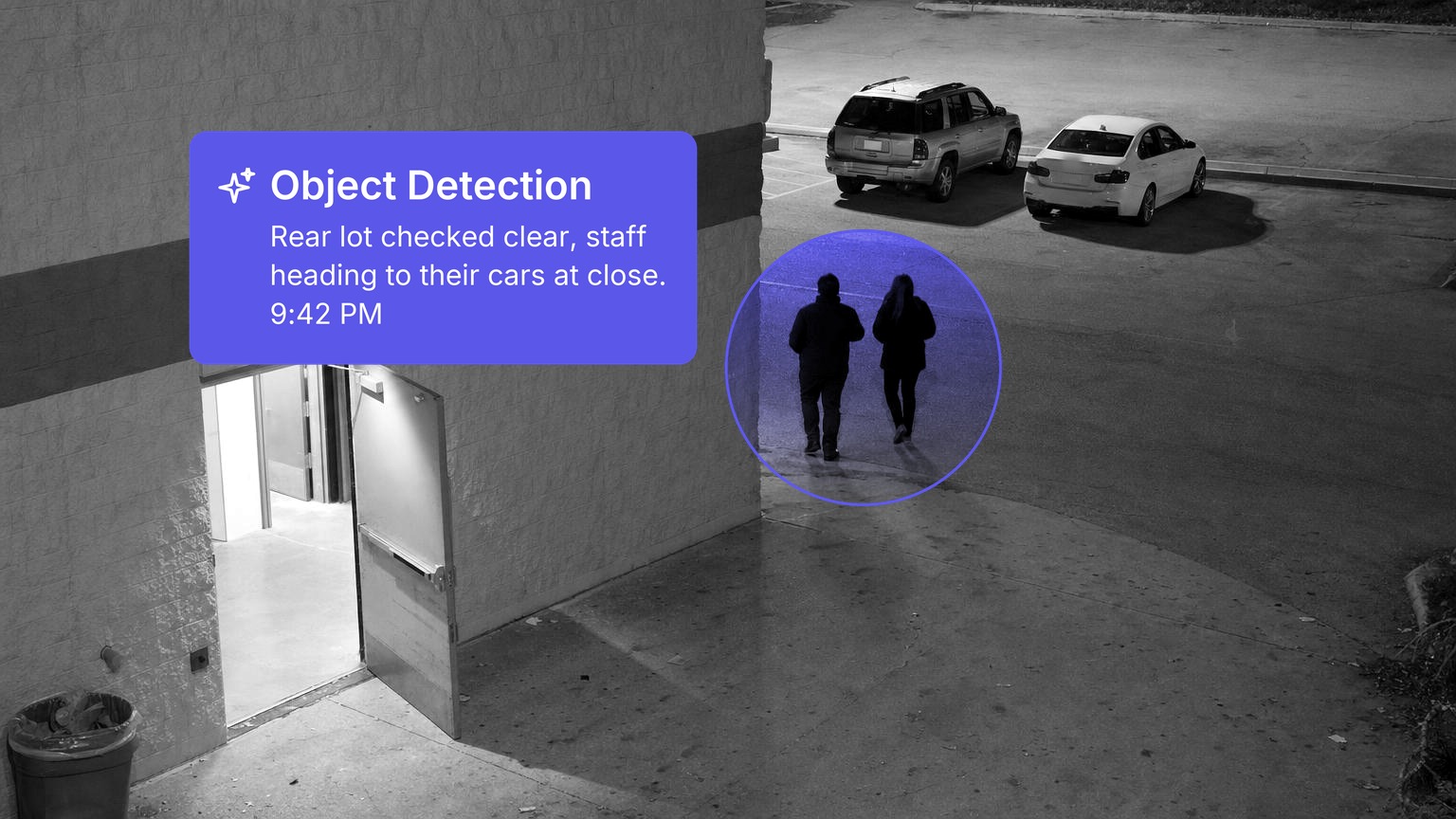
Detection: Video AI identifies behavioral cues — loitering in restricted areas, after-hours motion at back doors, unauthorized access attempts at stockrooms, or suspicious vehicle activity in parking lots.
Context-aware response: Rather than triggering a generic alarm, the system delivers contextual talk-downs — situation-specific audio that mirrors how a trained security professional would respond. A delivery driver at the loading dock gets a different message than an unauthorized person testing a fence line.
Escalation: If the initial deterrent doesn't resolve the situation, the system escalates — activating strobes, issuing firmer verbal warnings, and alerting law enforcement with time-stamped evidence already packaged for dispatch.
No associate needs to approach. No one needs to physically engage. The system creates a visible control presence that deters behavior before it becomes an incident requiring human intervention.
Mapping LP pain points to video AI capabilities
The table below connects the most pressing operational hurdles to specific capabilities within Spot AI's unified video AI platform:
LP pain point | How Spot AI addresses it |
|---|---|
Associates exposed to volatile parking lot confrontations | AI Security Guard detects loitering and suspicious activity at the perimeter, triggering automated deterrence before anyone inside the store is involved |
Blind spots outside store walls that invite ORC reconnaissance | After-hours loitering detection and back door motion alerts cover areas traditional indoor camera systems miss |
Too many stores, not enough LP coverage | Cloud dashboard centralizes live monitoring across locations — one team can cover 30+ stores without adding headcount |
Hours spent scrubbing footage after incidents | Intelligent search with attribute detection (clothing color, vehicle type) reduces investigation time from hours to minutes |
Expensive, inconsistent guard coverage | Automated deterrence delivers 24/7 presence at a fraction of ongoing guard labor costs, with uniform response quality across every site |
False alarms that waste time and erode trust | Context-aware detections distinguish between routine activity and genuine threats, reducing noise so teams focus on what matters |
Covering the perimeter to control what happens inside
ORC teams often conduct multiple reconnaissance visits before executing major thefts — testing response times, studying store layouts, and identifying optimal windows. Perimeter monitoring with video AI identifies these patterns early. When loitering, fence-line testing, or repeated vehicle presence triggers automated deterrence, it disrupts the planning cycle before theft execution begins.
This upstream approach — controlling the parking lot and perimeter to influence in-store outcomes — represents a fundamental shift from recording incidents to reducing their likelihood.
Panic button technology and emergency response integration
Silent panic buttons serve a critical role in situations where audible alarms could worsen circumstances — particularly during armed robbery or aggressive confrontation. (Source: SafetyLine Lone Worker) Wearable devices and mobile panic button applications allow LP personnel to summon assistance while maintaining the appearance of non-threatening engagement.
When integrated with video verification, panic button activations gain operational depth:
Security teams or external monitoring services can visually confirm the incident through connected camera systems before dispatching law enforcement.
Visual verification reduces false alarm costs from accidental button activation.
Arriving officers receive time-stamped video context, improving response accuracy. (Source: Everon Solutions)
Spot AI's camera-agnostic platform works with existing IP cameras, meaning panic button integration doesn't require ripping out current infrastructure. The system can be live in under a week, connecting to the cameras already in place and layering video AI capabilities on top.
Measuring what matters: KPIs for integrated safety and loss prevention
Programs that aren't measured don't get better. LP organizations running workplace violence prevention plans alongside loss prevention operations should track metrics across both domains — and look for the overlap.
Metric category | What to track | Why it matters |
|---|---|---|
Incident frequency | Verbal aggression, threats, physical assault, and property damage — tracked separately by category, location, and time of day | Different incident types respond to different interventions; granular tracking reveals where specific actions generate the greatest impact |
Time-to-detect and time-to-deter | Seconds or minutes from behavioral trigger to automated response | Faster detection and deterrence correlate with fewer escalated incidents |
Investigation time | Hours per case, from incident to evidence package | Reducing review time frees LP teams for higher-value work |
Guard cost reduction | Cost per store per month; overnight coverage hours replaced by automated deterrence | Quantifies ROI in terms executives understand |
Training retention | 30-day and 90-day post-training assessment scores, plus behavioral observation by managers | Single training events don't produce lasting change; retention metrics reveal whether knowledge transfers to real situations. (Source: Symonds Research) |
Employee safety perception | Survey data on whether associates feel adequately trained and supported | Organizations where employees report low safety confidence tend to see higher rates of unreported incidents. (Source: Second Sight Training Systems) |
Considerations and limitations
No technology eliminates risk entirely. Several factors deserve honest acknowledgment:
Camera coverage depends on placement. Video AI analyzes what cameras can see. Blind spots created by poor camera positioning or obstructed sightlines remain blind spots regardless of the software layer.
Automated deterrence reduces likelihood, not certainty. Strobes, audio warnings, and alerts lower the probability of escalation — they don't guarantee it. Human judgment remains essential for high-stakes decisions.
Training requires ongoing reinforcement. A single de-escalation workshop doesn't change behavior under pressure. Quarterly refreshers, scenario-based practice, and manager observation are necessary to sustain results.
Regulatory requirements vary by jurisdiction. New York's framework is the most detailed, but requirements differ across states and municipalities. Organizations should consult legal counsel when building compliance programs.
Integration takes planning. Connecting panic buttons, access control, and video systems into a unified workflow requires coordination between LP, IT, and operations teams — even when the technology itself deploys quickly.
Building a deterrence-first culture across your region
The shift from reactive investigation to active deterrence isn't just a technology decision — it's how LP standardizes response across every store. LP teams that embed remote deterrence into their standard workflows create a measurable safety advantage: fewer confrontations, faster case closure, and a store environment where associates feel protected rather than exposed.
Spot AI's unified video AI platform makes this shift practical across distributed retail operations. The system works with any existing IP camera, deploys in under a week, and delivers 24/7 automated deterrence through the AI Security Guard — so LP teams can cover more stores without adding headcount and keep employees out of volatile situations.
"We can't be everywhere at once. That's where technology becomes crucial - it's not about replacing people, it's about augmenting our capabilities to keep everyone safe."
Kevin, Unique Industries (Spot AI Customer Story)
To see how remote deterrence can work across your stores, request a demo of Spot AI's video AI platform. For real-world examples, explore customer stories from teams using video AI to deter incidents and speed up investigations.
Frequently asked questions
What are the key elements of a workplace violence prevention program
An effective program rests on five pillars: governance and policy frameworks that define escalation paths and reporting procedures; role-specific training tailored to each employee group's actual risk exposure; early detection capabilities including behavioral awareness and situational observation skills; unified visibility across video and security systems; and ongoing measurement through incident tracking, training retention assessments, and employee safety perception surveys. These components work together — a strong policy without training, or training without detection capability, leaves gaps that incidents exploit.
How can retail stores comply with New York's expanded Earned Safe and Sick Time Act
New York's expanded Earned Safe and Sick Time Act requires employers to recognize workplace violence as a legitimate reason for protected time off. Compliance involves providing at least 32 hours of unpaid protected time available from the first day of employment, posting updated Notices of Employee Rights in languages spoken by at least 5 percent of the workforce at each location, and ensuring that employees who experience threatening interactions can access leave without standard accrual requirements. Multi-state retailers benefit from building programs that meet New York's standards as a baseline, since other jurisdictions are trending toward similar requirements.
What training is required for retail employees regarding workplace violence
Training should be role-specific rather than one-size-fits-all. Frontline associates need de-escalation techniques and situational awareness skills. LP personnel require advanced behavioral threat assessment training, armed robbery response protocols, and clear decision frameworks specifying when confrontation should be avoided in favor of observation or law enforcement involvement. Training must be reinforced through quarterly or semi-annual refreshers — single training events do not produce lasting behavior change under operational pressure.
What technologies can enhance employee safety in retail environments
Three technology categories deliver the most impact for retail employee safety: video AI systems that detect behavioral patterns (loitering, unauthorized access, after-hours motion) and trigger automated deterrence responses; panic button systems (wearable or app-based) integrated with video verification so security teams can visually confirm incidents before dispatching law enforcement; and access control systems that track credential usage, flag unusual patterns, and create audit trails for sensitive areas like stockrooms and manager offices.
How can loss prevention strategies reduce the risk of violence during shoplifting incidents
The most effective approach replaces direct confrontation with remote deterrence. Rather than asking LP personnel to physically approach suspected shoplifters — which triggers defensive escalation — organizations use video AI to detect suspicious behavior early and deliver automated responses (audio talk-downs, strobe activation, law enforcement alerts) without requiring any employee to engage. When direct interaction is necessary, de-escalation training teaches personnel to open with neutral questions rather than accusations, maintain non-threatening body language, and avoid blocking exit pathways. Clear organizational policies should establish that employee safety takes absolute priority over merchandise recovery.
About the author
Sud Bhatija is COO and Co-founder at Spot AI, where he scales operations and GTM strategy to deliver video AI that helps operations, safety, and security teams boost productivity and reduce incidents across industries.

