




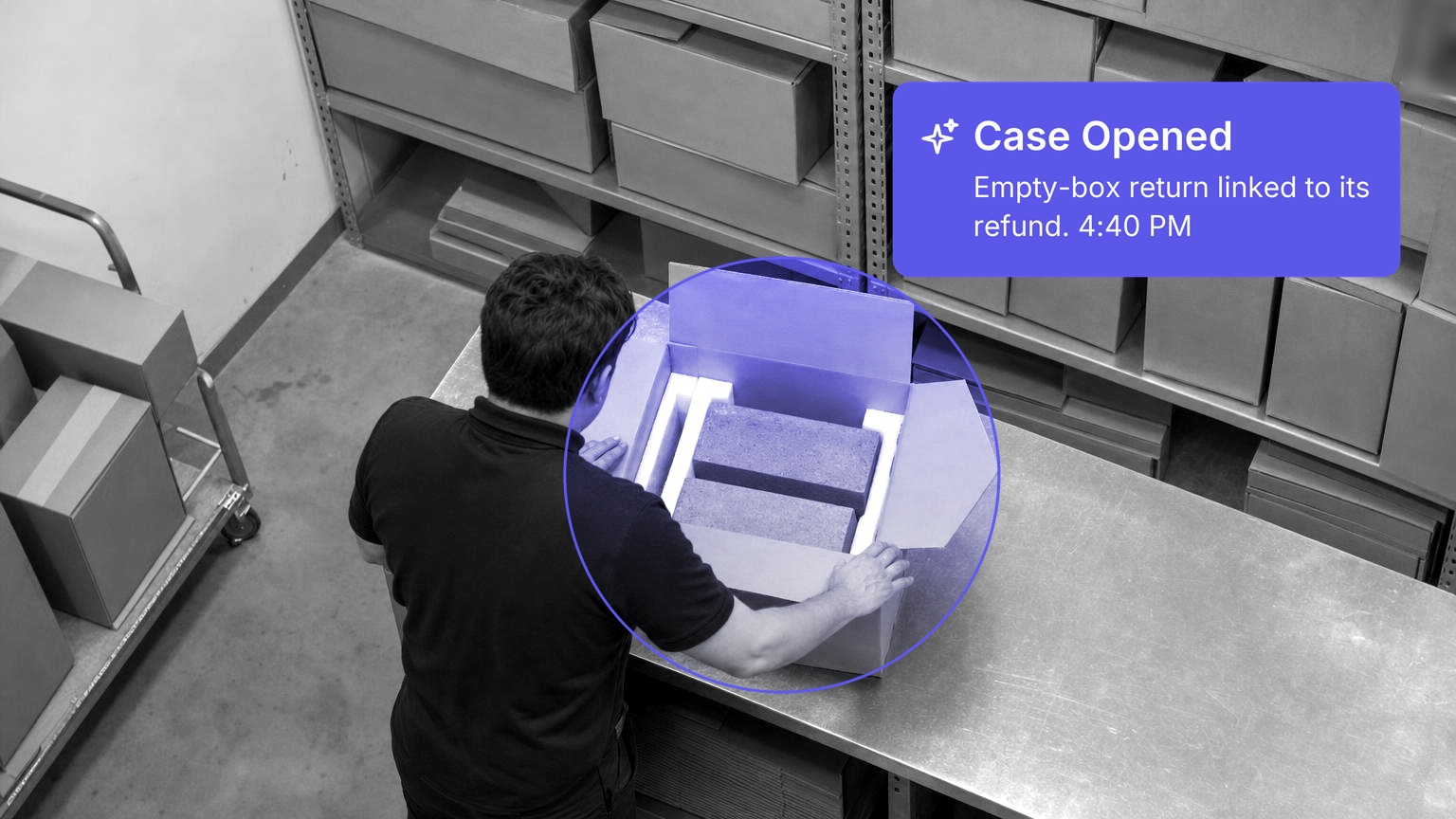


How to detect return fraud and receipt abuse with AI video
Return fraud detection works best when two records are checked against each other: the point-of-sale refund log and the video of what actually crossed the counter. A refund line on its own cannot tell you whether the box was empty, whether the receipt belonged to a different purchase, or whether the refund quietly landed on a gift card. Pairing exception data with video of both the return and the original sale is how loss prevention teams turn a suspicious refund into a resolved case.
The stakes are large. US retail returns are expected to total about $849.9 billion in 2025, and roughly 9% of all returns are fraudulent (Source: National Retail Federation). This guide lays out a buildable method for detecting return and receipt abuse, plus the criteria to judge any approach you evaluate.
Key takeaways
- Return fraud detection starts with exception-based reporting on refund data, then uses video to confirm what the numbers imply.
- The three schemes to model first are empty-box returns, receipt reuse or counterfeit receipts, and refund-to-gift-card conversion.
- Verify both sides of the event: the return at the counter and the original transaction the receipt claims to represent.
- Serial abusers and organized groups drive a large share of the loss, so link cases to people and plates, not single refunds.
- Detection only pays off when it ends in a case-ready, timestamped record you can share, not another spreadsheet.
How return fraud and receipt abuse actually work
Return fraud is a refund a store should never have paid, such as an empty-box return or a reused receipt. Return abuse, by contrast, is behavior a policy technically allows but that still costs money, like wardrobing or bracketing. The line matters because the two need different responses: fraud builds a case, while abuse informs policy. This guide is one piece of a broader convenience and multi-store loss prevention effort, and it stays narrowly on returns and receipts.
Among retailers that track these incidents, the tactics rising fastest are overstated quantity of returns (71%), empty box or "box of rocks" returns (65%), and decoy returns such as counterfeit items (64%) (Source: National Retail Federation). Three schemes deserve a model before anything else.
Scheme | How it works | What the refund log alone shows | What video has to confirm |
|---|---|---|---|
Empty-box or "box of rocks" return | A sealed or weighted box with no usable product, or a substituted item, is returned for a full refund. | A normal refund tied to a receipt. | Whether the associate opened and inspected the box, and what was actually inside. |
Receipt reuse or counterfeit receipt | One valid or forged receipt is used to return items it never covered, often shoplifted or bought elsewhere. | A refund that matches a receipt number. | Whether the original sale on that receipt actually included the item now being returned. |
Refund-to-gift-card conversion | A no-receipt or questionable return is pushed onto a gift card, turning it into near-cash. | A store-credit or gift-card refund. | Who received the card, and whether the same person appears across many such refunds. |
Stolen-tender or organized return | Items bought with stolen cards, or hauls from organized groups, are returned for cash or credit. | A cluster of refunds, sometimes across stores. | The same faces, vehicles, or plates recurring at the counter. |
Refund-to-gift-card conversion deserves extra attention. It is one of the quietest paths because store credit rarely triggers the same scrutiny as cash, yet a gift card is only a step away from cash on a secondary market. Treat it as its own scheme rather than folding it into general no-receipt returns.
What you need before you can detect it
Detection is a system, not a single tool. Before you build triggers, confirm you have the inputs that make a flagged return provable. Key prerequisites are:
- Refund and return data you can query, ideally through exception-based reporting rather than month-end summaries.
- Camera coverage that frames the returns counter, the register, and the customer's hands, not just a wide view of the aisle.
- A retention window long enough to reach back to the original transaction, governed by a clear video retention and chain-of-custody policy.
- A case workflow where clips, receipts, and notes live together instead of scattered across email.
- A written return policy that defines what a verified return requires.
Step 1: Flag the refund with exception-based reporting
Start from the data, not the video. Exception-based reporting scores refund lines against rules and baselines, surfacing the small share of events worth a human look. Build triggers for no-receipt refunds above a set value, repeat refunds to the same card or loyalty member, refunds keyed by one associate near shift open or close, and gift-card refunds on returns without a receipt. The pitfall is a rule that fires on every no-receipt return and buries the team. Tune thresholds so exceptions stay rare and meaningful.
Step 2: Verify the return at the counter on video
Pull the clip tied to the flagged transaction and watch the return itself. Confirm that the box was opened, that the item matches the receipt, and that the refund tender follows policy. Because AI video can jump straight to the moment a refund was keyed, this review takes minutes rather than an afternoon of scrubbing. The pitfall here is coverage: a camera that sees the associate's back but not the counter surface proves nothing. Frame the hands and the product.
Step 3: Verify the original transaction the receipt claims
This is the step most programs skip, and it is where receipt fraud comes apart. Match the receipt to the actual sale it references. With POS data linked to video, you can pull the original checkout and confirm the returned item was on that basket. A reused or counterfeit receipt fails this test, because the sale it points to never contained the item. Without the POS-to-video link you are only comparing paper to paper, so overlaying transaction data on the checkout clip is what closes the loop.
Step 4: Assemble a case and connect repeat offenders
Package the return clip, the original-transaction clip, the receipt, and the exception into one record. Then look for the same person, member ID, or vehicle across cases. Organized groups and serial abusers only become visible once cases are connected rather than filed one at a time, and connecting them is often what moves a single refund into a prosecutable pattern. The pitfall is evidence scattered across inboxes and spreadsheets, which slows law enforcement and weakens the case. Keep everything in one timestamped place.
The same discipline applies to adjacent fraud surfaces. Buy-online-pickup-in-store and curbside orders create their own refund and non-delivery claims, so a returns program should sit alongside your approach to BOPIS and curbside pickup fraud.
Detection triggers and what to verify on video
A short map from trigger to video check keeps reviews consistent across stores. Common pairings are:
Exception trigger | Likely scheme | What to verify on video |
|---|---|---|
No-receipt refund above threshold | Gift-card conversion, stolen goods | Item condition, tender type, and who receives the card. |
Repeat refunds to same card or member | Serial abuse, organized groups | The same individual recurring across dates and stores. |
Refund with receipt but mismatched item | Receipt reuse or counterfeit | The original transaction contents. |
Refund keyed at shift open or close by one associate | Employee refund fraud | Whether a real customer was present at the counter. |
Sealed-box return with an on-the-spot refund | Empty-box or decoy | Whether the box was opened and inspected before the refund. |
How to measure whether return-fraud detection is working
Detection should be judged on a few numbers you can trend, not on the drama of any single catch. Track these measures quarter over quarter:
- Share of refunds flagged as exceptions, which should stay low and stable.
- Average time to review a flagged return, with a target measured in minutes.
- Case closure rate and average case value recovered.
- Repeat-offender identification rate across stores.
- Refund fraud as a share of total refund dollars, trended over time.
Policy and staffing implications
Detection and policy reinforce each other. A return policy that requires a receipt for cash refunds, caps no-receipt store credit, and routes gift-card refunds through a second check removes the easiest targets before video is ever needed. Technology is moving the same direction: 85% of retailers say they employ AI to detect or reduce return fraud, using it to score returns and flag patterns that human staff would miss (Source: National Retail Federation).
The staffing math is not about adding people at the counter. It is about reclaiming hours lost to manual review. When detection runs continuously and surfaces only scored exceptions, a lean loss prevention team can cover more stores without more headcount. That matters because returns are a permanent share of the business, with retailers estimating 16.9% of annual sales were returned in 2024 against $890 billion in total returns (Source: National Retail Federation).
Tools that help
Modern video platforms turn the cameras you already own into AI coworkers that watch the returns counter around the clock. Spot AI's AI Security Guard follows a detect, deter, and document pattern: it flags the refund events that matter and assembles case-ready, timestamped evidence in one connected system. Because the platform is camera-agnostic and works over existing IP cameras, coverage of the service desk extends without a rip-and-replace. Used as the lens for evaluating a program, it helps a team weigh whether their current method actually verifies both sides of a return.
Key terms
- Exception-based reporting: scoring transaction data against rules and baselines to surface the few events worth a human review.
- Empty-box return: returning a sealed or weighted package with no usable product inside.
- Receipt reuse: using one valid or forged receipt to return items it never actually covered.
- Refund-to-gift-card conversion: pushing a questionable refund onto store credit to turn it into near-cash.
The fastest wins come from the triggers that need the least video. A no-receipt refund pushed onto a gift card can be scored the moment it is keyed, so the team reviews a short clip instead of a full shift.
Treat the original transaction as part of every return case. Confirming what the receipt actually bought is what separates a genuine refund from a reused or counterfeit one.
All Star Elite, a retailer with 80 stores, centralized its investigations this way. The company reported cutting cash shrink from 6% to 1% and improving investigation speed by more than 50%, with incident resolution moving from hours to minutes.
"The ability to formalize our incident reporting with Spot AI, keep every case in one database, and attach video directly to those cases has been a game changer."
Andrew Gonzalez, Corporate Director of Loss Prevention and Safety, All Star Elite
Return fraud will not disappear, but it does become visible when refund data and video work together. If you are mapping out a detection program, decide first whether your current method verifies both the return and the original transaction, or only one. See how Spot AI approaches return-fraud detection to compare that pattern against your own.
Frequently asked questions
What is the difference between return fraud and return abuse?
Return fraud is a refund a store should never have paid, such as an empty-box return or a reused receipt. Return abuse, like wardrobing or bracketing, is behavior a policy allows but that still costs money. Fraud builds a case, while abuse informs policy. Close to two-thirds of consumers admit to at least one costly returns behavior (Source: National Retail Federation).
How do you detect an empty-box or receipt-reuse return?
Start with an exception on the refund, then watch the video of the return to confirm the box was opened and the item matched. For receipt reuse, pull the original transaction the receipt references and check whether it ever included the item. Empty-box and overstated-quantity schemes are among the tactics retailers report rising fastest.
Why verify the original transaction instead of just the return?
A refund log and a receipt can both look valid while describing a sale that never happened. Matching the receipt to the actual checkout, using POS data linked to video, is what exposes a counterfeit or reused receipt. Skipping this step lets receipt fraud pass as an ordinary refund.
What role does video play in a return-fraud investigation?
Video converts a flagged exception into proof. It shows the item's condition, the tender used, and who collected the refund, and it links repeat offenders across dates and stores. AI video also shortens review from hours of footage to the minute the refund was keyed.
How do you measure whether return-fraud detection is working?
Track the share of refunds flagged as exceptions, the time to review each one, the case closure rate and value recovered, and refund fraud as a share of refund dollars over time. A healthy program keeps exceptions rare while raising closure rates.
About the author
Dunchadhn Lyons leads Spot AI's AI Engineering team, building real-time video AI for operations, safety, and security, turning video data into alerts, insights, and workflows that cut incidents and boost productivity.