




Best Solink alternatives in 2026
The best Solink alternatives in 2026 are the platforms that go beyond video plus point-of-sale exception reporting and act on retail risk as it happens. Spot AI, Verkada, Eagle Eye Networks, Genetec, Avigilon, Rhombus, and Coram AI each take a different path, so the right choice depends on how much your loss prevention team wants live AI detection, active deterrence, and multi-store visibility. The stakes are high: retail shrink reached $112.1 billion in 2022 (Source: National Retail Federation), and retailers reported an 18% rise in the average number of shoplifting incidents in 2024 versus 2023 (Source: National Retail Federation).
Key takeaways
- Solink is a cloud video management system built around video plus POS exception reporting, and it fits SMB and franchise operators focused on register fraud.
- Teams look beyond Solink when they need AI agents that detect and deter in the moment, not only reports reviewed after a transaction.
- The strongest 2026 alternatives split into cloud video management systems (Eagle Eye Networks, Genetec, Avigilon, Rhombus, Verkada) and AI-native platforms (Spot AI, Coram AI).
- Camera flexibility matters: most alternatives now support third-party ONVIF cameras, so a rip-and-replace is rarely required.
- Spot AI is the software-led, camera-agnostic option whose AI Security Guard acts live through context-aware deterrence and correlates events at the point of sale.
The table below compares eight retail loss prevention platforms on the criteria that decide most evaluations. Every competitor cell reflects each vendor's own current documentation, with "Not publicly specified" where a vendor does not document a capability.
System | Platform and deployment | Camera support | AI and active deterrence | POS and exception reporting | Best for |
|---|---|---|---|---|---|
Spot AI | Software-led video AI, hybrid edge-to-cloud | Any ONVIF IP camera a store already owns | 15+ pre-trained AI agents plus Iris custom builder; AI Talk Down active deterrence (customer-reported) | POS refund-fraud and no-customer-transaction detection | Retail LP teams wanting AI agents that act live across stores |
Verkada | Cloud platform; sells its own cameras | Own cameras; third-party via Command Connector (ONVIF Profile S, RTSP), with documented limits | On-platform analytics; AI-Powered Deterrence beta requires a proprietary camera plus a horn speaker or intercom | Not publicly specified | Single-site and SMB buyers standardizing on one hardware brand |
Eagle Eye Networks | Cloud video management system | Virtually any ONVIF camera, IP and analog | Cloud analytics (intrusion, loitering, line crossing, license plate recognition) | Not publicly specified | Teams wanting cloud analytics on a mixed camera estate |
Genetec | Unified platform; on-premises, cloud, or hybrid | Direct-to-cloud Axis, Bosch, Hanwha, i-PRO; existing cameras via Cloudlink | Unified video, access control, license plate recognition, and analytics | Not publicly specified | Large enterprises consolidating security systems |
Avigilon (Motorola Solutions) | Cloud (Alta) plus on-premises (Unity) | Third-party ONVIF cameras (Axis, Hanwha, Pelco, Vivotek) | AI-powered analytics; access-control-linked video evidence | Not publicly specified | Enterprises with an existing integrator relationship |
Rhombus | Cloud-managed; sells its own cameras plus connectors | Own cameras; third-party via Relay connectors (ONVIF, RTSP) | On-camera AI detections, smart search, license plate recognition | Not publicly specified | Mid-market teams wanting cloud-managed cameras |
Coram AI | Cloud, camera-agnostic | Any ONVIF or RTSP IP camera | Large-model natural-language search; Deep Investigation analyzes footage after the fact | Not publicly specified | Teams prioritizing investigation and video search |
Solink | Cloud video management system | A store's existing cameras | Sidekick AI scheduled scans; exception-based reporting | Video plus POS exception reporting (Toast, Square, NCR) | SMB and franchise operators focused on register exceptions |
Why retailers look beyond Solink
Solink earned its place in retail by pairing camera footage with POS data. Its exception-based reporting flags voids, discounts, refunds, and other suspicious transactions, then links each one to the matching clip so an investigator can confirm what happened at the till. According to its own documentation, Solink is a cloud video management system that works with a store's existing cameras, integrates with more than 300 business tools including POS systems such as Toast, Square, and NCR, and supports 20,000 or more customer locations across 32 countries. For a single-site or multi-unit operator whose main worry is register fraud, that focus is a genuine strength.
Retailers start shopping for alternatives when the job grows past transaction auditing. Three shifts tend to trigger the search. First, loss now spans more than the register: 67% of retailers reported involvement by a transnational organized retail crime group in the past year (Source: National Retail Federation), and shrink has held near a $100 billion problem, reaching a 1.44% rate as a share of sales in one recent NRF measure (Source: National Retail Federation). Second, teams want detection and deterrence that act in the moment rather than a report reviewed later. Third, growing fleets need consistent visibility and analytics across every store, indoors and out. Solink's exception reporting is anchored to transaction events, so buyers who need purpose-built AI agents, live active deterrence, and unified indoor and outdoor coverage often widen the shortlist.
Key terms
- Exception-based reporting: a method that flags unusual POS events (voids, refunds, discounts) and ties each to the matching video clip for review.
- Camera-agnostic: software that works with any standards-based IP camera a business already owns, without forcing a hardware swap.
- ONVIF: an open standard that lets video software and cameras from different makers work together.
- Active deterrence: a system that responds to a detected event in the moment, for example with lights, sirens, or a spoken talk-down, rather than only recording it.
The seven best Solink alternatives in 2026
Each alternative below is described from its own current documentation: what it is, where it is strong, what to weigh, and who it suits. Capabilities that a vendor does not document are marked as not publicly specified.
1. Spot AI
Spot AI is a software-led video AI platform that turns the cameras a store already owns into AI coworkers. It ships 15 or more pre-trained Video AI Agents plus Iris, a builder that creates custom detections from natural language. For retail loss prevention, its AI Security Guard detects intent in context, deters through AI Talk Down, and organizes case-ready evidence, while POS refund-fraud and no-customer-transaction detection tie events to the till.
- Strengths: AI agents that act live, context-aware active deterrence, and a hybrid edge-to-cloud design where full-resolution video stays on-site and only metadata crosses the network.
- Considerations: teams fully invested in a single hardware brand may need to confirm ONVIF compatibility for older cameras.
- Best for: retail LP and AP teams that want AI detection and deterrence across many stores, indoors and out.
2. Verkada
Verkada is a cloud platform that sells its own cameras and centralizes management in Verkada Command. Its Command Connector is an ONVIF Profile S conformant client and can ingest RTSP feeds, which lets teams bring existing cameras onto the platform, though Verkada documents some limits in analytics, alerting, camera maintenance, and network reliability for those third-party feeds.
- Strengths: a polished cloud experience and analytics that Verkada states reduce investigations from hours to minutes.
- Considerations: its AI-Powered Deterrence, in public beta, requires Verkada proprietary cameras plus specific audio hardware such as a horn speaker or intercom; POS exception reporting is not publicly specified.
- Best for: single-site and SMB buyers who prefer to standardize on one vendor's hardware.
3. Eagle Eye Networks
Eagle Eye Networks is a cloud video management system with a camera-agnostic stance. It captures video and analytics from virtually any ONVIF-conformant camera and works with both IP and analog cameras, so a store rarely has to replace what it has.
- Strengths: broad camera compatibility and cloud analytics such as intrusion detection, loitering, line crossing, and license plate recognition; basic analytics are available at no added tier and object counting and plate recognition are offered per camera.
- Considerations: active deterrence and POS exception reporting are not publicly specified, so LP teams that need till-level correlation should confirm the integration path.
- Best for: teams that want cloud analytics layered onto a mixed camera estate.
4. Genetec
Genetec Security Center is a unified physical security platform that combines video, access control, license plate recognition, intrusion detection, and analytics. It deploys on-premises, in the cloud through Security Center SaaS, or as a hybrid, and its Cloudlink appliances connect existing cameras to the cloud.
- Strengths: deep unification across security systems and direct-to-cloud support for Axis, Bosch, Hanwha, and i-PRO cameras.
- Considerations: the platform is enterprise-grade and integrator-led, which can mean a longer path to value; retail POS exception reporting and live active deterrence are not publicly specified.
- Best for: large enterprises consolidating video, access, and analytics on one platform.
5. Avigilon (Motorola Solutions)
Avigilon, part of Motorola Solutions, offers a security suite with the cloud-native Avigilon Alta and the on-premises Avigilon Unity. Alta supports third-party ONVIF cameras such as Axis, Hanwha, Pelco, and Vivotek, and also offers Avigilon Ava cameras and Alta Cloud Connectors for cameras without on-board analytics or storage.
- Strengths: AI-powered analytics, access-control-linked video evidence, and a wide integrator channel.
- Considerations: the breadth can add complexity, and retail POS correlation and live active deterrence are not publicly specified.
- Best for: enterprises with an established integrator relationship that want cloud and on-premises options.
6. Rhombus
Rhombus is a cloud-managed video security platform. It sells its own cameras and offers Relay connectors that use ONVIF and RTSP to bring third-party cameras onto the Rhombus console, which supports a gradual migration rather than a full swap.
- Strengths: a clean cloud console, an open API with 50 or more native integrations, and on-camera AI detections including people and vehicle detection, smart search, and license plate recognition.
- Considerations: POS exception reporting and live active deterrence are not publicly specified, so retail LP correlation would need validation.
- Best for: mid-market teams that want cloud-managed cameras with solid search.
7. Coram AI
Coram AI is a cloud, camera-agnostic platform that works with any ONVIF or RTSP IP camera. Its analytics center on large vision and language models, with natural-language video search and retail operational insights such as occupancy tracking, queue detection, and heat mapping. Coram raised a $35M Series B in June 2026 and names retail among its target segments.
- Strengths: strong natural-language search and Deep Investigation, an autonomous agent that reviews months of footage and logs to produce a report.
- Considerations: Coram frames Deep Investigation as after-the-fact analysis, and live active deterrence and POS exception reporting are not publicly specified.
- Best for: teams that prioritize investigation and search over in-the-moment response.
How to choose a Solink alternative
Loss prevention leaders can narrow the field quickly by scoring each platform against the criteria that move shrink and investigation numbers. Weigh these five in order:
- Detection model: does the platform run purpose-built AI agents, or does it depend on transaction exceptions and manual review?
- Response in the moment: can it deter an incident live through talk-down, lights, or sirens, or does it only document what already happened?
- POS correlation: does it tie video to till events for refund, void, and discount fraud out of the box?
- Camera flexibility: will it run on the ONVIF cameras you already own, indoors and out, without a rip-and-replace?
- Scale and architecture: does it give consistent analytics across every store, and does full-resolution video stay on-site to protect bandwidth and PCI scope?
Score alternatives on live response, not just reporting. Cloud video management systems and investigation-first tools are strong at documenting an event after it happens, while an AI-agent platform can call a person out and escalate as the event unfolds. That difference shows up directly in shrink and case-resolution numbers.
The Spot AI recommendation for retail loss prevention
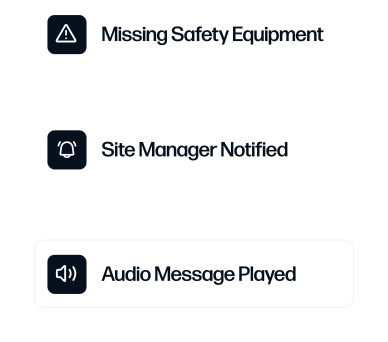
For retail LP and AP teams, Spot AI is the alternative that most directly closes the gap between reporting and response. Its AI Security Guard detects intent in context, deters in the moment through AI Talk Down that addresses a person by clothing and behavior, and turns each event into organized, timestamped evidence. Because Spot AI is software-led and camera-agnostic, it runs on the ONVIF cameras a store already owns, and its edge-first design keeps full-resolution video on-site so only metadata crosses the network, which keeps deployments PCI-clean and light on bandwidth. Spot AI is NDAA-compliant and SOC 2, and it does not use biometric identification.
The outcomes are customer-reported. All Star Elite, a retailer running 80 sports apparel stores, reduced cash shrink from 6% to 1%, cut merchandise shrink from a range of 10 to 15% to about 6%, and improved investigation efficiency by more than 50% after moving to Spot AI. See how the two platforms line up on the same criteria in the Spot AI versus Solink comparison.
"Within four minutes of the alarm going off, Spot AI gave us video footage of the incident on the responding officers' phones. We had five recoveries within the hour."
Josh Bowlin, IT Director, Don Franklin Family of Dealerships
To go deeper on the mechanics, the guide to exception-based reporting and AI camera systems explains how modern detection improves on transaction-only review, and the piece on an open API for connecting video AI with retail POS systems covers till-level correlation. For fleet-wide selection, see the guide to enterprise video monitoring and how Spot AI approaches BOPIS and curbside pickup risk. A full overview of the platform lives on the Spot AI product page.
Shortlist two or three platforms, then run a proof of value on your own video. Score each on the five criteria above, especially live response and POS correlation, so the decision rests on measured shrink and investigation results rather than a feature list.
Ready to see how AI agents detect and deter at the shelf and the register across your stores? Book a demo and Spot AI will run it on your existing cameras.
Frequently asked questions
What are the best alternatives to Solink in 2026?
The strongest alternatives are Spot AI, Verkada, Eagle Eye Networks, Genetec, Avigilon, Rhombus, and Coram AI. Cloud video management systems suit teams that want analytics on existing cameras, while AI-native platforms such as Spot AI add agents that detect and deter in the moment. The best fit depends on your need for live response, POS correlation, and multi-store scale.
Why do retailers look for alternatives to Solink?
Solink is built around video plus POS exception reporting, which is strong for register fraud. Retailers widen the search when loss spreads beyond the till, when they want detection and deterrence that act as an event unfolds, and when a growing fleet needs consistent analytics across every store, indoors and out.
What is the difference between Solink and an AI-native platform like Spot AI?
Solink flags suspicious transactions and links them to video for review after the fact. Spot AI runs pre-trained AI agents that detect intent in context and deter live through AI Talk Down, then organize timestamped evidence. Spot AI also ties events to the point of sale through refund-fraud and no-customer-transaction detection.
Which Solink alternative is best for multi-store retail loss prevention?
For multi-store loss prevention, an AI-agent platform that scales in software tends to fit best because it gives consistent detection and deterrence across locations without per-site hardware projects. Spot AI is camera-agnostic and edge-first, so it runs on existing cameras and keeps full-resolution video on-site while unifying visibility across stores.
Do these Solink alternatives work with existing cameras?
Most do. Spot AI, Eagle Eye Networks, and Coram AI are camera-agnostic and work with ONVIF cameras, and Verkada, Genetec, Avigilon, and Rhombus support third-party cameras through connectors or direct-to-cloud paths. Confirm ONVIF or RTSP support for older models before you buy.
About the author
Sud Bhatija is COO and Co-founder at Spot AI, where he scales operations and GTM strategy to deliver video AI that helps operations, safety, and security teams boost productivity and reduce incidents across industries.






.png)
.png)
.png)
.svg)