




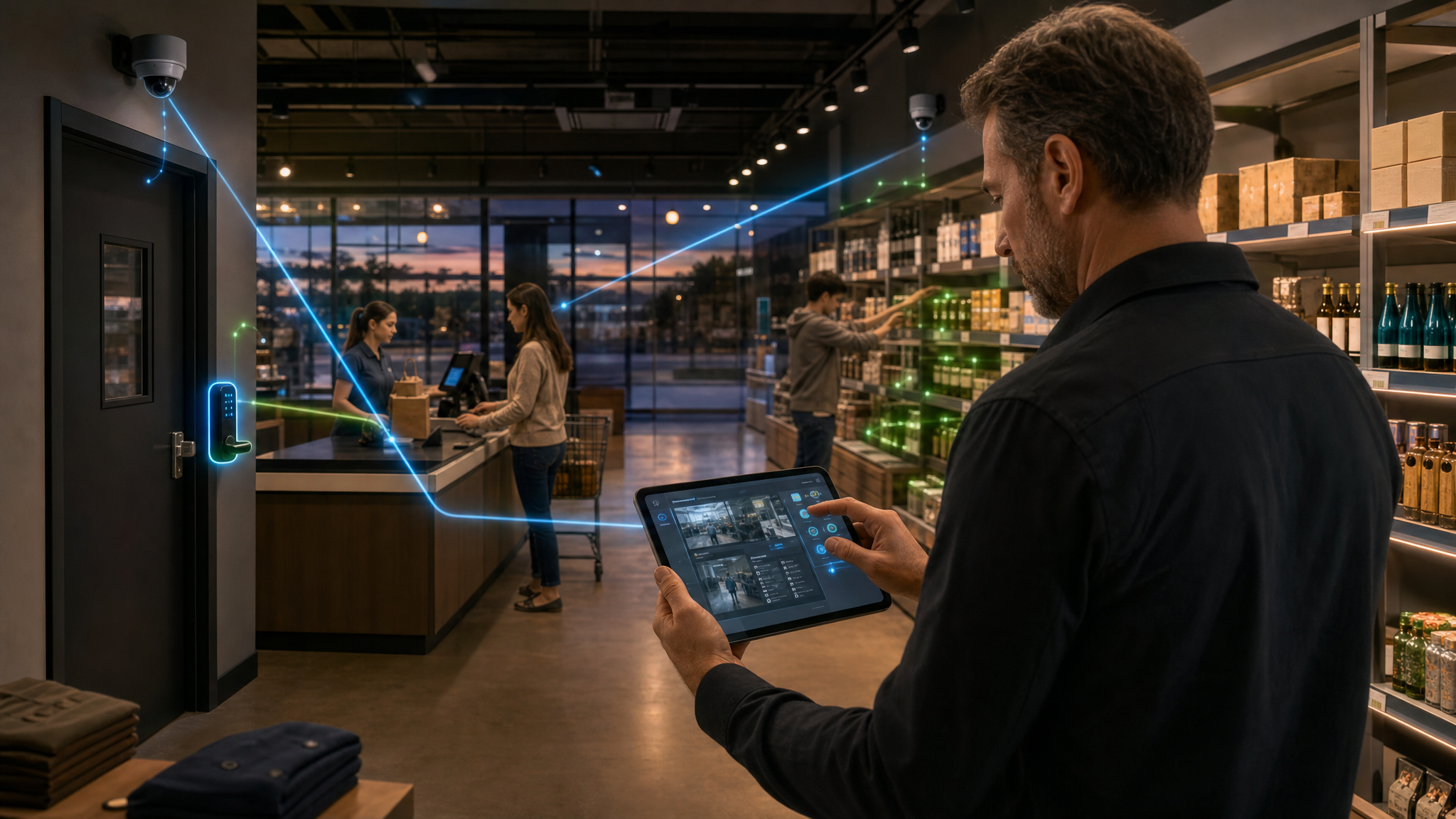


How to integrate facial recognition access control with Video AI, POS, and inventory in 2026
Loss prevention leaders are weighing a real decision: should facial recognition access control sit at the center of your shrink-reduction stack, or function as one signal inside a broader, camera-agnostic Video AI system? The stakes are concrete. Retailers saw a 93 percent increase in the average number of shoplifting incidents per year in 2023 compared with 2019, along with a 90 percent rise in dollar loss (Source: NRF). Meanwhile, roughly 60 percent of organizations are moving toward hybrid-cloud deployments in physical security (Source: Security Magazine). This guide helps you frame the choice, compare architectures, and define evaluation criteria before you sign anything.
Key takeaways
- Treat facial recognition access control as one signal, not the whole strategy. The stronger operating model reasons across access events, video, POS exceptions, and inventory data.
- Connect access events to four data sources for shrink investigations: AI-analyzed video, POS transactions, inventory movements, and staff incident reports.
- Hybrid architectures suit multi-store retail best, keeping real-time door decisions local while centralizing analytics and case review across sites.
- Reserve facial recognition for high-risk zones and supportive jurisdictions, using badges, PINs, or mobile credentials where the risk does not justify biometric governance.
- Privacy is a core evaluation criterion. The FTC's 2023 Rite Aid order shows what happens when notice, retention, and oversight are missing.
Why standalone access alerts fall short for loss prevention
Most retail security stacks were assembled one tool at a time. Access control logs live in one system, POS exceptions in another, and inventory adjustments in a third. When a stockroom door opens at 2:14 p.m., the access log records who entered. It tells you nothing about what happened next.
That fragmentation slows every investigation. The National Retail Federation describes organized retail crime as criminal enterprises directing large-scale theft of merchandise for resale, which means investigators must reconstruct a sequence of actions across systems (Source: NRF). A door opening, merchandise removal, a skipped or fraudulent transaction, and an eventual inventory write-off rarely sit in the same place. Pulling them together by hand burns the hours your team does not have.
The fix is not a bigger pile of alerts. It is connected context. When access events feed into a Video AI system that already reasons over what your cameras see, an isolated door log becomes a time-stamped narrative: who entered, what they did, and whether it lines up with transaction and inventory data.
Where facial recognition access control actually fits
Facial recognition access control uses a person's facial features as a credential to grant or deny entry, or to flag a watch-listed individual at a door. It is a high-assurance method because it binds an access event to a specific person rather than a borrowed badge or shared PIN.
Research from the ECR Retail Loss working group found that more than ten retailers in the UK and USA deployed facial recognition for watch-list monitoring, reporting around 99 percent accuracy when machine algorithms work alongside trained human reviewers, with alerts delivered to staff within 7 to 10 seconds of a watch-listed individual entering a store (Source: ECR Retail Loss). Those same retailers observed reduced incidents and shrink, largely because repeat and prolific offenders avoided stores equipped with the technology (Source: ECR Retail Loss).
That is a strong result. It also has limits. ECR notes adoption is uneven across jurisdictions, with some European countries banning retail use and North American regulators scrutinizing deployments (Source: ECR Retail Loss). So the practical question is not "should we adopt biometrics everywhere," but "where does identity-bound access earn its governance cost, and where do simpler credentials work fine?"
Key terms
- Facial recognition access control: An access method that uses a person's facial features as a credential to grant entry or to flag a watch-listed individual at a door.
- Video AI: Software that reasons over camera feeds to detect people, behaviors, and context such as loitering, restricted-area entry, and dwell time, then triggers alerts or actions.
- Case-ready evidence: Verified, time-stamped video and event data organized so an investigator or law enforcement partner can review an incident without manual searching.
- Hybrid edge-to-cloud: An architecture that keeps full-resolution video and latency-sensitive decisions on-premises while sending only metadata to the cloud for analytics and multi-site visibility.
When to choose facial recognition over badges, PINs, or mobile credentials
A layered access strategy beats a single universal method. Badges, PINs, and mobile credentials handle general employee entrances and low-risk stock areas at lower cost and with fewer privacy implications. Facial recognition or other biometrics earn their place where the consequences of misuse are high.
Three conditions point toward facial recognition access control:
- Identity assurance is critical, because borrowed badges or shared PINs would let internal collusion slip through (cash rooms, controlled-substance areas, high-value electronics storage).
- The potential impact of unauthorized access is large, whether measured in shrink or staff safety.
- Local laws and your organization's values support biometric processing with proper consent and transparency.
When those conditions do not all hold, layered non-biometric methods are usually the right call. The goal is risk-based deployment, not blanket biometric coverage.
What data to connect to access events for faster shrink investigations
An access event alone rarely explains a loss. To turn a door log into an investigation, connect it to four categories of data:
- Video context: AI-analyzed footage of who entered, their dwell time, path, and interactions with merchandise. Modern analytics classify motion and reduce false alarms by focusing on relevant behaviors (Source: Security Magazine).
- POS transactions: Voids, refunds, no-sales, discount abuse, returns, and cash-handling exceptions within the relevant time window.
- Inventory movement: Cycle count discrepancies, adjustments, vendor activity, and high-value SKU movement after the access event.
- Incident reports: Staff-documented events that justify watch-list entries and preserve evidence appropriately.
Stitch these under a single incident identifier and the picture sharpens. A facial recognition match at a stockroom door at 14:03, linked to footage of the individual entering and exiting, paired with POS data showing no legitimate transaction and inventory logs flagging discrepancies for specific SKUs, becomes a coherent, time-stamped narrative. That is the difference between a raw alert and case-ready evidence. Spot AI's Video AI platform and its AI Security Guard are built to reason across these signals rather than dump more alerts on your team.
Comparing access control architectures for multi-store retail
For chains, architecture shapes how easily you investigate across sites. The three common approaches trade off differently against your priorities.
| Criterion | On-prem | Cloud | Hybrid (Spot AI approach) |
|---|---|---|---|
| Multi-site visibility | Limited; cross-site review often needs manual consolidation | Strong central dashboards across stores | Strong central view with local control where needed |
| Latency for door decisions | Low; decisions stay local | Depends on connectivity | Low; real-time decisions run at the edge |
| Data governance | Full local control of data | Depends on provider controls and residency | Full-resolution video stays on-prem; only metadata leaves the building |
| Scalability and rollout | Heavier per-site hardware and setup | Fast to expand to new sites | Camera-agnostic, no rip-and-replace, most sites live in days |
Roughly 60 percent of organizations are now moving toward hybrid-cloud physical security deployments precisely because it balances scalability with local control (Source: Security Magazine). For multi-store retail, that often means real-time facial recognition and Video AI inference run locally, while watch-list synchronization and cross-site analytics happen centrally. Spot AI's hybrid edge-to-cloud design keeps full-resolution video in the facility and sends only metadata across the network, which keeps deployments fast, secure, and PCI-clean.
Open and camera-agnostic versus closed hardware ecosystems
The access control market is forecast to grow from roughly 13.4 billion USD in 2024 to 34.1 billion USD by 2035, which signals a steady stream of new tools and vendors over the decade (Source: MarketResearchFuture). That growth makes integration flexibility a survival skill. Proprietary, hardware-only deployments can increase lock-in and slow your ability to add new analytics later.
A camera-agnostic approach works with the IP cameras you already own, so there is no rip-and-replace, and it connects access control, POS, and inventory systems through open APIs and event streams. Spot AI is camera-agnostic across Avigilon, Pelco, Axis, Hanwha, and any ONVIF camera, with open APIs and webhooks to tie access events to transactions and inventory records. Pair that with the AI Operations Assistant for store-level visibility, and you keep the freedom to add signals as your program matures.
Privacy, consent, retention, and governance you cannot skip
Facial recognition carries heightened regulatory expectations. In December 2023, the U.S. Federal Trade Commission settled with Rite Aid and prohibited the retailer from using facial recognition for surveillance purposes for five years, after charging that the company failed to implement reasonable procedures and prevent harm across hundreds of stores (Source: FTC). The order required deletion of images and algorithms, consumer notice, structured complaint handling, independent assessments, and executive-level accountability (Source: FTC).
Use that order as a template. Strong governance for any biometric deployment should include:
- Clear, conspicuous signage notifying customers and staff that facial recognition is in use.
- Incident-based justification for every watch-list entry, with tiered notification scopes by risk level.
- Time-bound retention policies with periodic reviews to remove entries no longer needed.
- Role-based permissions, audit trails, and a defined process for false positives and complaints.
- Executive oversight and independent assessment of the security program.
ECR retailers that deployed facial recognition with clear signage reported no significant public complaints or sales declines, which suggests transparency can ease privacy concerns when the program is well governed (Source: ECR Retail Loss).
Evaluation criteria for your connected loss prevention stack
Before you select technology, score each option against criteria that map to your KPIs:
- Integration depth: Documented APIs and event streams that link access events to POS exceptions and inventory records.
- Alert quality: Analytics that reduce false alarms and rank cases by time, proximity to high-value inventory, and prior incident history (Source: Security Magazine).
- Architectural flexibility: Support for hybrid deployment and both legacy and cloud POS or inventory systems.
- Multi-site administration and evidence search: Centralized case review with fast, time-stamped video retrieval.
- Privacy controls: Role-based access, audit logs, consent mechanisms, and configurable retention.
- Implementation and total cost: Camera-agnostic options reduce lock-in versus proprietary hardware ecosystems.
- Measurable shrink KPIs: Baseline shrink, target reductions, and built-in reporting to track outcomes.
One Spot AI customer, All Star Elite, shows what a connected approach can do. The team cut cash shrink from 6 percent to 1 percent and improved investigation speed by 50 percent using Spot AI, while formalizing incident reporting and centralizing cases in one database with attached video evidence.
"The ability to formalize our incident reporting, have all our cases on one database, and attach videos to those cases has been a game changer. Cameras, case management, and people counting, it's great having that all in one system."
Andrew Gonzalez, Corporate Director of Loss Prevention and Safety, All Star Elite
You can read more in the Spot AI customer stories.
See how a connected approach compares
If you are mapping where facial recognition access control fits against a broader Video AI stack, start by seeing how connected investigations work in practice. Explore how Spot AI's Video AI platform turns the cameras you already own into AI coworkers that link access events, POS exceptions, and inventory context into case-ready evidence, then compare that model against the criteria above.
Frequently asked questions
What is facial recognition access control, and how does it work in retail
Facial recognition access control uses a person's facial features as a credential to grant or deny entry, or to flag a watch-listed individual at a door. In retail, it commonly governs back-of-house spaces like stockrooms and cash rooms, or it sends staff alerts when a known repeat offender enters. ECR retailers report around 99 percent accuracy when algorithms work with trained human reviewers, with alerts in 7 to 10 seconds (Source: ECR Retail Loss).
How can retailers integrate facial recognition access control with Video AI, POS, and inventory systems
Publish access events into a shared event stream that Video AI, POS, and inventory tools can subscribe to. A door event then triggers AI analysis of nearby footage, flags POS exceptions in the same time window, and links inventory adjustments under one incident identifier. Camera-agnostic platforms with open APIs make this practical without rip-and-replace.
When should a team use facial recognition instead of badges, PINs, or mobile credentials
Reserve facial recognition for high-risk zones where identity assurance is critical, the impact of unauthorized access is large, and local law supports biometric processing. For general employee entrances and low-risk stock areas, badges, PINs, or mobile credentials usually deliver enough control at lower cost and with fewer privacy implications.
How do cloud, on-prem, and hybrid architectures compare for multi-store retail
On-prem offers local control but makes cross-site investigations harder. Cloud centralizes visibility but depends on connectivity for door decisions. Hybrid keeps real-time decisions and full-resolution video local while centralizing analytics, which is why roughly 60 percent of organizations are adopting it (Source: Security Magazine).
What privacy and governance requirements apply before deploying facial recognition
Provide clear signage, justify each watch-list entry from a documented incident, set time-bound retention, and maintain role-based access with audit trails. The FTC's 2023 Rite Aid order shows the cost of skipping these steps, mandating deletion, consumer notice, independent assessments, and executive accountability (Source: FTC).
About the author
Dunchadhn Lyons is Director of AI Engineering at Spot AI. Dunchadhn Lyons leads Spot AI’s AI Engineering team, building real-time video AI for operations, safety, and security—turning video data into alerts, insights, and workflows that cut incidents and boost productivity.

