






The pressure to deliver continuous improvement in manufacturing often feels like searching for a needle in a haystack. You know process waste, hidden bottlenecks, and safety risks exist on the factory floor, but identifying them requires being everywhere at once. Traditional methods—manual Gemba walks, retrospective data analysis, and reactive firefighting—leave continuous improvement leaders operating with substantial blind spots.
Video AI agents change this dynamic by turning existing camera infrastructure into AI-powered tools. Instead of passively recording footage that is rarely reviewed, these systems analyze production environments 24/7. They provide timely data to improve Overall Equipment Effectiveness (OEE), support Standard Operating Procedure (SOP) adherence, and help mitigate safety incidents without adding to their administrative workload.
This guide explores how video AI agents help manufacturing leaders shift from reactive problem-solving to proactive optimization, leveraging computer vision to deliver measurable improvements in quality, safety, and operational efficiency.
Key terms to know
Video AI agents: Intelligent software that continuously analyzes video feeds to detect specific events, anomalies, or behaviors (like a person entering a no-go zone or a machine stopping) and triggers real-time alerts or workflows.
Computer vision: A field of artificial intelligence that enables systems to derive meaningful information from digital images, videos, and other visual inputs, allowing them to "see" and interpret the physical world.
Edge computing: Processing data near the source of generation (e.g., on the factory floor) rather than sending it to a centralized cloud, ensuring low latency and real-time decision-making.
Gemba walk: A fundamental Lean manufacturing practice where leaders go to the actual place where work is done (the "Gemba") to observe processes and identify opportunities for improvement.
Moving from reactive firefighting to anticipatory control
For many innovation and continuous improvement leads, the day begins with addressing issues that happened during the previous shift. Equipment failures, quality defects, or safety incidents are often discovered hours after the fact. This reactive cycle makes it difficult to implement sustainable improvements.
Video AI agents address this by providing more consistent visibility. Unlike human inspectors who experience fatigue, AI systems can continuously monitor production lines for defects and process deviations. This capability helps minimize the "data blind spots" that affect traditional operations.
How video AI maps to continuous improvement hurdles
Operational hurdle | Traditional method | Video AI solution |
|---|---|---|
Data blindness | Manual Gemba walks provide only snapshot views. | 24/7 monitoring helps capture more process variations and bottlenecks. |
Reactive culture | Investigating incidents hours or days after they occur. | Real-time alerts allow for rapid intervention before waste compounds. |
SOP compliance | Spot checks that cannot verify consistency across all shifts. | Automated detection of deviations, such as "Forklift enters no-go zones". |
Slow cycles | Root cause analysis takes weeks due to lack of evidence. | Swift historical search accelerates problem-solving and validation. |
Automating quality control and defect detection
Quality control represents the primary application for video AI in manufacturing. The goal is to maintain high First Pass Yield (FPY) while minimizing the cost of inspection. Computer vision systems can process visual data significantly faster than human inspectors and maintain high accuracy rates in well-deployed systems.
Capabilities of AI-powered inspection
Investigating quality issues: Video intelligence allows teams to quickly search and review footage of the production process to identify the root cause of surface defects like scratches, dents, or discolorations found by human inspectors.
Assembly verification: Object detection models confirm the presence and correct alignment of components, ensuring products meet specifications before moving down the line.
Zero-training inspection: Advanced Large Language Models (LLMs) like Amazon Nova Pro can identify defects without specialized training datasets, adapting to product variations through natural language prompts.
The real-world impact is considerable. Leading electronics and automotive manufacturers have automated quality assurance with AI-powered vision systems, achieving a significant drop in defect rates across their production floors.
Improving maintenance awareness and reducing downtime
Unplanned downtime is a major killer of OEE. Video AI provides the visual evidence needed for maintenance teams to investigate the root cause of downtime events more quickly. By analyzing visual indicators—such as unusual movement patterns or visible changes in equipment behavior—AI agents can flag anomalies that may require attention.
Benefits of video-based anomaly detection for maintenance teams
Early anomaly detection: Edge-based video systems analyze visual data to establish baseline "normal" behavior, alerting maintenance teams to deviations soon after they occur.
Maintenance planning: Surfacing issues earlier can help teams address problems before they escalate and plan interventions to avoid bigger failures.
Operational impact: Some manufacturers report minimized maintenance costs and downtime with improved anomaly detection and faster response; results vary by site and setup.
Digitizing the Gemba walk and operational visibility
The traditional Gemba walk is essential but time-consuming. It also suffers from observation bias—processes often run differently when a manager is watching. Video AI digitizes this concept, providing a more consistent, continuous view of operations that helps reveal hidden waste.
Uncovering hidden process waste
Changeover optimization (SMED): Video AI provides visual confirmation of external setup activities, ensuring materials and personnel are ready before the machine stops.
Bottleneck identification: Analytics detect inefficient movement patterns, excessive waiting times, and "Vehicle Absent" scenarios that indicate underutilized resources.
Cycle time analysis: By measuring the actual time between process steps across thousands of cycles, leaders can identify micro-stops and variances that manual timing misses.
Integrating live scheduling with video monitoring allows for tighter coordination between teams. For high-mix manufacturing environments, this visibility is critical for addressing the "Six Big Losses" associated with OEE, particularly setup and adjustment losses.
Enhancing safety and SOP compliance
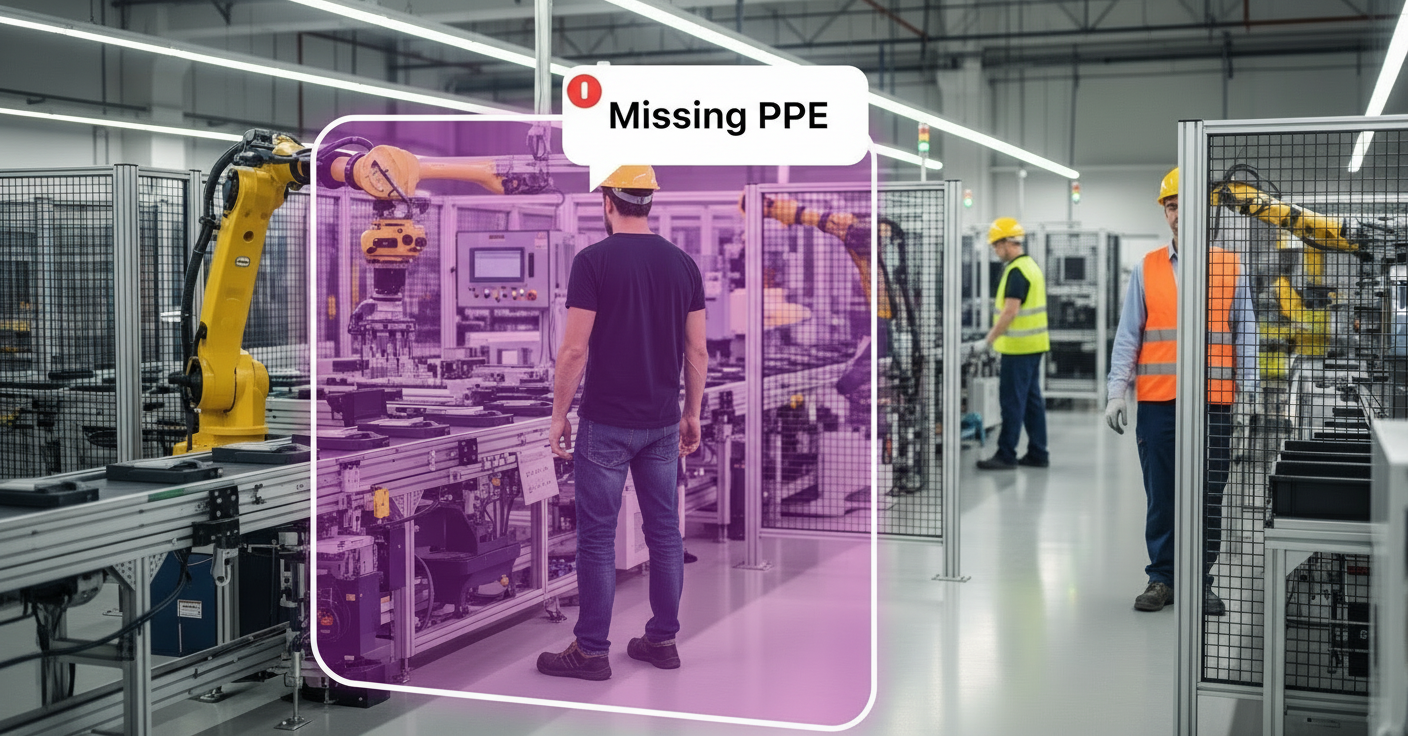
Safety incidents are often preceded by a pattern of minor non-compliance events. A worker forgetting PPE or a forklift taking a shortcut through a pedestrian zone are leading indicators of risk. Video AI agents shift safety culture from reactive reporting to preemptive coaching.
Top safety use cases for manufacturing
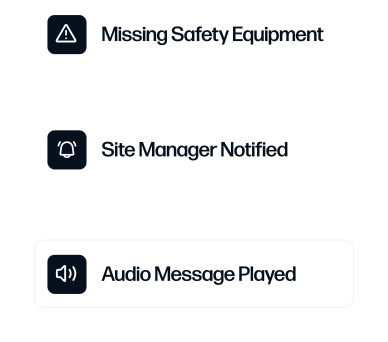
PPE detection: Systems can identify missing hard hats, vests, or goggles. This can support OSHA compliance and help protect workers in high-risk zones.
No-go zone enforcement: AI agents detect when pedestrians enter hazardous areas or when forklifts veer into restricted walkways, triggering on-the-spot alerts to mitigate collisions.
Ergonomic monitoring: Wearables and vision systems can track unsafe movements, helping to mitigate the risk of repetitive strain injuries and improve station design.
Facilities implementing these systems report a notable drop in safety infractions because they can intervene as issues arise. This creates a "safety first" culture where compliance is consistent, not just something that happens during an audit.
Best practices for implementation and integration
Successful deployment of video AI requires a strategic approach that respects the existing IT/OT landscape. The goal is to integrate with current infrastructure rather than replace it.
Steps for successful deployment
Start with a pilot: Begin with a specific problem area, such as a single production line with high defect rates or a zone with frequent safety incidents. Prove the ROI before scaling.
Leverage edge computing: Process data locally to avoid bandwidth issues and ensure real-time alerting, especially for safety-critical applications.
Integrate with MES and ERP: Connect video insights with Manufacturing Execution Systems and Enterprise Resource Planning platforms to create a unified view of operations.
Focus on workforce augmentation: Position the technology as a tool to help operators do their jobs better and safer, rather than as a tool to just watch them.
Comparing video AI solutions
Feature | Spot AI | Traditional VMS | Custom computer vision |
|---|---|---|---|
Deployment speed | Fast (under a week) | Slow (weeks/months) | Very slow (months/years) |
Camera compatibility | Agnostic (works with most IP cameras) | Often proprietary lock-in | Varies, often requires specific hardware |
AI capability | Pre-built agents (safety, ops) | Limited/basic motion | Highly custom (requires developers) |
Searchability | Natural language search | Time-consuming scrubbing | Varies |
Architecture | Hybrid edge-cloud | On-premise NVR/DVR | Cloud-heavy or complex edge |
Driving Measurable Change with Video Intelligence
Video AI agents offer a practical path to operational improvement for manufacturing leaders. By turning cameras into active data sources, facilities can minimize the limitations of manual observation and reactive firefighting. The technology can deliver measurable impact, with some manufacturers reporting minimized downtime alongside lower defect rates and improved safety compliance.
For the continuous improvement lead, this means finally having the evidence needed to drive change. Whether it is verifying SOP adherence, optimizing changeovers, or minimizing injury risk, video AI provides the visibility to make data-driven decisions that stick.
See how Spot AI video agents work in real manufacturing environments. Request a demo to explore the platform’s capabilities for your operations.
Frequently asked questions
How is AI used in quality inspection?
AI in quality inspection uses computer vision to analyze images of products on the production line. It detects defects like scratches, misalignments, or missing components by comparing live footage against trained models or using zero-shot learning to identify anomalies without extensive pre-training.
What are the benefits of video AI in manufacturing?
The primary benefits include minimized waste through early defect detection, improved OEE via proactive maintenance, enhanced worker safety through automated hazard detection, and faster cycle times by identifying process bottlenecks.
How can video AI minimize defects?
Video AI helps minimize the impact of defects by enabling teams to quickly review footage of production processes, identify root causes, and implement corrective actions to prevent faulty parts from moving to the next stage. This "closed-loop" quality control can minimize rework and scrap. Additionally, historical data analysis helps engineers identify the root causes of recurring defects.
What is the ROI of implementing video AI?
ROI varies by application and facility. Many teams see value through minimized scrap and faster issue resolution; results depend on deployment scope, process, and culture.
What are the best practices for deploying video AI in factories?
Best practices include starting with a targeted pilot program, ensuring the system is camera-agnostic to leverage existing hardware, utilizing edge computing for real-time processing, and involving frontline workers early to ensure the tool supports their daily tasks.
About the author
Dunchadhn Lyons leads Spot AI’s AI Engineering team, building real-time video AI for operations, safety, and security—turning video data into alerts, insights, and workflows that cut incidents and boost productivity.






.png)
.png)
.png)