






Process compliance is the operational backbone of any Consumer Packaged Goods (CPG) manufacturer. It is the difference between a profitable, safe shift and one plagued by waste, safety incidents, and regulatory headaches. For Innovation and Continuous Improvement Leaders, the hurdle isn't defining what should happen on the floor—it's verifying that it happens consistently across shifts and sites.
Traditional methods of verifying compliance—manual Gemba walks, clipboard audits, and retrospective data entry—are no longer sufficient in a manufacturing environment that demands agility and precision. These analog methods provide only a snapshot in time, leaving vast blind spots where inefficiencies and non-conformance hide.
This guide details how to implement a video-based process compliance program for CPGs. By leveraging Video AI, manufacturers can use existing cameras to collect and analyze video, helping standardize shifts, verify SOP adherence, and provide objective evidence to support continuous improvement.
Understanding the basics
Video AI agents: intelligent software that processes video feeds to detect defined behaviors, objects, or anomalies (like a person entering a no-go zone or a forklift absent from a station) with minimal human intervention.
Gemba: a Japanese term meaning "the actual place," referring to the shop floor where value is created. Digital Gemba refers to observing these processes remotely via video data.
SOP (standard operating procedure): documented, step-by-step instructions that operators must follow to uphold consistency and safety.
21 CFR Part 11: an FDA regulation that establishes the criteria for electronic records and electronic signatures to be considered trustworthy and equivalent to paper records.
Solving the continuous improvement leader’s dilemma
For leaders tasked with driving operational excellence, the gap between written procedures and floor reality is a constant source of frustration. You are often expected to deliver significant annual improvements in OEE and waste reduction, yet you lack the visibility to identify where those gains can be made.
A video-based process compliance program directly addresses the core frustrations faced by manufacturing leaders:
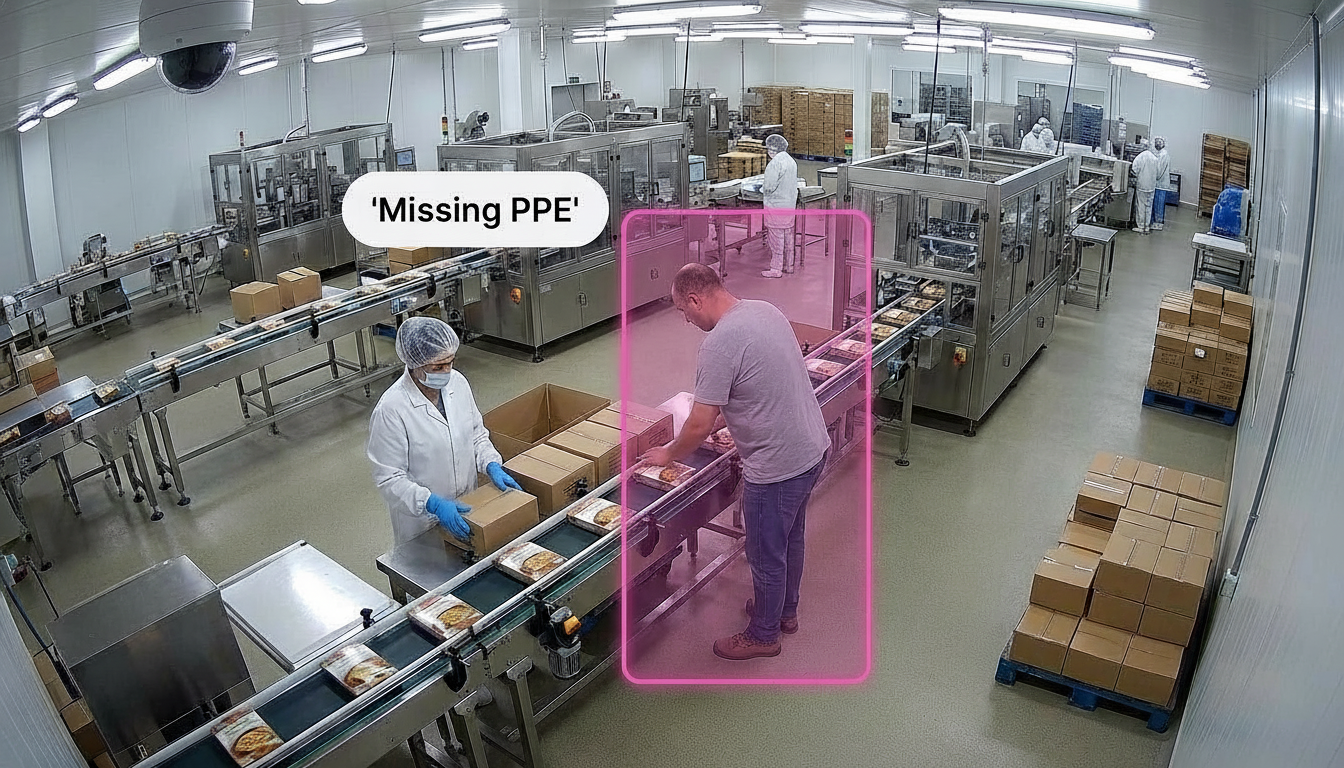
Eliminating reactive firefighting: instead of investigating accidents or quality spills after the damage is done, Video AI provides real-time alerts for leading indicators, such as missing PPE or unauthorized entry into hazardous zones. This shifts the culture from reactive to anticipatory.
Automating Gemba walks: physical floor walks are time-consuming and limited by your physical presence. Intelligent video platforms monitor operations 24/7, capturing many process variations and potential improvement opportunities without you needing to be on the floor.
Verifying SOP compliance at scale: validating consistent adherence across multiple shifts is nearly impossible with manual supervision. Video AI automatically detects deviations—such as skipping a cleaning step during changeover—confirming best practices are followed even during the night shift.
Exposing hidden process waste: minor inefficiencies, such as excessive walking or waiting time, accumulate into major losses. Computer vision analytics reveal hidden process waste by detecting inefficient movement patterns and unnecessary waiting time that periodic observation misses.
The foundation of a video-based process compliance program
A robust process compliance program encompasses the systematic adherence to documented procedures, regulatory requirements, and quality standards throughout production operations. In the CPG sector, this is not just about internal efficiency; it is a regulatory imperative.
Regulatory pressures and the need for digital evidence
The regulatory landscape is intensifying. In fiscal year 2024 alone, the FDA issued 190 warning letters to drug and biologics firms, a figure that nearly doubled from the previous year (Source: Perkins Coie). The primary drivers for these citations included lack of data integrity controls, inadequate staff training, and deficiencies in manufacturing processes.
For CPGs, specifically those in food and beverage, regulations like the Food Safety Modernization Act (FSMA) have shifted the paradigm from responding to contamination to preventing it through rigorous hazard analysis and preventive controls.
Implementing a video-based solution helps satisfy these rigorous standards by addressing:
Data integrity: FDA 21 CFR Part 11 requires electronic records to be trustworthy. Video provides an objective, time-stamped record of production activities, verifying that what is documented in the batch record matches what actually occurred.
Traceability: under FSMA Section 204, manufacturers must track products from origin through distribution. Video evidence integrated with traceability systems allows for rapid identification of affected batches, substantially reducing recall response times.
Audit readiness: ISO 9001:2025 places increased emphasis on data integrity. Video-based audit trails allow organizations to demonstrate compliance visually, moving beyond paper logs that can be easily falsified or filled out incorrectly.
Feature | Traditional compliance | Video-based compliance |
|---|---|---|
Monitoring frequency | Periodic audits (Spot checks) | Continuous 24/7 monitoring |
Data integrity | High risk of human error/falsification | Objective, time-stamped visual evidence |
Response time | Reactive (Post-incident) | Early-warning (Real-time alerts) |
Scalability | Limited by headcount | Scales across multiple sites |
Insight depth | Binary (Pass/Fail) | Granular (Root cause analysis) |
Key components of video AI for manufacturing
To implement a successful program, it is essential to understand the distinct capabilities that video analytics bring to the factory floor. These tools turn standard security cameras into data collection devices.
Real-time deviation detection: computer vision algorithms are trained to recognize designated operational procedures. For example, during a changeover, the software can verify if a particular cleaning step was performed. If the step is skipped, the platform alerts the supervisor promptly.
Automated safety monitoring: the technology can detect safety violations such as "Person Enters No-go Zones" or "Missing Personal Protective Equipment" (PPE). This capability is critical for reducing OSHA recordable incidents and protecting workers in high-risk areas.
Visual search and retrieval: instead of scrubbing through hours of footage to find an event, natural language search capabilities allow users to type "forklift in aisle 3" or "red vest" to swiftly retrieve relevant clips. This accelerates root cause analysis from days to minutes (Source: Spot AI).
Operational dashboards: integration with Manufacturing Execution Systems (MES) allows video data to be visualized alongside production metrics. This helps identify trends, such as a particular shift consistently taking 20% longer for changeovers (Source: Spot AI).
Step-by-step implementation guide
Deploying a video-based process compliance program requires a strategic approach that balances technical implementation with organizational change management.
1. Assessment and gap analysis
Do not attempt to monitor everything at once. Begin with a comprehensive facility assessment to identify high-risk operational areas and compliance gaps.
Identify pain points: interview production leads to pinpoint where non-compliance is costing the most money. Is it changeover time? Is it labeling errors? Is it safety incidents or close calls?
Audit infrastructure: evaluate existing camera coverage. Most manufacturing facilities have security cameras that can be repurposed for operations using camera-agnostic platforms like Spot AI.
Map regulatory requirements: determine which particular FDA or ISO requirements need visual verification (e.g., critical control points in food production).
2. Strategic pilot program
Launch a pilot program targeting a high-impact procedure. A common starting point is changeover optimization, where downtime is expensive and easily measurable.
Select the metric: choose a quantifiable metric, such as "Changeover Time" or "First Pass Yield."
Configure Video AI agents: set up targeted templates. For example, use "Forklift Absent" to track utilization or "Crowding" to identify bottlenecks at a packing station.
Validate accuracy: verify the AI accurately detects deviations in your specific lighting and environmental conditions.
3. Integration with quality systems
Video data should not exist in a silo. For maximum impact, integrate video insights with your existing stack.
Connect to QMS/MES: verify that when a deviation is detected, it triggers a workflow in your Quality Management System. This creates a unified operational view.
Enable traceability: link video footage to specific batch records. If a customer complaint arises, you can quickly pull the video evidence associated with that specific production run.
4. Change management and training
The success of this technology depends on worker buy-in. It is vital to position video monitoring as a tool for support and safety, not employee scrutiny.
Communicate transparency: be clear that the goal is process compliance and safety, not individual punishment.
Empower the frontline: use video clips to coach, not scold. Show operators video examples of "gold standard" performance to help them improve.
Visual SOPs: replace text-heavy binders with video clips of best practices. Operators learn faster from visual demonstrations than from reading complex documents.
Measuring success: KPIs for process compliance
To validate the ROI of your program, you must track key metrics that link compliance to business outcomes.
Metric category | KPI examples | Business impact |
|---|---|---|
Compliance | Compliance Achievement Rate: Percentage of procedures followed correctly. | Reduces regulatory risk and audit findings. |
Efficiency | Changeover Time: Reduction in downtime between products. | Increases production capacity and revenue. |
Quality | First Pass Yield (FPY): Percentage of product correct the first time. | Protects margins and brand reputation. |
Safety | Safety Incident Rate (TRIR): Frequency of recordable incidents. | Lowers insurance costs and protects workforce. |
Industry use cases
1. Reducing changeover time in packaging
For example, a packaging manufacturer struggling with lengthy changeovers can use video to analyze their process. Often, a significant portion of time is spent on non-value-added activities like searching for tools. By using video to identify these inefficiencies, standardize the process, and verify adherence, manufacturers can help reduce changeover time, unlocking additional annual production capacity.
2. Upholding data integrity in pharma
A pharmaceutical facility facing FDA warning letters for data integrity can implement video monitoring at critical control points. The platform provides a verified, time-stamped audit trail showing who accessed equipment and when. By using video data to show compliance controls are effective, facilities can strengthen their position during FDA inspections.
3. Accelerating recall response
A food manufacturer needing to meet retailer requirements for rapid traceability can integrate video documentation with their batch tracking. This allows them to quickly verify ingredient handling and processing steps, reducing response times. This rapid response capability can minimize product hold times and strengthen retailer trust.
Comparing video analytics solutions
When selecting a partner for your compliance program, it is crucial to choose a platform that is built for the complexities of enterprise manufacturing.
Feature | Spot AI | Traditional VMS | Basic cloud cameras |
|---|---|---|---|
Deployment speed | Minutes: Plug-and-play with existing cameras. | Weeks/Months: Requires heavy server infrastructure. | Days: Often requires replacing all hardware. |
Hardware flexibility | Camera-Agnostic: Works with many IP cameras. | Lock-in: Often requires proprietary cameras. | Lock-in: Works only with vendor cameras. |
AI capabilities | Edge-Native AI: Processes data locally for real-time speed. | Server-Based: High latency and bandwidth heavy. | Cloud-Only: High bandwidth usage, latency issues. |
Scalability | High: Scales across multiple sites. | Difficult: Complex networking and licensing. | Moderate: Bandwidth costs scale poorly. |
Searchability | Natural Language: "Show me forklift in aisle 4". | Manual: Scrubbing through timelines. | Basic: Motion events only. |
Transforming Compliance into a Competitive Advantage
Implementing a video-based process compliance program helps CPG manufacturers move from reactive problem-solving to continuous improvement. By illuminating the "Digital Gemba," leaders gain the visibility needed to standardize shifts, reduce waste, and support safety at scale.
Beyond satisfying regulators, this technology empowers the workforce. It provides the objective feedback loop necessary for continuous improvement, turning every camera into a tool for coaching and optimization. For the Innovation Lead, it answers the critical question of how to drive consistent performance across a fragmented manufacturing footprint.
Ready to see video AI in action?
Discover how Spot AI can help you standardize shifts and reduce risk. Request a demo to experience our Video AI Agents and explore their impact on your operations.
Frequently asked questions
What are the key elements of an effective compliance program?
An effective compliance program includes clear policies and procedures (SOPs), comprehensive training, continuous monitoring and auditing, reporting mechanisms for deviations, and a framework for response and improvement. In modern manufacturing, integrating video analytics adds a layer of objective verification to these elements.
How can technology improve process compliance?
Technology improves compliance by automating data collection, reducing human error in documentation, and providing real-time visibility. Video AI particularly helps by continuously monitoring operations to detect deviations that manual audits miss, maintaining consistent adherence to standards.
What are the common obstacles in manufacturing compliance?
Common obstacles include inconsistency across different shifts, lack of visibility into remote sites, manual and error-prone documentation, and the difficulty of maintaining audit readiness. Shift variability is a major issue, where night shifts often drift from SOPs due to lower supervision levels.
How do you measure compliance success?
Success is measured through KPIs such as Compliance Achievement Rate, reduction in safety incidents (TRIR), improvement in First Pass Yield (FPY), and reduction in audit findings. Operational metrics like reduced Changeover Time also indicate successful process adherence.
What role does video play in compliance monitoring?
Video acts as an always-on observer that validates that processes are being followed. It provides visual evidence for root cause analysis, supports training by capturing best practices, and offers an objective audit trail for regulatory purposes.
About the author
Sud Bhatija is COO and Co-founder at Spot AI, where he scales operations and GTM strategy to deliver video AI that helps operations, safety, and security teams boost productivity and reduce incidents across industries.






.png)
.png)
.png)