






What are video AI agents? How cameras become AI coworkers in 2026
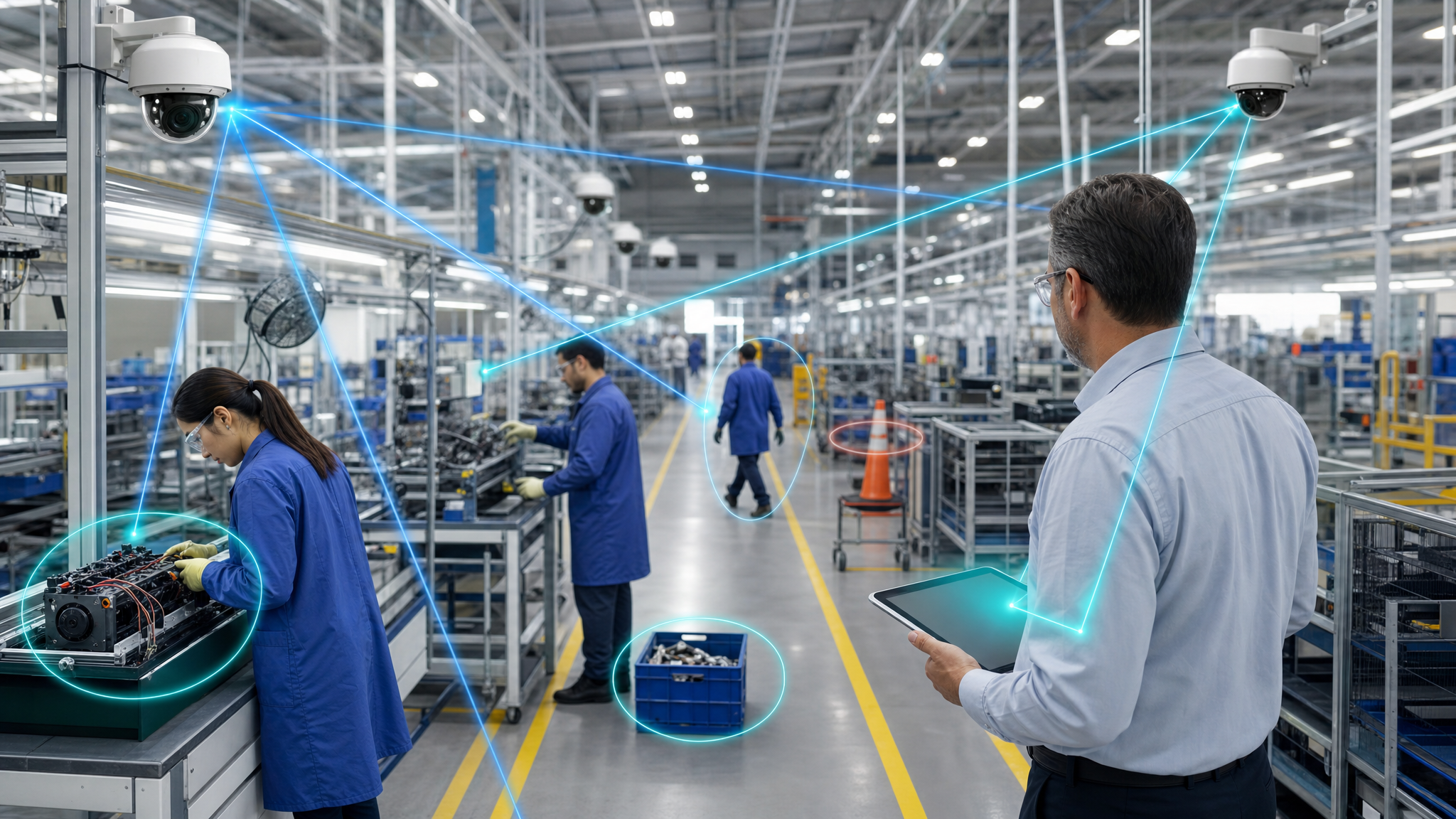
A video AI agent is software that connects computer vision, AI reasoning, and workflow automation so a camera can see what is happening, understand the context, decide what matters, and trigger a useful action. In other words, the camera stops being a passive recorder and starts behaving like an AI coworker on the floor. For a Director of Operations, that shift turns dormant video feeds into live operational visibility, faster coaching, and more consistent work across shifts and sites. This guide explains what video AI agents are, how they differ from motion alerts and traditional analytics, and what to weigh before deploying them in a plant.
Key takeaways
- Video AI agents combine vision, reasoning, and action, so cameras can interpret context and start workflows instead of only recording.
- They sit in the broader agentic AI category, which McKinsey defines as systems that execute multistep processes and refine behavior over time.
- They differ from passive cameras, motion alerts, traditional analytics, and AI VMS by acting inside systems of action, not just logging events.
- Common manufacturing uses include SOP drift, changeover analysis, bottleneck detection, PPE gaps, and faster incident review.
- Governance matters: plan for false positives, human review, audit trails, privacy, retention, and change management before scaling.
What are video AI agents, in plain terms
Think of a video AI agent like a seasoned shift lead who never blinks. A good lead does not just watch the line. They notice when a changeover runs long, connect that to the standard work, and flag it to the right person. A video AI agent applies that same loop to existing camera feeds at scale.
The category sits inside a larger trend. McKinsey describes agentic AI as systems built on foundation models that act in the real world by executing multistep processes, not just answering isolated prompts (Source: McKinsey). When that capability is coupled to live video, you get a video AI agent: a system that uses what it sees to start workflows, request human input, and follow up across safety, quality, or production tools.
This is also why the language overlaps. You will hear visual AI agents, video analytics AI agents, computer vision agents, and AI VMS used loosely. The defining trait is action. A video AI agent reasons against a goal or policy and triggers the next best step.
How a camera becomes an AI coworker
The clearest way to understand the category is to watch one event move through it. Picture a packaging line during a changeover.
- See: the camera captures the line, the operators, and the equipment state.
- Understand: the agent recognizes that a changeover has started and which step is underway.
- Reason: it compares the run against the standard operating procedure and the expected cycle time.
- Decide: it determines that a step is taking longer than the benchmark and is worth surfacing.
- Act: it generates an operator scorecard, alerts the supervisor, or logs the deviation for review.
Peer-reviewed research supports this loop. One study used computer vision to identify bottleneck stations on modular production lines by analyzing video feeds, tracking queues, and pinpointing where cycle times stretched, in effect an automated time and motion study (Source: ScienceDirect). That is the core idea of a video AI agent for manufacturing: it watches the line, recognizes emerging delays, and pushes the insight to a human before anyone has to notice it manually.
The World Economic Forum frames these systems as coworkers that take over routine monitoring and provide decision support, while humans keep authority over complex judgment calls (Source: World Economic Forum). The point is augmentation, not replacement.
How video AI agents differ from motion alerts, analytics, and AI VMS
Most plants already own cameras. The question is how much intelligence sits behind them. Security and operations technology has progressed from basic motion detection to systems capable of pose estimation, behavioral analysis, and anomaly detection that can flag unusual events in near real time (Source: Security Magazine). Video AI agents take those perception capabilities as inputs, then add reasoning and action.
The table below compares the main categories of camera-based systems across perception, interpretation, and action. It describes neutral concepts, not vendor products.
| System type | Interpretation depth | Action capability |
|---|---|---|
| Passive cameras | None beyond human review | Manual investigation only |
| Motion alerts | Movement versus no movement | Basic alerts without workflow logic |
| Traditional video analytics | Rule-based event flags | Event alarms, limited OT integration |
| AI VMS | Metadata indexing and pattern search | Faster retrieval and some notifications |
| Video AI agents | Context-aware analysis of behaviors and processes | Initiate and manage multistep workflows across systems |
Deloitte's 2026 Manufacturing Industry Outlook reinforces the distinction. It describes a move from isolated automation islands toward interconnected systems that share data and coordinate actions across production, maintenance, and logistics (Source: Deloitte). Video AI agents fit that pattern because they live inside systems of action, not just recording archives.
It is also worth saying what video AI agents are not. They are not consumer video generators, video editing assistants, avatars, or personal AI companions. The category is about physical operations.
Manufacturing use cases tied to operations KPIs
For a Director of Operations, the value shows up in familiar metrics. Video AI agents can support availability, performance, and quality, the three pillars of OEE. Practical use cases include:
- SOP adherence: evaluate every run against standard work and flag drift before it spreads across shifts.
- Changeover optimization: measure each step against a benchmark to standardize the best changeover.
- Bottleneck detection: surface where queues build and cycle times stretch on the line.
- Throughput consistency: compare shifts and sites so leadership can reward strong performers and coach the rest.
- Safety incident detection: catch PPE gaps, blocked exits, and no-go zone violations, then capture timestamped evidence for review.
- Faster investigation: jump straight to the relevant clip instead of scrubbing hours of footage.
Research backs several of these. A study on industrial quality inspection found that advanced AI models can improve defect detection and reduce false positives by learning complex patterns from production data, which supports real-time feedback loops (Source: MDPI). The WEF adds that AI-driven machine vision can detect product defects automatically and that AI can schedule complex lines to maximize throughput at minimal changeover cost (Source: World Economic Forum).
This is the territory where platforms like Spot AI apply video AI agents to physical operations. Its video AI platform turns existing cameras into AI coworkers, with an AI Operations Assistant for continuous improvement, an AI Safety Manager for around-the-clock risk detection, and an AI Security Guard for perimeter and interior protection. It is one example of the category, not the whole category.
The pattern produces real operational gains. One Fortune 500 packaging leader applied a video AI agent to changeovers across its North American plants.
"We've added an incremental $15M a plant in throughput. Across 19 NA sites, it's like adding a whole extra plant, at zero capex."
VP Operations, Fortune 500 packaging leader
That program moved changeover time from 28 minutes to 21 minutes in 6 months, a 25% gain, with a reported $15M in additional throughput per plant per year and zero new capex.
How video AI agents work under the hood
The architecture is simpler than it sounds. Key building blocks are:
- Existing cameras: most deployments reuse the IP cameras a plant already owns, so there is no rip-and-replace.
- Edge or cloud processing: inference often runs on edge appliances to keep latency low and limit how much video leaves the building.
- Vision and language models: vision models perceive objects and behaviors, while language models help reason over SOPs, manuals, and reports.
- Workflow integrations: the agent connects to messaging tools, ticketing, alarms, and operational systems to take the next step.
- Permissions and human review: role-based access and a human in the loop keep accountability with people.
The edge-versus-cloud choice is the most common design question. Edge processing favors low latency and tighter data control, while cloud processing favors heavier reasoning and cross-site analysis. Many platforms use a hybrid approach, keeping full-resolution video on-prem and sending only metadata across the network.
Governance, privacy, and accuracy before you deploy
Treating cameras as AI coworkers raises real questions, and good governance answers them up front. NIST's AI Risk Management Framework offers a structured set of functions, govern, map, measure, and manage, that organizations can apply to AI systems, including those running on video (Source: NIST). For a plant, that translates into a short list:
- False positives: tune detections and route only meaningful events to avoid alarm fatigue.
- Human-in-the-loop review: keep people accountable for acting on alerts and complex calls.
- Escalation design: define who receives what, and when, so alerts reach the right person.
- Privacy and access: apply role-based permissions and assess camera coverage thoughtfully.
- Data retention and audit trails: record what the agent saw, how it decided, and what it triggered.
- Change management: involve frontline teams early so the agent is seen as a coach, not a critic.
This frames the worker problem correctly. A long changeover is usually a process gap, not negligence, and the agent's job is to surface it so teams can standardize the better method.
Is your operation ready for video AI agents
Before committing, run through a quick readiness checklist:
- Do you have working IP cameras covering the processes you want to improve?
- Are your SOPs documented well enough to benchmark against?
- Can you support edge or cloud processing on your network?
- Do you have clear owners for alerts and escalation?
- Have you defined retention, access, and audit policies?
- Is leadership ready to treat early use cases as coaching, not policing?
If most answers are yes, a focused pilot on one high-value use case, such as changeover or SOP adherence, is a sensible next step. For a deeper look at the operations side of the category, see Spot AI's guide to the AI Operations Assistant and related reading on the video AI platform. The goal is steady, measurable gains, not a moonshot.
Frequently asked questions
What are video AI agents?
Video AI agents are software systems that combine computer vision, AI reasoning, and workflow automation. They let a camera see an event, understand its context, decide what matters, and trigger an action such as an alert, a report, or a coaching scorecard. They sit within the broader agentic AI category that McKinsey describes as systems executing multistep processes.
How do video AI agents turn cameras into AI coworkers?
They run a continuous loop of see, understand, reason, decide, and act on existing camera feeds. Instead of recording for later review, the agent surfaces the events that merit attention and routes them to the right person. The World Economic Forum frames this as coworkers that handle routine monitoring while humans keep authority over complex decisions.
How are video AI agents different from motion alerts and AI VMS?
Motion alerts only flag movement, and AI VMS mainly speeds up search and retrieval. Video AI agents add context-aware reasoning and the ability to initiate multistep workflows across other systems. The defining trait is action tied to a goal or policy, not just detection or logging.
What manufacturing use cases can video AI agents support?
Common use cases include SOP adherence, changeover optimization, bottleneck detection, throughput consistency, safety incident detection, and faster incident investigation. These map directly to OEE pillars of availability, performance, and quality. Research shows computer vision can reliably surface bottlenecks and improve defect detection on production lines.
What governance matters before deploying video AI agents in a plant?
Plan for false positives, human-in-the-loop review, escalation design, privacy, data retention, and audit trails. NIST's AI Risk Management Framework offers govern, map, measure, and manage functions to structure this work. Strong change management also helps frontline teams adopt agents as coaches rather than critics.
About the author
Nate Lee is an AI Architect at Spot AI who designs the computer-vision models and edge-cloud pipelines that power the company's Video AI Agents.

