Webinar recap: When cameras don't just watch, they act
How convenience and fuel operators put AI agents on the cameras they already own, from a four week pilot to real-time deterrence, register fraud, and the operations wins that follow.
Request a demo
In a Convenience Store News webcast, Melissa Kress sat down with Rish Gupta, Co-founder and CEO of Spot AI, and Taylor Chandler, Senior Product Manager, to cut through the hype on agentic video AI: what it does today in a convenience store, where it fits the systems already in place, and how to find out whether it works for you without buying anything new.
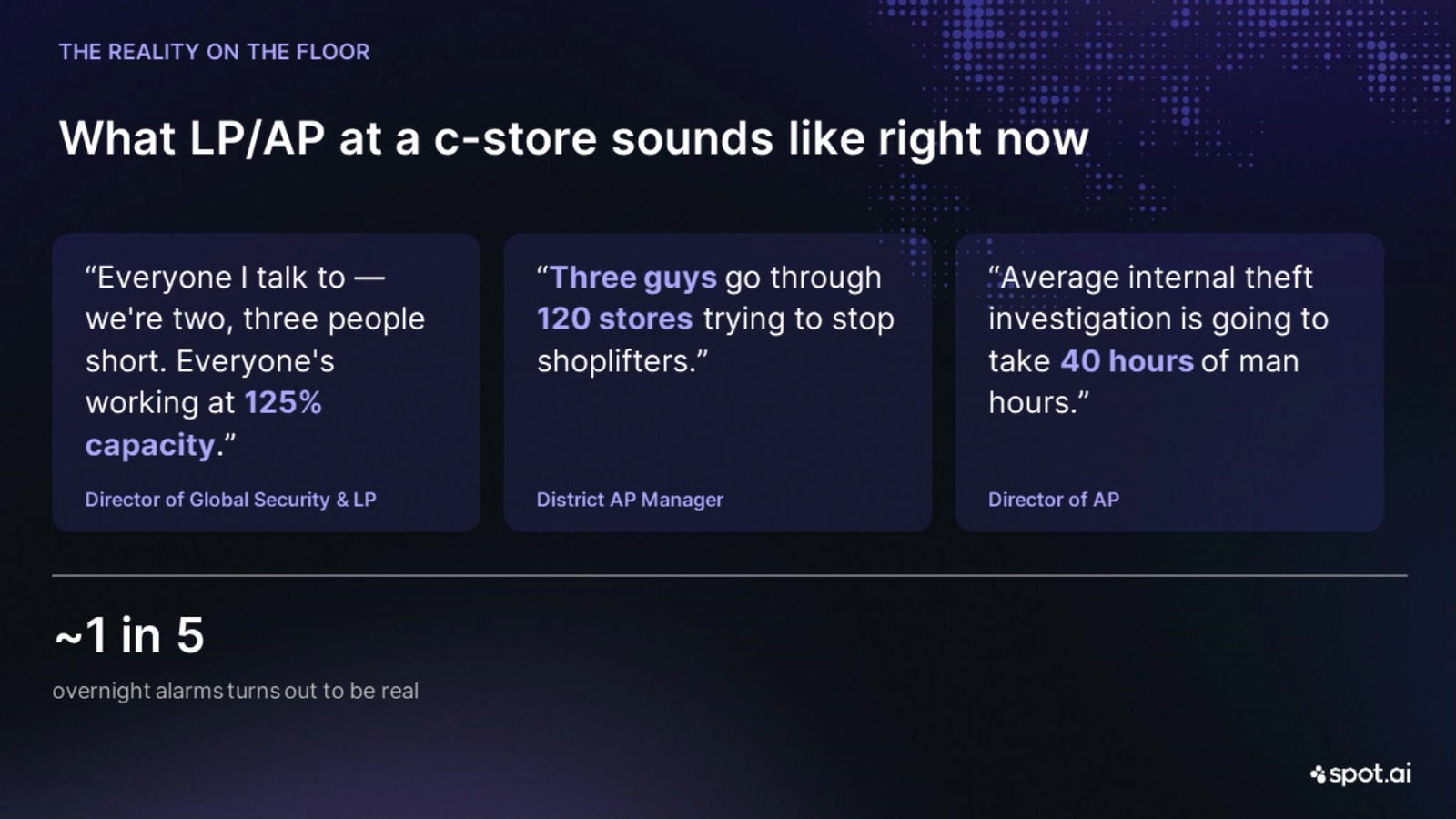
The framing came from the room. Loss prevention and asset protection teams in this segment are small and stretched, often three to five people covering a hundred or more stores, and a single incident can take hours to piece together across systems. The question was never whether cameras can see. It was whether they can take the first pass so a small team can spend its time on the calls that need a person.
Top takeaways
- A pilot runs four to eight weeks, not four to eight months. Pick one or two stores you can visit, connect an edge box to the cameras already there, agree the two or three use cases with the highest ROI, and prove those.
- Deterrence escalates on its own. A strobe and a recorded message first, then an AI talkdown that describes the person by what they are wearing, then a human in the contact center if they still have not left.
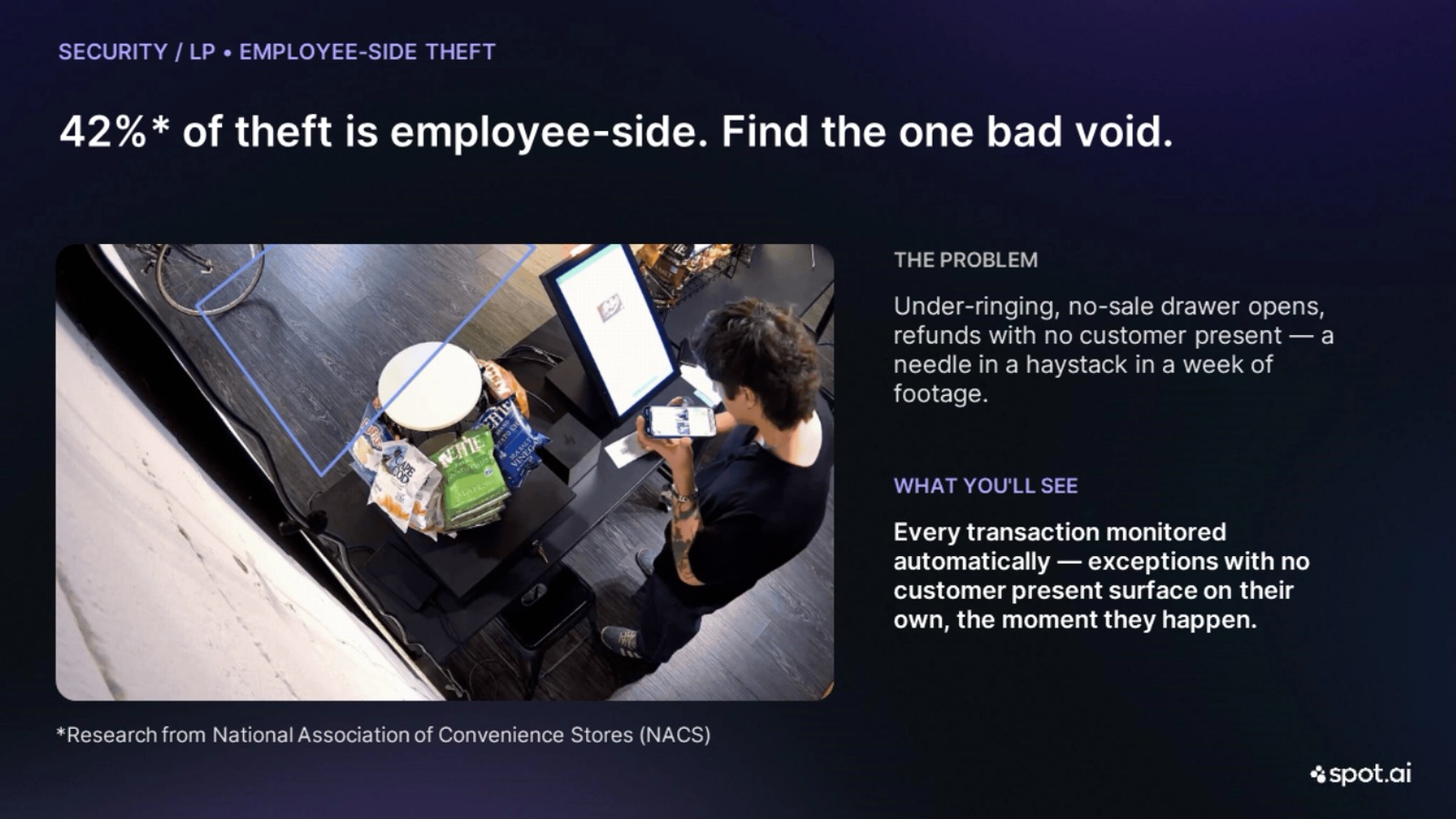
- Most of the loss sits closer to the register than the door. The National Association of Convenience Stores puts about 42% of theft on the employee side, and pairing POS exceptions with video is what cuts a week of alerts down to the few worth opening.
- Old cameras are not the blocker. Any IP camera at 720p or 1080p is enough for most agents, on the recorders already installed, indoors and out. Nothing gets ripped out.
- Humans keep the judgment calls. Agents take the first pass so the queue shrinks to what actually needs a person, which is the part that needed a human anyway.
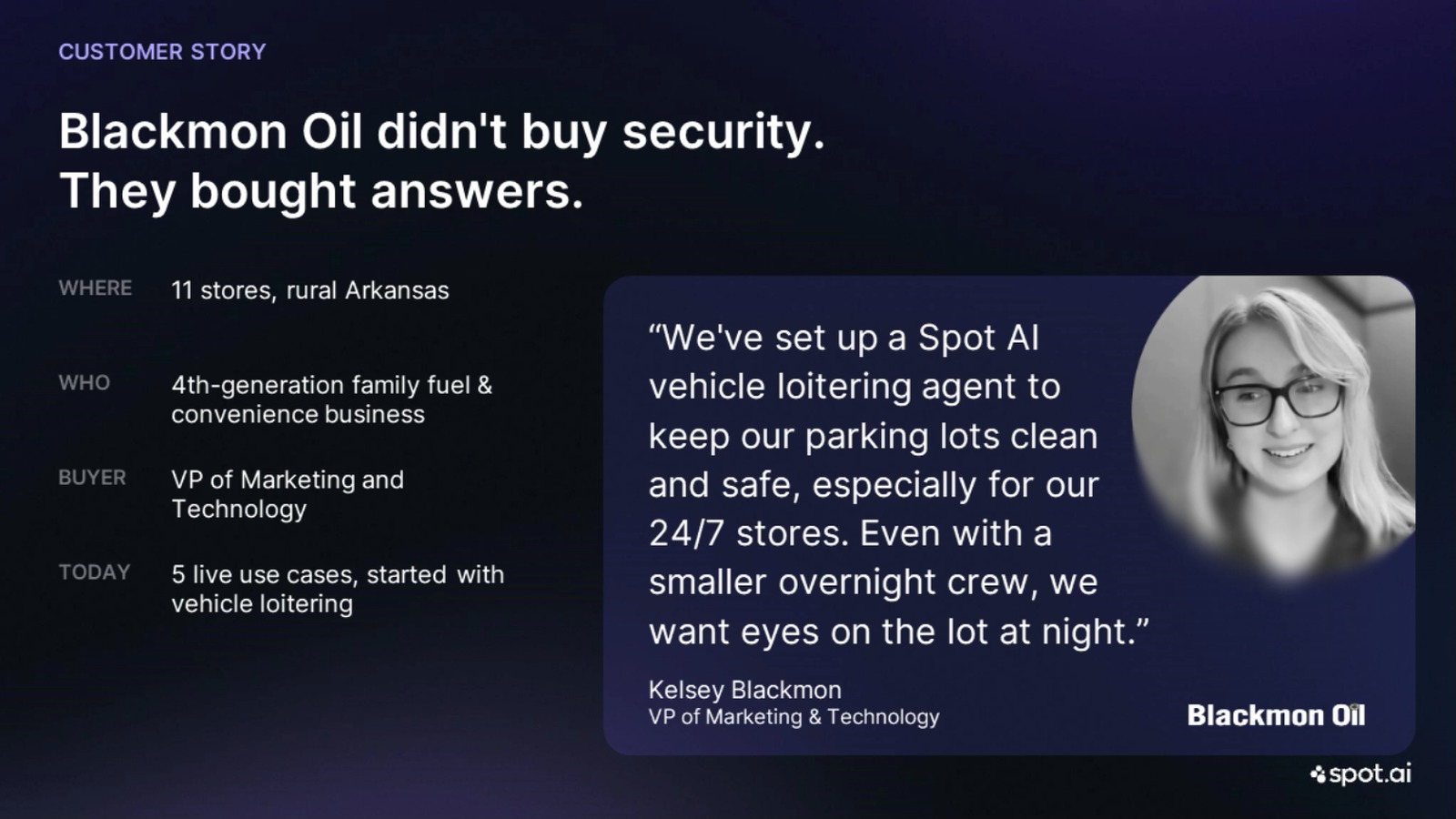
- Security is the doorway, operations is the building. Blackmon Oil started with one loitering use case and now runs five or more, on the same cameras: foot traffic, unattended registers, heat maps, and open and close audits.
Best practices and key learnings
The session ran a demo walkthrough and then took questions from the audience for twenty minutes. Seven themes came out of it, from the first pilot to where this is heading. Each one below pairs what was said with what a convenience and fuel team can act on, plus the clip from the recording.
What a smart pilot actually looks like
Pick one or two stores, ideally ones you can visit. An edge AI box goes on the network where the cameras already are, finds them, and starts ingesting video, so nothing gets replaced. Then you agree the two or three use cases that matter most, and you get four to eight weeks to prove the ROI on exactly those.
- Choose stores you can walk into, and the two or three use cases with the clearest ROI, before anything is connected.
- Hold the pilot to those use cases. Trying to prove everything at once is what makes a pilot drag.
We'll pick about two or three top use cases that you deeply care about and that drive the highest ROI. We'll work with you for a period between four to eight weeks to prove the ROI on those use cases.
Getting the team excited, not nervous
This question comes up more the bigger the company gets. Two things move it. Give store-level staff their own access rather than keeping the tool at head office, and train them on the two or three use cases that make their own shift easier: knowing a customer is waiting at the counter, or that something needs attention out on the forecourt. Once the tool is visibly working for them, it stops reading as head office watching over their shoulder.
- Give store-level teams access, with a report shaped for their store rather than the regional rollup.
- Lead with the two or three use cases that make their shift easier, not the ones that make the region easier to audit.
Once people know that they also have access to this tool, and that this tool is helping them keep their store secure, people start adopting it, rather than seeing it as a big brother or somebody in the head office watching over them.
It works with the cameras and systems you already have
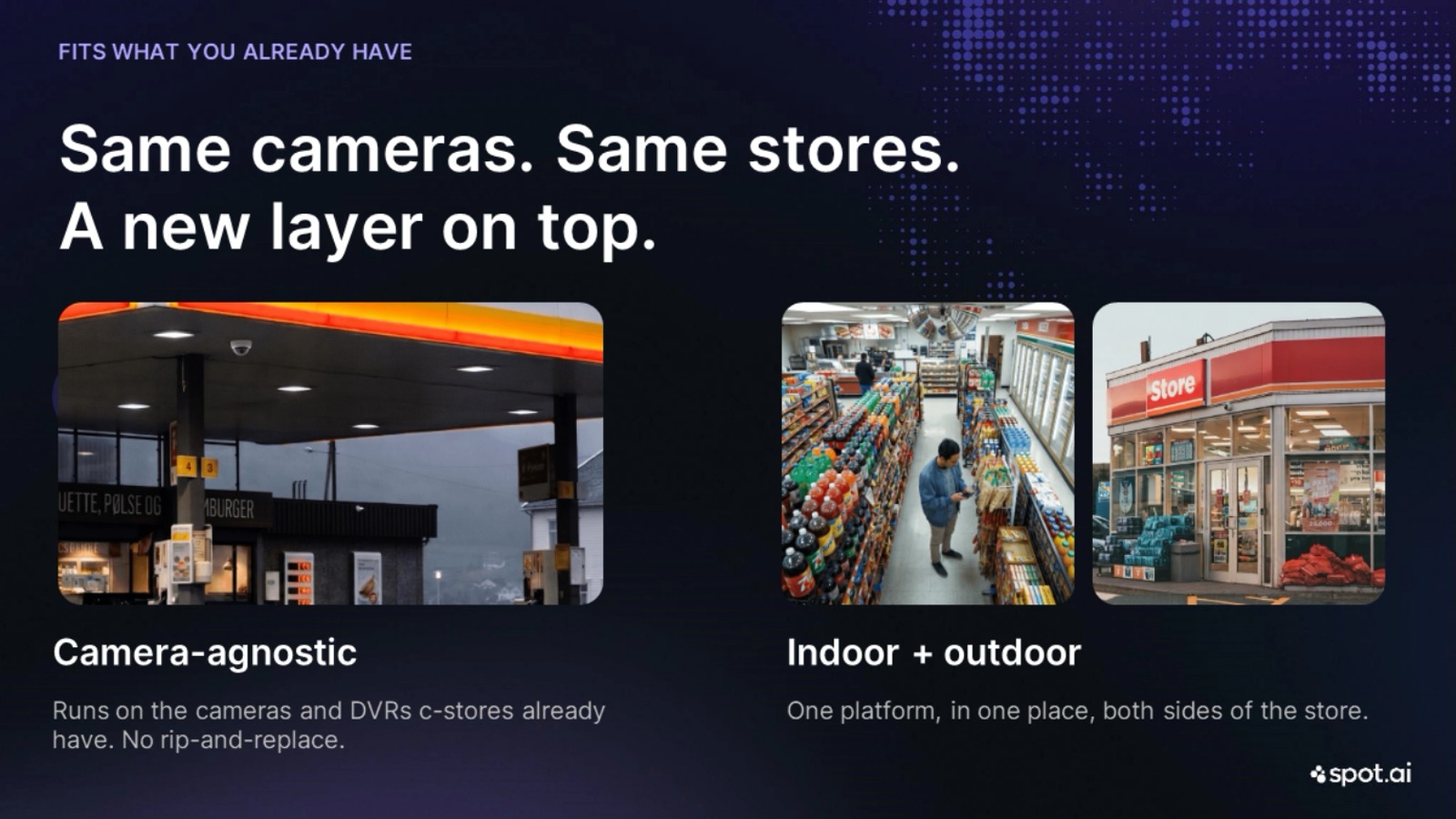
Two versions of the same worry came from the audience: we already bought a VMS and case management, and our cameras are old. Spot AI is camera agnostic and runs on the IP cameras and recorders already installed, indoors and out. Any camera at 720p or 1080p and up is enough for most agents. There is a VMS and a case management layer in the platform if you want them, and if you already have tools you like, those come with you.
- Check resolution, not age. 720p or 1080p IP cameras are the bar for most agents.
- Keep the VMS and case tools you already run, and map where incidents need to land before the pilot starts.
They don't need to upgrade their cameras. We can work with pretty much everything under the sun, bring it on with our system, and make those dumb cameras smart.
A day in the life once agents take the first pass
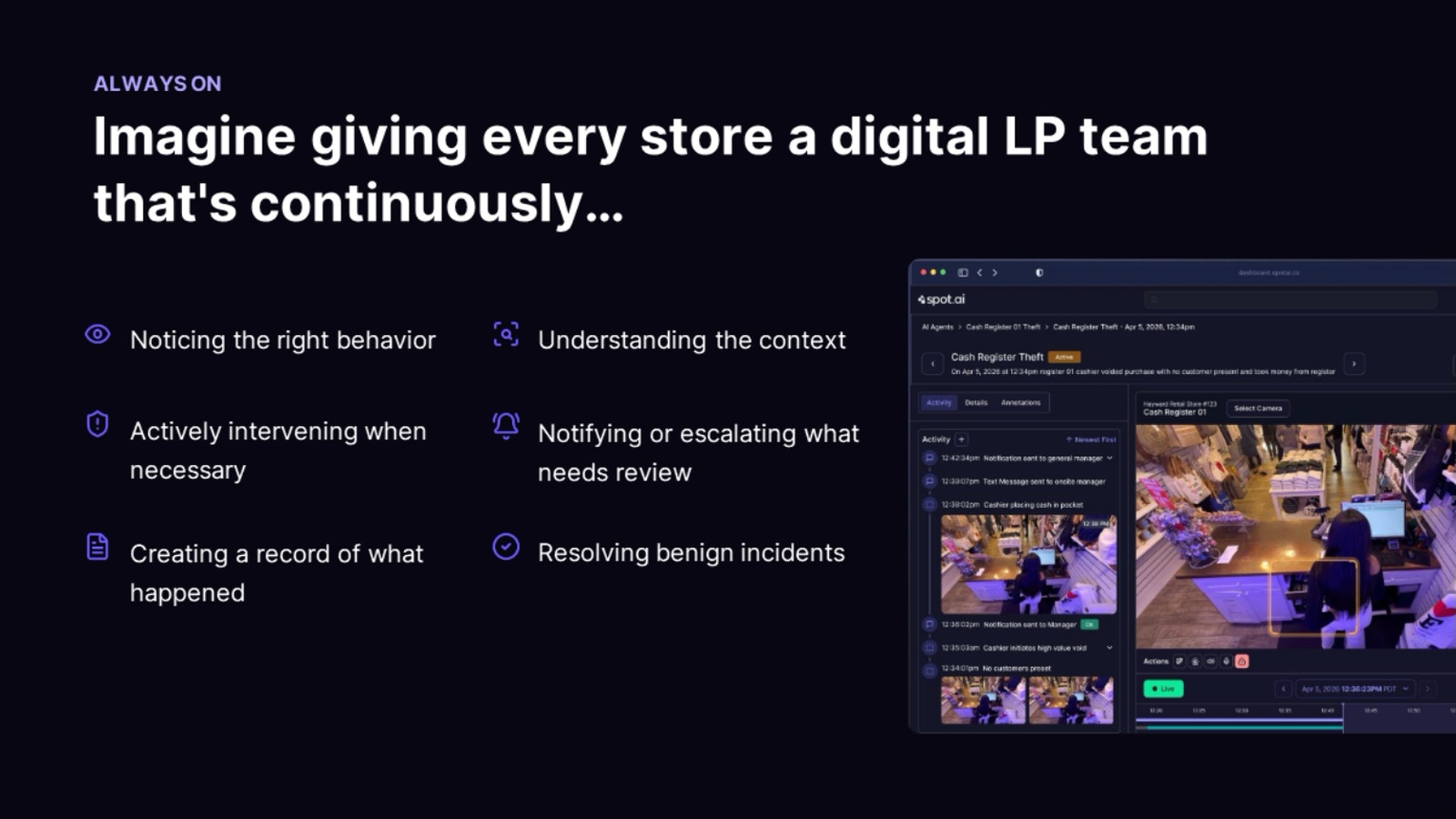
The recurring image through the session was the needle in the haystack. An LP or AP team of three to five people covering a hundred stores cannot open every exception, so the ones that matter get missed. The job of the agents is to shrink the haystack: surface the incidents that are real, packaged as a clip, a timeline and a summary, and leave the rest out of the queue.
- Measure how much of the shift goes to review today, then measure it again at the end of the pilot.
- Hand the analyst the packaged case, clip plus timeline plus summary, as the starting point rather than raw footage.
Putting humans on things that humans need to make judgment calls on, putting AI on everything else, to give humans their time back to focus on things that matter more for the business.
Measuring the win beyond shrink
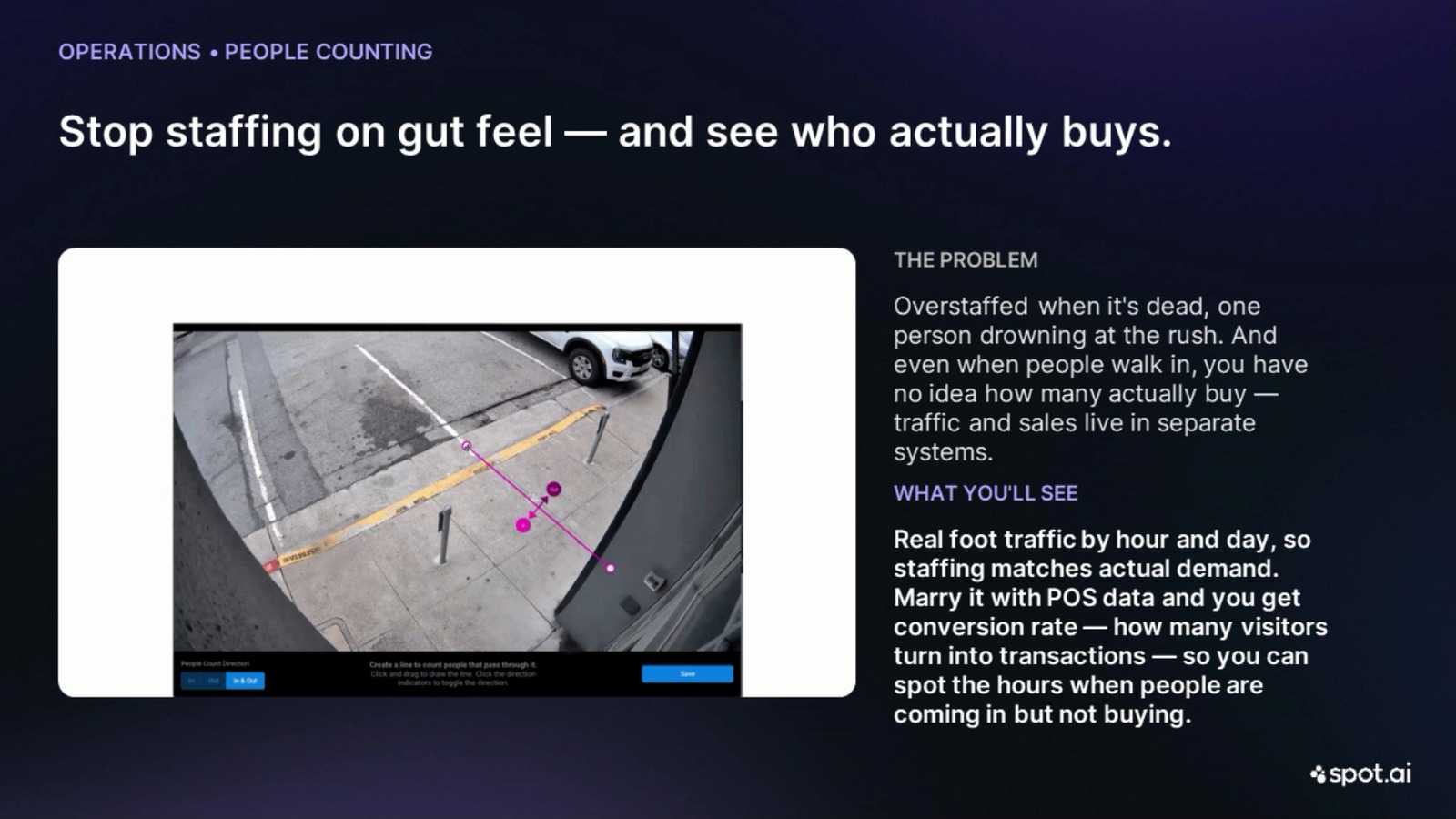
Shrink is the number the budget is written against, but it is not the only thing that moves and it is not the first. The measures that came up were efficiency, response time, conversion rate, employee experience and customer experience. The advice on top of that was to resist instrumenting everything: nail two or three numbers, get the organization used to them, then layer on the fourth and the fifth.
- Track response time and review hours from week one. They move well before the shrink number does.
- Pair foot traffic with POS data and you have a conversion rate, which is a sales number rather than a loss number.
It's efficiency, it's response time, it's conversion rates, it's employee experience, customer experience.
The use cases customers came up with themselves
Asked what customers invented that Spot AI did not see coming, Rish gave two. A multi-hundred store operator trained models on their own opening and closing procedures, a ten minute routine, and now gets an audit report on every store every day. Another, protecting EV charging on their forecourt, had agents trained to recognize bolt cutters and other copper theft gear in someone's hands, so the deterrence fires before the wire is gone.
- Open and close audits are the cheapest operations win: the cameras are already pointed at it.
- Adjacent wins split two ways, operations for customer experience and sales, merchandising for where high value product belongs.
We have trained models on their opening and closing procedures, a full ten minute relay of what needs to happen at the opening of the store and at the closing. And they get a full audit report on every store, every day.
Where this is heading
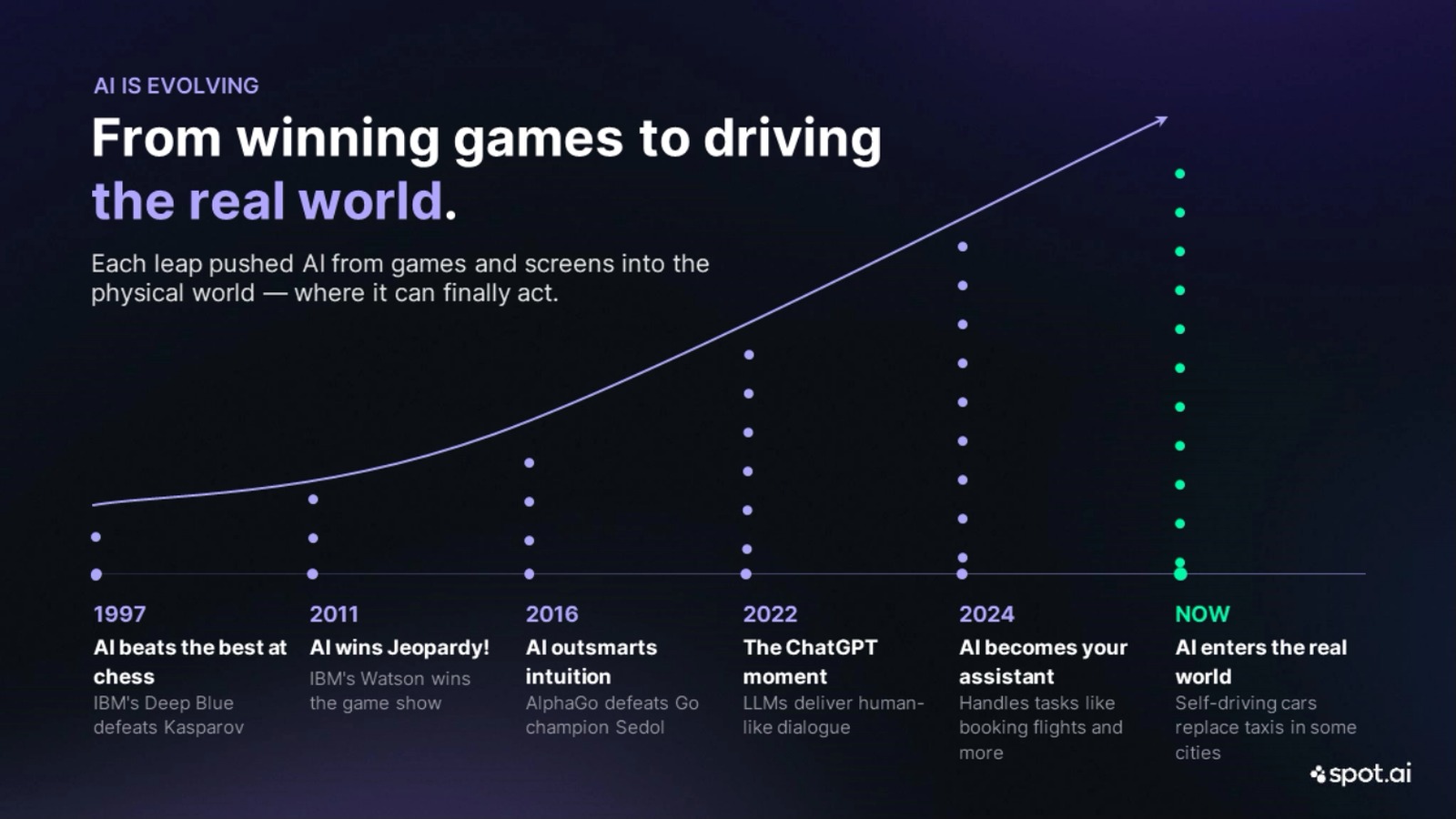
The closing question was whether c-store operators should be thinking about robotics yet. The answer was no, not yet: robotics is roughly a decade out, because picking up items of different sizes and firmness is still genuinely hard. The nearer shift is different. Anything a person can understand walking into a store, AI should be able to understand from reasonable camera angles within three or four years, and act on it.
- Plan for a small team supervising many agents, not for a larger team.
- Treat robotics as a later question. The camera estate you already own is where the next few years happen.
Every team in three to five years will be running with a larger number of agents in their team than the number of human employees.
How convenience and fuel teams can put this into practice
Nothing in the session required a new camera budget or a systems overhaul. The path described was narrow on purpose: prove two or three things, then widen.
- Pick one or two stores you can visit easily, and the two or three use cases that will actually move a number.
- Give it four to eight weeks and measure those use cases, rather than trying to prove the whole platform at once.
- Put the tool in the hands of store teams, not just head office, starting with the use cases that make their own shift easier.
- Once the first two or three land and the team is used to them, layer on the fourth and the fifth.
How Spot AI helps
Spot AI is the intelligence layer on the cameras a convenience and fuel operator already owns. Agents run the whole incident loop, detect, deter, then resolve, and the output is a packaged incident rather than another alert to triage.
- Camera agnostic: works with the IP cameras and recorders already installed, indoors and out, at 720p or 1080p and up.
- Iris answers questions across every site in plain language, and builds the dashboards and reports you want out of it.
- For larger deployments, forward deployed engineers build custom agents around your uniforms, store layouts and procedures.
Want to get your team up to speed on agentic AI first? Spot AI runs a 90 minute session with the AI experts and engineers on its team, on where agentic AI applies both on cameras and off them, how to connect systems without building integrations, and how teams use tools like Claude and ChatGPT day to day. It is deliberately less about Spot AI than about the technology.
Watch the full webinar
The complete 51 minute conversation with Rish Gupta and Taylor Chandler, hosted by Melissa Kress of Convenience Store News.
Put an AI coworker in every store
See how the latest in video AI spots risk sooner, deters faster, and keeps the forecourt and the register covered, around the clock.